No Products in the Cart


What if the walls of your home didn't just hold memories, but actually preserved a family legacy with the same precision as a professional gallery? Most people hesitate to start because they fear a cluttered result or the heartbreak of seeing precious images fade after just a few years. When exploring gallery wall ideas with canvas prints, the goal isn't just to fill empty space. It's to create a curated narrative that feels intentional, architectural, and permanent.
We understand the anxiety that comes with choosing the right layout or the technical specifications required for true longevity. You deserve a display that reflects your story without the stress of incorrect measurements or low-quality materials. In this guide, you'll learn how to transform your living area into a sophisticated exhibit using professional-grade layout strategies and museum-quality canvas prints. We'll examine everything from the "Statement + Satellites" approach to the technical nuances of archival pigment inks, ensuring your installation remains a vibrant centerpiece for decades to come.
The digital age has turned our most precious moments into ephemeral data, buried deep within smartphone folders. Transitioning these images into the physical world is an act of preservation. It's about honoring your history. A gallery wall serves as a permanent anchor in a home, transforming a sterile living space into a sanctuary of personal significance. By choosing physical media, you're ensuring that these stories aren't just stored; they're lived with every single day.
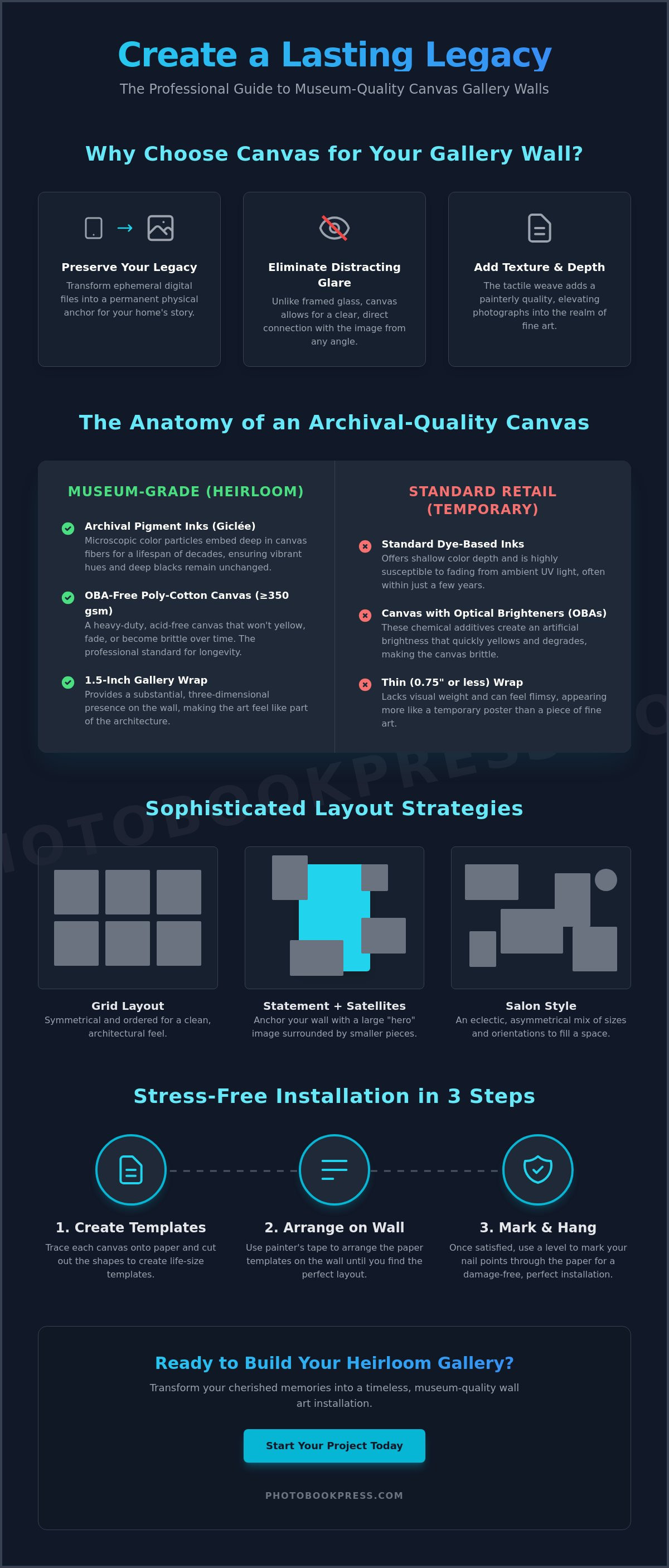
When considering what is a canvas print? and why it remains the preferred choice for curators, the answer lies in its quiet elegance. Unlike traditional framed photography, canvas eliminates the distraction of glass glare. This allows the viewer to connect with the image from any angle or lighting condition. The tactile nature of the weave adds a painterly quality that elevates a standard photograph into the realm of fine art.
To better understand how these artistic elements come together in a residential setting, watch this helpful video:
Large-scale personal art does more than decorate; it validates. Seeing your family’s journey or your personal triumphs displayed with museum-grade quality fosters a sense of belonging. To achieve this, you must define a clear narrative. Some prefer a chronological flow that charts the growth of a family, while others opt for a color-coordinated collection that harmonizes with their interior palette. The most successful gallery wall ideas with canvas prints often center on a thematic anchor, such as a series of black-and-white landscapes or a collection of candid travel moments.
Every successful installation begins with a "hero" image. This is your anchor, usually the largest piece, which dictates the tone for the surrounding satellites. To create a dynamic feel, balance formal professional portraiture with raw, candid moments. Mixing different eras, such as vintage family photos alongside modern high-resolution shots, creates a rich, multi-generational legacy that feels curated rather than manufactured.
Texture is often the missing ingredient in modern home design. The visible weave of a museum-grade canvas adds a layer of depth that flat paper simply can't replicate. When implementing gallery wall ideas with canvas prints, the physical presence of the medium is just as important as the image itself. Utilizing a 1.5-inch gallery wrap allows the image to bleed over the edges, creating a three-dimensional effect. This structural depth makes the art feel like an integrated part of the architecture.
While the aesthetic arrangement is vital, the physical integrity of the medium determines if your collection is a temporary decoration or a lasting heirloom. To truly execute sophisticated gallery wall ideas with canvas prints, you must look beneath the surface. The difference between a retail-grade print and a museum-quality piece lies in the chemistry of the ink and the composition of the substrate. In 2026, museum-grade standards require a poly-cotton blend, ideally at least 350 gsm, that's entirely free of Optical Brightener Additives (OBAs). These additives might make a canvas look bright initially, but they inevitably yellow and become brittle as the years pass.
Professional installations rely on the science of giclée printing. Unlike standard dye-based printers that offer shallow color depth and rapid fading, giclée uses archival pigment inks. These microscopic particles of color sit deep within the fibers of the canvas, offering a lifespan that resists the elements. This ensures the deep blacks and vibrant hues of your original photographs remain unchanged. Precision is the hallmark of a master artisan. Each print should undergo rigorous color calibration to ensure the final product matches the photographer's vision. This technical meticulousness is why discerning collectors choose professional-grade canvas prints for their most significant projects.
The visual weight of your wall is heavily influenced by the gallery wrap. A 1.5-inch depth provides a structural presence that mimics a traditional oil painting. This three-dimensional profile ensures your art stands out, creating natural shadows and depth that flat, framed prints simply can't replicate. It's a subtle architectural detail that transforms a simple photo into a substantial artifact.
A premium print is a complex assembly of high-performance materials. Acid-free substrates are non-negotiable for long-term preservation; they prevent the chemical degradation that leads to unsightly discoloration. For rooms bathed in natural light, UV-resistant coatings are essential to shield the pigments from solar damage. Hand-stretching remains superior to machine processes. An artisan can feel the tension of the fabric, ensuring it's tight enough to resist sagging but flexible enough to accommodate changes in humidity over decades.
The foundation of every print is the stretcher bar. Utilizing solid, kiln-dried wood prevents warping or bowing, which is a common failure in mass-produced alternatives. This commitment to heritage production ensures that the physical act of manufacturing remains a noble craft. Archival canvas is a material designed to last over 100 years without degradation. By investing in these superior materials, you aren't just buying a product; you're securing a piece of your history for the next century.
Designing a layout is the bridge between individual pieces of art and the architecture of your home. It's where personal history meets intentional design. When exploring gallery wall ideas with canvas prints, the arrangement shouldn't feel like an afterthought. A well-executed layout provides a sense of rhythm and purpose, ensuring each print contributes to a larger, cohesive narrative. Whether you prefer the rigid precision of a grid or the organic flow of a salon-style display, the goal is to create a visual footprint that complements the room's proportions.
The Grid Layout remains the definitive choice for those seeking architectural symmetry. By using canvases of identical size and orientation, you create a clean, modern aesthetic that feels inherently ordered. This approach works exceptionally well with a series of related images, such as a collection of architectural details or a set of black-and-white portraits. To maintain the formal integrity of a grid, precision is paramount; even a slight misalignment can disrupt the entire visual balance. It's a bold declaration of sophisticated minimalism.
For a more eclectic and cozy atmosphere, the Salon Style offers a curated organized chaos. This layout allows you to mix different canvas sizes and orientations, creating a display that can grow over time. A popular strategy in 2026 is the "Statement + Satellites" approach. You begin with one larger, central anchor piece and surround it with smaller, complementary works. Current trends suggest keeping the total collection to around 5-7 pieces to ensure the wall feels curated rather than cluttered. This method treats your wall as a living exhibit of your life's most significant events.
Achieving a professional-grade installation requires adhering to specific spatial principles. Consistent spacing is the hallmark of a high-end gallery. A hallmark of professionally designed walls is maintaining a gap of 2-3 inches between every canvas. This breathing room prevents the arrangement from feeling cramped while still maintaining a clear connection between the pieces.
Proportion is equally critical. The centerline of your entire arrangement should be positioned at eye level, which is approximately 57-60 inches from the floor. When hanging art above furniture, the total width of the gallery should ideally span about two-thirds to three-quarters of the furniture's width. This ensures the art feels anchored to the room rather than floating aimlessly. By calculating the total footprint before you begin, you ensure the installation feels like a permanent, integrated part of your home's design.
The transition from a conceptual layout to a physical installation is the most critical phase of the creative process. It's where your vision finally meets the architecture of your home. Executing sophisticated gallery wall ideas with canvas prints requires a shift from artistic curation to technical precision. A professional-grade result isn't achieved by chance; it's the product of a methodical approach that treats your wall as a precious canvas in its own right.
Begin by translating your digital plan into the physical world using the paper template method. Trace each of your canvas prints onto craft paper and cut them to size. Using low-tack painter's tape, arrange these templates on your wall according to your chosen strategy. This allows you to visualize the spacing and balance without driving a single nail. You can step back, live with the arrangement for a day, and make micro-adjustments until the flow feels effortless. It's the only way to ensure the final result feels intentional rather than accidental.
Once the templates are perfected, marking the wall becomes a matter of geometric accuracy. Use a pencil to mark the exact center point for your hardware on each template. When you are ready to begin your installation, ensure your source material matches your effort by choosing museum-quality canvas prints that arrive with pre-installed hardware, ensuring they're ready for immediate display. This seamless transition from production to presentation is what defines a true heirloom-quality installation.
A laser level is perhaps the most significant investment you can make for a multi-piece gallery. While a traditional bubble level works for single pieces, a laser ensures a perfectly straight horizon across the entire span of your wall. This is especially vital for grid layouts where even a millimeter of deviation is visible. Don't forget to apply adhesive rubber bumpers to the bottom corners of each frame. These small additions provide essential airflow behind the canvas and prevent the art from shifting over time, keeping your legacy perfectly aligned.
Lighting is the final layer of curation that breathes life into the texture of the weave. To highlight the three-dimensional quality of a gallery wrap, consider track lighting or dedicated picture lights. Aim for a color temperature between 3000K and 4000K; this range provides a warm, natural glow that accurately represents the colors of your photography. Position your art away from direct window light to prevent long-term UV exposure and distracting reflections. When light grazes the surface of the canvas at an angle, it reveals the physical depth of the medium, transforming a flat image into a tangible artifact.
The final step in curating a fine-art legacy is selecting a production partner who treats your memories with the same reverence as a museum curator. While the previous sections have provided the architectural and aesthetic framework, the physical execution requires a level of craftsmanship that mass-market services simply cannot replicate. Professional photographers and discerning homeowners trust Photobook Press because we understand that a canvas isn't just a product. It's a vessel for your most significant life events.
Our Maryland-based facility is where state-of-the-art giclée technology meets the steady hand of an artisan. Every piece we produce is hand-stretched over solid wood stretcher bars, ensuring the tension is perfectly balanced to prevent sagging or warping over the coming decades. This artisanal approach is vital when executing complex gallery wall ideas with canvas prints, as it guarantees that every individual piece in your installation meets a singular standard of excellence. We don't rely on automated assembly lines; we rely on the eyes and hands of experts who have dedicated their lives to the noble craft of manufacturing.
For many of our clients, the journey toward a curated home begins with custom photobook printing. These books serve as a comprehensive archive of a family’s history, but certain moments deserve to be liberated from the page and placed upon the wall. By using the same archival pigment inks and premium materials across both mediums, we help you create a cohesive brand for your home memories. The colors in your leather-bound wedding album will perfectly match the large-scale canvas in your master suite, creating a seamless visual narrative throughout your living space.
Our commitment to material excellence extends from our leather-bound portfolio books to our museum-grade canvas prints. We utilize OBA-free, acid-free substrates that are designed to last over a century without yellowing. This dedication to longevity is paired with a global reach. We offer worldwide shipping options, ensuring that whether you are preserving a legacy for a local residence or sending a gift across borders, the quality remains uncompromised. It's a boutique experience defined by reliability and prestige.
Transforming your home begins with a single image. Our intuitive platform allows you to upload and calibrate your high-resolution files, ensuring they are prepared for maximum impact at any scale. If you're managing a large-scale installation, our experts are available to consult on image resolution and layout harmony. We invite you to move beyond digital clutter and embrace the tactile beauty of a physical legacy. Elevate your home with custom canvas prints from Photobook Press and begin the process of turning your personal history into a work of art.
Your home is the ultimate exhibit for your most cherished moments. By combining archival material excellence with intentional layout strategies, you've moved beyond simple decoration to create a lasting fine-art legacy. We've explored how technical precision and architectural balance can transform a living space into a sanctuary of personal history. These gallery wall ideas with canvas prints are more than just design trends; they're investments in the long-term preservation of your family's narrative.
Since 1985, our Maryland-based facility has specialized in artisanal production, blending traditional craftsmanship with professional-grade giclée technology. This dedication to precision is why professional photographers rely on us for their high-end client albums and wall installations. You deserve a display that reflects the weight of your memories with the highest level of care. It's time to treat your history as the precious artifact it truly is.
Design your museum-quality gallery wall at Photobook Press. Your stories deserve to be told with substance and aesthetic perfection. We look forward to being your partner in this creative journey.
The ideal spacing for a professional-grade installation is a consistent gap of two to three inches between each piece. This distance provides enough breathing room to appreciate each individual work while maintaining a cohesive visual footprint. If the gap is too wide, the arrangement loses its architectural rhythm; if it's too narrow, the wall feels crowded and heavy.
Your choice depends entirely on the aesthetic atmosphere you wish to create. Identical sizes are essential for a formal grid layout, which emphasizes symmetry and modern precision. However, varying your sizes allows for a more organic salon-style display that feels collected over time. Mixing dimensions adds a layer of visual interest that keeps the eye moving across your personal narrative.
A grid layout is the definitive choice for formal spaces like dining rooms or home offices where order and symmetry are paramount. Conversely, a salon-style arrangement is better suited for living areas where you might want to add new memories in the future. When exploring gallery wall ideas with canvas prints, consider the room’s existing architecture; rigid lines favor grids, while eclectic decor pairs beautifully with salon styles.
Canvas prints are inherently designed for a frameless presentation, utilizing a 1.5-inch gallery wrap to create a three-dimensional effect. This minimalist approach allows the focus to remain steadily on the imagery and texture. If you desire a more traditional or high-end finish, a floating frame can provide a sophisticated border without touching the edges of the canvas itself.
Integrating different mediums is a hallmark of the "everyday exhibit" trend, which blends textures to create a rich, tactile experience. You can successfully pair your canvases with metal prints, vintage mirrors, or even framed textiles. The key is to maintain a unifying element, such as a consistent color palette or shared thematic anchor, to ensure the collection feels intentional rather than random.
To avoid a cluttered appearance, limit your collection to five to seven significant pieces and utilize a central "hero" image to anchor the arrangement. Consistent spacing and a clear centerline at eye level are the most effective tools for maintaining visual order. By prioritizing quality over quantity when implementing gallery wall ideas with canvas prints, you ensure each print has the space it needs to be treated as a precious artifact.
While custom sizes are available, the most versatile dimensions for a curated display include 8x10 and 11x14 for satellite pieces, with 16x20 or 20x30 serving as impactful anchor points. Using a mix of these standard sizes allows you to build a balanced composition that fits most residential wall spaces. These proportions are widely recognized in the art world for their ability to hold detail without overwhelming the room.
Maintaining the integrity of your archival prints requires minimal but careful attention. Use a dry, soft microfiber cloth to gently remove dust from the surface and edges of the canvas. It's vital to avoid chemical cleaners or moisture, as these can compromise the UV-resistant coating and the pigment-based inks. Keeping your art away from direct sunlight and high-humidity areas will ensure its longevity for decades to come.
