No Products in the Cart


What if the 1,500 digital files from your wedding day are actually losing their emotional resonance the longer they sit on a hard drive? It's a common dilemma for modern couples who want to honor their memories but feel paralyzed by the sheer volume of imagery. You recognize that a wedding photo book is the definitive way to preserve these moments, yet the fear of choosing subpar materials that might yellow over 20 years or creating a cluttered, uninspired layout often leads to stagnation.
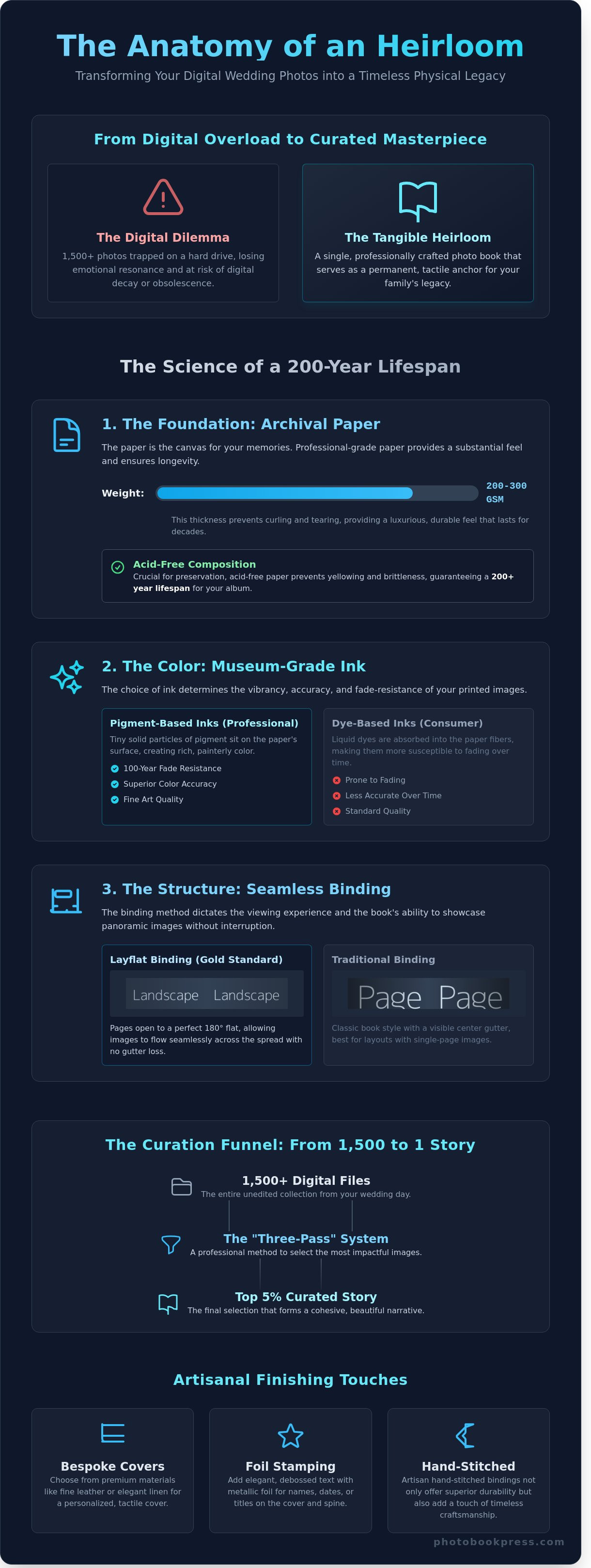
We understand that your wedding isn't just a collection of data; it's the beginning of a legacy. You'll discover the artisanal secrets to transforming a chaotic digital gallery into a sophisticated, professional-grade heirloom that feels like a curated gallery piece. We'll walk through a streamlined process for selecting the top 5% of your images and explain why archival-quality, acid-free paper is essential for a 200-year lifespan. This master class provides the technical confidence and design clarity needed to ensure your story is told with the grace it deserves.
The digital age changed how we view memories. While a cloud drive might hold 2,000 high-resolution images from your ceremony, these files often remain trapped behind a screen, rarely revisited and easily lost in the noise of a scrolling feed. A wedding photo book serves as a physical vessel for your legacy, transforming a digital commodity into a permanent anchor for your home. It's a deliberate choice to prioritize your history over a temporary social media post.
Psychological studies, such as those conducted at the University of Oslo, suggest that tactile interaction with physical media improves emotional recall and cognitive engagement. When you feel the weight of a heavy cover and the texture of premium paper, your brain processes the experience as a significant event rather than a fleeting digital interaction. This sensory connection bridges the gap between a past moment and your current reality, making your memories feel more substantial and real.
To better understand how to bring these memories to life, watch this helpful video:
Social media platforms are notoriously unstable; platforms that dominated in 2010 are now obsolete. Relying on them to store your wedding story is a risk to your family archive. A physical book requires no software updates or login credentials to be enjoyed 50 years from now. A wedding photo book is a curated narrative of a couple’s foundational day, bound in a form that invites quiet reflection. It stands as the first true archive of a new family, intended to be passed down through generations.
There is a vast difference between a consumer photo product and a handcrafted press book. Professional-grade pigment inks, which carry a 100-year archival rating, offer a level of color accuracy and depth that back-lit digital screens cannot replicate. These inks saturate the fibers of the paper, creating a painterly quality that elevates photography to fine art.
The "Press" heritage is rooted in the tradition of master printers who viewed every page as a canvas. By choosing professional printing, you aren't just making a book; you're investing in a piece of personal history that maintains its integrity long after the digital files have been forgotten.
A wedding photo book isn't just a collection of images; it's a structural masterpiece designed to house your most significant history. The foundation of this artifact begins with paper weight. Professional grade albums typically utilize paper between 200 and 300 GSM (Grams per Square Meter). This thickness ensures the pages don't curl or tear over decades of handling. It provides a distinct tooth, or texture, that catches the light without glare, inviting the viewer to linger on every detail of the print.
The choice of binding dictates how your story unfolds. Layflat binding is the gold standard for panoramic spreads. It uses a specialized hinge or a continuous sheet of paper to allow the book to open a full 180 degrees. This engineering prevents the loss of important details in the gutter, or center fold. Traditional sewn bindings offer a classic, library-style aesthetic. They're excellent for smaller, portrait-heavy books, though they don't offer the same seamless visual impact as a handcrafted wedding photo book.
True quality is measured in centuries. Archival grade materials must be acid-free to prevent the paper from yellowing or becoming brittle. We use pigment-based inks rather than standard dyes. Pigment inks consist of tiny solid particles that sit on the surface of the paper, offering a 100-year resistance to fading under normal lighting conditions. This technical precision ensures that the clarity of the wedding day remains as vivid for future generations as it was the moment the shutter clicked.
Tactile experience is the final layer of curation. The materials you touch should reflect the weight of the occasion:
These materials transform a digital gallery into a physical legacy. When you hold a book with a heavy cover and substantial pages, the sensory input reinforces the emotional value of the memories within. It becomes a permanent fixture of your home, designed to be touched, shared, and preserved.
Curation is the bridge between a digital hard drive and a physical legacy. Your photographer likely delivered 1,200 high-resolution files, but a timeless wedding photo book thrives on restraint. The goal is to distill those hundreds of moments into 80 to 100 images that represent the soul of the day. This transformation requires a disciplined "Three-Pass" system to ensure every page earns its place in your history.
A successful narrative arc balances the grand and the granular. We recommend a distribution of 20% for "Getting Ready," 40% for the "Ceremony," and 40% for the "Celebration." By mixing wide-angle hero shots with candid photography, you capture both the scale of the event and the 15% of unscripted moments that reveal true character; the shared laugh between bridesmaids or a quiet glance during the toasts.
Begin by identifying your "Anchor Photos." These are the 10 to 12 definitive images that will serve as the centerpieces for each chapter. At this stage, technical perfection is secondary to emotional resonance. If a slightly blurred candid captures the exact joy of your first dance, it's more valuable than a technically perfect but sterile portrait. To refine this further, you can explore our guide on how to curate photos for your wedding photo book to master the art of selection.
A book is a journey, and the pacing should mirror the day's natural rhythm. While formal family portraits are essential for the historical record, they often work best when grouped in a dedicated section to avoid stalling the artistic momentum of the ceremony. Select detail shots like the delicate weave of a veil or the handwritten script on a place card to act as visual breathers between high-emotion scenes. This intentional spacing allows the viewer to absorb the gravity of a "first look" before transitioning into the energy of the reception.
Sophistication in a wedding photo book begins with the courage to embrace emptiness. High-end design follows the principle that less is truly more. By dedicating up to 40% of a page to white space, you transform a simple collection of images into a professional gallery experience. This negative space allows the most evocative moments to breathe, ensuring the viewer isn't overwhelmed by visual noise. It directs the eye to the intimacy of a shared glance or the intricate lace of a veil without distraction.
Color harmony dictates the emotional flow of your story. Grouping images by their dominant light source or tonal palette creates a seamless transition between pages. For instance, a spread featuring the cool, blue hour of a cocktail terrace shouldn't sit adjacent to the warm, amber glow of a candlelit dinner. Professional curators often use a 60-30-10 color rule. This means 60% of the spread shares a primary tone, 30% a secondary hue, and 10% an accent color to maintain visual equilibrium. Typography should remain equally disciplined. Use a clean serif or minimalist sans-serif font at 9pt or 10pt for vows or locations to ensure the text whispers rather than shouts.
A 12x12 inch book offers a breathtaking 24-inch landscape when opened. To ensure crispness across this expanse, your source files must meet a minimum of 300 DPI. While our layflat binding eliminates the traditional lost space of a deep gutter, you should still avoid placing faces or critical details directly on the center fold. Positioning subjects at least 1.5 inches from the spine ensures they remain undistorted. Always include a 0.125-inch bleed to account for the precision trimming process that characterizes archival printing.
The rhythm of your wedding photo book relies on alternating intensity. Follow a complex 6-image grid with a single, quiet portrait on the facing page to reset the viewer's focus. Applying the rule of thirds ensures that your primary subjects sit off-center, creating a more dynamic and engaging composition. Use consistent 0.5-inch margins for every page to provide a sense of structural integrity. This disciplined approach separates a standard album from a museum-quality heirloom.
Your wedding memories deserve a physical home that matches the gravity of the occasion. At Photobook Press, we rely on a 40-year heritage of print excellence within our Maryland facility to create something truly permanent. Every wedding photo book we produce is a testament to this history. We don't just print pages; we assemble legacies. Our artisans combine decades of technical knowledge with modern precision to ensure that your colors remain vibrant for generations. Experts in the field often choose our press because we offer bespoke customization that mass-market services cannot match. You can select from premium materials including ethically sourced custom leathers and intricate foil stamping to make the cover as unique as the ceremony itself.
Our commitment to national craftsmanship means that while we ship globally, every item is born from a single point of origin where quality is the only metric that matters. This boutique exclusivity ensures that your album isn't just another product on a shelf, but a curated piece of art. We understand that these images represent the start of a new family history, and we treat them with the reverence they require.
Quality is never an accident. It's the result of 100% manual binding processes that ensure structural integrity over decades of use. Our team inspects every signature and stitch to meet rigorous archival standards. This level of care is why a professional wedding album is an investment that pays dividends every time you open the cover. Our quality control protocol involves a 12-point inspection before any book leaves our workshop. We ensure that every edge is crisp and every hue is accurate to your original vision. It's this commitment to the "press" heritage that defines our boutique approach.
Starting your project is simple. Our intuitive design tools allow you to curate your layout with professional-grade flexibility. Whether you're a hobbyist or a professional photographer managing 50 client galleries a year, our support team is available to guide your creative choices. We ship globally from our American workshop, ensuring boutique quality reaches your doorstep regardless of your location. Your story is unique. It deserves to be told with the weight and elegance of a true heirloom. Design your heirloom wedding photo book with Photobook Press today and secure your history in print.
Your wedding day is a collection of fleeting moments that deserve a permanent home. By mastering the art of curation and applying sophisticated design principles, you've moved beyond simple snapshots to create a true narrative. A professional wedding photo book isn't just an album; it's a sensory experience that bridges the gap between the digital screen and the physical world. It requires a balance of white space, chronological flow, and the highest grade of materials to ensure your story remains as vivid as the day it was captured.
Since 1985, our Maryland-based artisans have dedicated themselves to the noble craft of the press. We utilize archival-quality materials engineered to resist aging for 100+ years, preserving your history for generations. We also provide exclusive discounts for professional photographers who demand technical precision and aesthetic perfection. Your legacy is too precious to be left to a hard drive or a cloud server. It belongs in your hands, bound in excellence, and ready to be shared. Begin your story with a handcrafted wedding photo book. Your story, beautifully told, starts with a single page.
A wedding photo book uses high-end press printing on archival-quality paper, while a traditional album consists of photographic prints mounted onto thick, rigid boards. Books offer a modern, editorial aesthetic that allows for up to 200 pages of storytelling. Albums are typically limited to 40 or 50 heavy spreads due to their physical bulk.
You should select between 80 and 120 images to ensure a sophisticated and uncluttered narrative for your wedding photo book. This range allows for 2 or 3 photos per page on average, giving your most significant moments the space they deserve. Overcrowding a layout with 10 or more images per page often diminishes the emotional impact of the photography.
While 90 percent of couples prefer a chronological sequence, you can also curate your book by emotional themes or color palettes. A linear path from the morning preparations to the evening departure provides a natural rhythm for the reader. If you choose a thematic approach, group images by "Portraits," "The Ceremony," and "The Celebration" to maintain a clear visual logic.
A matte finish is the definitive choice for a timeless heirloom because it provides a 100 percent non-reflective surface that resists fingerprints. Glossy finishes often create harsh glares and can look dated within a few years. Our archival-quality matte paper preserves the delicate textures of a white dress and the subtle tones of a sunset with professional precision.
You can certainly integrate 300 to 500 words of vows, speeches, or song lyrics to add a literary layer to your visual history. Typography acts as a design element when you use a classic 10-point serif font. Placing a single meaningful quote on a dedicated white page creates a powerful, gallery-like experience that balances the vibrant imagery.
Our master printers require 10 to 14 business days to hand-assemble and meticulously inspect each book before it leaves the press. This deliberate pace ensures that every lay-flat binding and color calibration meets our 100 percent quality standard. Standard shipping typically adds 3 to 5 business days to the total delivery timeline.
You must use images with a minimum resolution of 300 DPI at the final print size to ensure professional clarity. For a 24-inch panoramic spread, your digital file should be at least 7,200 pixels wide. Using lower resolution files can result in a 15 percent loss of detail in fine textures like lace, silk, or floral arrangements.
Choose premium Italian leather for a 100-year heirloom feel or select European linen for a contemporary, organic texture. Leather offers a traditional weight and unmatched durability for a classic library display. Linen provides a refined, tactile experience that suits a minimalist or outdoor aesthetic. Both materials are ethically sourced and archival-grade to protect your memories for decades.
