No Products in the Cart


The safest place for your most important memories isn't in the cloud; it's on your wall. It’s a familiar disappointment. You’ve meticulously edited a photograph, capturing the perfect light and emotion on screen, only to receive a print that feels like a pale imitation. The colors are muted, the paper is flimsy, and you worry that its vibrancy is already destined to fade, just as a 2022 industry report confirmed that nearly 40% of consumer-grade prints show noticeable color shift within just ten years.
Yes, you can achieve stunning results from a smartphone, provided the original image file is used. A modern phone, like an iPhone 15 Pro with its 48-megapixel sensor, captures more than enough detail for a large format print. The crucial step is to transfer the original, full-size file, a requirement for both artistic prints and specialized online services like AAA ID INC. that prepare photos for official documents. Images saved from social media are heavily compressed, often to just 72 DPI, and are unsuitable for quality printing. Always begin with the source image from your camera roll.
This guide changes that narrative. We will demystify the art of professional picture printing, revealing the master techniques required to transform your digital files into tangible, gallery-quality artifacts. You will discover how to achieve breathtakingly accurate color, select exquisite, heavyweight papers that feel substantial in your hands, and create heirlooms that preserve your story with archival integrity. From professional color calibration to the distinct character of fine art finishes, we'll walk you through the craft of creating prints that truly honor your work for generations to come.
This level of dedication applies to any photographic subject, from cherished family portraits to the vibrant, detailed world of indoor horticulture. For photographers passionate about capturing the latter, the right equipment is key, and resources from specialists like Discount Hydro can provide a foundation for creating stunning botanical subjects year-round.
In an age of infinite scrolling and ephemeral digital galleries, the decision to create a physical print is a profound act of preservation. A file on a hard drive is a possibility; a print on your wall is a declaration. It transforms a fleeting moment captured in pixels into a permanent, tangible artifact. This transition from the digital screen to the physical world is where a photograph truly comes to life, moving beyond mere data to become a centerpiece of your home and a guardian of your history.
We exist in a precarious "Digital Dark Age," where our most cherished memories are often one hard drive failure away from oblivion. With annualized drive failure rates hovering around 2%, the risk of losing a decade's worth of images is a statistical reality, not a remote possibility. Professional picture printing serves as the ultimate, time-tested backup, ensuring your legacy is not dependent on migrating files or obsolete technology. It is the only guaranteed method to carry your story forward for generations to see, touch, and experience directly.
More than just a backup, a meticulously crafted print is the ultimate expression of a photograph’s intent. Your screen, with its variable brightness and uncalibrated color, can only offer an approximation of the image. A professional print, however, is a definitive statement. It translates the photographer’s vision into a physical medium with exacting color science, profound shadow detail, and textures you can feel, honoring the artistry captured in the original moment.
There is an undeniable psychological value in this permanence. Holding a beautifully printed photograph connects us to the past in a way that swiping through a digital album never can. It encourages contemplation. It invites conversation. It becomes a physical anchor to a memory, an object imbued with personal significance that deepens its emotional resonance over time.
The distinction between a standard retail print and an archival one is measured in decades. Most consumer-grade prints use dye-based inks on resin-coated papers, which can show noticeable fading in as little as 5-10 years when exposed to indirect sunlight. The science behind the modern photographic printing process has evolved specifically to combat this decay. Professional printers utilize pigment-based inks and acid-free, 100% cotton rag papers, materials engineered for stability. Archival quality is defined by an object's ability to resist chemical decomposition for over 100 years.
The substance of a print communicates its value before you even fully register the image. This is the power of premium paper, measured in grams per square meter (GSM). While a typical photo kiosk print uses a thin, 190 GSM stock, a fine-art gallery print often begins at 300 GSM. This added weight and rigidity feel significant in your hands, signaling importance and permanence. The sensory experience of a textured, heavyweight paper transforms a simple photograph into an heirloom, changing how we interact with our own history through exceptional picture printing.
A truly exceptional photograph possesses a tangible quality that a screen can never replicate. This transformation from digital file to physical artifact isn’t magic; it’s a meticulous science. The profound difference between a home office print and a gallery-quality piece lies in the deliberate harmony of chemistry, materials, and data. Understanding these components is the first step toward creating a gallery wall that doesn’t just display images, but preserves legacies.
The entire professional picture printing process hinges on a calibrated workflow, where specialized ICC profiles ensure that the colors conceived on a calibrated monitor are precisely translated onto paper. This system removes guesswork, guaranteeing that the deep emerald of a landscape or the subtle blush of a portrait is rendered with absolute fidelity. Without this control, color becomes a game of chance. It’s this disciplined approach that elevates a print from a simple reproduction to a faithful work of art.
At the heart of a print’s longevity and color depth is its ink. Unlike dye-based inks that soak into and stain paper fibers, pigment-based inks consist of microscopic, encapsulated particles that sit directly on the paper's surface. This seemingly small difference is monumental. It allows for superior lightfastness, with prints rated to resist fading for over 100 years under typical indoor conditions. Professional labs use printers with 10- or 12-color ink sets, which provide a significantly wider color gamut and, crucially, deeper blacks (a higher D-max) and flawlessly smooth tonal gradients that a standard four-color printer simply cannot achieve.
The paper you choose is the foundation upon which your image is built. It’s not merely a surface, but an active participant in the final presentation. Professional papers fall into several exquisite categories:
A critical factor in a paper’s archival nature is the absence of Optical Brightening Agents (OBAs). These chemicals create an artificial, bright-white appearance but are known to decay and cause yellowing within just 5 to 10 years. For true longevity, the established guidelines for archival-quality photo preservation strongly advise using materials free of such additives. The texture of the paper also plays a vital role; a smooth matte finish can render fine details with crystalline clarity, while a subtly textured paper can impart a rich, painterly feel to an image. This meticulous attention to material science is what separates a fleeting image from a lasting artifact. To ensure your memories are given this level of care, you can explore our curated selection of fine art papers and see the difference for yourself.
Finally, the most sophisticated inks and papers are only as good as the data they receive. The industry standard for high-quality printing is a file resolution of 300 pixels per inch (PPI). This means that to create a stunning 16x20 inch print, your digital file must be at least 4800 x 6000 pixels. Supplying a file with inadequate resolution forces the printer to guess at the missing information, resulting in a soft, pixelated image that betrays the quality of the materials.
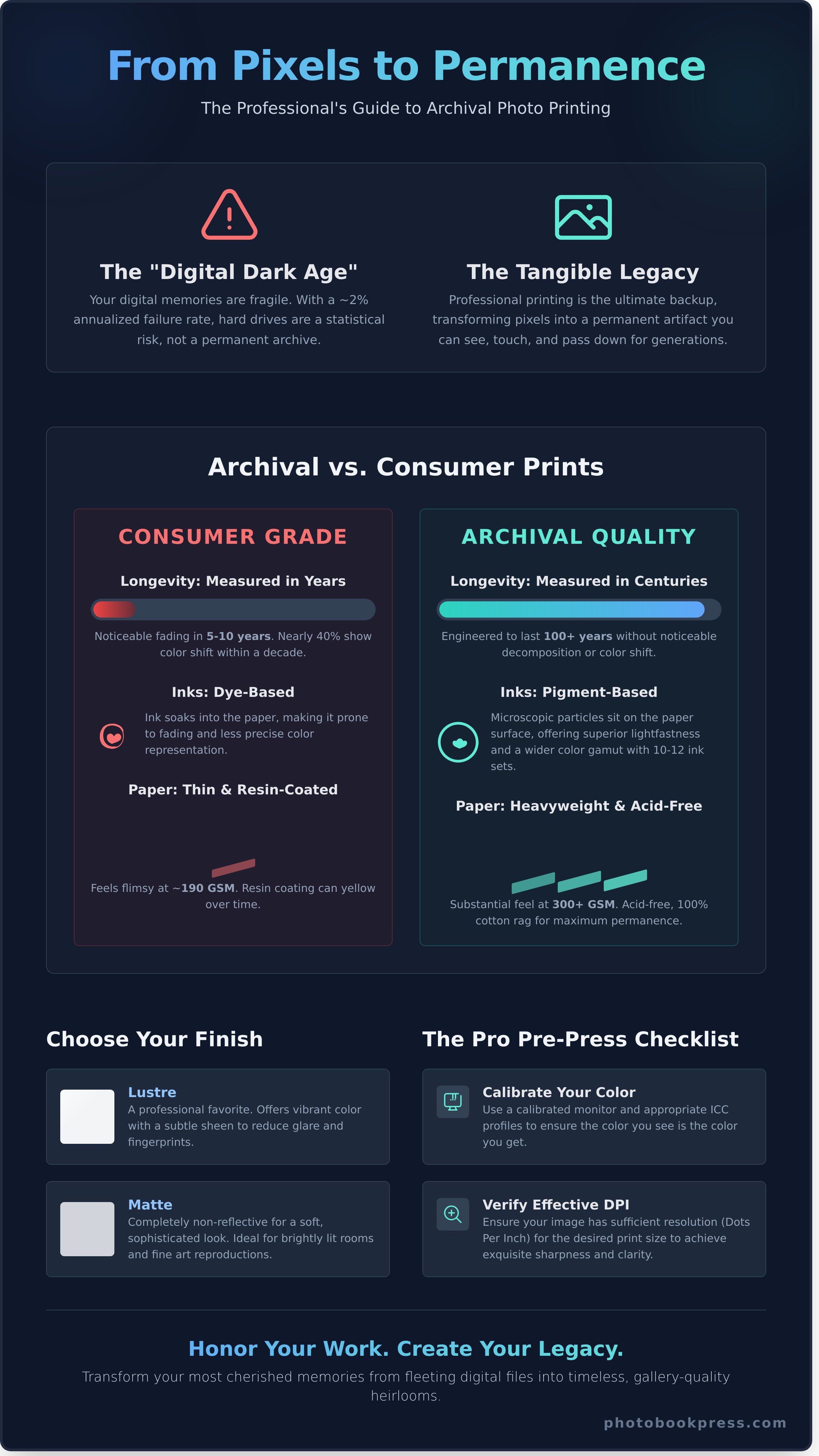
The journey from a digital file to a tangible artifact is not complete until you select its surface. This final, artistic choice dictates how light interacts with your image, fundamentally shaping its emotional tone and visual impact. The science of superior picture printing lies in this meticulous decision. A photograph’s finish can transform a bright, punchy memory into a quiet, contemplative moment, or elevate a simple portrait into an exquisite work of art. Whether a surface absorbs light or reflects it determines the final character of the print, making this selection as crucial as the photograph itself.
The most foundational decision in photography rests between two opposing surfaces. Each offers a distinct viewing experience, tailored to different subjects, lighting conditions, and aesthetic goals. Your choice here sets the stage for how your story is told.
For a truly commanding presence on your wall, modern picture printing technologies offer materials that transform a photograph into a three-dimensional object of art. These specialty finishes are designed for undeniable impact and longevity.
The journey from a digital image on your screen to a tangible, heirloom-quality print is a delicate and rewarding process. It’s where artistry meets technical precision. To ensure your cherished memories are rendered with the depth and clarity they deserve, a few preparatory steps are essential. Properly preparing your files is the single most effective way to avoid the common disappointments of prints that appear too dark, unexpectedly blurry, or with colors that feel muted and untrue to your vision.
A glowing screen and a reflective paper surface interpret light in fundamentally different ways. What appears bright and vibrant on your monitor can translate into a dark or muddy image without the right adjustments. This section offers the expert guidance needed to bridge that gap, ensuring your files are perfectly optimized for an exquisite fine art printing experience.
The foundation of any breathtaking print is resolution. It is the very structure of your image, the digital data that will become physical ink on archival paper. For gallery-quality results, the industry standard is an "effective resolution" of 300 pixels per inch (PPI). You can check this with a simple calculation before you upload.
With resolution confirmed, your focus can shift to the subtleties of color and composition. These final touches are what elevate a good print to an extraordinary one. The color space of your file dictates its potential color range, while the crop defines its final story.
For the most consistent results in professional picture printing, we recommend saving your files in the sRGB color space. While Adobe RGB (1998) offers a wider color gamut, particularly in greens and cyans, sRGB is the universal standard for web and most print labs, preventing unexpected color shifts. For advanced photographers using a fully calibrated monitor, soft proofing with a printer’s specific ICC profile can provide an accurate on-screen preview of the final printed piece.
Remember to compose your image with its final aspect ratio in mind. Your camera’s sensor likely captures images in a 2:3 ratio, which doesn’t fit perfectly into a 5:7 or 8:10 frame without cropping. Crop with intention to preserve the heart of your image. We also advise keeping essential elements, like signatures or faces, at least 1/8th of an inch away from the edges to account for the printer’s "bleed," the small margin trimmed during finishing.
Finally, consider your file format. While JPEGs are convenient, they use a "lossy" compression that discards a small amount of image data every time the file is saved. For maximum data retention and the highest archival quality, we recommend submitting an uncompressed TIFF file. It preserves every pixel of your original edit, honoring the full integrity of your work.
Preparing your files is an act of care that pays dividends in the final product. Our intelligent upload tool is designed to analyze your file's resolution against your chosen print size, providing instant feedback. Begin your gallery wall project with the confidence that every detail is accounted for.
The final, most crucial step in creating your gallery wall is translating your digital images into tangible art. This is where the story you've curated finds its physical voice. At Photobook Press, we believe in a simple, guiding philosophy: your story, beautifully told. We understand that each photograph is more than a file; it’s a captured moment, a piece of your legacy deserving of meticulous care and unparalleled artistry.
Our work is a delicate balance of heritage and innovation. From our Maryland facility, a space steeped in the traditions of printmaking since 1985, we embrace the future. We pair decades of artisan knowledge with forward-thinking technology, such as our state-of-the-art Canon imagePROGRAF printers, to ensure every detail is rendered with breathtaking accuracy. This unique fusion allows us to honor the timeless craft of printing while delivering a product that meets the exacting standards of today's high-resolution photography.
We've built our reputation by serving those who refuse to compromise on quality. Our clients range from professional photographers who rely on us for consistent, gallery-ready results for their clients, to discerning hobbyists who believe their personal milestones deserve the finest presentation. What unites them is a shared passion for excellence and an understanding that a printed photograph is an investment. It’s an heirloom in the making, and our handcrafted approach ensures every print we produce is worthy of that title.
Your vision shouldn't be limited by a template. We offer a curated selection of products, from individual archival prints perfect for your gallery wall to luxurious layflat wedding albums bound in exquisite Japanese silk. Our customization options, including a diverse portfolio of fine art papers and custom foil debossing, provide a level of personalization that mass-market labs simply cannot replicate. For our professional partners, our "pro-first" support guarantees the consistent, high-volume quality their businesses depend on.
True quality cannot be automated. Before any order leaves our facility, it undergoes a rigorous manual inspection by a print expert. We check for perfect color fidelity against a calibrated monitor, ensure flawless paper handling, and verify that every detail meets our stringent internal standards. It's a human touch that makes all the difference.
This commitment extends to our materials. We use advanced 12-color archival pigment inks, a superior method of picture printing that produces stunning color depth and longevity. Our prints are rated by independent labs to resist fading for over 200 years under typical indoor display conditions, transforming your photographs into enduring works of art. You've captured the memory; allow us to preserve it with the elegance it deserves. Experience the difference of professional picture printing at Photobook Press.
Your journey through this guide has revealed the essential elements of exceptional prints. It’s the precise harmony of archival-quality materials and meticulous file preparation that defines professional picture printing, empowering you to give your photographs the physical presence they deserve. When you’re ready to bring that vision to life, trust the artisans who have perfected this craft since 1985.
At Photobook Press, we use only archival-quality pigment inks and premium papers, with every single piece hand-inspected in our Maryland facility for absolute perfection. Elevate your memories with professional-grade printing at Photobook Press. Your best images shouldn't just be seen; they should be felt. Give them the permanence they deserve.
The ideal resolution for exquisite picture printing is 300 dots per inch (DPI) at your desired print size. This industry standard ensures every detail is rendered with crisp, gallery-worthy clarity. For an 8x10 inch print, your digital file should measure at least 2400x3000 pixels. Submitting a file with a resolution below 200 DPI will likely result in a soft or pixelated image that fails to honor the memory it holds. Your story deserves precision.
Our professional, archival-quality prints are crafted to last over 100 years without noticeable fading when displayed in typical home conditions. We achieve this by using pigment-based inks and acid-free, fine art papers. In contrast, many retail prints from kiosks or one-hour labs use less stable, dye-based inks on basic paper, which can show significant color shifts and fading in as few as 5 to 10 years. An heirloom is defined by its permanence.
A true photographic "print" is created by exposing light-sensitive paper to produce continuous, seamless tones and exceptionally deep colors. It's the standard for fine art. A "press" product, like a postcard or a standard book, is made using a printing press that applies tiny dots of ink (CMYK) to the paper's surface. While excellent for text and graphics, press products can't match the tonal depth and authenticity of a genuine photographic print for a gallery wall.
Yes, you can achieve stunning results from a smartphone, provided the original image file is used. A modern phone, like an iPhone 15 Pro with its 48-megapixel sensor, captures more than enough detail for a large format print. The crucial step is to transfer the original, full-size file. Images saved from social media are heavily compressed, often to just 72 DPI, and are unsuitable for quality printing. Always begin with the source image from your camera roll.
Your prints may appear darker because screens are backlit, emitting light to create an image (RGB color space), which naturally makes photos look brighter. A print, however, reflects light (CMYK color space). The best way to ensure accuracy is to edit on a professionally calibrated monitor. If you don't have one, we suggest increasing your image's brightness by about 10% before uploading to better approximate the final printed result on paper.
Matte finishes are overwhelmingly preferred for displaying cherished wedding photography. The non-reflective surface imparts a soft, elegant, and timeless quality that prevents glare from windows or indoor lighting, allowing the emotional moment to remain the focus. Our most popular choice is a Lustre finish, which delicately balances the rich color of a glossy print with the fingerprint-resistance of matte. It offers vibrancy without distraction, preserving the day's beauty with grace.
"Archival quality" is a promise of permanence, signifying that the materials used are chemically stable to resist degradation for over a century. This standard requires two key components: acid-free, lignin-free papers that won't yellow over time, and lightfast pigment-based inks that resist fading from light exposure. A print meeting these criteria, as all of ours do, is not just a photograph; it's a handcrafted heirloom ready to be passed down through generations.
Yes, we are proud to partner with the creative community. Our Pro Services program provides professional photographers with a standing 20% trade discount, dedicated expert support, and access to studio samples. For our non-professional clients creating a large gallery wall, we automatically apply a 15% volume discount to any order containing 25 or more individual prints. We believe in making exceptional quality accessible for projects of every scale.
