No Products in the Cart


What if the most expansive moments of your life didn't have to be interrupted by the structural limitations of traditional bookbinding? It's a common frustration to see a sweeping mountain range or a grand wedding processional lose its heart to the deep, dark crease of a standard gutter. When you invest your soul into a wide-angle masterpiece, you deserve seamless panoramic photo spreads that allow your vision to breathe across the page without any distortion or loss of detail.
We believe that your photographs are more than just digital data; they're precious artifacts of your personal history that deserve the highest level of care. This guide will show you how to transform those high-resolution files into breathtaking physical realities that rest perfectly flat. We'll explore the sophisticated engineering behind layflat photo books, the necessity of archival-quality materials, and the specific technical steps required to prepare your work for a museum-grade finish. From understanding paper grain to mastering the 180-degree spread, you're about to learn how to create a legacy piece that truly does justice to the scale of your story.
A seamless panoramic photo spread is the ultimate expression of wide-angle artistry in physical form. Unlike a standard page layout where two separate images sit side-by-side, a seamless spread utilizes a single, continuous sheet of archival paper that flows across the entire width of an open book. This technique ensures that not a single pixel of your composition is lost to the binding. It's the difference between viewing a landscape through a window with a wooden frame and standing on a balcony with an unobstructed view. When you create seamless panoramic photo spreads, you're choosing to honor the full scale of your vision without compromise.
The psychological impact of this gutter-free experience shouldn't be underestimated. In a traditional book, the central crease acts as a visual "stop" that reminds the viewer they're looking at a manufactured object. By removing that barrier, the eye moves fluidly across the horizon, allowing for a deeper emotional connection to the subject matter. It's an immersive experience that transforms a simple collection of pages into a premium gallery-grade heirloom.
To better understand this concept, watch this helpful video:
In recent years, digital platforms have popularized "seamless" carousels that allow users to swipe through a split panorama. While these digital mimics have made the concept of seamless panoramic photo spreads more familiar, they're often limited by low resolution and small mobile screens. A digital scroll is fleeting; a physical spread is permanent. Transitioning from a digital-first mindset to a professional print workflow requires a shift in how you perceive resolution. While a screen might only require 72 pixels per inch, a physical masterpiece demands a minimum of 300 dots per inch to maintain the integrity of every fine detail, from the texture of a bridal veil to the distant peaks of a mountain range.
Standard Bookbinding techniques, such as perfect binding or case binding, are designed for text, not expansive imagery. These methods involve gluing or sewing individual pages into a deep spine, creating what's known as "gutter loss." This can hide up to a quarter inch of your photo in the center fold. For a landscape photographer, this results in "pinched" horizons that look broken or misaligned. For architectural shots, it ruins the geometric symmetry that defines the work. This is why we specialize in layflat photo books, which utilize a unique hinge and single-sheet construction to ensure your images remain perfectly flat and entirely visible from edge to edge.
To achieve true visual continuity, one must look beyond the image and into the architecture of the book itself. Traditional binding methods, while efficient for text-heavy novels, fail when confronted with the demands of seamless panoramic photo spreads. In a standard "perfect bound" book, individual pages are stacked and glued into a rigid spine. This creates a physical "V" shape at the center, burying a portion of your image in the shadows of the fold. Layflat binding is the sophisticated antithesis of this approach. It is a feat of engineering. By utilizing a specialized hinge or a continuous sheet method, the book opens to a full 180 degrees, allowing the paper to rest entirely flat.
This 180-degree opening is essential for panoramic visibility. Without it, the eye is forced to compensate for the distortion caused by the curve of the paper. When the pages lie flat, the horizon line remains straight; the architectural columns remain parallel; the grand scale of your memory remains intact. The evolution of modern Adhesive binding has enabled artisans to move away from these rigid spines toward flexible, flat-opening designs that prioritize the image above all else. Every pixel remains visible. You can experience this level of precision firsthand by exploring our collection of Layflat Photobooks.
The secret to a book that stays flat for generations lies in the chemistry of its construction. We utilize premium, archival-grade adhesives that maintain their flexibility long after traditional glues have become brittle. These specialized bonding agents are designed to withstand the tension of a 180-degree opening without cracking or losing their grip. Structural integrity also requires a specific weight of paper. We favor heavy-weight, archival-quality stocks that provide the necessary "heft" to resist curling. This combination of superior materials ensures that your seamless panoramic photo spreads don't just look beautiful today, but remain pristine artifacts of your legacy for decades to come.
True seamlessness is best achieved through single-sheet printing. In this process, a panoramic image is not split into two separate leaves. Instead, it's printed onto one expansive sheet of paper that is then precision-folded. This eliminates the risk of color shifts between the left and right sides of a spread. When two different sheets are used, subtle variations in ink density or paper grain can create a jarring visual break. By using a continuous sheet, we maintain perfect ink consistency across the entire panoramic horizon. For those seeking a deeper dive into these construction methods, our resource on The Art of the Layflat Photo Book: A Definitive Guide for 2026 provides an exhaustive look at the materials we select to ensure this level of excellence.
Creating a masterpiece requires more than just a beautiful photograph; it demands a spatial understanding of how that image will live on a physical canvas. When you design for seamless panoramic photo spreads, you're essentially building a bridge between two pages. This process begins with the aspect ratio. Most premium spreads utilize a 2:1 ratio, meaning a 12x24 inch spread requires an image that can be elegantly cropped or composed to fit those expansive dimensions. If your original file is too narrow, you risk losing the sense of scale that makes panoramic photography so compelling.
Compositional intentionality is the hallmark of a professional layout. Use natural leading lines, such as a winding road or a shoreline, to guide the viewer's eye from the left page across the center to the right. While our layflat technology ensures the center fold is nearly invisible, we always recommend the "Center-Point Rule." Don't place a subject's eyes, a person's face, or a critical architectural detail directly on the fold. Shifting these elements slightly to one side creates a more balanced, sophisticated aesthetic that respects the physical form of the book. This level of detail is what separates a standard gift from a true heirloom, especially when designing wedding albums that are meant to be cherished for generations.
The transition from a digital file to a printed page involves technical precision. Bleed is the extra eighth-inch of image that extends beyond the final trim line, ensuring your panoramic spread reaches the very edge of the paper without any white margins. Without proper bleed, even the slightest shift in the cutting process could result in an unfinished look. The safe zone is the interior area where all critical elements, such as text or focal points, must reside to avoid being trimmed or lost during the final binding process. By keeping your most important details within this zone, you guarantee the integrity of your composition.
Landscape and architectural photography often feature vast, subtle gradients in the sky or shadows. To prevent banding, which are those distracting "steps" in color, it's vital to manage your files correctly before submission. We recommend using the sRGB color profile, as it offers the most reliable translation to our high-end printing systems. Soft-proofing your files allows you to preview how the ink will interact with the specific texture of our archival paper. This ensures that the deep blues of a twilight sky or the vibrant greens of a forest are reproduced with the same emotional resonance you felt when you captured the moment.
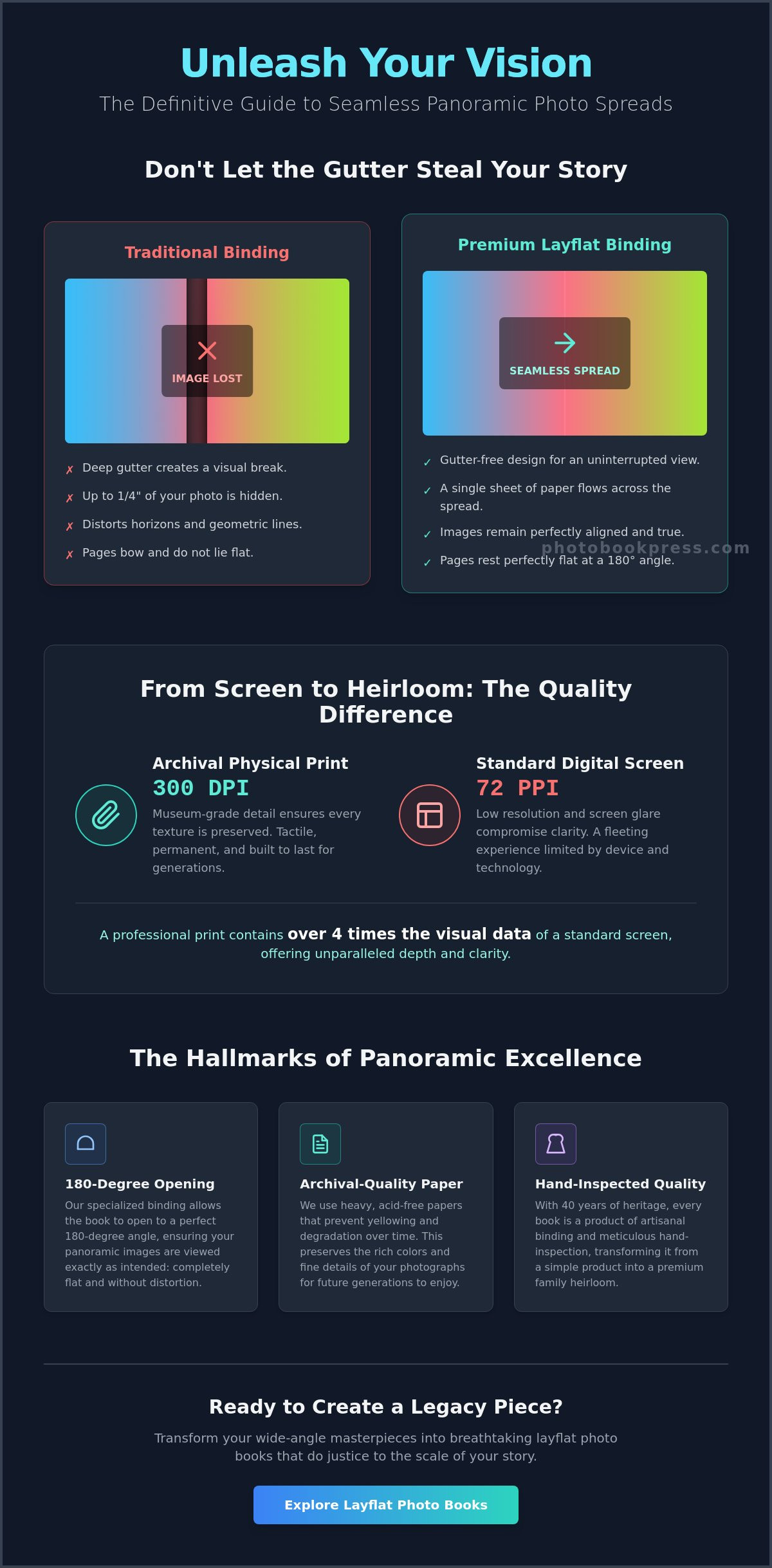
While digital displays offer convenience, they often strip the soul from a wide-angle photograph. Mobile screens, regardless of their marketing claims, typically compress files, shedding a significant amount of the original detail to ensure fast loading times. Physical print operates on a different plane of existence. When you commit your work to seamless panoramic photo spreads, you're moving from the fleeting pixels of a screen to the enduring precision of ink on paper. A professional print at 300 dots per inch (DPI) provides a depth and clarity that even the highest-resolution mobile devices can't match.
The transition to physical media transforms a photograph into a legacy. Digital algorithms are ephemeral; a printed book is a permanent anchor for your history. For a deeper understanding of how these elements combine, you can explore our resource on Professional Photo Books: The Ultimate Guide to Archival Quality & Design (2026). This transition isn't just about resolution; it's about the permanence of your creative expression.
The choice of paper is as critical as the lens used to capture the shot. For panoramas, the finish dictates the emotional tone of the spread. A Lustre finish offers a subtle sheen that enhances the vibrancy of colors and adds a sense of three-dimensional depth, perfect for dramatic sunsets or vivid cityscapes. Conversely, a Matte finish provides a sophisticated, non-reflective surface that invites the viewer to appreciate the fine textures of a landscape without glare. We use heavy-weight, high-GSM paper to ensure each page feels substantial and resists curling. This archival-quality stock is chemically stable, preventing the yellowing of panoramic horizons over time.
Digital engagement is often measured in milliseconds and swipes. Immersion, however, is a "lean-in" moment. It's the physical act of opening a book and feeling the weight of the covers. It's the ritual of turning a page to reveal a grand landscape that spans two feet in width. This sensory experience is heightened by the materials you choose for the exterior. Whether you select the timeless texture of genuine leather or the understated elegance of fine linen, the cover sets the stage for the artistry within. Sharing a physical album with a client or a loved one creates a shared space for storytelling that a glowing screen can't replicate.
If you're ready to see your vision in its most refined form, order your custom layflat photo book to experience the difference of museum-grade printing.
Our Maryland-based facility has been a sanctuary for traditional craftsmanship since 1985. For over 40 years, we've dedicated ourselves to the refined art of the physical print, evolving alongside technology while never losing our master artisan's touch. We don't simply produce books; we curate legacies. Every one of our seamless panoramic photo spreads undergoes a rigorous hand-inspection process by experts who understand the nuances of paper grain and binding tension. This ensures that the structural integrity of your book meets our uncompromising standards before it ever leaves our studio.
Premium materials are the foundation of our work. We source only the finest archival papers and specialized adhesives to ensure your memories remain pristine for generations. By treating each photograph as a precious artifact, we create a tactile experience that matches the emotional weight of your history. This boutique approach to production allows us to balance technical precision with a quiet, sophisticated confidence that generic services can't replicate. When you choose us, you're investing in a piece of art that's built to endure.
Professional photographers consistently trust our seamless layflat technology for their most demanding projects, including high-end wedding albums. They know that when a once-in-a-lifetime moment spans two pages, there's no room for structural failure or image loss. We also offer specialized wholesale programs for creators who require high-volume Portfolio Books without sacrificing artisanal quality. Our extensive customization options, from fine linens to genuine leathers, allow you to tailor every element to your specific aesthetic vision.
Designing a masterpiece shouldn't be a daunting task. We've developed intuitive tools that make creating seamless panoramic photo spreads accessible to everyone, regardless of technical background. You can focus on the narrative of your journey while our state-of-the-art printing technology handles the complexities of color density and structural engineering. Knowing that your book is manufactured in our own facility provides a level of security and reliability that's rare in the modern market. Your story is unique, and it deserves to be told through a medium that's as flawless as the memories themselves.
Design your custom layflat photo book with seamless spreads today.
The journey from a wide-angle capture to a museum-grade heirloom is a transition from the fleeting digital world to a permanent physical legacy. By mastering the technical nuances of layflat technology and archival design, you ensure that every expansive horizon remains uninterrupted. Choosing seamless panoramic photo spreads isn't just a design preference; it's a commitment to preserving the emotional depth of your story without the structural interference of traditional gutters. These physical artifacts allow you to relive your most significant moments with a tactile clarity that digital screens simply cannot replicate.
At our Maryland-based facility, we've practiced the noble craft of artisanal hand-binding since 1985. We combine decades of heritage with professional-grade archival materials to treat your memories as the precious artifacts they are. Every page you design is an investment in a history that won't fade, yellow, or break over time. It's time to bring your most grand visions to life with the quality and care they deserve. Your legacy is waiting to be bound in excellence.
Start building your custom layflat photo book with Photobook Press and experience the enduring beauty of a perfectly flat spread.
A seamless panoramic spread is a design where a single continuous image spans two pages without any portion being lost in the center binding. Unlike traditional books where the spine creates a deep crease, these spreads utilize a single sheet of archival paper. This allows your wide-angle photography to be viewed in its entirety. It's the definitive way to present grand landscapes or wedding processional shots in a layflat photo book.
You don't need specialized professional design software to achieve this look, as our intuitive online tools are built to handle wide-angle files. The focus remains on the quality of your original high-resolution image. Simply upload your panorama and stretch it across the two-page layout. Our systems are engineered to ensure the file translates perfectly into seamless panoramic photo spreads during the physical production phase in our Maryland facility.
Your photograph will remain one continuous piece of art because we print on a single expansive sheet of paper rather than two separate leaves. In traditional binding, pages are cut and glued into a spine, which often results in image loss. Our layflat construction involves precision folding instead of cutting at the center. This artisanal approach preserves every detail of your composition, ensuring the horizon line remains perfectly aligned across the fold.
The ideal aspect ratio for a full two-page panoramic spread is typically 2:1, though this can vary based on the specific dimensions of your book. For instance, a 12x12 inch book creates a 12x24 inch canvas when opened. Ensuring your image fits these proportions prevents unnecessary cropping of the sky or foreground. This balance is particularly important when creating portfolio books where geometric precision is paramount to the presentation.
Low-resolution photos aren't suitable for large spreads because physical printing reveals every imperfection that a small screen might hide. To maintain the integrity of a panoramic view, we recommend a resolution of at least 300 DPI at the final print size. Since these spreads often span 20 inches or more, using a high-resolution file ensures that the fine textures of archival paper enhance your work rather than highlighting pixelation or digital noise.
Layflat binding is exceptionally durable because it utilizes premium archival adhesives and heavy-weight paper stocks designed for longevity. Unlike standard glue-heavy bindings that can become brittle, our specialized hinges are engineered to withstand thousands of page turns. This structural integrity is a hallmark of our 40 years of craftsmanship. It ensures that even the largest, most expansive books remain a stable and beautiful heirloom for your family to enjoy.
Consistent color is guaranteed through our single-sheet printing process, which eliminates the risk of ink variations between pages. When two separate sheets are used, subtle shifts in printer calibration can cause the left side to look different from the right. By printing your panorama on one continuous sheet, we maintain perfect ink density and tonal balance across the entire horizon. This meticulous attention to detail is essential for preserving the emotional resonance of your work.
The primary difference lies in the 180-degree opening capability of layflat books compared to the "V" shape of standard binding. Standard books hide approximately 1/4 inch of your image in the gutter, which can distort faces or architectural lines. Layflat books use a unique construction that allows the pages to rest completely flat. This makes them the superior choice for anyone who values the uninterrupted beauty of seamless panoramic photo spreads and museum-grade presentation.
