No Products in the Cart


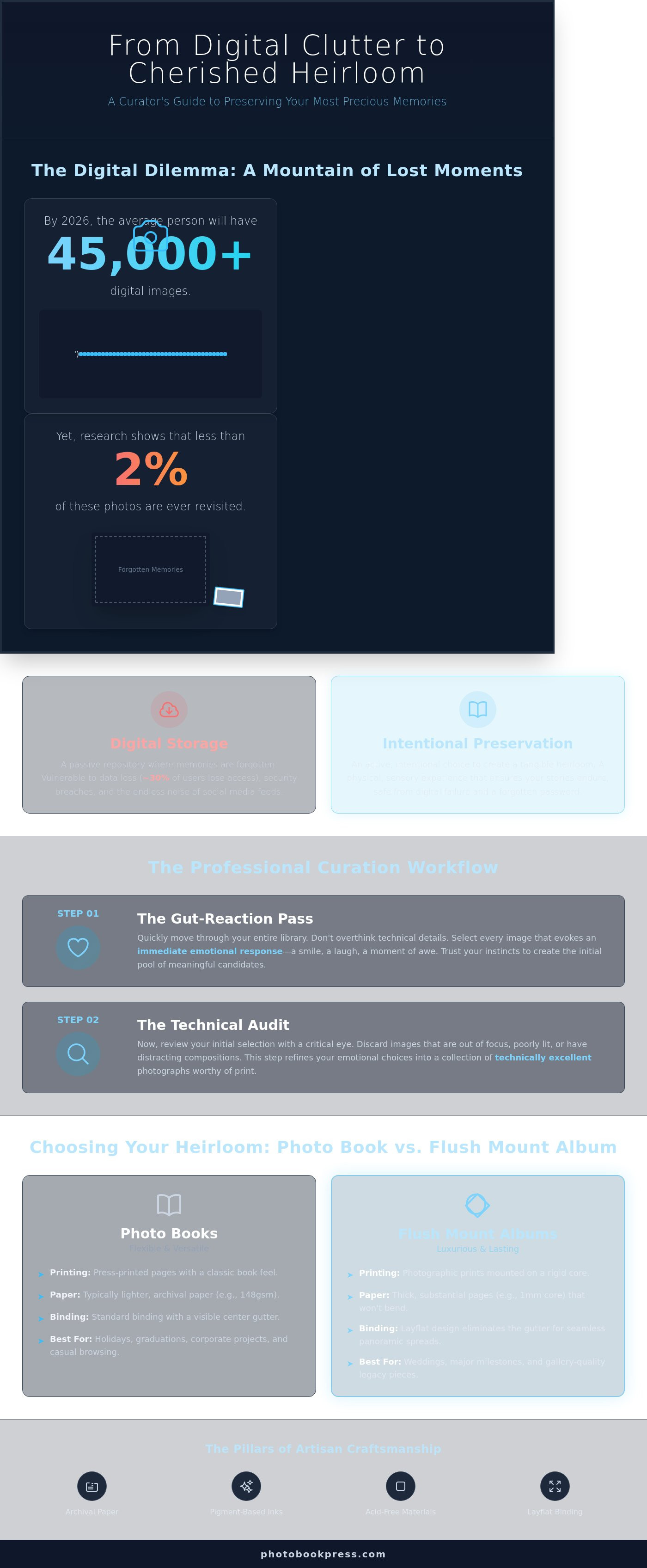
By the start of 2026, the average person will have accumulated over 45,000 digital images; yet research shows that less than 2% of these snapshots are ever revisited. What if your most precious memories are currently buried under a mountain of digital debris? You likely feel the exhaustion of scrolling through endless duplicates, paralyzed by the choice of what to keep and what to discard. It's a common struggle that often results in beautiful moments remaining trapped behind a cold screen, lost to the sheer volume of modern life.
Of course, the quality of the final album depends on the quality of the initial photographs. For significant life events, working with a professional photography service like Limalixart can ensure you have a stunning, high-resolution collection to begin with, making the curation process a joy rather than a chore.
We're here to help you move past that decision fatigue. This guide reveals the professional secrets of curation and narrative sequencing used by gallery curators to transform your digital library into a sophisticated album of photographs. You'll learn a refined workflow for selecting images that resonate and an understanding of visual pacing that ensures your project feels like a handcrafted heirloom. We'll walk you through the exact steps to transition from overwhelming clutter to a physical masterpiece that honors your personal history with clarity and grace.
A modern album of photographs is far more than a simple collection of images. It's a meticulously curated visual narrative designed to withstand the passage of decades. Many people confuse photo storage with photo preservation. Storage is a digital cloud; it's a passive repository where files often go to be forgotten. Preservation is an active, intentional choice. It's the transition from a fleeting pixel to a tangible, printed reality. This physical presence creates a deep psychological anchor. When you hold a book, your brain engages with the memory differently than when you swipe on a cold glass screen.
The history of the photo album reveals a long-standing human desire to ground our memories in the physical world. By selecting specific moments for print, you're creating an heirloom. This is an investment in your family legacy. It ensures that your most precious stories aren't lost to a forgotten password or a crashed server. In an era of infinite digital noise, the curated album stands as a quiet testament to what truly matters. It's a gallery you can hold in your hands, a sensory experience that links generations through the simple act of turning a page.
To better understand the craftsmanship involved in preserving these memories, watch this helpful video:
By the year 2026, the volume of digital data will be staggering, yet the risk of a "digital dark age" remains a genuine threat to personal history. Statistics from a 2024 data security report suggest that nearly 30% of users have lost access to primary cloud accounts due to security breaches or technical failures. Social media platforms are often graveyards for low-resolution snapshots that disappear into an endless feed. A physical book offers a sanctuary from this chaos. The current trend toward a "digital detox" has seen a 20% rise in the production of high-quality print goods as people seek more meaningful connections. Physicality offers a permanence that a screen cannot replicate. It's the difference between a temporary signal and a lasting monument.
Technical precision defines the quality of your legacy. Choosing the right format depends on the story you wish to tell and the level of durability you require. Standard photo books typically feature press-printed pages on 148gsm archival paper. They're excellent for documenting a summer holiday, a graduation, or a corporate retrospective. They offer a lighter, more flexible feel that's perfect for casual browsing.
Flush mount albums represent a higher tier of luxury and engineering. These pages are mounted on a rigid core, often 1mm thick, creating a leaf that stays perfectly flat when opened. This construction eliminates the center gutter, allowing panoramic images to flow seamlessly across a two-page spread. It's the preferred choice for weddings and significant milestones. Photobook Press remains committed to these artisan standards, using acid-free materials and pigment-based inks to prevent yellowing or fading. Every album of photographs we produce is a testament to the belief that some stories deserve to live forever. We treat every project with the meticulous care of a gallery curator, ensuring that your investment in print becomes a cherished artifact for the next century.
Creating a legacy begins with a single, decisive act: selection. Transforming a digital archive into a physical heirloom requires the eye of a curator rather than the impulse of a collector. A professional professional curation workflow prioritizes the narrative arc over sheer volume. This process ensures that every page turned feels intentional, moving the story forward with grace and precision.
Organize your digital workspace into three distinct folders: 'Yes', 'No', and 'Maybe'. This system prevents decision paralysis by allowing you to move non-essential images out of sight immediately. Ignore duplicate shots that differ only by a few seconds; the subtle shift in a hand position rarely justifies the extra space. Visual fatigue is the psychological exhaustion experienced by a viewer when confronted with repetitive imagery or cluttered layouts, leading to a loss of interest in the narrative. By adhering to a 15% selection rate from your total shoot, you keep the viewer engaged from the first page to the last.
A 'Hero' shot acts as the anchor of a visual chapter, often a wide-angle landscape or a poignant portrait that establishes the setting or mood. Balance these heavy-hitters with 'texture' shots, such as close-ups of architectural details, local flora, or the fabric of a gown. These details provide the sensory context that makes a memory feel tangible. Integrate candid shots with formal portraits to maintain a natural, lived-in feel. Professional editors often find that a ratio of 70% candid moments to 30% formal portraits creates the most compelling album of photographs. When your selection is complete, choosing a bespoke layout ensures your curation receives the presentation it deserves. This rhythmic balance between the grand and the granular is what elevates a simple collection into a true work of art.
A legacy is built through intentionality. When you assemble an album of photographs, you're not just archiving images; you're directing a viewer's emotional response. A 2022 study on visual memory suggests that humans retain information 50% more effectively when it's presented in a structured narrative rather than a random sequence. Choosing a framework provides the necessary scaffolding for your memories to resonate for decades. It transforms a collection of digital files into a cohesive, handcrafted artifact.
Chronology remains the most intuitive path for a reason. It mirrors the natural heartbeat of our lived experiences. For travel volumes, follow your actual itinerary to preserve the sense of discovery. Use archival-quality 'chapter' pages with minimal text to signal a shift from one location to the next. This structure works exceptionally well for wedding narratives, where the progression from morning preparations to the final dance creates a built-in tension and resolution. You can find specific strategies for this in our guide on How to Curate Photos for Your Wedding Photo Book. By anchoring the story in time, you create a reliable map for future generations to follow.
Grouping images by 'vibe' or color palette transforms a simple book into a curated gallery. This method prioritizes emotion over the calendar. For a family heirloom, consider sections titled 'Quiet Moments' or 'Wild Adventures.' Researchers at Tilburg University explore The Art of Curation as a way to find meaning in our digital abundance. By acting as a trusted guide, you help the viewer see the recurring motifs of a life. Use short, elegant quotes to bridge these thematic gaps. They act as a gentle connective tissue between disparate moments, ensuring the flow remains sophisticated and purposeful.
The 'Day in the Life' approach offers a high-impact alternative for those seeking a compressed narrative. It distills the essence of a year into the rhythm of a single 24-hour cycle. Start with the soft, blue morning light and conclude with the warm, amber glow of a bedside lamp. This style creates a visceral connection to the mundane beauty of your daily routine. It's particularly effective for an album of photographs intended to capture the fleeting details of early childhood or a specific season in a family home.
Pacing is the secret language of the master printer. Overcrowding a page suffocates the art and exhausts the eye. Incorporate 'breathing room' or white space to allow significant images to stand alone. A 2023 design audit revealed that premium photo books often dedicate 30% of their layout to intentional negative space. This deliberate silence emphasizes the weight of the surrounding photos. It ensures that your story is not just seen; it's felt. Your story, beautifully told, requires the confidence to let the paper itself speak. This rhythmic flow mirrors the turning of a high-quality page, allowing each moment the respect it deserves.
A photograph on a screen is a fleeting light; an album of photographs is a physical anchor. When you transition from digital files to a printed book, the materials you choose dictate the emotional weight of the story. The tactile response of the paper and the sturdy click of a cover closing are sensory cues that tell the reader this narrative matters. Crafting a legacy requires more than just good composition; it demands a commitment to the medium of print itself.
The weight of the paper is your first decision in this artisan process. We recommend a minimum of 200gsm to ensure every page feels substantial and premium. Texture alters the viewer's focus. A smooth, deep matte finish absorbs light to highlight the nuances of shadows in a portrait, while a subtle luster adds a professional sheen that mimics traditional darkroom prints. These choices aren't merely aesthetic; they're the difference between a temporary document and a permanent artifact.
True preservation depends on chemistry. Archival quality refers to materials that are chemically stable and pH neutral, typically resting at a pH of 7.0. This prevents the "acid burn" that causes cheap paper to become brittle. Archival-grade papers are designed to resist yellowing and fading for over 100 years, ensuring your colors remain as true as the day they were printed. You can explore these technical details further in our guide on [Understanding Paper Weight and Texture in Books].
Traditional bookbinding often results in "gutter loss," where the inner edges of your images disappear into the spine. For a storyteller, this is a significant hurdle. Layflat binding uses a specialized hinge technique that allows the book to open perfectly flat. This is essential for panoramic storytelling. When a landscape image stretches across two pages without a break, it creates an immersive 180-degree experience for the viewer.
Durability is another hallmark of professional binding. While mass-market books often rely on quick-dry glues that crack after 24 months of use, manual binding techniques ensure the structural integrity of the spine remains intact for decades. This is particularly vital for wedding albums or travel journals that you'll revisit frequently. It's a hallmark of craftsmanship that elevates your album of photographs from a simple book to a gallery-grade collection.
Choosing the right exterior and format completes the narrative arc:
The size of the book dictates the pacing of the story. A large-format volume demands a slow, deliberate viewing, whereas a compact book feels personal and accessible. Every choice, from the spine to the stitch, serves the photographs it protects. Your memories aren't just data; they're a history that deserves to be held.
Ready to transform your digital library into a masterpiece? Start designing your handcrafted photo book today and preserve your story for the next century.
Transforming a curated collection of memories into a physical album of photographs requires a significant shift in perspective. It's no longer about the fleeting nature of a digital screen; it's about the enduring weight of a legacy. This final stage of your creative journey shouldn't be rushed. At Photobook Press, we view ourselves as the final editors of your narrative. We provide the archival materials and artisan techniques that elevate your work from a simple project to a gallery-grade heirloom. Quality takes precedence over speed here, as we believe that a story worth telling is a story worth preserving with absolute precision.
Our professional-grade design tools are built to be a collaborative extension of your vision. We offer the flexibility to control every nuance of the layout, from the gutter margins to the delicate placement of captions. This isn't a generic template service. It's a sophisticated platform that honors the rhythm of your storytelling. By choosing to build your book with us, you're entering a partnership where your creative intent is matched by our technical mastery. We invite you to take your time, explore the textures of our paper options, and ensure every page turn feels intentional.
Our commitment to the "press" tradition began in 1985. Over the last 39 years, our Maryland facility has evolved into a specialized hub where heritage craftsmanship meets modern innovation. We've witnessed the industry shift from analog plates to high-resolution digital presses, yet our core philosophy remains unchanged. We don't rely solely on automated assembly lines. Instead, we prioritize the human touch in every phase of production. Our binding process involves skilled technicians who inspect every fold and stitch, ensuring structural integrity that machines alone cannot guarantee.
This meticulous approach is why we've become the definitive choice for both professional photographers and discerning hobbyists. We understand that a wedding album or a travel chronicle is more than just paper and ink. It's a physical artifact. Our quality control team performs a 100% manual inspection of every order before it leaves our doors. This rigorous standard ensures that the color fidelity you see on your calibrated monitor is exactly what appears on the printed page. We treat your memories with the same reverence a curator shows a museum piece.
The emotional value of a finished album of photographs lies in its ability to transport you back to a specific moment in time. Our signature style is defined by clarity and grace, allowing your imagery to take center stage without the distraction of fleeting design trends. When you hold a Photobook Press volume, you feel the difference in the paper weight and the smooth mechanism of the lay-flat binding. These technical details are the essential components of an exquisite emotional experience. They transform a collection of pictures into a cohesive, tactile narrative.
Before you finalize your project and hit the order button, we recommend a final review to ensure your heirloom is flawless. Use this checklist to guide your last look:
Once these details are perfected, you're ready to create something that will stand the test of time. Start building your custom album of photographs at Photobook Press and experience the quiet confidence that comes from genuine artisan craftsmanship. Your history deserves nothing less than perfection.
Your digital archives deserve more than a life spent on a silent hard drive. Transforming a curated selection into a physical album of photographs is an act of intentionality that bridges the gap between a fleeting moment and a lasting legacy. By mastering the professional workflow of selection and applying a cohesive narrative framework, you ensure every page turn tells a deliberate story. The final step is choosing a partner who understands that materiality is just as vital as the imagery itself.
Since 1985, our Maryland-based workshop has dedicated itself to the noble craft of artisan printing. We use archival-quality materials that carry a 100+ year guarantee, ensuring your history remains vibrant for generations. We also offer professional discounts for photographers who require gallery-standard precision for their clients. You aren't just making a book; you're crafting a tactile heirloom that demands to be felt.
Design Your Artisan Photo Album Today
Your most precious memories are ready to be held. It's time to bring them home.
A standard heirloom album typically features 50 to 100 images across 20 to 40 pages to maintain a clean visual narrative. This range ensures each image has room to breathe without cluttering the layout. For a 12x12 inch book, limiting your selection to 3 photos per page preserves the artistic impact of every frame.
You should aim for a minimum of 300 DPI for a large-format 11x14 inch print to ensure professional clarity. Higher resolutions like 600 DPI are ideal for preserving fine textures in detailed portraits. This technical standard prevents pixelation and ensures your album of photographs displays the sharpness of a gallery exhibit.
Layflat binding is essential for panoramic storytelling because it removes the center gutter that swallows 0.5 inches of your image. This 180-degree opening allows a single landscape photo to span two pages seamlessly. It's a premium investment that protects the spine from cracking over 50 years of frequent viewing.
You can use social media photos, but they often require downscaling to a 4x6 inch print size to maintain clarity. Most Instagram exports are only 1080 pixels wide, which results in roughly 72 DPI on a large page. For the best results, use original files that exceed 2 megabytes to avoid visible compression artifacts in your album of photographs.
A professional album uses silver halide photographic paper mounted on 2mm thick boards, while a photo book uses thinner 100lb text-weight paper. Albums are handcrafted with flush-mount techniques that prevent warping over a century. Photo books are similar to high-end magazines, while albums are heavy, archival heirlooms designed for multi-generational durability.
Choose full-grain leather for a classic 100-year legacy or 100% natural linen for a modern, tactile aesthetic. Hardcover image wraps are best for 80-page travel journals where the cover image sets the tone immediately. Leather covers offer the highest durability, resisting oils and wear more effectively than fabric or paper options.
The process typically takes 21 to 28 business days from the final design approval to delivery at your door. Our artisans spend 5 to 7 days on the hand-binding process alone to ensure every corner is perfectly tucked. Shipping usually adds 3 to 5 days depending on your proximity to our boutique press facility.
Look for acid-free, lignin-free paper with a weight of at least 200 GSM to ensure the pages don't yellow or become brittle. Papers like Mohawk Superfine or Hahnemühle are industry standards that resist fading for 200 years under normal lighting. These materials ensure your colors remain vibrant and your blacks stay deep for decades.
