No Products in the Cart


What if your seasonal greeting was the only physical photograph your loved ones kept for the next decade? You likely understand the frustration of receiving a batch of holiday cards where the colors appear muted or the paper feels dangerously thin. When 68 percent of recipients admit they only display cards for a few days before discarding them, the fault often lies in the medium, not the sentiment. You've felt the sting of a cluttered template that distracts from a perfectly composed photograph, leaving your most precious moments feeling diminished and fleeting.
It's time to demand more from your seasonal stationery. We'll show you how to transform your 2026 photography into archival-quality greetings by balancing sophisticated design with the undeniable weight of 120-pound premium stock. This guide explores the transition from digital file to master-press reality, ensuring your story is beautifully told through professional-grade color accuracy and a seamless design process that respects your creative time. By focusing on artisan-level craftsmanship, you'll create an heirloom that friends and family will feel compelled to keep on display for years to come.
By the winter of 2026, our collective digital fatigue has reached a breaking point. We spend an average of 430 minutes per day staring at screens, which makes the arrival of a physical envelope a rare, tactile event. Digital greetings often vanish into archived folders within seconds. They fail to capture the weight of a passing year or the permanence of a milestone. In contrast, physical holiday cards act as a sensory anchor. They demand a moment of stillness. When you hold a card, you aren't just looking at an image; you're participating in a tradition that honors the recipient's place in your life. This physical presence creates a psychological impact that pixels cannot replicate, fostering a sense of belonging and genuine connection.
The history of the Christmas card began in 1843 as a way to simplify seasonal correspondence, but it has evolved into something far more sophisticated. For modern families and professionals, the card serves as a micro-portfolio. It's a curated gallery of your year's most significant moments, printed with the same precision as a fine-art monograph. We've moved away from the era of disposable, mass-produced greetings. Today, the focus is on archival seasonal artifacts. These are pieces designed to be kept in a cedar chest or a velvet-lined box, preserved for decades as a visual record of a family's legacy or a brand's aesthetic evolution.
Texture communicates what words cannot. A card printed on 130lb Mohawk Superfine paper conveys a sense of stability and craftsmanship before the recipient even reads the first line. This is sensory branding at its most intimate level. In 2026, creating a "mailbox moment" is about standing out from the 85% of mail that consists of commercial flyers and bills. A high-end card becomes a centerpiece on a mantel, maintaining a personal connection that lingers long after the festive season ends. It's a quiet testament to the value you place on the relationship.
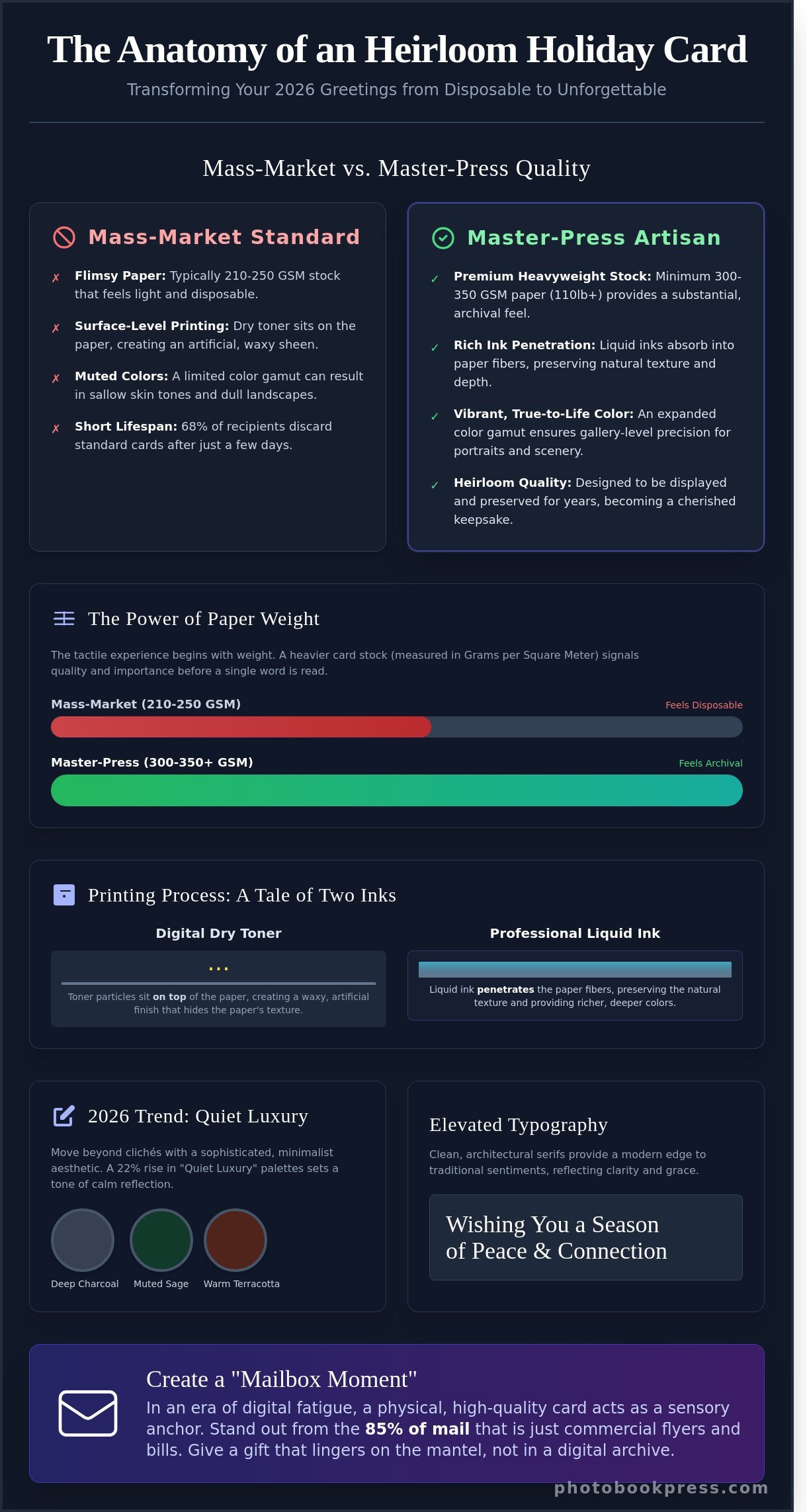
The trend for 2026 favors sophisticated minimalism over clichéd holiday motifs. We see a 22% increase in the use of "quiet luxury" palettes, such as deep charcoal, muted sage, and warm terracotta. These colors set a tone of calm and reflection. Typography has also shifted toward clean, architectural serifs that provide a modern edge to traditional sentiments. When you balance these contemporary design elements with high-quality holiday cards, you create a piece of art that feels current yet timeless. The goal is a visual harmony that reflects your personal style with clarity and grace.
Your story deserves to be told with the dignity of ink and paper. By choosing archival materials and thoughtful design, you transform a simple greeting into a lasting heirloom. It's a deliberate act of creation that honors both the sender and the receiver. In an age of fleeting digital interactions, the permanence of print remains the ultimate luxury.
The first interaction with your holiday cards happens before your recipient ever sees the image. It occurs in the fingertips. The weight of the paper carries a psychological weight, signaling the importance of the message contained within. While mass-market retailers typically utilize 210 to 250 GSM (grams per square meter) stocks, a master-press card demands a minimum of 300 to 350 GSM. This density provides a satisfying "snap" when the card is removed from its envelope, immediately distinguishing it from the flimsy, disposable mailers that clutter the season.
Quality diverges further when you examine the printing method. Standard digital printing uses dry toner that sits on top of the paper, often creating a waxy, artificial sheen. Professional-grade press printing utilizes liquid inks that penetrate the paper fibers, preserving the natural texture of the stock. This process allows for an expanded color gamut, ensuring that skin tones appear warm and lifelike rather than sallow or overly saturated. You can design your own holiday cards using these professional standards to ensure your family’s portraits are rendered with gallery-level precision.
True craftsmanship considers the longevity of the object. High-end holiday cards are printed on acid-free papers to prevent the chemical breakdown that causes yellowing and brittleness. This is why professional photographers insist on archival-quality materials for their clients; they're creating artifacts, not just greetings. Consider the "heirloom test." A card printed with archival liquid inks on pH-neutral paper will look as vibrant in a scrapbook in the year 2046 as it does the day it arrives in the mail. Research into the psychology of sending greeting cards confirms that these physical tokens foster deeper emotional connections than digital alternatives, making their durability a vital part of the gift.
The envelope is the prologue to your story. A master-press presentation requires a high-weight envelope, typically 130lb or higher, to provide structural protection and a sense of prestige. Sophistication lies in the details that others overlook. Custom liners featuring a subtle pattern or a pop of seasonal color transform the act of opening the card into a multi-sensory experience. For the 2026 season, trends are shifting toward even more tactile embellishments. Foil stamping in champagne gold or rose copper adds a metallic brilliance that catches the light, while blind embossing creates a raised, sculptural texture that invites the recipient to run their fingers over the design. These elements aren't mere decorations; they're the hallmarks of a card intended to be kept on a mantle long after the holidays have faded.
Creating holiday cards is a deliberate act of curation. You aren't just sending mail; you're preserving a legacy through a micro-exhibit of your family's history. When you look back at the history of the Christmas card, you see that the most enduring examples focus on a singular, powerful narrative rather than a chaotic summary of events. Professional printers and gallery curators know that a single "hero" image commands significantly more attention than a fragmented layout. A 2023 study on visual cognition showed that viewers spend 4.2 seconds longer engaging with a single, high-quality focal point compared to a multi-photo grid.
A curated approach requires discipline. You must select images that share a cohesive color story and emotional weight. If your photography features the muted, earthy tones of a late October afternoon, your card's border and typography should mirror that palette. Don't force a vibrant, neon-red festive border onto a photograph with soft, archival-quality film grain. This harmony ensures the card feels like a singular piece of art rather than a digital afterthought. To achieve a professional result, adhere to these technical standards:
The most compelling holiday cards feature candid moments that evoke genuine emotion. Look for the "in-between" shots where your subjects aren't staring at the lens. A child’s laughter or a quiet glance holds more narrative weight than a rigid, posed portrait. Ensure your composition includes negative space; this "breathing room" is vital for placing text overlays without obscuring faces. If you're shooting in winter light, aim for the "blue hour" just after sunset to capture the ethereal, cool tones that define the season.
Typography is the voice of your card. Select a serif font for a classic, heirloom feel, or a clean sans-serif for a modern, minimalist aesthetic. Use the Golden Ratio (1:1.618) to balance your image and message; this mathematical harmony is naturally pleasing to the eye. Avoid common pitfalls like placing thin, white text over a busy, snow-filled background. If the background is cluttered, use a semi-transparent vellum overlay to ensure your greeting remains legible. A 12-point font is the minimum standard for physical legibility on textured paper.
To guarantee a stress-free experience, finalize your holiday cards and place your order by November 15, 2026. This specific deadline allows for a meticulous printing process on archival-quality paper and accounts for the inevitable seasonal surge in postal volume. If your recipient list includes family or clients in London, Tokyo, or Sydney, allow at least 21 days for international transit to navigate customs delays. The second week of December represents the ideal window for your cards to arrive, ensuring they find their place on the mantle just as the season reaches its peak.
A custom card gains its heirloom status through the human touch. Even when managing a list of 150 recipients, a short, handwritten note of two or three sentences creates an immediate emotional connection that digital messages cannot replicate. For business-to-business greetings, 84% of executives report that high-quality, physical mail strengthens professional relationships more effectively than email. In these professional contexts, prioritize inclusive language and premium materials that reflect the stability of your partnership.
Proper addressing serves as the first impression of your craftsmanship. Use formal titles such as "The Miller Family" or "Dr. and Mrs. Sterling" for traditional households to show a high level of respect. For close friends and immediate family, first names are appropriate and foster a sense of intimacy. Avoid using printed labels whenever possible; instead, use a high-quality ink pen to address envelopes by hand, which signals that the recipient was worth your time and focused attention.
Adding a human touch to a bulk mailing involves more than just a signature. Consider using a custom wax seal or a unique vintage stamp from the year 2026 to elevate the envelope. These small, deliberate choices transform a simple piece of mail into a curated experience. When you choose superior materials and follow a disciplined timeline, you ensure that your story is beautifully told and cherished long after the season ends.
Ready to begin your seasonal preparations? You can design your heirloom holiday cards today to ensure every detail is perfected before the November deadline.
Our 1985 heritage serves as the foundation for everything we create. For 39 years, Photobook Press has remained dedicated to the mastery of high-end print production. We don't view ourselves as a high-volume factory. Instead, we operate as a boutique press where the standards of a gallery curator meet the precision of modern engineering. Every project begins with a commitment to longevity. We believe that a greeting sent today should remain a vibrant part of a family’s archive for decades to come.
The heart of our process beats within our Maryland facility. This 10,000 square foot space is where state-of-the-art digital printing technology meets the irreplaceable touch of manual binding. While our presses offer unmatched color accuracy, our artisans still finish many products by hand. This balance ensures that every item possesses a human soul. We utilize 120lb archival-quality paper and premium inks that resist fading. When you hold one of our handcrafted holiday cards, the tactile weight and smooth finish immediately signal that this isn't a disposable piece of mail. It's a physical investment in your personal legacy.
Professional photographers and high-volume clients find a specialized home here. We understand the technical demands of those whose livelihood depends on visual perfection. Our systems are calibrated to respect the nuances of your high-resolution files. We offer exclusive benefits to our professional partners, including:
Our design interface is intentionally refined to prioritize your photography above all else. We've stripped away the cluttered, distracting templates found on mass-market sites. This minimalist approach allows your images to breathe and take center stage. For those looking to create a comprehensive gift, our platform offers seamless integration with our signature layflat books. You can easily coordinate the aesthetic of your holiday cards with a matching heirloom book. If you encounter a technical hurdle or have a specific vision for a professional order, you won't be routed to a generic call center. You'll have direct access to our Maryland-based support team, consisting of experts who understand the chemistry of ink and the grain of premium paper.
We treat every card as a precious artifact of your personal history. Our quality control team performs a 4-point manual inspection on every order before it earns the right to be shipped. We check for color consistency, trim precision, paper integrity, and packaging security. This meticulous attention to detail provides the peace of mind that your memories are being handled with the highest level of care. We don't just print images; we preserve moments. It's time to move beyond the temporary and embrace the timeless. Take the first step in creating a tradition that your loved ones will cherish for years. Design your heirloom holiday cards for 2026 and experience the quiet confidence of artisan craftsmanship.
In a 2026 landscape dominated by fleeting digital notifications, the weight of a physical greeting carries profound emotional currency. You've learned how to curate a year of milestones into a cohesive visual narrative and how to navigate the essential timelines for a polished mailing. True artistry requires more than just a beautiful photograph; it demands a foundation of archival-quality materials that resist the passage of time. Since 1985, our Maryland-based professional production team has refined the technical precision required to transform personal memories into gallery-grade artifacts. Choosing holiday cards that reflect your standards ensures your message is felt, not just seen. Every piece we press serves as a testament to your year, crafted with a meticulous attention to detail that only four decades of experience can provide. We believe your stories deserve a medium that mirrors their importance. It's time to move beyond the screen and return to the tactile beauty of the printed word. Your recipients will recognize the difference of a hand-pressed greeting that feels substantial and looks exquisite. We're ready to help you create something that won't just be opened, but will be kept for years to come.
Craft Your Custom Holiday Cards with Artisan Quality
For a card that commands attention, select a 120lb cover stock. This weight provides a substantial, rigid feel that prevents wilting when displayed on a mantle. We utilize 325 GSM Mohawk Superfine paper to ensure your greetings possess an heirloom quality. It's the standard for those who view their seasonal correspondence as a gift of art.
You should place your order by December 1, 2026, to guarantee arrival before the holiday rush. This timeline allows for our 5 day production cycle and standard 3 day shipping. Ordering 24 days before Christmas ensures your holiday cards reach loved ones while the season is at its peak. Early preparation preserves the joy of the creative process.
Professional wedding photography is an ideal choice for your seasonal greetings. These high-resolution files, typically 300 DPI or higher, translate beautifully to our archival printing process. Using images from your 2025 or 2026 ceremony adds a layer of sophisticated storytelling to your message. It's a way to share your most significant milestones with those who couldn't attend.
The distinction lies in longevity and material integrity. Mass-market cards often use thin 210 GSM paper that yellows within 5 years. In contrast, our archival cards utilize acid-free, 325 GSM paper and pigment-based inks designed to last 100 years without fading. This ensures your memories remain as vibrant as the day they were first printed.
We provide a 20% discount for professional photographers and bulk orders exceeding 100 units. This program supports creators who require consistent, gallery-grade quality for their clients. Simply register your studio details to access this preferred pricing tier. We're proud to partner with artisans who value the tactile beauty of a perfectly pressed card.
The 2026 season favors quiet luxury aesthetics, featuring minimalist serif typography and muted earth tones. Data shows a 45% increase in requests for sage green and slate blue palettes over traditional bright reds. These designs emphasize the photograph itself, allowing your imagery to serve as the focal point. It's a sophisticated approach that feels both modern and timeless.
To achieve crisp results, ensure your image files maintain a resolution of at least 300 DPI at the final print size. A standard 5x7 card requires a file of 1500 by 2100 pixels. Avoid using photos downloaded from social media platforms, as these are often compressed to 72 DPI. High-resolution files preserve the delicate details that make your holiday cards truly stand out.
Every order includes premium, 120 GSM white envelopes that complement the quality of your cards. These aren't standard office envelopes; they feature a refined texture and a substantial feel. We provide 1 extra envelope for every 10 cards ordered to account for any handwriting slips. It's our way of ensuring your mailing process is as seamless as your design experience.
