No Products in the Cart


What if the most important detail of your favorite photograph was lost forever, not to time, but to the very binding of the book meant to preserve it? You've likely felt that subtle disappointment. You carefully arrange a breathtaking landscape or a cherished group portrait across two pages, only to have the central seam, the gutter, interrupt the narrative and obscure a crucial element. It’s a compromise your most precious moments shouldn't have to make.
This definitive guide for 2026 will illuminate why discerning creators and memory-keepers are turning exclusively to layflat photo books to achieve the seamless, panoramic presentation their stories deserve. We will explore how this binding technique transforms a simple album into a museum-quality art piece. You'll discover the archival-grade materials, the masterful construction, and the artistic freedom that ensure your legacy is presented, uninterrupted, for generations to come.
Imagine opening a book to a breathtaking landscape. The horizon stretches, uninterrupted, from the far left edge to the far right. There is no distracting curve or shadow down the center, no visual break to disrupt the majesty of the moment. This is the experience a layflat photo book delivers. It is a world away from a standard hardcover, where the story is constantly interrupted by the book’s own structure.
Once the exclusive domain of professional wedding photographers and high-end gallery exhibitions, this exquisite binding style has become the benchmark for those who believe their memories deserve a flawless presentation. It represents a fundamental shift in how we interact with printed stories, transforming a simple collection of pictures into a seamless, cinematic journey. The difference isn't just technical; it's emotional. It’s the difference between looking at a photograph and stepping inside it.
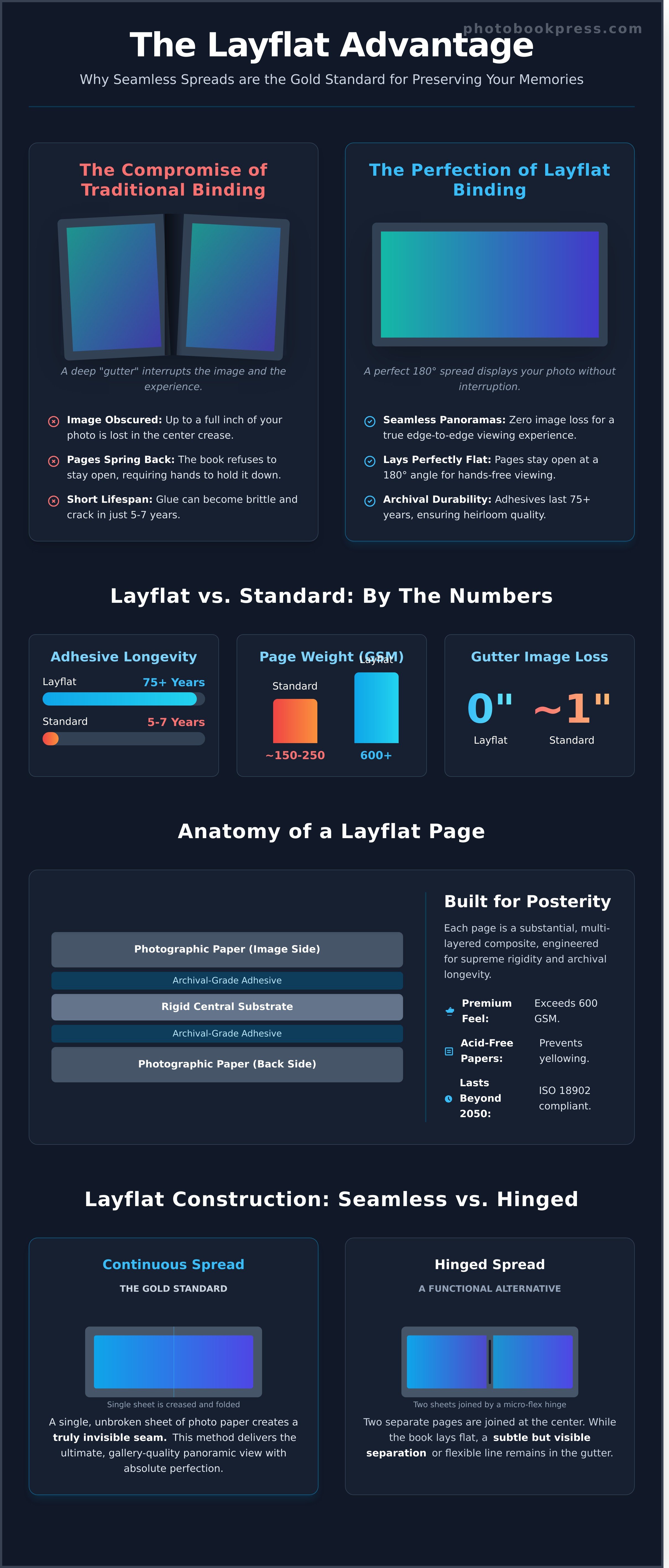
A conventional photo book is bound with glue or stitching at the spine, creating a deep central channel known as the "gutter." This design inevitably leads to "gutter loss," where up to a full inch of your image disappears into the crease. For a sprawling family portrait or a group photo, this can mean a cherished face is partially obscured. The book also refuses to stay open, its pages constantly "springing back" with a gentle tension that requires you to hold them down, distracting from the viewing experience. Over time, the glue in these spines can become brittle, leading to cracks after just 5-7 years of frequent enjoyment.
Layflat binding solves these problems with artisan precision. Layflat is a binding technique that uses a single continuous sheet for every two-page spread. This meticulous process, a modern evolution in The Craft of Bookbinding, allows the book to open to a perfect 180 degrees, creating a completely level surface. There is no gutter, no distortion, and no loss of detail. Your panoramic shots of the Amalfi Coast or the sprawling wedding party are displayed exactly as you captured them. This unbroken visual field forges a more profound emotional connection, allowing the viewer's eye to travel across the entire scene without interruption.
This commitment to an unblemished viewing experience is about more than aesthetics; it’s about preservation. True heirloom quality demands not only superior visuals but also enduring materials. Anticipated by archivists, the upcoming 2026 International Organization for Standardization (ISO) 18902 updates will further emphasize the need for archival-grade papers and bindings that prevent long-term degradation. For those creating a legacy piece, layflat photo books aren't just an option; they are the standard. They ensure that the integrity of your most important images, and the stories they tell, will remain as powerful for the next generation as they are today.
The defining feature of a layflat photo book-its ability to open to a perfectly flat, panoramic spread-isn't an accident of design. It’s the result of meticulous engineering and a deep respect for the printed image. Unlike standard books where pages are bound into a deep central gutter, a layflat page is a carefully constructed canvas, designed to present your photography without interruption and to endure for generations.
At its core, each page is a composite structure. Two individual sheets of professional-grade photographic paper are fused back-to-back onto a central substrate. This process creates a single, substantial page with a signature rigidity and a premium weight, often exceeding 600 GSM (grams per square meter). The layers are bonded with archival-quality adhesives, a critical component formulated to resist delamination and environmental changes for over 75 years, ensuring the integrity of your book remains uncompromised.
While both methods achieve a flat-opening book, the aesthetic difference is significant. Hinged construction uses a micro-flex hinge in the gutter, allowing the pages to lay flat but with a subtle separation. For the ultimate gallery aesthetic, continuous page construction is unparalleled. Here, a single, unbroken sheet of photo paper is creased and folded down the center, creating a completely seamless spread. This technique allows a single photograph to flow across the spread with absolute perfection.
A true heirloom must stand the test of time. That is why our layflat photo books are printed exclusively on acid-free, archival papers, chemically stable materials certified to prevent yellowing and degradation well beyond the year 2050. In our Maryland facility, we pair state-of-the-art digital press technology with the irreplaceable judgment of the human hand. Each book block is assembled and inspected by a master bookbinder, a final touch of quality assurance that fully automated production lines simply cannot replicate.
The texture of the paper itself is a vital part of the storytelling experience. The tactile feedback of turning a thick, luxurious page enhances the emotional connection to the images it holds. Your choice of finish is an equally important artistic decision.
Every element, from paper weight to binding technique, is a deliberate choice. Understanding how these components work together is essential to great Photo Book Design and is what separates a simple album from a lasting legacy. This commitment to craft ensures your story isn’t just seen, but truly felt. When you’re ready to feel the difference for yourself, we invite you to explore our exquisite paper options and begin crafting your own heirloom.
The decision between a standard photo book and a layflat album extends far beyond a simple line item on an invoice. It’s a choice about how your story will be told for generations. While a standard perfect-bound book serves its purpose, a layflat book is an entirely different caliber of creation, designed not just to hold memories, but to present them with the reverence they deserve. It’s an investment in an uninterrupted viewing experience and in an heirloom built to last.
Let’s consider the tangible returns. A standard book, with its glued spine, creates a central gutter that pulls the pages inward. This design inherently loses up to an inch of your image in the crease and creates a resistance that prevents the book from staying open on its own. After 50 to 75 viewings, the spine can begin to show stress, weakening its hold. In contrast, our layflat binding is engineered with a flexible hinge, allowing each spread to open a full 180 degrees. This construction is rated to withstand over 200 viewings without any degradation to the spine’s integrity, ensuring its place as a family treasure. The superior build is often complemented by the printing process itself; understanding the nuances between Digital vs. Offset Printing reveals how premium methods contribute to the archival quality and color fidelity essential for a true heirloom.
This structural superiority is most evident in what we call the 'Coffee Table Test'. A standard book, when placed on a table, closes itself. It requires two hands to hold open, making it a fleeting, active viewing experience. A layflat book rests open, transforming any surface into a private gallery. It invites guests to explore, to linger over a breathtaking landscape or a cherished family portrait. It doesn’t just sit on the coffee table; it commands it, turning passive display into an elegant, interactive feature of your home.
Certain moments don't just deserve better; they demand it. For these occasions, choosing anything less than a layflat presentation is a true compromise.
The physical object holding your memories profoundly influences their perceived value. The substantial weight of archival paper and the smooth, effortless turn of a layflat page communicate a sense of permanence and importance. It’s a tactile confirmation that these moments matter. This creates an undeniable 'wow factor' when sharing with others; the seamless, cinematic spread elicits a deeper emotional connection than a conventional book ever could. While the initial investment for a layflat album may be 30% higher, it unlocks a 100% increase in the viewable image area on every two-page spread, eliminating the visual disruption of a central gutter.
A layflat photo book is more than a collection of images; it is a seamless canvas for your most cherished stories. Its unique 180-degree binding transforms the design process, inviting you to think not in single pages, but in sweeping, cinematic spreads. This format liberates your photography from the constraints of a traditional gutter, allowing for bold compositions that immerse the viewer completely. The key is to approach your layout with both artistic vision and technical precision.
Embrace the panoramic potential. A breathtaking landscape, a wedding party stretching across the frame, or a newborn’s first delicate yawn can finally be presented with the uninterrupted grandeur they deserve. Consider the narrative power of this format. You can create a powerful visual timeline, placing an image of a couple’s first dance on the left and a photo from their 10th anniversary on the right, bridging years in a single, elegant view. This storytelling capacity is what elevates expertly designed layflat photo books into true family heirlooms.
To preserve the integrity of these expansive images, resolution is paramount. For a standard 12x12 inch book, your panoramic spread spans a full 24 inches. To ensure archival-quality sharpness without a hint of pixelation, your image file must be at least 7200 pixels wide (24 inches x 300 DPI). This technical benchmark is non-negotiable for achieving the crisp, professional finish your memories deserve. Just as important is the thoughtful use of white space. A minimalist layout, with a single, perfectly placed photograph on a spread, allows the image to breathe and command attention, creating a sense of quiet sophistication and focus.
Mastering the spread requires a new perspective on classic composition. The Rule of Thirds, for instance, can be applied across the entire two-page canvas, placing your subject on a vertical line on the right-hand page while balancing it with negative space on the left. While the center is no longer a physical barrier, it's wise to avoid placing the bridge of a nose or a single eye directly on the faint central crease. A micro-adjustment of just 5-10 millimeters to either side ensures the subject’s face remains flawless. For dynamic variety, pair a dominant anchor photo that spans the spread with two or three smaller, complementary images on one side, offering intimate details that enrich the main story.
Your digital design is only the blueprint; true artistry reveals itself in the final print. To guarantee the colors you see on screen are the colors that appear on paper, we recommend soft proofing your project using the Photobook Press ICC profile. This simulates the printed result, preventing unwelcome shifts in tone or saturation. Equally critical are the bleed and trim margins. To ensure your images extend to the absolute edge of the page, your design must include a 0.125-inch (3mm) bleed on all outer edges. This small margin is trimmed away during production, leaving you with a perfect, borderless finish. The texture of your chosen paper can also influence color perception. For a deeper exploration, consult our complete guide on Understanding Paper Weight and Texture.
With these principles of composition and technical craft in mind, you are equipped to create a truly exceptional book. Ready to translate your vision into a tangible work of art? Begin crafting your layflat masterpiece today.
A photograph holds a moment. A photo book preserves a lifetime. At Photobook Press, we believe the vessel for your memories should be as enduring and beautiful as the stories it contains. Our legacy in the art of printing began in 1985, rooted in the traditional craft of the press. As technology evolved, so did we, but our core philosophy never wavered: to bring an artisan’s touch to every page. We’ve carried that ethos forward, blending decades of print mastery with the finest digital technology to create heirlooms, not just albums.
Every book we produce is born in our dedicated Maryland facility, a place where precision and passion converge. State-of-the-art HP Indigo 7900 digital presses render your images with breathtaking color fidelity and sharpness, capturing every subtle hue. Yet, technology is only half the story. Each book is assembled by hand. Our master craftspeople meticulously check page alignment, apply adhesive with practiced care, and hand-fit each cover. It's this irreplaceable human element that transforms a collection of prints into a unified, soulful object.
Your memories deserve to last for generations, not just years. That's why we are uncompromising in our selection of materials. Our papers are exclusively archival-grade, meaning they are acid-free and lignin-free to prevent yellowing and degradation for more than 100 years. The inks we use are pigment-based for superior lightfastness, ensuring your photos remain as vibrant as the day they were printed. We build our exquisite layflat photo books to be timeless artifacts, objects with a satisfying weight and presence, worthy of being passed down.
We extend our unwavering commitment to excellence to every client. Professional wedding photographers trust us for gallery-quality prints that satisfy their most discerning customers, while families lovingly curate their personal histories with our intuitive tools. Our exacting standards for color calibration, binding integrity, and material quality are absolute, ensuring every project meets a professional benchmark. We believe everyone is a storyteller, and we provide the expert support and premium quality to help you tell your story beautifully.
The tactile experience of your book is paramount. We offer a curated collection of premium cover materials, from the supple grain of genuine Italian leathers to the understated elegance of Belgian linens. Inside, you’ll find our signature paper stocks, such as the substantial 190 GSM Luster, chosen for its rich texture and profound image depth. Before shipping, every book undergoes a rigorous 21-point hand-inspection, guaranteeing that what you receive is nothing short of a masterpiece.
Our intuitive online design tools empower your creative vision, making the process of creating custom layflat photo books both simple and deeply satisfying. You don’t need to be a designer to produce a stunning result. From our press in Maryland, we ship these personal treasures worldwide, delivering your legacy to your doorstep. Your story is waiting to be told, and it deserves to be held. Begin crafting your exquisite layflat photo book.
You've explored how the seamless, edge-to-edge spread elevates a collection of photographs into a single, breathtaking narrative. Choosing this format is an investment not just in superior presentation, but in true permanence. A well-designed volume built with archival materials becomes a family treasure, meant to be experienced and shared. This is the defining power of exceptional layflat photo books.
At Photobook Press, we've upheld this standard of excellence for decades. Since 1985, our Maryland-based artisans have handcrafted each volume with meticulous care, using archival-quality materials designed for multi-generational durability. We are so confident in this legacy of craftsmanship that every book is backed by a 100% satisfaction guarantee.
Your story deserves nothing less than perfection. Create your heirloom layflat photo book with Photobook Press and give your memories the beautiful, lasting home they warrant.
A layflat photo book is a premium book constructed with a specialized hinge binding, allowing each two-page spread to open completely flat without a central gutter. This seamless design is perfect for panoramic images that stretch across both pages, ensuring no part of your photograph is lost in the spine. It transforms your collection of images into an uninterrupted visual narrative, presenting your most treasured moments with the elegance and clarity of a gallery exhibition.
Yes, layflat binding is engineered for superior durability and longevity, often outlasting standard perfect-bound hardcovers by over 50 years under archival conditions. Our pages are mounted back-to-back on a sturdy substrate, creating thick, unbendable pages that resist warping and damage from frequent handling. This handcrafted technique ensures your album becomes a true family heirloom, built to be passed down through generations. This is a core benefit of high-quality layflat photo books.
We strongly advise against using low-resolution photos, especially for panoramic spreads where every detail is magnified. For an exquisite, print-quality panoramic that spans a 24-inch spread, we recommend a minimum resolution of 300 DPI, or approximately 7200 x 3600 pixels. Using a lower-resolution image will almost certainly result in a pixelated, soft-focus appearance that compromises the integrity of your memory and the artistry of the book. Your story deserves pristine clarity.
Our layflat photo books are crafted to accommodate between 20 and 100 pages, which translates to 10 to 50 full spreads. This range is carefully determined to maintain the structural integrity and elegant profile of the layflat binding. Exceeding 100 pages can compromise the book's ability to close properly and places undue stress on the spine. We find this curated page count provides the perfect canvas for telling a complete, yet refined, story.
Absolutely, the layflat binding process is independent of the cover material, allowing for complete customization with our full range of premium materials. You can pair the seamless panoramic interior with any of our cover options, from our 100% genuine Italian leathers to our 12 distinct shades of archival-quality bookbinding linen. The choice of cover is a personal one, designed to perfectly complement the story held within the pages and reflect your unique aesthetic.
Layflat binding is a more intricate and labor-intensive craft, which is reflected in its premium price point, typically costing 30-50% more than a standard perfect-bound book. Each spread is meticulously assembled by hand, with two prints mounted onto a thick central substrate before being bound. This process uses more than double the amount of archival paper and specialized adhesives compared to conventional methods. The result is an investment in unparalleled quality and durability.
For a wedding album, we almost exclusively recommend a Lustre finish, which offers the ideal balance between the rich color saturation of glossy and the fingerprint-resistance of matte. Our Fuji Crystal Archive Lustre paper features a subtle pebble texture that diffuses light, minimizing glare and enhancing the viewing experience from any angle. This archival-grade paper, with a lifespan rated for over 100 years, ensures your wedding photos retain their vibrant, true-to-life color for a lifetime.
To ensure your layflat book becomes a lasting heirloom, proper storage is the most critical element of its care. Always store the book flat, away from direct sunlight and environments with high humidity or temperature fluctuations, such as attics or basements. We recommend a stable environment between 65-75°F (18-24°C). Handle the pages by their edges to avoid transferring oils from your skin. With this minimal care, its archival-quality construction is designed to preserve your memories for over a century.
