No Products in the Cart


A digital photograph is merely a transient sequence of light until it finds its permanent home on a physical medium. You likely feel that your most significant milestones deserve more than a fleeting existence on a backlit screen. When you transition these moments into professional canvas prints, you aren't just decorating a wall; you're preserving a legacy. It's natural to hesitate when faced with the 15 percent color shifts or the structural sagging common in mass-produced alternatives. You want the quiet confidence that the art you hang today will retain its vibrancy for decades.
Beyond traditional wall displays, there are other innovative ways to celebrate your personal history. For instance, you can transform your favorite images into custom AI-styled jigsaw puzzles from Piece by Piece; learn more about how these unique pieces offer a new way to engage with your most cherished moments.
This guide reveals how to elevate your digital narratives into museum-quality heirlooms through master craftsmanship and archival materials. We'll explore the technical precision of 400gsm cotton-poly blends and pigment-based inks designed to resist fading for over 100 years. You'll gain expert clarity on resolution requirements and edge finishing to ensure your final piece matches your creative vision with 99 percent color accuracy. Your story, beautifully told, begins with understanding the intersection of fine art and technical excellence.
Digital images are often fleeting. They live on servers or hidden within smartphone folders, rarely surfacing to be truly experienced. A 2023 report from the Professional Photographers of America indicates that 62% of families feel a deeper emotional connection to physical portraits than digital files. This shift marks a return to the artisan craft. A high-quality canvas print acts as a bridge; it takes the sharp precision of modern sensors and softens it with the warmth of a traditional gallery piece. It's a sophisticated way to transition from the ephemeral to the eternal.
Observe the meticulous journey from a digital file to a finished work of art in this demonstration:
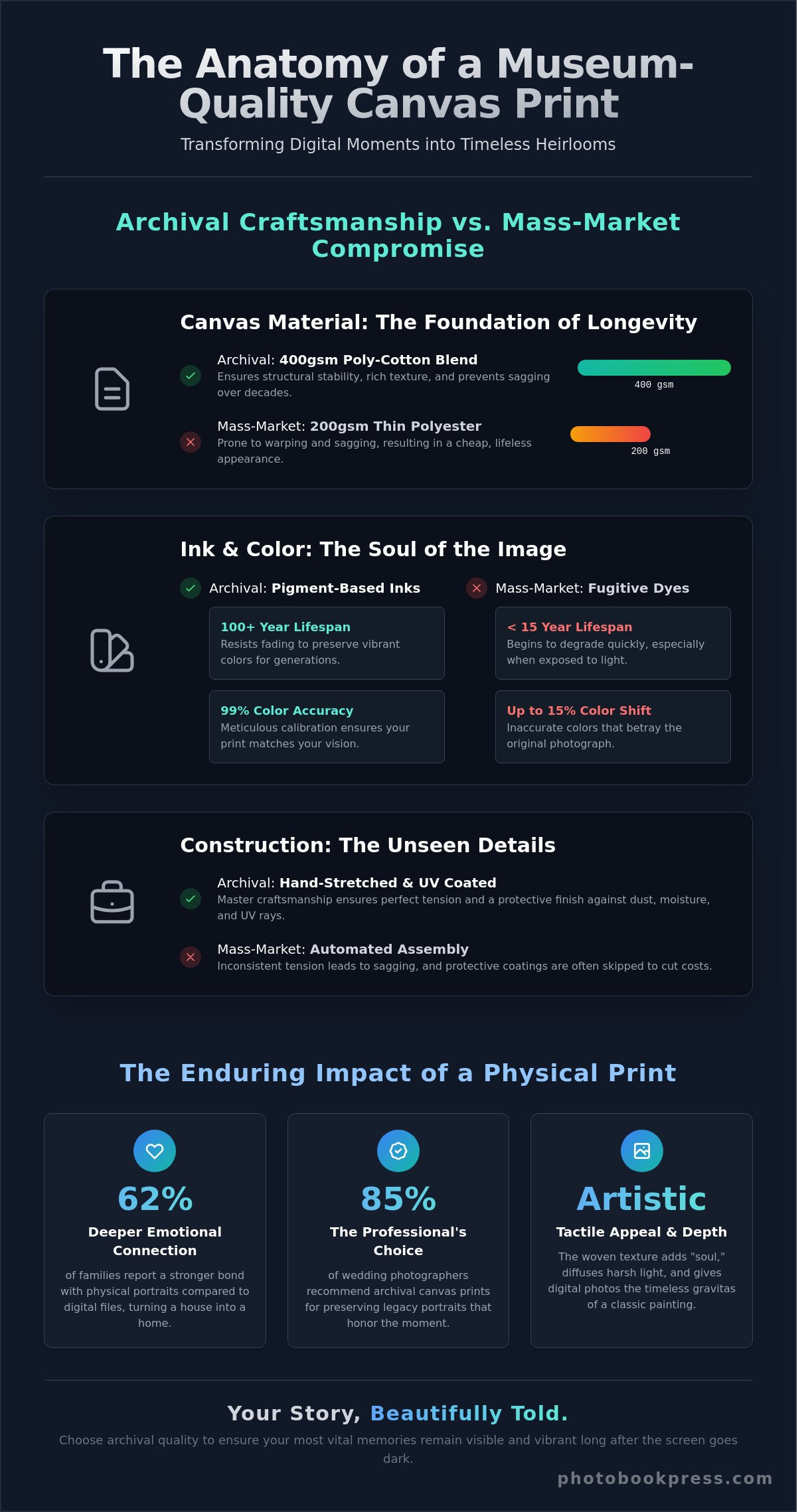
The psychological impact of a large-scale print is profound. When a memory occupies a physical space, it commands attention and dictates the mood of a room. It's not merely a decoration; it's an anchor. Mass-produced items from big-box retailers often use thin 200gsm polyester that lacks character. Boutique printers utilize 400gsm archival poly-cotton blends instead. This weight ensures the art doesn't sag or warp over time. It's why 85% of wedding photographers recommend canvas prints for legacy portraits. The medium honors the gravity of the occasion with a quiet, confident prestige.
Digital files are often flat and clinical. The unique grain of a woven canvas adds a sense of "soul" to the image that a screen cannot replicate. This texture does more than look good; it effectively breaks up light reflections. In a room with floor-to-ceiling windows, a high-gloss print might become unviewable at noon. Canvas diffuses that light, maintaining clarity. Landscapes and candid portraits benefit most from this organic depth. The weave mimics the brushstrokes of a master painter, giving a 2024 landscape the weight of a classic oil painting.
Social media posts have a lifespan of less than 24 hours. A physical heirloom lasts for generations. We believe in the philosophy of "Your story, beautifully told" through every piece we create. Investing in a boutique print means choosing 100-year archival inks over cheap, fugitive dyes. A canvas print is a museum-grade reproduction of a personal moment. It transforms a house into a gallery of lived experiences. This medium ensures that your most vital memories remain visible and vibrant long after the screen goes dark.
Choosing a boutique printing process over a mass-market alternative is a commitment to quality. It reflects a desire to treat personal history with the same reverence a curator shows a masterpiece. When you move beyond the screen, you aren't just printing a photo; you're preserving a legacy.
A professional canvas isn't merely a piece of fabric. It's a complex assembly of high-grade materials designed to withstand the passage of time. To be considered "archival," a canvas must meet specific weight and composition standards. Most premium canvas prints utilize a heavyweight blend of cotton and polyester, typically measured at 400 gsm (grams per square meter). This specific ratio provides the natural, tactile texture of cotton with the structural stability of polyester. It ensures the surface doesn't shrink or stretch excessively as the seasons change.
Preservation begins at the microscopic level. Without a specialized UV-resistant coating, even the most vibrant colors begin to degrade within 15 years of exposure to ambient light. High-end finishes act as a sophisticated barrier, filtering out harmful ultraviolet rays and protecting the integrity of the ink. This level of protection is a standard requirement for displaying canvas art in gallery environments where light exposure is constant. These coatings also provide a moisture-resistant seal, allowing the artwork to be gently dusted without risking damage to the underlying pigments.
The framework beneath the fabric determines the longevity of the entire piece. Cheap, lightweight wood often contains high moisture levels that lead to warping as the wood dries in your home. Quality stretcher bars are crafted from kiln-dried wood, usually pine or fir, sourced from sustainable forests. These bars are often 1.5 inches deep. This robust profile resists the inward pressure of a tightly stretched canvas and prevents the unsightly "ghosting" or sagging that plagues inferior products. When the wood is properly dried to a 6 to 8 percent moisture content, it remains straight and true for a lifetime.
Dye-based inks soak into the fibers, which makes them susceptible to moisture and rapid fading. In contrast, pigment-based inks consist of tiny, solid particles that sit on the surface. These particles offer a 100-year fade resistance under normal indoor lighting conditions. This technology allows for a wider color gamut. It captures the subtle gradients of a Maryland sunset or the intricate lace of a wedding dress with absolute precision. Photobook Press utilizes 12-color inkjet systems to ensure every hue is rendered with museum-grade accuracy, reflecting the true depth of your original file.
Mass-produced prints often rely on machine wrapping. This can result in uneven tension and unsightly bulging at the corners. Hand-stretching is a deliberate, artisan process. Each piece is manually tensioned by a craftsman who understands the unique "give" of the fabric. This ensures a drum-tight finish that remains taut for decades. Using kiln-dried wood prevents the frame from bowing, even in climates with humidity fluctuations above 60 percent. This meticulous attention to detail transforms a simple image into a lasting heirloom of your story, beautifully told through superior craftsmanship.
Transforming a digital file into a physical heirloom requires more than a simple upload. It's a meticulous process of translation that demands an eye for both technical precision and aesthetic harmony. To move from a glowing screen to a textured wall, you must prepare your files with the same level of care a gallery curator applies to a new acquisition.
Step 1 involves a rigorous assessment of resolution. While the 300 DPI standard is mandatory for fine art books, canvas prints offer more latitude. A file at 150 DPI is often sufficient for a 24x36 inch display because the viewer's eye typically rests 4 feet from the wall. If you're printing a 12-megapixel smartphone photo, your maximum high-quality width is approximately 26 inches before the image begins to degrade.
Selecting a subject that complements the natural texture of the weave marks Step 2. The tactile dimension of canvas adds a depth that can soften sharp digital edges, which favors organic shapes and portraits over rigid architectural grids. Choosing a subject with broad color fields allows the weave to create a painterly depth that isn't achievable on flat, glossy paper.
Composition for the gallery wrap defines Step 3. A standard 1.5-inch depth pulls the outer edges of your image over the wooden stretcher bars. You must ensure that no vital elements, like a subject's hand or a horizon line, sit within 2 inches of the frame's edge. Professional photographers often leave "bleed" space during the shoot to account for this 3-inch total loss in visible surface area.
Color correction serves as the final technical hurdle in Step 4. Professional canvas often possesses a slightly warmer, creamier base than bright white photographic paper. To maintain the intended mood, you might need to adjust your image's white balance by 2% toward the blue spectrum. This ensures your highlights remain crisp. Our commitment to excellence relies on archival-quality materials to ensure your legacy remains vibrant for 75 years or more.
A common error involves ignoring the 4:3 aspect ratio typical of digital sensors when ordering a 2:3 canvas. This results in a 12% loss of the original composition. Before finalizing your order for canvas prints, use these metrics:
This simple math prevents the pixelation that ruins large-scale art and ensures your imagery retains its professional polish.
Not every beautiful image belongs on a wall. A "book photo" is a narrative detail, like a close-up of wedding rings, that works best in a sequence. A "wall photo" possesses high emotional resonance and visual weight. For professional portfolios, select images with a singular, clear focal point. Data suggests 90% of successful wall art pieces evoke a specific memory or feeling within 3 seconds of viewing, making them worthy of a permanent place in your home.
Selecting the right finish for your canvas prints is a decision that bridges the gap between a digital file and a physical heirloom. The transition from a simple image to a curated piece of wall art depends on the technical specifications of the build. These choices affect how light hits the surface and how the piece interacts with the surrounding architecture of your home.
Edge treatments dictate the profile of your art. A gallery wrap continues the image around the sides of the wooden stretcher bars, providing a seamless, three-dimensional look. If your photograph is tightly cropped, a mirrored edge replicates the outer pixels of the image to cover the sides without losing any of the primary subject. For a more graphic, modern aesthetic, solid color edges in black or white provide a crisp border that defines the work's boundaries against the wall.
Depth plays a critical role in the visual weight of the piece. A 1.5-inch museum wrap offers a bold, sculptural presence that commands attention in minimalist settings; it stands 100% further from the wall than a standard profile. The 0.75-inch slim profile is the preferred choice for those who intend to place the canvas inside a traditional decorative frame later. This thinner depth ensures the art doesn't protrude awkwardly from the molding.
A well-designed gallery wall relies on consistent spacing and thematic harmony. To create a professional display, maintain a strict 2 to 3-inch gap between multiple canvases. In traditional interiors, a symmetrical grid of four 16x20 prints provides a sense of order and prestige. Modern spaces often benefit from an asymmetrical layout where a large 24x36 anchor piece is balanced by smaller 8x10 accents. Aim to keep the center of the arrangement at the standard museum eye-level of 57 inches from the floor.
Floating frames are the gold standard for contemporary galleries because they create the illusion that the artwork is suspended in mid-air. This effect is achieved through a 0.25-inch gap between the canvas edge and the frame's inner border. Choose a matte black finish for high-contrast photography, or opt for natural wood to add warmth to a minimalist room. A white floating frame provides a clean, ethereal look that complements bright, airy interiors while hiding the raw staples of the canvas wrap.
Lighting is the final step in turning a print into a focal point. Use LED bulbs with a Color Rendering Index (CRI) of 90 or higher to ensure colors appear vibrant and true to the original file. Position accent lights at a 30-degree angle to the wall; this specific tilt prevents glare while highlighting the unique weave of the canvas texture. Avoid placing your art in direct sunlight, as UV exposure can degrade even archival-quality pigments over a 10-year period.
Whether you are curating a single statement piece or a collection of canvas prints, the structural choices you make define the room’s atmosphere. You can design your heirloom canvas today to ensure your memories are preserved with professional-grade craftsmanship.
Since 1985, Photobook Press has functioned with the quiet belief that every image deserves the dignity of a master's touch. We began our journey as a boutique press nearly four decades ago, long before the digital revolution transformed the industry. Today, that heritage of excellence continues within our single, dedicated facility in Maryland. We don't believe in outsourcing or utilizing distributed manufacturing networks. By keeping every stage of production within our own walls, we maintain 100% control over the final result. This centralization allows our team to monitor environmental factors, such as humidity and temperature, which can affect how ink interacts with the substrate. It's a level of precision that mass-market providers simply cannot replicate.
Professional photographers frequently turn to us because we offer wholesale-grade quality that meets the highest gallery standards. These professionals know that a print is only as good as the materials supporting it. We use sustainable, kiln-dried wood for our stretcher bars, ensuring the frame won't warp or bow as the years pass. Our canvas prints utilize a heavyweight, acid-free blend designed for archival longevity. We avoid the thin, polyester-heavy fabrics found in budget shops. Instead, we select materials that offer a rich texture and a wide color gamut. This commitment to substance ensures that every piece we produce remains vibrant for decades, reflecting our identity as a trusted partner in the creative process.
The production process is a blend of modern technology and old-world craftsmanship. Before any file reaches the press, our master printers perform a manual review. If the resolution is insufficient for the requested size, we reach out to you directly. We don't let a sub-par image pass through just to meet a shipping quota. Once printed, each canvas is hand-stretched by an artisan who understands the specific tension required for a perfect wrap. The unboxing experience reflects this care. When you open your package, you'll encounter the weight of solid craftsmanship and the distinct, clean aroma of premium materials. It's a tactile reminder that your memories are in expert hands.
A digital file is a fleeting thing, but a physical print is a permanent record of a life well-lived. We view our work as the creation of heirlooms rather than mere decor. By using pigment-based inks and archival coatings, we ensure our canvas prints resist fading for 100 years. This durability is central to the Photobook Press promise of artistic integrity. We treat your wedding portraits, travel landscapes, and family milestones with the reverence a curator treats a masterpiece. Your story, beautifully told, becomes a gift for future generations to admire. Create your heirloom canvas print today and begin building your own gallery of history.
The transition from a fleeting digital image to a permanent gallery piece requires a meticulous approach to materials and a deep respect for the printing craft. By utilizing archival-quality pigment inks and a sturdy poly-cotton canvas, you create a foundation that resists the passage of time. These canvas prints aren't merely decorative items; they're sophisticated investments in your personal history. Since 1985, our Maryland-based artisans have hand-finished every piece to meet the rigorous standards preferred by professional photographers worldwide. It's a level of detail that ensures your memories remain as vibrant and sharp as the day they were captured.
Your walls provide the perfect stage for a curated narrative of your most meaningful experiences. When you combine expert image preparation with intentional framing strategies, you elevate a simple photograph into a true heirloom. We're honored to serve as your partner in this creative process, providing the technical expertise and premium materials your story deserves. There's a profound joy in seeing your work finally take its place in the physical world.
Design Your Custom Heirloom Canvas Print
We look forward to helping you transform your favorite moments into breathtaking art that will be cherished for decades.
Archival-quality canvas prints will retain their vibrant color for over 100 years when displayed indoors away from direct sunlight. We utilize UV-resistant pigment inks that bond with the 100% cotton fabric to prevent degradation. A 2023 study on giclée longevity suggests that under standard gallery lighting, visible fading won't occur for at least 75 years. This ensures your captured moments remain as vivid as the day they were printed, preserving your family legacy for generations.
You can safely remove dust from your artwork using a clean, dry microfiber cloth or a soft-bristle brush. Avoid using water, detergents, or chemical solvents, as these can compromise the protective topcoat and lead to ink bleeding. For a deeper clean, a slightly damp cloth with 5% mild soap can be used cautiously, but 98% of maintenance only requires a gentle dusting. Keeping the surface clear preserves the exquisite texture of the weave without damaging the handcrafted finish.
A gallery wrap extends the original image around the sides of the 1.5-inch wooden frame, creating a continuous visual flow. In contrast, a mirrored edge clones the outer 2 inches of your photo to wrap the sides, ensuring the entire original composition remains visible on the front face. This technique is particularly useful for portraits where essential details sit close to the edge. Both styles provide a finished, professional look that transforms a simple photograph into a sculptural piece of art.
Your image should ideally maintain a resolution of 150 to 300 dots per inch (DPI) at the final print size to ensure professional clarity. For a 24x36 inch canvas, this requires a file with dimensions of at least 3600 by 5400 pixels. If your file is below 2 megabytes in size, the resulting print may appear soft or pixelated. We review every file to ensure the final heirloom piece meets our exacting artisan standards for sharpness and detail.
You don't need a frame because the internal 1.25-inch or 1.5-inch stretcher bars provide a complete, sculptural aesthetic. Many collectors prefer the minimalist look of a frameless gallery wrap for its modern appeal. However, adding a custom floater frame can provide a 0.25-inch gap between the art and the wood, creating a sophisticated gallery-style presentation. It's a choice between contemporary simplicity and traditional refinement for your canvas prints, depending on your personal decor style.
If your canvas loses its drum-like tension after 5 or 10 years, you can easily tighten it using the small wooden corner keys provided in the frame. Tapping these wedges further into the slots expands the frame by 1 or 2 millimeters to pull the fabric taut again. Alternatively, spraying a fine mist of distilled water on the back of the canvas causes the fibers to shrink as they dry. This simple maintenance restores the structural integrity of your handcrafted art.
Canvas is significantly more durable than paper in environments with 60% or higher humidity, such as bathrooms or coastal homes. Unlike paper, which can ripple or "cockle" behind glass, high-quality poly-cotton canvas expands and contracts naturally without trapping moisture. The archival inks and protective coatings we apply offer a 40% increase in moisture resistance compared to standard matte photo paper. It's a resilient choice for preserving memories in diverse climates where traditional prints might fail.
Choose a matte finish if your room has multiple light sources, as it eliminates 95% of distracting glare and reflections. This finish highlights the organic texture of the weave and provides a classic, understated elegance for black and white photography. A glossy finish is better for high-contrast landscapes, as it increases the perceived color saturation by 15% and adds a luminous depth. Your decision should reflect the specific lighting conditions and the emotional tone of your gallery space.
