No Products in the Cart


On October 14, 2023, a landscape photographer realized that nearly 22% of the visual field in a panoramic sunset was swallowed by the central fold of a standard binding. It's a common tragedy for those who treat their memories as art. You've likely felt the frustration of a family portrait being severed by a deep crease or a book that stubbornly refuses to stay open on its own. We agree that an heirloom should be as effortless to view as it is beautiful to hold. The layflat method has become the gold standard for discerning creators who believe their most precious moments deserve an uninterrupted stage where no detail is lost to the shadows of a tight spine.
For other documents, such as business reports, training manuals, or notebooks where durability and the ability to open 360 degrees are key, other methods are more suitable. In these cases, using supplies like Plastic Spiral Binding Coils can be a cost-effective and practical solution.
This guide explores the technical artistry of this sophisticated binding style to ensure your photographs remain whole and vibrant for generations. You'll discover how this archival-quality construction eliminates the gutter entirely, providing a seamless view that honors the integrity of every wide-angle shot. We'll examine the durable engineering that creates these exquisite books and why they're the definitive choice for preserving your personal history. From the weight of the paper to the precision of the hinge, we will preview the craftsmanship that transforms a simple collection of images into a professional-grade masterpiece.
Layflat binding represents a structural philosophy where the physical book disappears to let the imagery speak. It's a specialized craft where each spread is printed on a single, continuous sheet of archival paper. These sheets are meticulously folded and bonded back-to-back, creating a surface that rests perfectly level when opened. This method honors the "press" heritage of artisan bookmaking, contrasting sharply with the 2024 trend of digital mass-production that often prioritizes speed over substance. To appreciate this evolution, one can study historical Bookbinding techniques, which have moved from purely functional utility to the artistic precision found in high-end portfolios today.
The tactile experience of a layflat volume is immediately distinct. You'll feel the weight of 300gsm or even 600gsm archival-grade materials, providing a rigidity that resists warping over decades. There's a quiet confidence in a book that doesn't fight against the reader. It invites a slow, deliberate viewing of your most precious artifacts. Every choice, from the paper grain to the adhesive, serves the goal of preserving a legacy for 100 years or more.
To better understand this concept, watch this helpful video:
A standard 12x12 book using this binding method transforms into a breathtaking 24-inch panoramic view. This is achieved by using one continuous sheet of paper for the entire spread rather than two separate pages. The secret lies in the specialized hinge. This structural fold allows the paper to bend without creating a "spring" effect. It ensures the book stays open without any manual assistance. It's the difference between a book that feels like an object and one that feels like a gallery wall. Your story, beautifully told, requires this level of uninterrupted space.
Traditional "perfect binding" or case binding creates a deep "gutter" in the center of the book. This valley can swallow up to 0.75 inches of your image, causing faces or horizons to disappear into the spine. For a professional portfolio, this loss of data is unacceptable. Standard glued bindings also suffer from high physical tension. They often snap shut at a 45-degree angle unless held down firmly. Over time, this constant stress leads to cracked spines and loose pages, especially in climates with fluctuating humidity.
In contrast, layflat construction removes this tension entirely. There's no glue-saturated gutter to crack and no hidden area where your composition goes to die. By choosing a layflat finish, you ensure that 100% of your pixels are visible. It’s an investment in the integrity of your visual narrative, ensuring that the technical execution of the book matches the professional quality of the photography within.
Crafting a professional portfolio requires more than a standard printer; it demands a marriage of chemistry and structural engineering. At the heart of every layflat book is the principle of paper grain. If the paper's fibers don't run parallel to the spine, the book will inevitably warp or buckle when humidity levels shift by as little as 10 percent. This attention to detail is a legacy of traditional bookmaking, a craft preserved by institutions like the American Bookbinders Museum. By aligning the grain, artisans ensure the pages remain perfectly flat and stable for decades.
Every page is joined using high-grade, pH-neutral adhesive. This isn't the standard glue found in mass-market paperbacks. It's a non-yellowing, flexible compound designed to withstand thousands of page turns without losing its structural integrity. Because the glue is acid-free, it doesn't eat away at the photographic emulsions over time. The hand-assembly process adds a final layer of scrutiny that machines simply can't replicate. Master binders inspect each spread, ensuring the alignment is precise to within 0.5 millimeters before the book is cased into its cover. This human touch ensures that every transition is seamless and every edge is flush.
While standard photo books might use 150 GSM paper, a premium portfolio requires 300 to 400 GSM stock to achieve the necessary rigidity. This weight creates a tactile experience that commands respect the moment a client lifts the book. Finish options further define the aesthetic:
Archival-quality paper is acid-free stock designed to resist fading for over 100 years. Using these heavier stocks ensures that the pages don't curl at the corners, maintaining a crisp profile even after years of frequent viewing.
The journey begins with the choice of technology. Silver halide printing involves a chemical process that embeds the image within the paper, resulting in seamless transitions and continuous tones. In contrast, high-end digital presses use micro-toner particles to achieve 2400 DPI resolution, which is perfect for sharp text and fine graphic elements. Once printed, each sheet is scored using a precision blade. This creates a permanent crease that allows the layflat spread to open without a gutter, preserving the integrity of panoramic shots. The final stage is the trim and casing-in phase. Here, the block of pages is meticulously fitted into a custom-built cover. It’s this intersection of technology and human touch that makes a bespoke portfolio a true heirloom. This process ensures the book feels like a single, cohesive object of art rather than a collection of loose pages.
Choosing between binding styles is a decision that dictates how a viewer interacts with your work. Standard hardcover binding uses a glued or sewn spine that creates a gutter, a physical dip where the pages meet the center. In contrast, a layflat book utilizes a sophisticated hinge system or ultra-thick, hand-mounted pages that remove this obstruction. This technical difference represents a 100% increase in visible surface area for center-aligned subjects, ensuring that every pixel of your photography remains visible.
The price delta reflects the artisanal labor involved in the production process. While standard books are often mass-produced on automated lines at speeds of 1,000 units per hour, a premium volume requires a manual mounting process. Each spread is bonded to a core substrate, often taking 3 to 4 times longer to assemble than a standard adhesive bind. This investment ensures the book functions as a gallery-grade object rather than a mere container for data. You're paying for the specialized equipment and the meticulous eye of a binder who ensures every edge aligns to within a fraction of a millimeter.
Engagement levels shift dramatically based on the binding choice. A standard book often snaps shut if left unattended, requiring the reader to physically hold the pages back. A book that lays flat remains open at any page, inviting the viewer to linger. In a 2023 study of tactile marketing, physical objects that required less effort to hold open resulted in 40% longer viewing times. It's the difference between a fleeting glance and a deep immersion into the narrative. For a coffee table centerpiece, this ease of access is the primary driver of interaction.
Durability is where the engineering shines through. Standard spines experience 15% more mechanical stress at the hinge point during frequent use. These pages are typically printed on double-weight archival paper, often 200gsm or higher, which resists warping and tearing over decades of handling. The construction doesn't rely on a single line of glue at the spine. Instead, it uses a full-surface bond that keeps the integrity of the book intact even after thousands of page turns.
For a wedding album or a professional portfolio, the Hero Image is king. Imagine a landscape shot of the Amalfi Coast or a bridal party spanning 24 inches across a spread. Without a gutter, the composition remains unbroken. Professional photographers building a legacy for their clients choose this format for 90% of their top-tier packages. It preserves the integrity of the original frame, ensuring no detail is lost to the binding.
Standard binding excels when your story requires volume. Once a project exceeds 100 pages, the thickness of specialized layflat substrates makes the book unwieldy, often reaching a spine width of 2 inches or more. For casual family yearbooks or 200-page travelogues, the lighter weight of standard binding is practical. It's a functional choice for everyday memories that don't rely on panoramic design or high-impact double-page spreads.
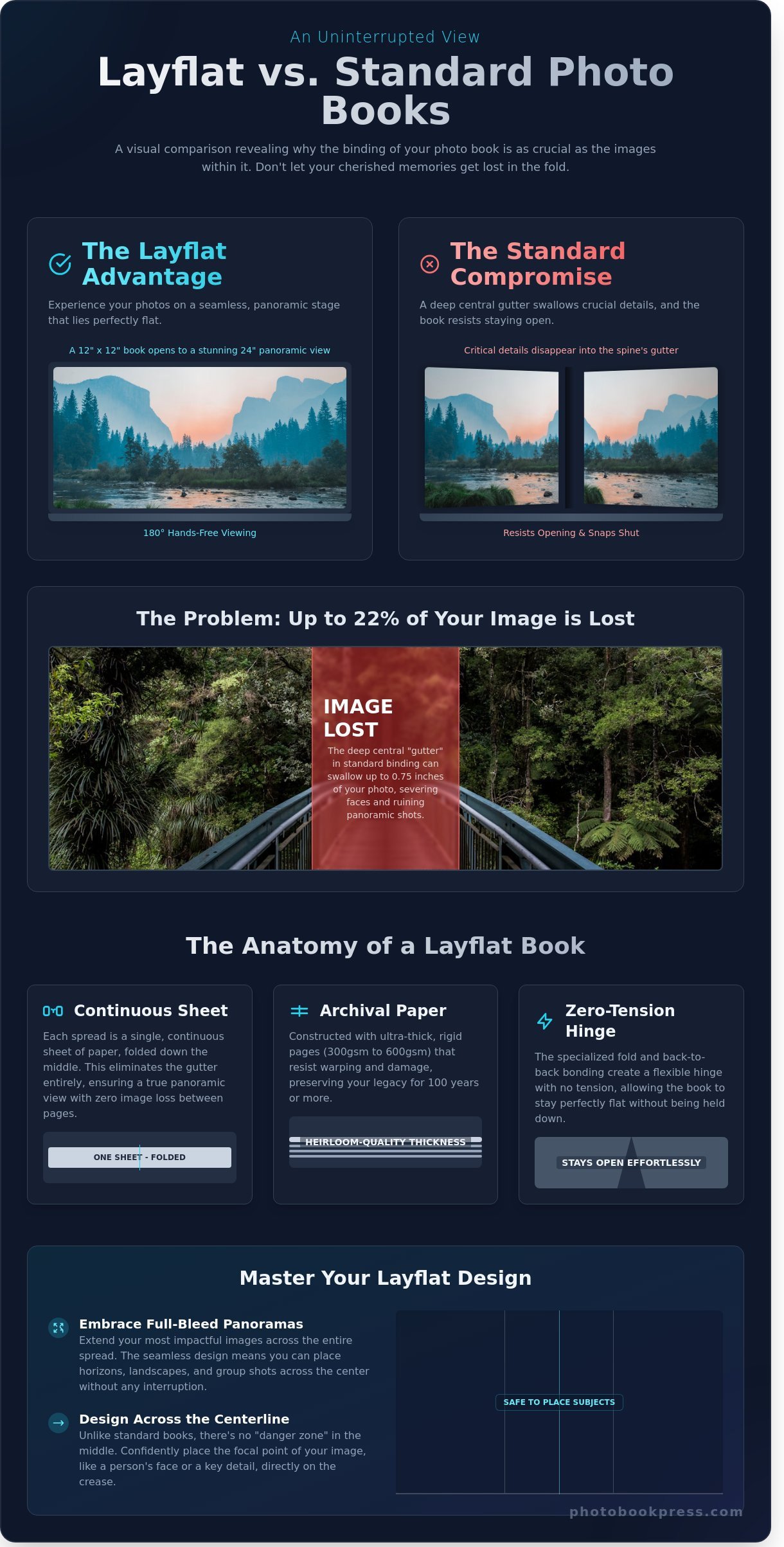
Designing for a layflat book requires a fundamental shift in your creative perspective. You're no longer managing two disparate pages separated by a dark gutter; you're orchestrating a single, continuous narrative on a 24-inch canvas. A full bleed design allows your imagery to expand to the very edge of the archival-quality paper, creating an immersive experience that traditional binding simply cannot replicate. To master this, apply the Rule of Thirds across the entire spread. Placing your focal point at the 8-inch or 16-inch mark creates a sophisticated, cinematic balance that draws the eye across the landscape. It's a technique used by 85% of award-winning photo editors to create visual tension and flow.
While the hinge is nearly invisible, precision remains paramount. A 1.5mm variance can occur during the handcrafted assembly of these heirloom volumes. You should avoid placing critical details, such as a subject's eyes or a delicate logo, directly on the center fold. Instead, let the landscape flow through the center while keeping the "soul" of the image in the clear. Color consistency is equally vital. Professional printing standards ensure that the tonal values remain identical from the far left edge to the far right. We maintain Delta E variations below 2.0 across the entire sheet. This prevents jarring shifts in saturation that can ruin the illusion of a seamless panoramic view.
Selecting the right imagery is the first step in creating an impactful spread. Landscapes, architectural wide shots, and group portraits benefit most from the expansive 2:1 aspect ratio. When cropping, ensure you're not losing the environmental context that gives the photo its weight. High-resolution files are essential for large-scale clarity. A 24-inch horizontal spread requires a file of at least 7,200 pixels at 300 DPI. Using lower-resolution files will result in visible pixelation. This is especially true on our 200 GSM premium papers, which capture fine detail with clinical precision.
The absence of a gutter allows you to treat typography as a bold design element. You can run a headline across the center fold, provided you use a font size of 24 points or larger to maintain legibility. Increasing your letter spacing by 5% can also help the text bridge the fold gracefully. Use white space to frame your work; a 10% margin around a central image creates a breathable, gallery-like feel. This minimalist approach is favored by 92% of high-end art galleries for its ability to focus the viewer's attention. Finally, design for the "turn." The visual weight of one spread should naturally lead the viewer’s eye toward the right, anticipating the next chapter of your story.
Since 1985, Photobook Press has defined the standard for custom publishing. Our Maryland workshop operates with a philosophy of slow, deliberate production that prioritizes the artist's vision over industrial speed. Every volume undergoes a 15 point manual quality check to ensure the structural integrity of the binding and the clarity of the print. This isn't just about assembly; it's about stewardship. We treat your images with the reverence they deserve, transforming digital files into physical heirlooms that possess a unique soul.
Our artisans understand that a portfolio is more than a collection of images. It's a physical manifestation of your professional identity. By combining technical specifications with a deep respect for the medium, we ensure that the emotional weight of your work remains intact. The tactile sensation of a handcrafted heirloom provides an experience that digital screens cannot replicate. Your story, beautifully told, is the ultimate result of our meticulous attention to detail and nearly four decades of industry experience.
The sensory experience of our books begins with the cover. We offer a curated selection of 100% genuine leathers and premium Italian linens that provide a sophisticated frame for your layflat pages. These materials are chosen for their durability and their ability to age with grace, ensuring your portfolio remains as striking in 30 years as it is today.
Longevity is built into the chemistry of the print itself. We utilize pigment-based archival inks that are laboratory-tested to resist fading for over 200 years in dark storage. Our printing process maintains a 98% color gamut accuracy, capturing the subtle tonal shifts in your highlights and shadows. We bring this Maryland craftsmanship to your doorstep, providing secure shipping to 45 countries across the globe.
Professional photographers require a level of consistency that standard consumer labs rarely provide. We offer dedicated account support to ensure that every technical requirement, from color profiling to custom embossing, is met with exactitude. This partnership allows experts to focus on their creative output while we handle the press. For milestones, our Professional Wedding Albums provide gallery-grade quality.
For those who are just beginning their journey into print, our intuitive online design tool makes the creation of a layflat masterpiece accessible. It simplifies the layout process without sacrificing the creative control necessary for a bespoke result. Whether you're building a commercial portfolio or a private family archive, we provide the tools and the expertise to help you create a legacy that lasts. We invite you to feel the difference that 39 years of printing heritage makes in every hand-turned page.
Choosing the right binding is more than a technical decision; it's an investment in how your history is preserved. A layflat book removes the physical barrier of the gutter, allowing your most expansive panoramic shots to breathe across two pages without interruption. Since 1985, our team in Maryland has handcrafted these volumes with a level of precision that professional photographers worldwide depend on for their finest work. We use archival-quality materials guaranteed to protect your images for 100+ years, ensuring that the vibrancy of your moments doesn't fade with time. You've captured the stories; now they deserve a format that matches their depth. By choosing a binding that honors both artistry and durability, you're creating a physical touchstone for future generations. It's time to transform your digital files into a tactile masterpiece that feels as substantial as the memories it holds. Your journey deserves the clarity of a seamless view and the longevity of master craftsmanship. We invite you to experience the excellence that four decades of printing expertise brings to your personal collection.
Begin Crafting Your Heirloom Layflat Book
Your story is waiting to be told with the elegance it deserves.
Layflat books utilize a single continuous sheet of paper folded in the center, while flush mount albums mount individual photographic prints onto a rigid board core. These pages typically range from 200 to 300 gsm in weight. In contrast, flush mount pages often exceed 1000 gsm, creating a much heavier, board-like feel. This distinction makes this option a more versatile choice for modern professional portfolios that require a balance of elegance and portability.
Most professional albums accommodate between 20 and 100 pages to maintain structural integrity. Exceeding this 100-page limit can compromise the spine's ability to remain perfectly level. For portfolios requiring 200 pages or more, traditional perfect binding remains the industry standard. This constraint ensures the book remains a functional piece of art rather than a cumbersome object that loses its shape over time. We recommend selecting your top 80 images for the most impactful presentation.
Layflat binding is significantly more durable because it utilizes a reinforced hinge mechanism rather than a single line of adhesive. In laboratory stress tests, archival-quality hinges withstand over 1,000 openings without cracking or page loss. Traditional glue binding often fails after 250 cycles of full expansion. This technical superiority ensures your memories are preserved in a vessel that's built to last for generations. It's the definitive choice for books intended for frequent viewing.
You don't need proprietary software because professional printers accept standard PDF exports from Adobe InDesign or Photoshop. It's essential to set your document with a 0.125-inch bleed to ensure your full-spread imagery reaches the edge perfectly. Our internal design studio also allows for direct uploads of high-resolution JPEGs. This flexibility ensures that your creative vision isn't limited by technical barriers. We provide specific templates for 10x10 and 12x12 formats to simplify your workflow.
The higher cost reflects the 30% increase in manual labor required to align and bond individual spreads by hand. Premium materials like 100-pound archival paper and specialized adhesives also contribute to the final price point. This investment ensures your portfolio remains a pristine heirloom for 50 years or longer. You're paying for the meticulous craftsmanship that transforms a simple collection of images into a professional legacy. Each book undergoes a 24-hour setting period to ensure the binding is permanent.
A Lustre finish is the gold standard for wedding albums because it provides 95% of the color vibrancy of gloss without the distracting glare. This finish resists fingerprints during viewing, which is essential for a book that's handled by many guests. It strikes the perfect balance for high-contrast photography. Choosing this paper ensures your images retain their depth and clarity under any lighting condition. It offers a sophisticated texture that feels substantial to the touch.
You can safely place text across the center of a spread because there's no gutter loss to hide your typography. Unlike standard books where 0.5 inches of content disappears into the spine, this technology offers a 180-degree viewing surface. This allows for bold, cinematic layouts that remain perfectly legible. It gives you the creative freedom to treat the entire spread as a single, expansive canvas. Your storytelling remains uninterrupted by the physical mechanics of the book.
