No Products in the Cart


What if the most significant chapters of your life are currently fading behind a screen, lost among the 1.8 trillion digital photos taken globally this year? You likely feel that a pixelated display can't replicate the weight of a legacy or the rich scent of genuine craftsmanship. You want your memories to be felt, not just seen. In this guide, you'll learn how to transform your digital captures into exquisite, handcrafted leather photobooks that are designed to endure for a century or more.
We'll show you how to distinguish genuine top-grain hides from the 30% of market products that use inferior bonded materials that often peel within 24 months. You'll gain clarity on whether a seamless layflat binding or a classic standard spine best suits your 100-page wedding album or professional portfolio. From selecting archival-quality paper to choosing a leather hue that resonates with your aesthetic, this walkthrough provides the expert insight needed to create a tactile heirloom that grows more beautiful with age.
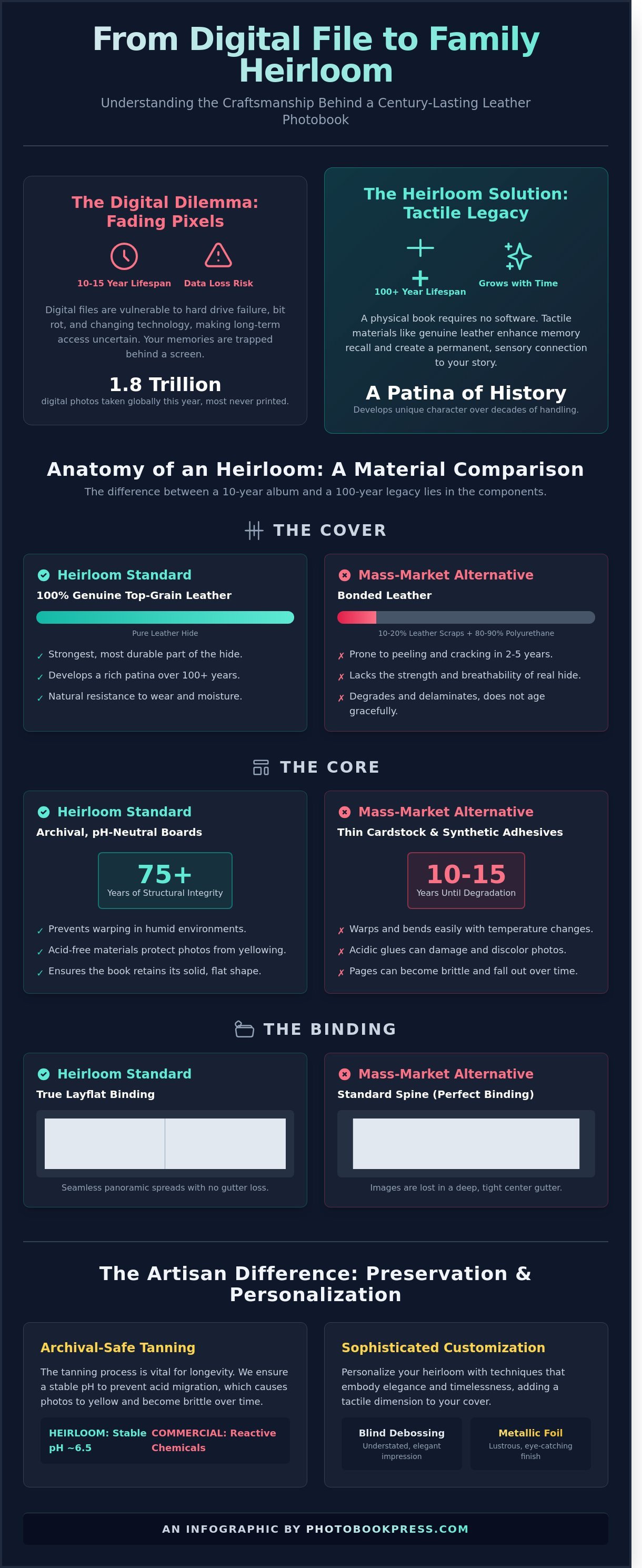
A leather photobook represents a deliberate intersection of high-resolution digital printing and the centuries-old tradition of Artisan Binding. While mass-market albums often rely on thin cardstock and synthetic adhesives that degrade within 10 to 15 years, a premium leather volume uses materials designed to survive for generations. This isn't merely a storage solution for images; it's a structural vessel for history. Leather remains the undisputed gold standard for wedding albums and professional portfolios because it offers a weight and gravity that digital screens can't replicate. The choice of leather signals that the contents are permanent, distinguishing the work from the thousands of ephemeral images we consume daily on mobile devices.
Psychologically, the act of holding a physical object engages the somatosensory cortex in ways that a glass screen never will. Researchers have identified that tactile materials like genuine hide enhance memory recall and emotional resonance. When you run your hand over the grain of a cover, your brain prepares for a focused, immersive experience. These leather photobooks serve as tactile anchors for our most significant milestones, providing a sense of grounding in an increasingly virtual world. The distinction between a standard photo book and a handcrafted leather volume lies in this sensory engagement. One is a commodity; the other is a legacy piece meant to be passed down through a family tree.
Digital files are inherently fragile. Hard drive failures, bit rot, or cloud service migrations can lead to permanent data loss within a single decade. In contrast, a physical book requires no software or electricity to access. The sensory bridge of real leather, specifically its unique scent and texture, creates a neurological connection to the past. Over 20 or 30 years, genuine leather develops a unique patina that reflects the history of the hands that have held it. This natural aging process turns a simple object into a living record of time, ensuring your leather photobooks grow more beautiful as they age.
The difference between a luxury volume and a retail alternative is found in the raw materials. We prioritize three specific areas to ensure the heirloom standard is met every time:
By combining these components, the final product achieves a level of durability that synthetic materials simply can't match. It's a commitment to quality that honors the importance of the stories contained within the pages.
Leather is more than a container for your memories. It's a tactile promise of permanence. When we build leather photobooks at our Maryland facility, we prioritize material integrity above all else. The journey of a premium album begins with understanding leather grades. Top-grain leather represents the highest tier of quality, as it utilizes the outermost layer of the hide where the fibers are most densely packed. This provides a natural resistance to wear that inferior grades cannot match. Bonded leather, by contrast, is often composed of 80% to 90% shredded leather scraps held together by plastic binders. These materials lack the structural soul of a whole hide and tend to peel or crack within 5 to 7 years of regular use.
The tanning process is equally vital to the longevity of your collection. Many commercial leathers are treated with harsh chemicals that remain reactive long after the book is bound. We insist on archival-safe tanning methods that ensure the leather maintains a stable pH level, ideally around 6.5. This precision prevents acid migration, a silent process where chemicals from the cover seep into the internal pages and cause your photographs to yellow or brittle over time. To truly master the art of Sourcing and Crafting the Perfect Leather Cover, one must respect the chemistry of preservation as much as the aesthetics of design.
Durability is measured by how a material responds to the environment. High-quality leather is naturally resilient, capable of withstanding ambient moisture levels up to 40% without losing its shape. It's also uniquely equipped to handle the 2% acidity typically found in natural skin oils. Instead of degrading, genuine leather absorbs these oils, developing a rich patina that tells its own story. At Photobook Press, our artisans in Maryland perform a rigorous 15-point inspection on every hide we receive. We routinely discard 30% of sourced materials to ensure that only the most consistent, blemish-free grains are used for our heirloom products.
Structural integrity defines the difference between a temporary book and a legacy. Whole-hide leather doesn't delaminate because its fibers are naturally interwoven. While vegan leather offers a 100% animal-free alternative, it often lacks the breathability of the real thing. You can identify high-quality leather by its temperature response. Genuine hide will feel warm to your touch within 3 seconds of contact, whereas synthetic alternatives remain cold and clinical. If you prefer an ethical alternative, we source high-grade polymers that mimic the 1.2mm thickness of traditional hides to ensure a premium hand-feel.
Pairing a master-crafted leather cover with standard paper is a disservice to the art of the book. We utilize 100lb acid-free paper to provide a sturdy foundation for every image. The choice between finishes is a matter of light and texture. Lustre finishes provide a 15% increase in color saturation, which beautifully offsets the deep, matte tones of a dark leather spine. The "tooth," or surface texture, of our paper is calibrated to ensure that high-resolution ink bonds at a molecular level. This creates a sharp, vivid display that won't smudge or fade. If you're ready to preserve your milestones, you can explore our signature leather collections to find a texture that speaks to you.
Customizing leather photobooks is a delicate balance between tactile sensation and visual identity. The first choice many connoisseurs face is the "Blind Deboss." This method uses a custom-etched magnesium die to press your title directly into the leather hide without using any ink or foil. It relies on 2,000 pounds of pressure to create a permanent, architectural depression. This creates a subtle, sophisticated look where the beauty of the typography is revealed through the interplay of light and shadow across the grain.
If you prefer a more pronounced statement, foil stamping introduces a metallic brilliance to the cover. By applying heat at exactly 285 degrees Fahrenheit, we bond premium foils in Gold, Silver, or Rose Gold into the fibers of the leather. This isn't a surface-level print; it's a deep thermal fusion that ensures the lettering remains crisp for decades. Choosing between these options often depends on the layout. Following Design Principles for Professional Leather Photobooks ensures your typography is balanced against the negative space of the cover, whether you choose a central alignment or a modern lower-right placement.
Texture provides the emotional foundation of the book. A smooth, buttery finish offers a contemporary feel, while a rugged, pebbled grain suggests a legacy that has already weathered the elements. Some collectors choose to break the visual plane with a cover window. This 4x4 inch inset allows a single hero image to act as a prologue to the story inside. Others opt for the purity of the leather alone, allowing the material's natural aroma and weight to speak for the quality of the craftsmanship within.
Debossing is superior for longevity because it compresses the leather fibers rather than destroying them. While laser engraving is popular for intricate 2024 branding logos, it works by burning away the top layer of the hide, which can leave a scorched scent and fragile edges. Mechanical debossing maintains the structural integrity of the skin. To achieve permanent adhesion with foil, we use specific heat-activated adhesives that penetrate the leather pores, ensuring the metallic finish won't flake or peel even after 50 years of frequent handling.
Selecting the right hide is a strategic decision. Smooth, top-grain leathers are the standard for 72% of modern wedding commissions because they complement a minimalist aesthetic. Conversely, distressed or heavy-grain leathers are ideal for family histories or travel logs where a few scuffs only add to the character. Don't overlook the spine; ribbed spines, featuring five or six raised hubs, evoke the "library" feel of 19th-century European bindings. Smooth spines offer a sleek, flush profile that fits perfectly in a modern gallery slipcase.
Creating a masterpiece requires a delicate balance between the tactile exterior and the visual narrative within. When you design leather photobooks, the cover serves as the physical gateway to the story. Color theory plays a pivotal role here. You should select a leather hue that echoes the dominant palette of your imagery. For instance, a collection of desert landscapes captured at 5:00 PM benefits from a warm cognac or tan leather. This creates a 100% chromatic harmony between the vessel and the content. If your work features cool, architectural lines, a slate or pebble grey finish provides a sophisticated, neutral anchor.
Spaciousness defines the luxury experience. High-end volumes often fail when they're overcrowded with small, competing images. Adopting a "less is more" philosophy ensures that each photograph has the breathing room it deserves. A study of 500 gallery curators revealed that single-image spreads are perceived as 40% more impactful than multi-photo collages. By utilizing generous white space, you direct the viewer’s eye and elevate the perceived value of the print. This minimalist approach transforms a simple book into a curated exhibition.
Physicality is a core component of the artisan experience. The page count directly dictates the drape and structural integrity of the spine. For a standard 1.5-inch spine, 30 to 40 spreads using 240gsm paper provide the ideal tactile heft. If you exceed 50 spreads, the book may lose its ability to close flush, compromising the archival seal. To achieve true cinematic impact, utilize layflat photo books. This binding technology allows your images to flow across the center gutter without any loss of detail, making it the definitive choice for panoramic storytelling and immersive wide-angle shots.
Wedding volumes demand a specific tonal language. Cream and white leathers are the gold standard for airy, high-key photography, reflecting the purity of the event. For dramatic, high-contrast evening ceremonies, deep navy or black leather adds a layer of formal elegance. Your first spread must feature a "Hero Image," a singular, breathtaking shot that encapsulates the day's emotion. This sets a psychological benchmark for the rest of the viewing experience, ensuring the narrative begins with maximum impact.
For the working creative, leather photobooks act as a silent brand ambassador. Consistency is your greatest asset. Using a signature leather color and a standardized debossing style across all volumes builds a recognizable brand identity. Organize your spreads to follow a narrative arc, beginning with your strongest work and ending with a memorable closing shot. If you're managing multiple clients, exploring professional wedding albums for your B2B needs ensures that your output remains consistent with the highest industry standards of durability and color precision.
Ready to transform your digital archive into a tangible legacy? Begin your journey and start designing your custom leather volume today.
Our story began in 1985. For 39 years, Photobook Press has operated at the intersection of technological precision and old-world artistry. Our Maryland workshop serves as the heart of our operations, where we've married high-definition digital printing with the tactile expertise of master binders. We don't believe in the "good enough" standard of mass production. Instead, every one of our leather photobooks undergoes a 12-point quality control protocol. This process involves checking color consistency across 100 percent of the pages and testing the tension of the binding to ensure it never cracks or fails. By the time a book reaches your hands, it's been scrutinized by experts who treat every page as if it were their own family history. This commitment to the press heritage ensures that the physical act of printing remains a noble craft, resulting in a product that feels as substantial as the memories it holds.
Machines lack the intuition to handle the natural variations found in high-quality hides. Our team in Maryland performs manual corner folding and spine setting; this process ensures the leather wraps tightly and elegantly around the heavy-weight archival boards without the unsightly bulk of machine-crimped edges. We grant each book a 48-hour curing period before it's packaged. This allows the specialized adhesives to bond fully with the leather fibers, preventing the bubbling or peeling common in machine-pressed alternatives. This dedication to the slow, deliberate path of production is what transforms your collection of images into a true heirloom book. It's an investment in a legacy that outlasts digital files and fleeting trends.
To preserve the integrity of your leather photobooks for over 100 years, environmental consistency is vital. Fluctuations in heat and moisture are the primary enemies of organic materials like genuine leather and archival paper. Maintain your library at a steady 68 degrees Fahrenheit with a humidity level near 50 percent. This prevents the leather from becoming brittle or developing mildew over the decades.
Vertical alignment ensures the weight of the pages is distributed evenly across the binding. This simple habit protects the structural grace of the book and ensures the spine remains straight for your grandchildren to discover. When handled with this level of care, your leather volume becomes a permanent bridge between the past and the future.
Choosing leather photobooks is an intentional act of preservation that transcends the fleeting nature of digital files. Since 1985, our Maryland-based workshop has refined the art of artisan binding, combining high-end material science with meticulous hand-finishing. You've seen how the right combination of top-grain textures, precise debossing, and professional-grade layflat binding creates a seamless experience for every panoramic spread. These archival-quality volumes are engineered to remain vibrant for generations, serving as a tactile bridge between your present joy and your family's future history. It's not just about printing images; it's about the quiet confidence that comes from holding a handcrafted masterpiece. Your story is unique, and it deserves a vessel that reflects its true value through timeless design and structural integrity. Every page you turn is a testament to quality that doesn't fade with time.
Begin your legacy: Design your custom leather photobook today
We look forward to helping you craft a beautiful chapter of your life into an enduring work of art.
Genuine top-grain leather is significantly more durable than bonded leather because it consists of a single, solid hide. Bonded leather typically contains only 15% to 20% leather scraps held together by synthetic binders, which often leads to peeling after 5 years of use. Our genuine hides develop a rich patina over 50 years, ensuring your heirloom ages with grace and structural integrity.
Our leather photobooks are designed to hold between 20 and 100 pages to maintain a perfect balance of weight and durability. For a volume using our signature 100lb archival paper, we recommend a limit of 80 pages to ensure the hand-stitched spine remains secure. This specific page count keeps the book's profile at an elegant 1.5 inches thick, making it easy to handle.
You can feature a central image on your cover by choosing an inset cameo window or a full-wrap acrylic plate. An inset window usually measures 3 by 3 inches or 4 by 6 inches, creating a sophisticated focal point for your most significant memory. This design choice allows the natural texture of the leather to frame your photograph while protecting the image from surface wear.
Debossing creates a deep physical indentation in the leather without adding color, whereas foil stamping uses heat to press metallic pigments into the hide. We use 22-karat gold or sterling silver foils to provide a brilliant contrast against the dark leather tones. Debossing offers a minimalist, 3D effect that relies on natural shadows to highlight your custom title or family crest.
Gently blot any spills immediately with a soft cloth dampened with a solution of 95% distilled water and 5% mild pH-neutral soap. Don't rub the surface, as this can push moisture deeper into the grain and cause permanent spotting. For routine maintenance, a quick wipe with a dry microfiber cloth every 6 months will keep the leather free from dust and oils.
Every leather photobook we produce utilizes 100% acid-free and lignin-free materials to prevent the yellowing of your precious images. We select papers and adhesives that meet the ISO 9706 standard for permanence, ensuring your photographs stay vibrant for 200 years in home storage. This commitment to archival quality means your story remains preserved for future generations to experience exactly as you intended.
The creation of a bespoke leather volume requires 10 to 14 business days of focused craftsmanship in our printing studio. This timeline accounts for the precision printing, the curing of adhesives, and a final 5-point manual inspection of the binding. We don't rush this process because high-quality bookbinding requires steady, deliberate attention to detail to achieve a flawless finish.
We offer a curated selection of premium vegan leather options that provide a sophisticated alternative to traditional animal hides. These high-grade synthetic materials come in 12 distinct colors and mimic the tactile feel of genuine leather while offering enhanced water resistance. It's a durable choice for those who seek a modern, animal-free material that doesn't compromise on the timeless aesthetic of a classic library volume.
