No Products in the Cart


Your digital photo library is a beautiful, fragile illusion. It's an anxiety many of us share: the fear that a corrupted drive could erase a decade of memories. In an era of fleeting digital moments, the modern photo album has reemerged not as a relic, but as an essential act of preservation. It’s the definitive way to ensure your story endures, tangible and timeless.
Before you can begin curating, you need a complete collection. For major events like weddings, gathering photos from every guest can be a significant challenge. Using a dedicated platform to streamline this process is a modern solution; for instance, Gatherpix helps you effortlessly collect and organize all your guest photos in one place, creating the perfect digital starting point for your album project.
We understand the hesitation that comes with creating something so important. You worry about flimsy paper, overwhelming design software, and colors that don't translate from screen to print. This guide is our promise to you. We will show you how to transform your digital archives into a sophisticated, museum-quality heirloom that feels as substantial as the memories it holds. From selecting archival-grade materials to achieving perfect color fidelity, this is your definitive map to creating a legacy piece with confidence.
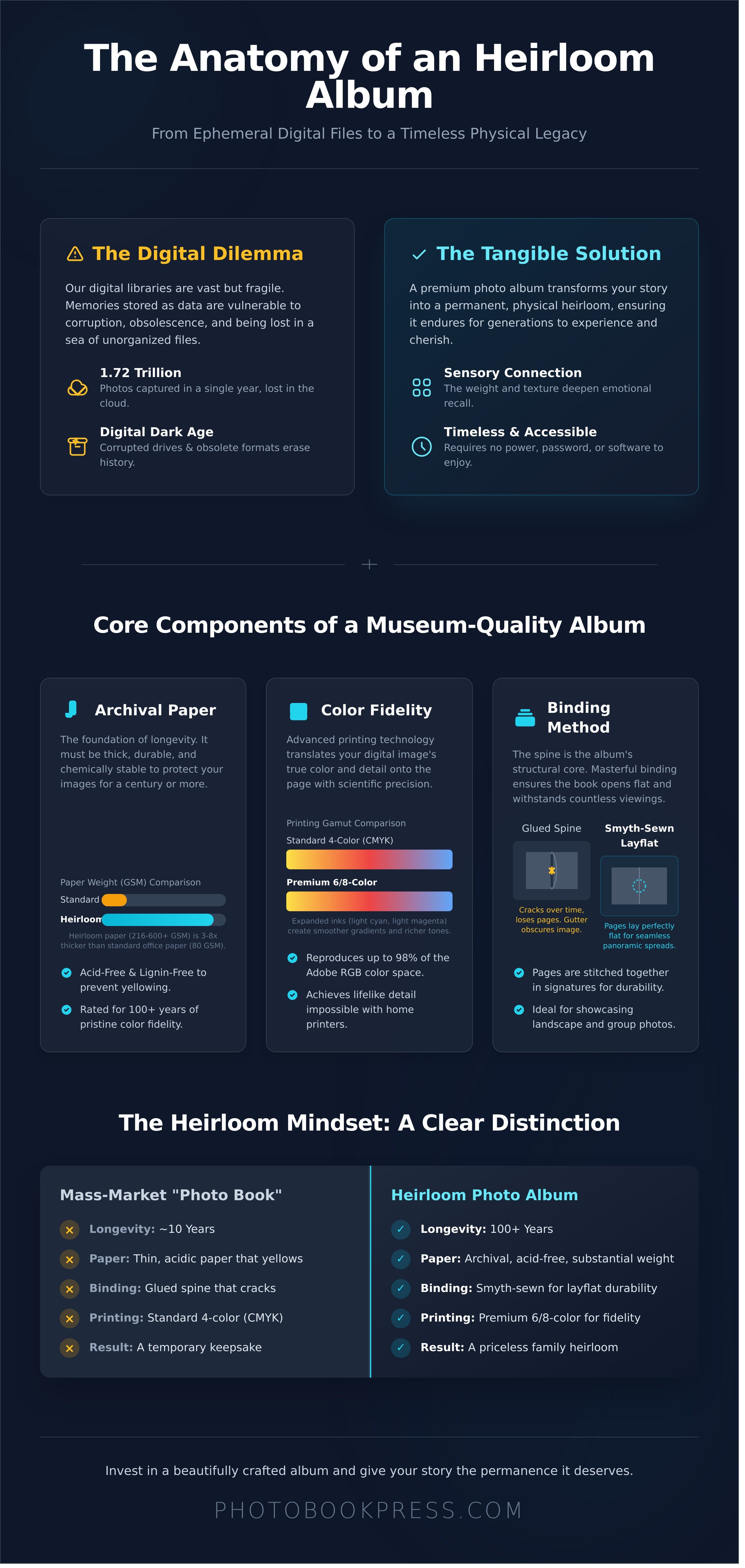
We live in an age of photographic paradox. In 2023 alone, humanity captured an estimated 1.72 trillion images, yet our most cherished memories feel increasingly ephemeral. Lost in a digital cloud of countless duplicates and forgotten files, our stories risk becoming mere data points. This digital deluge creates a profound need for something tangible, something real. It’s why the meticulously crafted, physical photo album is experiencing a powerful resurgence, not as a relic of the past, but as an essential anchor for our future.
The act of turning a page engages the senses in a way a screen never can. The subtle texture of archival paper, the satisfying weight of the book, and the uninterrupted visual narrative trigger deeper emotional and neurological responses. Studies in cognitive psychology consistently show that information presented in a physical format is more readily absorbed and recalled. When you hold your history in your hands, you don't just see a memory; you feel its permanence.
More critically, a handcrafted album is the ultimate safeguard against the ‘Digital Dark Age.’ We’ve already seen generations of memories vanish with obsolete technology. Think of the 3.5-inch floppy disks, the corrupted hard drives from 2010, or the proprietary file formats from defunct cloud services. While the digital age certainly transformed the long history of the photo album, it also revealed the fragility of purely digital archives. An archival-quality print, however, requires no software, no password, and no power to tell its story a century from now. It is a testament to the quiet rebellion of the 'Slow Tech' movement, a conscious choice to invest in artifacts that offer lasting value and a respite from the relentless pace of digital life.
An heirloom is defined by its ability to transcend a single lifetime. It’s an asset crafted from archival-quality materials, with lay-flat Smyth-sewn binding and inks rated for 100+ years of fidelity. This stands in stark contrast to mass-market "photo books" with glued spines that crack and acidic papers that yellow within a decade. The modern archivist understands this distinction, choosing to curate a single, exquisite photo album over hoarding ten thousand unorganized files.
A premium album is more than a container for memories; it is a piece of bespoke art for your home. Displayed on a coffee table or bookshelf, its cover of Belgian Linen or top-grain Italian leather becomes a sophisticated design element that complements your aesthetic. It serves as an elegant and inviting centerpiece, sparking conversation and connection in a way no digital gallery ever could. It silently invites guests to discover the story of the people who live there.
A true heirloom is defined not just by the memories it holds, but by the physical form that protects them. While any collection of pictures can be a book, a premium photo album is an object of art, meticulously engineered to endure for generations. Its longevity is a direct result of deliberate choices in materials and the time-honored traditions of master bookmakers. It all begins with the very pages that will carry your story.
The foundation of a lasting album is its paper. We insist on archival-quality sheets that are both acid-free and lignin-free. Lignin, a natural polymer in wood pulp, is the primary culprit behind the yellowing and brittleness you see in old newspapers. By using purified pulps, we ensure the pages remain pristine for over a century. This commitment to material science aligns with professional guidance on how to properly preserve family archives, ensuring your photographs are shielded from chemical decay. The paper’s weight, measured in Grams per Square Meter (GSM), dictates its substantial, luxurious feel. While standard office paper is a flimsy 80 GSM, our pages start at 216 GSM and go up to a rigid 600+ GSM for mounted lay-flat designs, providing a satisfying heft with every turn.
Color fidelity is where art meets science. Standard 4-color (CMYK) printing can suffice for everyday documents, but it cannot capture the subtle gradients of a sunset or the precise tonality of professional portraiture. Our presses utilize 6-color and 8-color printing, adding light cyan, light magenta, and multiple blacks to the mix. This expanded gamut reproduces up to 98% of the Adobe RGB color space, resulting in richer tones and lifelike detail that a home-office inkjet simply cannot match. This is the heritage of the press: a commitment to mechanical precision for the sake of visual poetry.
The structural integrity of your album rests in its spine. We employ Smyth-sewn binding, a classic technique where pages are folded into signatures and stitched together with thread. This method allows the book to lay perfectly flat, preventing gutter loss and ensuring panoramic spreads are seamless. Unlike common adhesive bindings that can dry out and crack within 15-20 years, a Smyth-sewn spine is built to last a lifetime, flexing gracefully without stress.
The cover is the first point of contact, a tactile introduction to the story within. We offer materials chosen for both their beauty and resilience. Genuine Italian leather develops a rich patina over time, its character deepening with age. For a softer, more textural experience, our refined linens and silks provide a warm, inviting feel. Each cover is finished with a discreet UV coating, offering crucial protection against the fading effects of ambient light and ensuring its color remains true for decades.
Every material, every stitch, and every drop of ink is a conscious decision designed to honor your memories. Exploring our curated material options is the first step toward creating a truly personal and permanent home for your most cherished moments.
The vessel that holds your story is as integral as the photographs themselves. The weight, texture, and construction of your album dictate the rhythm of the viewing experience, transforming a collection of images into a tangible narrative. Your choice of format isn't merely a matter of preference; it's a curatorial decision that aligns the physical object with the emotional weight of its contents. From the revolutionary sweep of a layflat design to the timeless gravitas of traditional leather, each format offers a distinct language for your memories.
For images that demand an uninterrupted canvas, the layflat format is unparalleled. Its defining feature is the seamless center fold, where each two-page spread is printed as a single, continuous sheet and mounted on a rigid substrate. This completely eliminates the "gutter" or visual break found in traditional binding, allowing your most expansive photographs-sweeping wedding party portraits, dramatic landscapes, and precise architectural studies-to flow across the spread with cinematic impact.
For milestone collections like a family yearbook or a travel retrospective, the classic hardcover offers a perfect balance of prestige and durability. Its sturdy, library-quality construction ensures your memories are protected for generations, presenting your work with a clean, professional finish.
When only the most classic aesthetic will suffice, a traditional leather-bound photo album stands as the ultimate heirloom. Its rich, tactile appeal speaks to a legacy of craftsmanship, making it the definitive choice for a multi-generational family history or a golden anniversary celebration. This connection to classic bookbinding reflects the deep roots of the medium itself; a fascinating journey detailed in The History of the Photo Album, which traces its origins to Victorian-era parlors. A leather album isn't just a book; it's a testament to enduring love and a piece of family history in the making.
The physical dimensions of your album directly influence its narrative power. A large-format 12x12 inch book makes a commanding statement on a coffee table, giving key images breathtaking prominence. In contrast, a more intimate 8x8 inch format invites closer inspection, creating a personal and cherished experience. Consider the source of your images and match the album's orientation-landscape, portrait, or square-to the dominant format of your photography for a truly cohesive design.
Finally, consider the scope of your story when selecting a page count. A tightly curated narrative, such as a weekend getaway or a newborn's first year, finds its perfect home within 20 to 40 archival-quality pages. A more comprehensive event, like a wedding day from start to finish, often requires the expansive canvas of 70 to 100 pages to breathe and unfold naturally. The right number of pages ensures your story feels complete, never rushed or padded.
Transforming a collection of images into a cohesive, heirloom-quality photo album is an act of artistry. It requires more than just good photographs; it demands the discerning eye of a curator. This is where your story takes its final, tangible form. The process is meticulous, moving from a vast digital archive to a beautifully paced, printed narrative. Here is the five-step framework our master printers recommend for designing with intention.
Step 1: The Meticulous Cull. A great story isn't about showing everything. It's about showing the right things. The first task is to distill your collection. To reduce a gallery of 500 images to the essential 50, we suggest a three-pass system. Your first pass eliminates technical flaws: any image that is out of focus, poorly exposed, or has distracting elements. The second pass removes redundancies. Choose the single best shot from a series of near-duplicates. The final, most crucial pass is for narrative. Does this image move the story forward? If the answer isn't a firm yes, set it aside. This 90% reduction is the foundation of a powerful visual edit.
Step 2: Establish a Narrative Flow. With your curated selection, you can now build the narrative. A chronological sequence is classic for events like weddings or travels, guiding the viewer from start to finish. For a more evocative approach, consider organizing by emotion. Group all the quiet, contemplative moments together, followed by a chapter of pure joy. An even more sophisticated method is to sequence by color palette, creating spreads that feel harmonized and intentional, where the tones of one image bleed gracefully into the next.
Your most powerful image, the 'Hero Shot,' deserves its own stage. Give it a full, uninterrupted two-page spread to maximize its impact. For quieter, candid moments, group three to five images together to create a mosaic of feeling. This technique builds emotional resonance. Always remember to use 'breathing room' or white space, dedicating at least 30% of a spread to negative space to enhance the sophistication and draw the eye where it matters most.
Step 3: Master the Art of White Space. In premium book design, what you don't include is as important as what you do. White space, or negative space, is the quiet pause in your visual symphony. It gives each photograph the prominence it deserves, preventing sensory overload and creating a refined, gallery-like experience. A cluttered page shouts; a well-spaced page speaks with confidence.
Step 4: Refined Typography. If you choose to include text, treat it as a subtle anchor, not the main event. A classic serif font like Garamond for a date or location, paired with a clean sans-serif like Helvetica Neue for a brief caption, adds context without competing with the imagery. Keep text size small, typically between 8 and 10 points, and place it discreetly in a corner or beneath an image.
The most frequent error we see is overcrowding pages, which diminishes the value of every photo. Remember, less is more. Another critical issue is ignoring low-resolution warnings; every image destined for print must have a resolution of 300 DPI (dots per inch) at its final size to ensure sharp, clear results. Finally, avoid clashing colors on a single spread. A consistent aesthetic maintains the immersive quality of your volume.
Step 5: The Final Technical Review. Before sending your project to press, a final check is essential. Confirm every image is 300 DPI. Verify your design includes a standard 0.125-inch (3mm) bleed on all outer edges, ensuring your images extend to the very edge of the page after trimming. Lastly, check that all crucial elements, like text or important parts of a photo, are within the safe zone, typically 0.25 inches from the trim line, to avoid being cut off. This final, careful review ensures your vision is executed flawlessly.
Once your design is perfected, it deserves to be printed with uncompromising quality. Explore our archival-quality papers and signature lay-flat binding to give your story the permanence it deserves.
You've meticulously curated your photographs, weaving them into a narrative that speaks volumes. Now, the final chapter of this creative journey begins: transforming your collection into a tangible heirloom. A story as personal as yours deserves a home built with intention and artistry. At Photobook Press, we don't just print pictures; we honor them.
Our legacy in the art of the press began in 1985, long before the digital age redefined photography. We carry forward a deep-seated respect for the printed page, blending decades of traditional bookbinding wisdom with the precision of modern technology. Every volume we create is a testament to this heritage. Inside our Maryland facility, a dedicated team of artisans brings each project to life. This isn't an automated assembly line. It's a studio where master printers and bookbinders meticulously oversee every stage, from color calibration on our HP Indigo presses to the final, hand-finished spine.
We believe that professional-grade materials are not a luxury, but a necessity for preserving memories. That's why we make them accessible to every storyteller. Your images will be printed on archival-quality papers, like our substantial Mohawk Superfine Eggshell, chosen for its rich texture and exceptional color fidelity. For your cover, you might select a supple genuine leather sourced from Italy or a fine, tactile linen. This commitment ensures your custom photo album will not only look exquisite but will endure for generations. Our standards were born from serving the most demanding professional photographers, and we extend that same uncompromising quality to you.
Our unique approach marries the world’s most advanced digital printing for unparalleled clarity with the time-honored craft of manual binding. This fusion ensures every page turn is a seamless experience, with lay-flat spreads that honor your panoramic shots. With a curated library of archival papers and genuine materials at your fingertips, and direct access to our print experts for guidance, your vision is never compromised. It's simply perfected.
Crafting your heirloom is a graceful and intuitive process with our online design studio. The tools are powerful yet simple, allowing your creativity to flow uninterrupted. Once your design is complete, our artisans get to work, and we ship your finished masterpiece anywhere in the world. Your story is waiting to be held. Design your custom photo album with Photobook Press and give your memories the permanent home they deserve.
Digital files are fleeting, but a tangible collection of memories is a powerful legacy. We've learned that the true value lies not just in selecting your images but in the intentional curation of your story and the choice of superior materials that honor it. A well-crafted photo album transforms your most cherished moments into a timeless artifact, a piece of your history that can be held and shared.
Your story deserves the finest craftsmanship. At Photobook Press, we've been dedicated to this art since 1985, meticulously handcrafting each volume in the USA. Our commitment is evident in every detail, from professional-grade layflat binding that presents your images without interruption to the archival-quality materials guaranteed to last for generations. It’s time to give your memories the permanent home they deserve.
Ready to begin? Create your heirloom photo album at Photobook Press and watch your story unfold in print. The most beautiful stories are the ones we can hold.
A photo album features true photographic prints mounted directly onto thick, rigid pages for a classic, substantial feel. In contrast, a photo book's pages are printed directly onto paper using press-printing technology, much like a high-end art book. The album offers a traditional, heirloom quality with superior image permanence, while the book provides a modern, sleek presentation for your visual narrative. The distinction is crucial for your project's final aesthetic.
Absolutely. Layflat binding is essential for images that span a full two-page spread, as it eliminates the disruptive gutter found in standard books. This allows for seamless, panoramic displays of your most impactful photographs, such as a sweeping landscape or a large family portrait. For a truly immersive storytelling experience where no detail is lost, the investment in layflat technology, which adds approximately 15-20% to the base cost, is unequivocally justified.
A well-curated photo album typically features between 60 to 80 images across 20 to 30 pages. This intentional pacing, averaging two to three photos per page, gives each image the space it deserves to resonate with the viewer. Overcrowding diminishes the impact of your story. For a milestone event like a wedding, we find that a discerning selection of 75 key moments creates the most compelling and elegant narrative.
Archival quality signifies that the materials used are chemically stable and designed for longevity, meeting ISO 9706 standards for permanence. This means our acid-free papers and pigment-based inks are certified to resist fading, discoloration, and deterioration for over 100 years under normal indoor conditions. Your photographs aren't just printed; they are preserved with museum-grade materials, ensuring your legacy remains vibrant for generations to come.
Yes, you can create a stunning album using phone photos, provided they meet our resolution standards. For an exquisite 8x10 inch print, we recommend a minimum image resolution of 2400x3000 pixels, or about 8 megapixels. Most modern smartphones, including the iPhone 12 or newer, easily exceed this. Our design software will automatically flag any images with insufficient resolution to ensure every page is impeccably sharp and clear.
The creation of your bespoke photo album is a meticulous, handcrafted process. Our standard production timeline, from your final proof approval to completion, is 7-10 business days. Following this, our standard shipping within the continental U.S. typically takes an additional 3-5 business days. We also offer an expedited service with a 4-day production time for those with more urgent deadlines. Excellence requires this dedicated time.
For the timeless elegance a wedding album demands, we recommend a Luster paper finish. It provides the ideal balance between the rich color saturation of a glossy finish and the fingerprint-resistance of matte. Luster paper, with its subtle sheen and fine texture, beautifully renders skin tones and intricate details in wedding attire. Over 90% of the professional wedding photographers we partner with select this finish for its classic, refined appearance.
Both materials offer exceptional longevity when properly cared for. Genuine leather develops a rich patina over decades, embodying a classic, heirloom tradition. Our archival-quality bookbinding linens are remarkably durable, resistant to scuffing, and offer a modern, tactile elegance. The choice is purely aesthetic. Leather provides a traditional, stately presence, while linen offers a sophisticated, contemporary feel. Both are crafted to protect your memories for a lifetime.
