No Products in the Cart


A photographer's most stunning landscape, a breathtaking panorama meant to span two full pages, is tragically lost in the deep gutter of a poorly constructed book. The colors, so vibrant on screen, appear muted and flat on the thin, glossy paper. It's a story we hear all too often, a creative vision compromised by subpar production.
The craft has transformed dramatically since its traditional press roots of the mid-1980s. The advent of sophisticated digital-offset technology has bridged the gap between mass production and bespoke quality, allowing for professional-grade monographs without the need for massive print runs. This heritage matters. A printer with a deep history in presswork understands the science of color and the archival properties of ink and paper, ensuring your book maintains its vibrancy for generations, not just years. This dedication to bespoke quality is the hallmark of specialist printers like Ambrose Press.
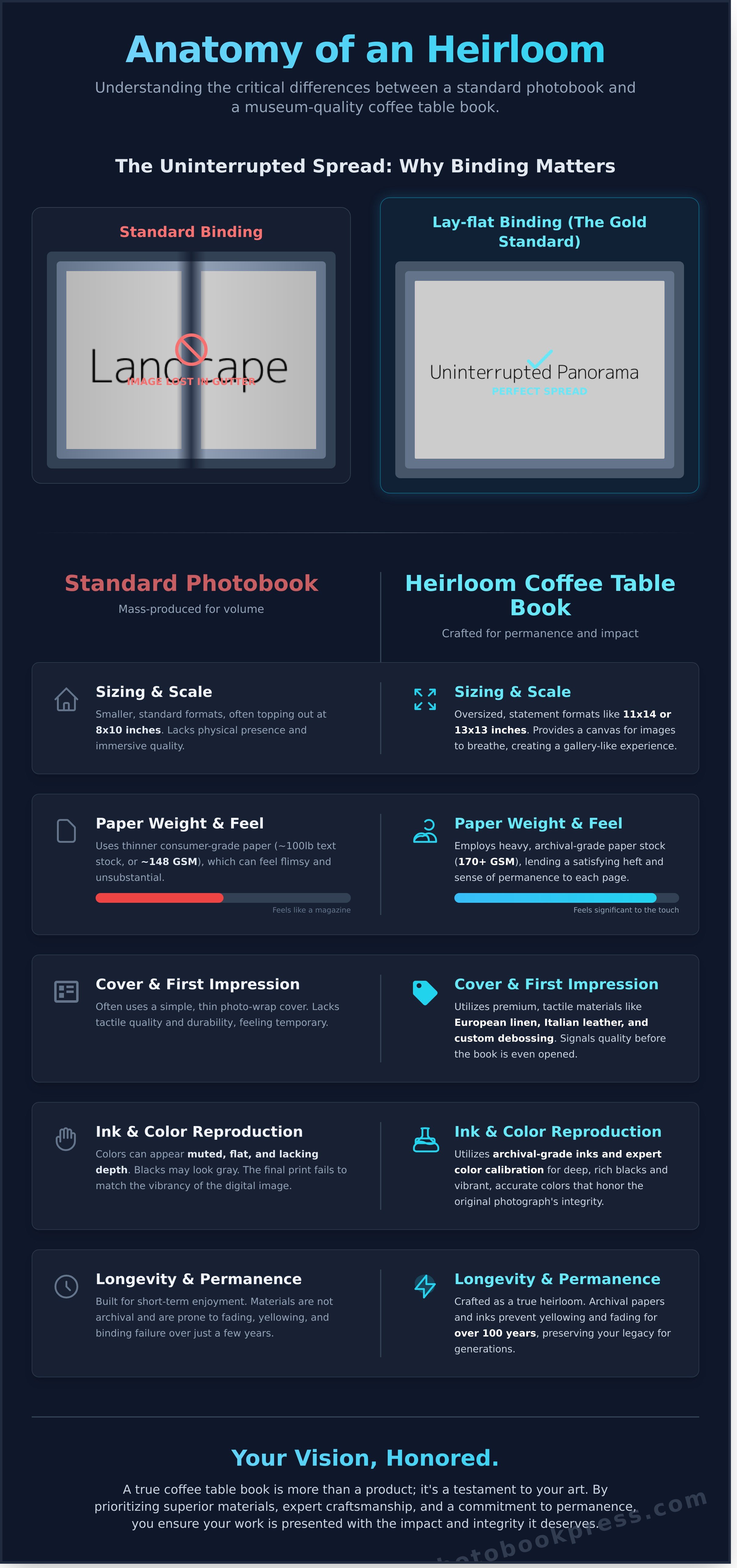
You know this disappointment. You've poured your heart into curating a collection of images, and the final printed piece should feel just as significant, a true reflection of your artistry. It should never be a compromise. This guide is your definitive resource for mastering the art of coffee table book printing. We will walk you through the precise technical standards and deliberate artistic choices required to transform your digital collection into a museum-quality heirloom, one that honors the integrity of every single photograph. From selecting archival-grade papers that prevent yellowing for over 100 years to understanding the mechanics of lay-flat binding for perfect, uninterrupted spreads, we'll cover the critical details that ensure your work endures.
A true coffee table book is not merely a collection of photographs; it is a curated experience, a piece of art designed to be displayed and explored. Its defining characteristics are its substantial, often oversized format, its deep and vibrant ink density, and its clear artistic intent. In a world saturated with fleeting digital images, a physical book offers a powerful sense of permanence. It’s an heirloom, a tangible piece of your legacy that invites connection in a way a screen never can. While the formal definition of what is a coffee table book has evolved, its core purpose remains: to make a statement through exceptional visual storytelling.
To see how these elements of paper, ink, and binding come together to create an unforgettable object, this short video offers a beautiful example:
This commitment to artistry is precisely where many mass-market "premium" books fail the gallery test. Produced for volume, their colors can appear muted, their blacks lack depth, and their bindings feel temporary. True artisan coffee table book printing is guided by a different philosophy: precision over volume. It’s a meticulous process where every decision, from paper selection to color calibration, is made to honor the integrity of your work. The goal isn't just to print a book; it's to craft a lasting testament to your vision.
The craft has transformed dramatically since its traditional press roots of the mid-1980s. The advent of sophisticated digital-offset technology has bridged the gap between mass production and bespoke quality, allowing for professional-grade monographs without the need for massive print runs. This heritage matters. A printer with a deep history in presswork understands the science of color and the archival properties of ink and paper, ensuring your book maintains its vibrancy for generations, not just years.
The distinction between a simple photobook and an exquisite coffee table book lies in the deliberate selection of superior materials. These are not subtle differences; they define the entire experience of the final product. Three key areas set them apart:
A digital file is a fleeting suggestion of an image. A printed photograph is a physical declaration. The journey from screen to page is where your art gains permanence, and the quality of that journey is defined by a precise alchemy of materials and machinery. The substance of your portfolio lies not just in the images themselves, but in the paper that holds them, the ink that gives them life, and the expert hand that guides the press.
It begins with the tactile experience of the page. Paper weight, measured in Grams per Square Meter (GSM), dictates the book's substantial feel. While standard office paper is a flimsy 80 GSM, a true portfolio demands a weight of at least 170 GSM, lending each page a deliberate, satisfying heft. The paper’s finish then sculpts the viewer's perception of your work:
What does "archival-quality" mean for your legacy in 2026 and beyond? It means your work will defy time. The primary enemy of paper is acid, which is inherent in the lignin of wood pulp. Over years, this acid breaks down the paper’s cellulose fibers, causing the familiar yellowing and brittleness. To prevent this, we use pH-neutral materials. According to ISO 9706 standards, true archival paper must be acid-free, contain an alkaline reserve to neutralize environmental acids, and resist oxidation. This commitment ensures your portfolio remains as vivid in thirty years as it is today.
Achieving perfect color is a shared responsibility between photographer and printer. Your process of using calibrated monitors and embedded ICC profiles is honored by our artisan workflow. We utilize state-of-the-art digital offset presses, which use liquid inks to replicate the dot precision and tonal richness of traditional lithography. This dedication to craft, from printing to finishing, is a holistic discipline. True Binding Excellence isn't just about the cover; it's about ensuring every component, including color fidelity, contributes to a perfect final piece. While automated AI color correction can "fix" an image to a generic standard, it can't interpret artistic intent. Our master printers perform manual quality checks, holding physical proofs next to the press to ensure the quiet mood of a dawn landscape isn't lost to an algorithm.
This meticulous process stands in stark contrast to the "gang printing" trap. Many volume printers place hundreds of different projects on a single, massive press sheet to reduce costs. The press is then calibrated for an average color balance across the entire sheet, meaning no single project receives the specific attention it requires. Your carefully balanced skin tones are compromised for the project next door. For professional coffee table book printing, this one-size-fits-all approach is unacceptable. Each book is a singular work of art, and it deserves the undivided attention of a dedicated press run. The interplay of these technical elements is complex, which is why we invite you to explore our curated paper selections and feel the difference for yourself.
The experience of a portfolio begins before the first image is even seen. It starts with the satisfying weight in your hands and the subtle, solid thud as it settles on a table. This tactile introduction sets the stage for the work within. Yet, so often, that initial promise is broken by a simple, frustrating flaw: the gutter. Standard binding methods, like perfect binding, create a deep central crease that swallows critical details, forcing your panoramic landscapes and architectural spreads into a disruptive visual break. Your most impactful compositions are literally torn in two.
Layflat binding is the definitive answer to this problem. The mechanics are elegantly simple. Instead of gluing individual pages to a spine, full, seamless press sheets are folded precisely down the middle and bound together. This creates a single, uninterrupted canvas across a two-page spread. There is no gutter. No distortion. Your image is presented exactly as you intended, flowing from left to right in a continuous, immersive narrative. This isn't just a feature; it's a fundamental requirement for professional presentation.
A standard perfect-bound book, common for paperbacks, can lose up to 15% of an image's central detail into the tight curve of the gutter. Case bound (hardcover) books offer more durability, but the sewn text block still creates a visible gutter that interrupts the flow. Layflat binding, however, ensures every single pixel is visible. While a traditional leather-bound book might suit a classic wedding album, a creative portfolio demands the flawless visual continuity that only layflat provides. Explore The Art of the Layflat Photo Book to see the profound difference for yourself.
At our Maryland facility, every book undergoes a rigorous three-point manual inspection during the binding process to ensure perfect page alignment and flawless cover adhesion. We build books to endure, using double-reinforced spines and archival-quality endpapers that survive decades of page-turning. Your portfolio is then finished with exquisite exterior customizations, from brilliant foil stamping and subtle debossing to protective, full-color dust jackets. It’s a testament to artistry, inside and out.
Beyond the visual perfection lies a commitment to heirloom quality. The durability of a handcrafted book stands in stark contrast to mass-produced, heat-glued alternatives whose spines can turn brittle and fail within a decade. Our process involves meticulously assembling each page block and reinforcing the spine to create a volume that feels substantial and permanent. This dedication to craft is the cornerstone of premium coffee table book printing. The substantial feel of a well-made book isn't a modern invention; the entire history of the coffee-table book is rooted in its presence as a physical object of art. This physical integrity ensures your work is not just seen, but experienced, for generations.
An exceptional photograph deserves an exceptional presentation. Yet, even the most stunning images can lose their power when poorly arranged on the page. The transition from digital file to physical artifact is where true artistry reveals itself, moving beyond simple collection to thoughtful curation. A question often debated on photography forums like Reddit asks, "How many pages make a 'decent' coffee table book?" The answer isn't a number, like 60 or 100 pages. The true measure is the strength of the story you tell.
A portfolio is a curated exhibition, not a comprehensive archive. Resist the temptation to include every good shot. Instead, select images that contribute to a cohesive theme or narrative. Think of yourself as a gallery curator. Your goal is to guide the viewer's eye and emotion from one page to the next, creating an immersive experience. A powerful sequence might feature a dramatic, full-bleed landscape to establish a sense of place, followed by a grid of smaller, detailed shots that explore the textures and characters within that environment. Mastering this flow is essential for creating a volume with lasting impact. For a deeper look into this process, we recommend our guide on Telling a Story With Your Photo Selections.
The space between your photos is as important as the photos themselves. White space is an active, elegant design element that gives your images room to breathe. Amateur books often feel cluttered, with images crammed edge-to-edge on every page, overwhelming the viewer. A professional layout uses negative space to create focus, establish a sophisticated pace, and elevate the perceived value of each photograph. It signals confidence in your work.
Think of your book's structure like a film. Your opening spread must make an immediate impact, capturing attention and setting the tone. The middle pages should build on this theme, varying the rhythm by mixing expansive full-bleed panoramas with intimate multi-image grids. Your final image should provide a sense of closure or a lasting thought, leaving the viewer with a powerful, resonant feeling long after they've closed the cover.
Professional coffee table book printing demands technical precision. Pay close attention to your design software's safe zones to ensure no critical elements are trimmed during production. Bleed lines, which extend your image slightly beyond the final trim edge, are crucial for achieving a flawless, borderless print. Finally, choose typography that complements, not competes with, your photography. A clean, classic serif or sans-serif font often works best, adding context without distracting from the art.
To ensure your images are rendered with gallery-quality precision, your digital files must contain at least 300 dots per inch (DPI) at the final print size. For a signature 13x13 inch square book, this means your image files must be a minimum of 3900 x 3900 pixels for a full-page print. Anything less risks a soft, pixelated result that undermines the quality of your work and the investment in a premium book.
Our intuitive design tools are built with these professional standards in mind, making it simple to manage bleed lines, safe zones, and high-resolution files. Begin crafting your custom portfolio book today and let your work shine with the flawless presentation it deserves.
Choosing a printer for your portfolio is not merely a logistical step; it's an artistic partnership. Since our founding in Maryland in 1985, we've honored the timeless craft of bookmaking. We merge this four-decade legacy of meticulous craftsmanship with the precision technologies that will define 2026, creating not just books, but heirlooms. This unique fusion of heritage and innovation ensures your vision is rendered with the depth, color, and texture it demands.
Professional photographers trust us with their most critical projects for one simple reason: we understand that their reputation is bound into every page. They don't just seek a printer; they seek a guardian for their work. Our commitment to G7 Master certified color accuracy means the vibrant reds and subtle blues you captured in-camera are the same ones your client will see. Our archival-quality papers and inks guarantee that a portfolio presented today will retain its brilliance for generations. This is the professional advantage that turns a client meeting into a signed contract.
Your finished book is a completed work of art, and its journey to you should reflect that. We ship worldwide with a white-glove packaging standard designed to protect and impress. Each volume is carefully wrapped in archival-grade materials and secured in a custom-fitted container, ensuring it arrives in pristine condition, no matter the destination. This isn't just shipping. It's the final, reverent step in the creation of something meant to last, a book designed to be touched, shared, and kept forever.
The journey of your book begins not with a machine, but with a person. Our pre-press specialists manually review every file, ensuring its integrity before it ever touches paper. For the creative community, we proudly offer wholesale and studio sample programs, providing tangible, exquisite examples of our coffee table book printing to share with your clients. It’s a process built on care, from our expert hands to yours. Begin your legacy project with Photobook Press today.
In an era of fleeting digital moments, a physical book is an act of permanence. It’s the ultimate gift for 2026, a tangible anchor in a world of digital volatility. Hard drives fail and cloud services change, but a beautifully printed book is a physical backup that safeguards your most important work and memories. It’s an investment in a format that requires no updates, no passwords, and no power to be enjoyed for the next century.
Your life's work and your most cherished memories are not disposable data. They are chapters in a story that deserves to be held. Your memories deserve the dignity of high-end print.
Your vision deserves a life beyond the screen, a physical presence that can be held and treasured for years to come. The journey from concept to heirloom is one of deliberate choices. It requires an unwavering commitment to archival-quality papers, inks that render color with absolute fidelity, and the narrative grace of true layflat binding. This is the definition of masterful coffee table book printing, where technical precision meets artistic soul.
At our Maryland-based artisan facility, we have been perfecting this process since 1985. It's a legacy of craftsmanship trusted by professional wedding and portfolio photographers to give their work a permanent, exquisite form. Every volume we create is constructed from hand-inspected, archival materials, ensuring that the story you tell today will resonate with the same power for generations. Your masterpiece awaits its final form.
Create Your Masterpiece: Explore Our Coffee Table Book Options
Your story, beautifully told.
A coffee table book typically contains between 40 and 150 pages, allowing for a substantial yet curated visual narrative. We find that a 90-page book strikes the perfect balance for most professional portfolios, offering enough space to develop themes without overwhelming the viewer. The final count should always serve your story. A tightly edited collection of 50 images can be more powerful than a sprawling 200-page volume. It's about crafting an intentional, memorable experience.
The most impactful professional coffee table books are often larger, with 11x14 inch portrait and 12x12 inch square formats being our most requested sizes. These generous dimensions provide a truly immersive canvas for your photography, allowing each image to be appreciated in exquisite detail. For a more intimate collection, an 8.5x11 inch landscape book offers a classic, elegant presentation. The ideal size ultimately depends on the orientation and intended scale of your best work.
Yes, you can print a book using phone photos, provided they meet our quality standards for archival printing. For optimal results, your images should have a resolution of 300 DPI (dots per inch) at the desired print size. Modern smartphones with 12-megapixel cameras or higher can produce beautiful 8x10 inch prints. We recommend carefully reviewing each image file to ensure it possesses the clarity and detail your memories deserve before committing them to the page.
Layflat binding allows your book to open a full 180 degrees, with pages that lie perfectly flat without a central gutter. This creates a seamless, uninterrupted canvas, which is ideal for panoramic images that span across two pages. Standard (or perfect) binding is a more traditional bookbinding method where pages are glued to the spine, resulting in a slight curve into the center. For a truly immersive, gallery-quality portfolio, layflat binding is the superior choice.
To achieve true-to-life color, first calibrate your monitor using a hardware device like an X-Rite or Datacolor tool. This ensures your screen displays color accurately. We print using a carefully managed sRGB workflow, so exporting your files in this color profile is essential. For professionals seeking the highest level of precision, we offer downloadable soft-proof profiles, allowing you to preview exactly how your images will translate from screen to our archival-quality paper.
For high-contrast photography, a lustre or semi-gloss paper finish is the superior choice. Our archival lustre paper, typically a substantial 100 lb. stock, renders rich, deep blacks and crisp, vibrant highlights without the distracting reflections of a full gloss finish. This surface strikes the perfect balance between color saturation and subtle texture, lending your images a profound sense of depth and dimension that truly honors the dramatic quality of your work.
Our professional coffee table book printing process is a meticulous, handcrafted endeavor. Production typically requires 5 to 7 business days from the moment you approve your final proof. This allows our artisans time for precise printing, color checking, and binding. Once your heirloom-quality book is complete, standard shipping within the continental U.S. takes an additional 3 to 5 business days. We believe excellence requires patience, and the final product reflects this dedicated craftsmanship.
Yes, we are honored to support the work of professional artists. Our Photobook Press Pro Program offers exclusive benefits and pricing for registered photographers, including studio sample discounts. For larger projects, we provide tiered volume discounts for coffee table book printing, starting at 15% off for orders of 10 or more identical books. We view creative professionals as our valued partners and are dedicated to providing exceptional quality that elevates your business and your art.
