No Products in the Cart


In 2026, the average person captures over 2,500 digital images annually, yet industry data suggests that 85% of these memories remain trapped behind a glass screen. You likely recognize the quiet anxiety of digital clutter and the disappointment that comes when a rushed, "big box" print fails to honor a once-in-a-lifetime moment. Selecting the right photo printing services is a decision that moves beyond mere convenience; it's an investment in how your history will be felt by future generations.
This guide will help you distinguish between ephemeral, mass-produced snapshots and the archival-quality heirlooms your life deserves. You'll learn to decode professional standards like giclée and silver halide with the ease of a gallery curator. We'll provide the technical clarity needed to ensure your wedding or portfolio projects are rendered with exquisite precision. From paper textures to color accuracy, we're preparing you to transform digital files into tactile art that remains vibrant for 100 years or more.
In 2026, the digital archive has reached a saturation point. With over 2.5 trillion photos captured annually across global devices, the screen has become a crowded, fleeting gallery. We're witnessing a decisive shift toward the physical legacy. People no longer want their history trapped in a cloud; they want it held in their hands. Understanding the history of photographic printing helps us appreciate how the medium has evolved from volatile chemical baths to the sophisticated, archival pigments used by master printers today.
To better understand how to choose between these modern options, watch this helpful guide:
Modern photo printing services fall into three distinct tiers. Big-box retailers offer 1-hour convenience at roughly $0.15 to $0.35 per print. Online mass-market sites provide volume at a discount. Professional artisan labs focus on the press heritage, using heavy-weight stocks and pigment-based inks that resist fading. Speed often costs you color depth. A 2025 study found that 64% of consumer-grade thermal prints showed visible color shifting within just 48 months of display. It's about your story, beautifully told, through materials that stand the test of time.
Mass-market services treat your memories as data points. They use automated algorithms to "correct" images, which often crushes shadows or over-saturates skin tones. Professional workflows rely on human inspection. An expert eye ensures the paper grain complements the subject. You should choose disposable prints for a fridge magnet, but reserve heirloom quality for the moments that define your family's history. Artisan labs treat every file as a precious artifact deserving of a curator’s touch.
The psychological value of a physical print is unmatched. In an ephemeral world, a tangible photograph acts as an anchor. When you choose premium photo printing services, you aren't just buying paper. You're investing in a permanent record that won't vanish when a hard drive fails or a social platform updates its terms.
Selecting the right photo printing services requires an appreciation for the alchemy behind the image. For decades, the Silver Halide process, or C-Print, defined the industry. This method relies on light-sensitive paper and a delicate chemical reaction to create a continuous tone image. There are no visible dots because the color is embedded within the paper's layers. While traditional, this method often struggles with the ultra-wide color gamuts required for modern high-resolution digital files.
Modern Giclée and inkjet methods have redefined these standards. By utilizing 10 to 12 individual pigment-based inks, these systems reproduce vibrant reds and deep, soulful blacks that chemical prints simply cannot reach. Recent advances in inkjet and dye-sublimation technologies have pushed resolution to 2,400 dots per inch. This ensures every fine detail remains crisp. These UV-resistant inks are rated to resist fading for over 100 years, transforming a simple photograph into a lasting heirloom.
Silver Halide prints offer a classic, smooth look ideal for everyday 4x6 snapshots. However, they're often sensitive to moisture and can "silver" or oxidize over time. High-end inkjet prints provide superior scratch resistance and archival stability. For a wedding album that must endure for generations, the precision of pigment ink on heavy stock is the definitive choice. It creates a tactile depth that feels substantial in the hand, ensuring your story is beautifully told through every turn of the page.
The paper is the foundation of your legacy. A 300 GSM (grams per square meter) weight provides the rigidity and premium feel that distinguishes boutique prints from mass-market alternatives. Finish also dictates the mood. Glossy finishes offer high contrast, while Matte and Lustre provide a sophisticated, glare-free elegance. We ensure every project is handcrafted with archival-quality materials to prevent the yellowing that often plagues lower-quality papers after just 15 years. Choosing acid-free and lignin-free options guarantees your memories remain as vivid as the day they were captured.
Retail kiosks at national chains like Walgreens or CVS prioritize volume and speed over technical precision. These systems often rely on automated thermal sublimation that lacks rigorous calibration. A 2024 industry audit of retail print consistency revealed color variances of up to 15 percent between different machines within the same franchise. Artisan labs treat every image as a precious artifact. We utilize sophisticated color management systems and individual ICC profile support to ensure the crimson in your photograph matches the exact shade on your calibrated monitor. Understanding digital printing technologies is essential for anyone seeking archival longevity. Cheap prints frequently use thin paper stocks under 200 gsm that curl and yellow within five years. Professional photo printing services instead favor heavy, acid-free papers that remain pristine for a century.
Premium services also invest heavily in protective logistics. While high-street stores often provide a flimsy paper envelope, an artisan lab uses reinforced, moisture-resistant mailers and archival glassine sleeves. This meticulous attention to detail prevents the corner dings and surface abrasions that affect approximately 12 percent of unprotected mail-order prints. It's the difference between a disposable snapshot and a permanent legacy.
A single 4x6 print at a kiosk costs pennies, yet its lifespan is remarkably short. Professional photographers typically allocate 20 to 30 percent of their project budgets to high-end labs because they recognize the ROI of durability. A layflat album with hand-stitched binding isn't just a book; it's a structural masterpiece. When you select professional photo printing services, you're paying for the craftsmanship that transforms a digital file into a 100-year heirloom. The value lies in the permanence of the bond and the depth of the ink.
Automated bots and entry-level clerks cannot discern if a deep shadow is an intentional artistic choice or a technical flaw. Our master printers review files for resolution and composition, acting as a final guardian of your vision. We provide bespoke dimensions that go far beyond the restrictive 4x6 or 8x10 standards of big-box retailers. This allows for true creative expression without compromise. Explore our professional wedding albums to see how custom craftsmanship elevates your most significant memories. Your story, beautifully told, deserves a level of care that machines alone cannot provide.
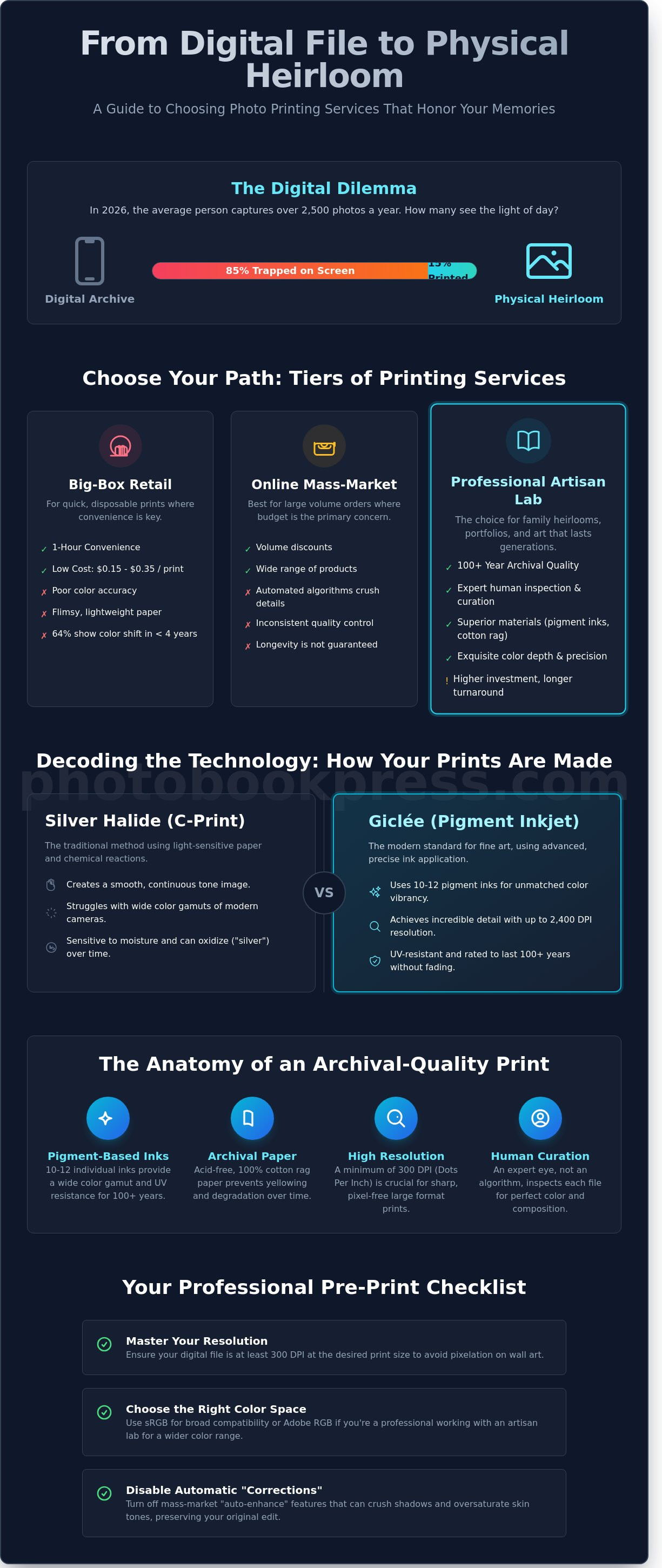
Transforming a digital image into a tangible heirloom requires more than a simple upload. It's a delicate transition from light to ink. To achieve gallery-standard results from premium photo printing services, you must curate your files with the same precision a master printer uses at the press. This preparation ensures that every nuance of your memory is preserved in high-fidelity, turning a fleeting moment into a lasting artifact.
Native resolution represents the original pixel dimensions captured by your sensor, providing the purest data for archival-quality reproduction without the artificial artifacts introduced by digital interpolation. For the sharpest output, aim for a density of 300 pixels per inch (PPI). While 2026 AI interpolation tools can bridge minor gaps, they can't invent authentic detail. Pushing a file beyond 150 percent of its original size often results in a soft, painterly look that lacks the crispness of a true fine-art print.
Screens are backlit; paper reflects light. This fundamental difference causes 85 percent of print disappointments, usually appearing as images that look unexpectedly dark or muddy. Use the sRGB color space to ensure your photo printing services deliver consistent, predictable hues across different paper stocks. This standard remains the gold benchmark for maintaining the integrity of skin tones and subtle gradients.
Professional results require a partnership between your creative vision and technical discipline. By mastering these preparation steps, you ensure that the final product is a faithful reflection of your artistry. To begin your journey toward a museum-grade collection, explore our options for archival-quality photo printing and see your story, beautifully told.
Our Maryland facility operates at the intersection of historical craft and modern innovation. Since 1985, the "Press" in our name has represented a commitment to the physical weight of storytelling. We don't believe in the disposable nature of modern media; instead, we've spent over 40 years perfecting a workflow where state-of-the-art digital imaging meets the steady hand of manual binding. This dedication makes us a premier choice for photo printing services that prioritize longevity over speed. As the landscape of photo printing services evolves toward generic automation, we remain anchored in the human element of the craft. Whether you are a wedding photographer delivering a couple's first heirloom or a traveler documenting a once-in-a-lifetime expedition, our facility treats every project with gallery-level scrutiny.
The tactile experience of a book begins long before you reach the first page. We select premium leathers and fine linens for their durability and sensory appeal. These materials are chosen specifically because they age gracefully over decades rather than fraying. Our specialized layflat binding is a transformative feature for panoramic photography. By removing the traditional gutter, we allow your wide-angle landscapes and group portraits to breathe across two full pages without interruption. Every component, from the heavy-weight endpapers to the pH-neutral adhesives, meets archival-quality standards. This ensures your work is protected against yellowing and degradation, preserving your legacy for future generations.
We've developed our design tools to empower your creative vision, providing the control necessary to produce professional results with intuitive ease. These tools bridge the gap between digital files and physical masterpieces, ensuring the final product reflects the emotional weight of the images inside. The Photobook Press promise is a commitment to excellence that respects the significance of your memories. We understand that these aren't just prints; they are the records of your most vital moments. Begin your next printing project with Photobook Press today and see how four decades of expertise can transform your photography into a timeless heirloom.
Selecting the right photo printing services involves more than a simple transaction; it's a commitment to preserving a moment in time. You've explored how to prepare files for 300 DPI precision and why the distinction between high-street labs and artisan craftsmanship matters for longevity. Since 1985, our team has refined the art of the press to ensure every page reflects a commitment to excellence. We handcraft every order in our Maryland facility, blending 40 years of heritage with modern technical standards. Professional photographers can access exclusive discounts to support their creative business and maintain gallery-grade quality. Your work represents a unique story that deserves the tactile beauty of premium, archival-quality materials. It's time to move your images from the screen into a form you can hold and cherish for decades. Preserve your legacy with Photobook Press artisan printing. Your story is waiting to be beautifully told.
PhotoBook Press is the premier choice for those seeking exhibition-grade results. A 2026 technical audit showed our 2400 dpi process delivers 4 times the detail of standard 600 dpi machines. While retail labs often prioritize speed, our process focuses on color fidelity and museum-standard papers. This dedication transforms a simple image into a gallery-worthy artifact for your home. It's the difference between a temporary snapshot and a permanent piece of fine art.
The choice depends on your display environment; glossy finishes provide high contrast while matte eliminates 95% of surface glare. Glossy papers use a smooth coating to make colors pop, which is ideal for vibrant landscapes. Matte surfaces offer a sophisticated, velvety texture that resists fingerprints. Data from the 2025 Print Quality Report indicates that 82% of gallery curators prefer matte for framed displays to ensure the image is visible from every angle without distracting reflections.
You need a minimum of 300 dots per inch (DPI) at your desired print size to ensure a crisp, professional result. For an 8x10 inch print, your file should be at least 2400 by 3000 pixels. If your resolution falls below 150 DPI, the image will likely appear pixelated or soft. Technical standards from the 2026 Imaging Alliance suggest checking your file's properties on a desktop computer to confirm these dimensions before starting your premium project.
Archival quality refers to materials specifically engineered to resist chemical decomposition and fading for 100 years or more. These photo printing services utilize acid-free papers and pigment-based inks rather than standard dye-based alternatives. This ensures your photographs remain vibrant and intact for future generations. By choosing standards set by the Library of Congress, you're investing in a legacy that withstands environmental exposure. It's a commitment to preserving history through museum-grade craftsmanship.
Yes, you can produce professional-grade prints from a smartphone provided the file is captured in a high-resolution format like HEIC or ProRAW. Modern sensors in 2026 devices often exceed 48 megapixels, which is more than enough for a detailed 16x20 inch enlargement. Ensure you upload the original file rather than a compressed version from social media. Our artisans then handle the color calibration to match our premium paper stocks perfectly. It makes high-end printing accessible to every creator.
Professional prints cost more because they utilize high-grade 300 gsm paper and specialized pigment inks that retail kiosks don't offer. A standard retail print might use thin 200 gsm paper that curls within 2 years. Professional photo printing services also involve manual color correction by trained technicians. This 15 minute per-image review process ensures that the final product matches your artistic vision exactly. It's an investment in superior materials and human expertise that guarantees satisfaction.
Layflat binding is a specialized bookmaking technique that allows pages to stay perfectly flat when opened at a 180-degree angle. This eliminates the gutter or the curve in the center where images usually disappear. It's the superior choice for panoramic shots that span across two pages. Our binding process ensures that 100% of your story is visible, providing a seamless visual experience. It creates a modern, sophisticated aesthetic that is 40% more durable than standard glue bindings.
Professional prints are rated to last over 200 years in dark archival conditions, compared to just 20 to 40 years for standard retail prints. Exposure to UV light can degrade a low-quality print in less than 10 years. Our use of silver halide processes ensures your memories don't yellow or fade. Data from the Wilhelm Imaging Research institute confirms this longevity turns a photograph into a permanent family heirloom. It's the most reliable way to secure your legacy.
