No Products in the Cart


Most seasonal mail is destined for the recycling bin by January 5, 2026, yet your life's most meaningful milestones deserve a far more permanent legacy. A standard announcement often fails to capture the vibrancy of the moment; it's frequently printed on low-grade paper that lacks the weight of the occasion. When you invest in high-end photo cards, you're choosing to transform a brief digital capture into a tangible piece of art. It's about moving beyond the temporary and embracing the archival.
You likely feel that a photograph's true soul is only revealed when the ink meets the paper with absolute precision. We agree that a blurred edge or a muted sky is a disservice to your story. In this guide, you'll discover how to achieve gallery-level color accuracy and select materials that feel as substantial as the memories they hold. We'll walk through the essential elements of bespoke design, ensuring your final product is a sophisticated heirloom rather than a generic template.
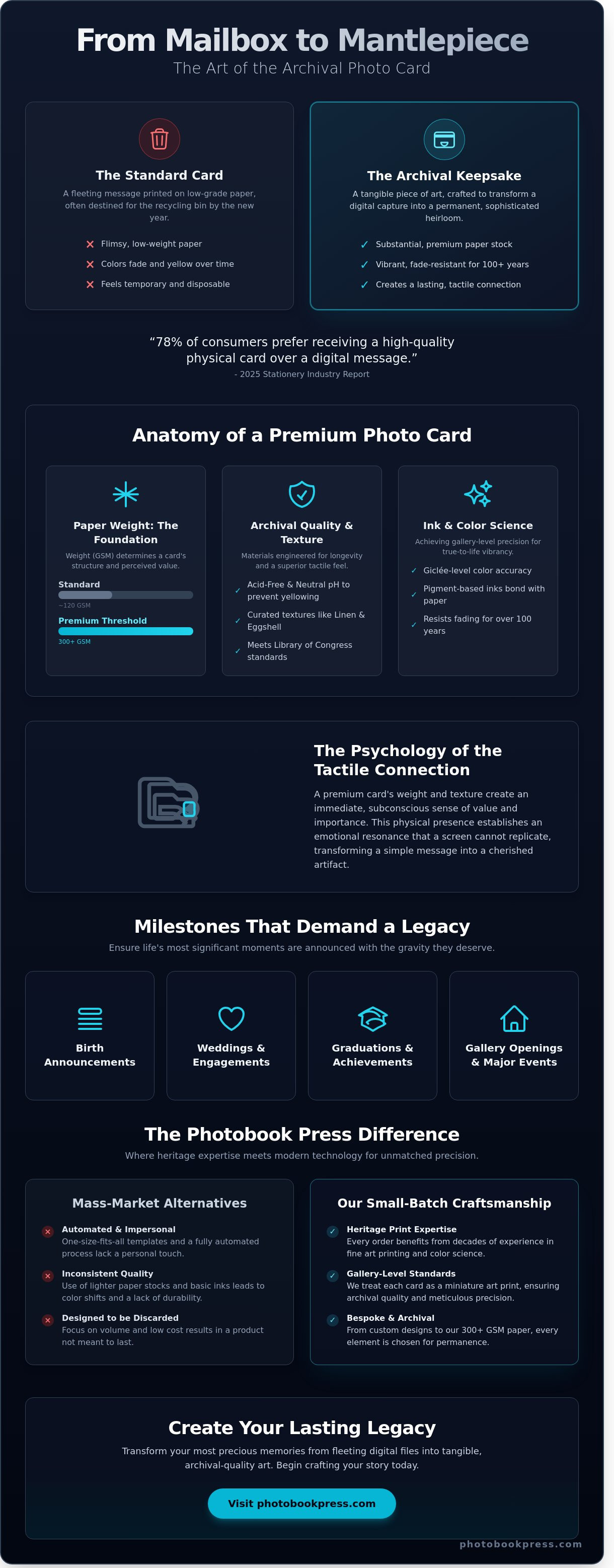
The contemporary photo card has evolved far beyond a simple holiday greeting. In 2026, these pieces represent a sophisticated fusion of fine art printing and intimate correspondence. While the history of greeting cards dates back to ancient China and Egypt, the modern iteration focuses on permanence rather than fleeting sentiment. Today, 78% of consumers in a 2025 stationery industry report indicated they prefer receiving a high-quality physical card over a digital message. This shift marks a definitive departure from disposable culture, positioning the photo card as a meaningful artifact of personal history.
To see how personal imagery transforms into a physical treasure, watch this demonstration:
High-end photo cards serve as the first introduction to life's most significant milestones. Whether announcing a birth, a marriage, or a gallery opening, the medium carries the message. Choosing archival-quality materials ensures that these announcements survive the transition from the mailbox to the archive. It's the difference between a temporary notification and a permanent record. In an era of digital saturation, the deliberate act of sending a physical card communicates a level of respect and intention that pixels cannot match.
The weight of a card in one's hand communicates value before a single word is read. A 130lb cover stock feels substantial; it demands immediate attention. This physical presence creates an emotional resonance that a screen cannot replicate. When you choose premium materials, you aren't just sending mail. You're establishing a personalized legacy through high-end customization. These cards become artifacts of a specific moment in time. They bridge the gap between a temporary update and a lasting record of your family's journey.
Modern photo cards are increasingly designed with the intention of being displayed. In professional photography circles, the "keepsake card" has gained significant traction, functioning as a miniature gallery print. Photobook Press applies rigorous gallery standards to every individual order, ensuring color precision and archival durability. We treat each card as a singular piece of art. This involves using acid-free papers and pigment-based inks designed to resist fading for over 100 years. When a recipient receives a card of this caliber, they don't discard it. They frame it. It moves from the mailbox to the mantle, serving as a permanent reminder of a shared history. Your story, beautifully told, deserves nothing less than this level of craftsmanship.
A premium photo card begins with the tactile sensation of weight. We consider 300 GSM (grams per square meter) the definitive threshold for luxury stationery. This specific density provides a structural integrity that lighter stocks simply cannot replicate; it ensures the card stands proudly on a mantle without warping or wilting over time. When you hold a card of this caliber, you feel the physical substance of the fibers. These materials are chosen because they meet the rigorous archival-quality paper standards recognized by the Library of Congress. By utilizing paper with a neutral pH and an alkaline reserve, we ensure your memories resist the yellowing and brittleness that often affect mass-produced alternatives.
Color science is the invisible partner to high-quality paper. To achieve Giclée-level precision on cardstock, the relationship between the ink and the paper must be meticulously calibrated. Modern archival pigments don't just sit on the surface. They're absorbed into the paper’s architecture, creating a bond that remains vibrant for decades. This deep absorption prevents the image from cracking at the folds and protects the highlights of your photo cards from fading, even when displayed in sunlit rooms. It's a technical feat that transforms a simple greeting into a lasting heirloom.
The finish you select dictates the emotional resonance of your photography. Glossy surfaces offer high contrast and vivid saturation, which works exceptionally well for high-resolution landscapes or vibrant celebrations. However, many of our clients prefer the understated elegance of uncoated, archival-grade papers like eggshell or linen. These textures diffuse light softly, giving portraits a painterly, intimate quality. When you compare different photo printing services, the distinction often lies in the depth of these textures and how they complement the grain of your images.
True luxury in 2026 is defined by responsibility as much as beauty. We prioritize FSC-certified papers, ensuring that every heirloom we produce originates from responsibly managed forests. Our state-of-the-art production facility in Maryland utilizes modern print technology that reduces chemical waste by approximately 40% compared to legacy systems. This precision allows us to maintain incredible color depth while minimizing our environmental footprint. You can explore our curated paper collections to find a medium that reflects both your aesthetic standards and your values. Every card is a testament to the idea that your story deserves to be beautifully told, without compromise.
A digital message disappears in seconds. A physical card lingers for decades. Certain life milestones require more than a temporary pixel; they demand the permanence of heavy cardstock and lightfast inks. Archival-grade photo cards serve as the tangible anchors for these moments, ensuring that the vibrancy of a wedding day or the softness of a newborn's features remains unchanged by the passage of time. Your story, beautifully told, begins with the choice of materials that honor the weight of the occasion.
Your wedding stationery sets the tone for your entire celebration. By matching your save-the-dates and thank you notes to a professional wedding album, you create a unified visual narrative that spans from the first announcement to the final keepsake. These invitations act as the first chapter of your marriage legacy. Hand-finished details, such as debossed lettering or custom foil accents, signal to your guests that this event is a significant historical marker. It isn't just mail; it's a handcrafted invitation to witness a life-altering vow. These pieces often become the first artifacts in a couple's shared history, preserved in a memory box for future generations to rediscover.
Introducing a new generation involves more than a social media post. High-quality birth announcements allow family members to hold a piece of history in their hands. This choice is rooted in the psychology of card giving, which suggests that the physical act of selecting and sending a card expresses personal identity and strengthens social bonds more deeply than digital alternatives. For a new parent, an archival card is a promise that their child's earliest image won't fade as the child grows. It transforms a simple update into a cherished heirloom that grandparents and distant relatives can display with pride.
Photographers and high-end artisans use photo cards as high-impact leave-behinds to reinforce their brand identity. In a high-touch business model, a physical thank you card creates a lasting impression that an email cannot replicate. Many professionals utilize wholesale opportunities to maintain a consistent stock of premium cards, ensuring every client interaction feels curated and exclusive. Using archival materials reflects a commitment to quality that mirrors the professional's own work. It's a strategic investment in prestige that builds trust and encourages long-term client loyalty.
Holiday cards provide a chronological archive of a family’s growth. When families commit to archival standards, they build a collection that survives for generations. By 2026, the trend toward intentional living has increased the demand for these physical artifacts. A decade of holiday cards becomes a mini-gallery of a family's evolution, preserved in exquisite detail. These cards don't just celebrate a season; they document a life, ensuring that the joy of today remains accessible fifty years from now.
Creating photo cards that transcend the ordinary requires a disciplined eye and a commitment to the "less is more" philosophy. Your photography should lead the design, acting as the centerpiece rather than a secondary element. In 2026, the most sophisticated designs embrace generous white space to create a gallery feel. This intentional void allows the eye to rest and ensures the emotional weight of your image remains the focal point. Avoid the temptation to fill every corner with graphics or text; instead, let the paper's texture and the image's clarity speak for themselves.
Typography trends for 2026 favor a delicate balance between heritage and modernity. We see a resurgence of classic serifs, such as refined Garamond or high-contrast Bodoni, paired with ultra-clean, geometric sans-serifs. This juxtaposition offers a sense of timelessness while remaining contemporary. Keep your type hierarchies simple. A single, elegant headline paired with a legible sans-serif for the details provides a polished, professional finish that mirrors the quality of a museum exhibition.
Technical precision is the invisible foundation of every archival-quality card. Before finalizing your design, verify your files against this professional checklist:
Choose images that evoke a singular, cohesive mood. A holiday card might benefit from the warm, golden-hour glow of a family portrait, while a formal announcement demands the crisp, high-contrast clarity of a professional studio shot. Composition is equally vital. Ensure your subject's placement respects the 5x7 or 4x6 dimensions of the card. A vertical portrait rarely thrives in a horizontal layout without compromising the original intent of the frame. High-resolution files are mandatory for heirloom results; low-quality mobile uploads will lack the depth and detail required for premium cardstock.
Harmonize your design by sampling colors directly from your photograph. Using an eyedropper tool to match your font color to a muted tone in the background, like a soft sage from a landscape or a deep navy from a coat, creates instant visual unity. Subtle border details can frame your image without causing distraction, often a 1pt line in a neutral charcoal or warm cream is enough to add structure. For those who value a coordinated home aesthetic, ensure your cards complement other seasonal items like a custom calendar to maintain a unified visual story throughout the year.
Photobook Press has refined the art of the printed word and image since 1985. We don't view printing as a mere utility. Instead, we treat it as a noble craft that requires both technical precision and an artisan’s eye. Our Maryland-based facility serves as the heart of our operations, where we combine historical expertise with modern innovation to ship exquisite products worldwide. By maintaining a boutique, small-batch production model, we ensure that every order receives a level of oversight that mass-market providers simply cannot replicate.
We believe that high-end craftsmanship shouldn't be reserved for industry insiders. Our platform grants you access to the same archival quality used by world-class professional photographers. We bridge the gap between digital ease and traditional artistry through a process that includes manual binding and meticulous quality checks. This human touch ensures that your photo cards are more than just mail; they are tactile representations of your most cherished moments. Our experts monitor every color profile to ensure your vision translates perfectly from the screen to the physical page.
Selecting premium materials is an intentional investment in your family’s long-term archive. We use archival-quality components to ensure your photo cards remain vibrant and crisp for decades. This commitment to durability provides the peace of mind that comes from knowing your history is protected against the fading effects of time. These keepsakes serve as the physical anchors of your legacy, turning fleeting digital files into permanent artifacts that future generations can hold. Your story deserves to be told with grace and preserved with integrity. Start your legacy project today.
The transition from a fleeting digital image to a permanent physical artifact requires a commitment to excellence. In 2026, the most meaningful photo cards are those that prioritize archival integrity over temporary trends. By selecting Giclée-level precision and premium papers, you ensure your personal history remains vibrant for future generations. Since 1985, Photobook Press has operated as a Maryland-based artisan printer, perfecting the balance between heritage techniques and modern technology. This dedication to craft is why professional photographers worldwide trust us with their most significant works. It's time to treat your memories as the precious artifacts they truly are. Every card you send becomes a chapter in a story that deserves to be told with grace and durability. We're here to help you translate your vision into a tactile masterpiece that stands the test of time.
Design Your Custom Photo Cards with Photobook Press
Your story, beautifully told, starts with a single, exquisite choice.
For high-quality photo cards, you should choose a paper weight of at least 110lb cover or 300gsm to ensure a premium, tactile feel. This density prevents the card from warping and provides the structural integrity required for a lasting keepsake. Our Signature Matte stock utilizes 120lb paper, offering a substantial weight that reflects the artisanal quality of your most cherished images.
You can certainly order a single proof or sample of your custom design to verify the finish before committing to a larger run. We understand that perfection requires precision; therefore, we offer individual test prints for 100 percent of our card designs. This allows you to feel the texture of the paper and see the ink saturation in your own home environment.
To ensure your printed photo cards match your screen, you should calibrate your monitor using a hardware tool like the X-Rite i1Display. Digital screens emit light in RGB, while printers use physical ink, creating a natural variance. We recommend editing your files in the sRGB color space to maintain 98 percent color accuracy between your digital preview and the final physical product.
Giclée printing uses a 12-color pigment-based ink system, whereas standard card printing typically relies on a 4-color CMYK toner process. This advanced method results in a broader color gamut and smoother gradients, which are essential for professional photography. While standard prints may fade after 10 years, Giclée prints on archival paper are rated to last over 100 years without noticeable degradation.
Every card produced by PhotoBook Press is crafted using acid-free, archival-quality materials to prevent yellowing or brittle edges over time. We select papers that meet the ISO 9706 standard for permanence, ensuring your photo cards remain as vivid as the day they were captured. These museum-grade materials transform your personal correspondence into heirlooms that can be passed down through generations without losing their original luster.
You're encouraged to use professional photography for your custom cards, provided you have the appropriate licensing or usage rights from your photographer. High-end imagery truly shines on our professional-grade presses, capturing the fine details that lower-resolution files might miss. Our system supports high-capacity uploads, allowing you to maintain the integrity of 50MB files or larger without the need for destructive compression.
Production for custom cards typically takes 5 to 7 business days, as each order undergoes a manual quality check by our master printers. Once your cards leave our facility, standard shipping adds another 3 to 5 days depending on your specific location. We prioritize craftsmanship over speed, ensuring that 100 percent of our products meet our rigorous standards for excellence before they reach your door.
Your photos should have a resolution of 300 dots per inch (DPI) at the final print size to achieve the sharpest results. If you're printing a 5x7 card, your image file should be at least 1500 by 2100 pixels. Images with lower resolutions may appear pixelated or soft, detracting from the sophisticated aesthetic of your custom project and the clarity of the captured moment.
