No Products in the Cart


Your wedding invitation isn't merely a piece of mail; it's the first physical chapter of your family's history. You want a guest's first touch of the paper to convey the quiet elegance of the day to come. A 2023 survey by The Knot found that 68% of couples feel overwhelmed by technical choices, fearing their stationery will feel flimsy or look mass-produced. We believe that mastering the intricacies of wedding invitation printing shouldn't be a source of stress. It's an essential step in ensuring the tactile experience matches the emotional weight of your celebration.
Fine art standards require archival materials to remain stable for over 100 years, yet standard commercial prints often show signs of fading within 15 years. This guide will show you how to transform your vision into a museum-grade keepsake using professional techniques and premium materials. We'll demystify technical specifications like 300 GSM paper weights and pigment-based ink precision so you can make decisions with total confidence. You'll learn how to curate a cohesive, exquisite suite that serves as a permanent record of your story, beautifully told.
A wedding invitation is much more than a simple delivery of logistics; it's a sensory prelude to the union itself. It represents the first physical touchpoint your guests will have with your celebration, acting as a tangible manifestation of your promise. While a digital notification exists within a crowded cloud of fleeting pings and notifications, a printed piece commands a different kind of attention. It signals that this event is distinct from the everyday. The history of wedding invitations shows a clear evolution from town criers to the intricate copperplate engravings of the 18th century, proving that we've long viewed these documents as vital social markers that deserve a permanent form.
To better understand the tactile beauty and variety of modern production techniques, watch this helpful video:
Weight and texture create a psychological anchor for the recipient. When a guest pulls a heavy, 130lb cover stock from an envelope, the brain immediately registers the event's importance. This tactile feedback is something digital screens can't replicate. As we look toward 2026, the design landscape is shifting toward "minimalist maximalism." This trend focuses on clean, understated layouts executed with the highest possible material quality. Professional wedding invitation printing ensures that ink saturation is deep and the edges are crisp, reflecting the gravity of your commitment through every fiber of the paper.
An invitation is more than stationery; it's a family artifact. In an era of digital decay, archival-quality paper ensures your announcement becomes a keepsake for generations. DIY solutions often lack the lightfast inks and acid-free properties required for true longevity. Choosing professional wedding invitation printing means investing in a piece of personal history that won't yellow or fade. It's the difference between a temporary notice and a handcrafted heirloom that will eventually sit in a memory box or a frame.
Your choice of paper stock should mirror your venue and theme. A coastal ceremony might call for a textured, deckle-edged cotton paper, while a metropolitan gala demands a smooth, high-gloss finish. Typography acts as your visual voice, guiding the guest's emotional response before they read a single word. Consider these elements as part of a larger whole. The Invitation Suite functions as a cohesive visual brand, uniting every element from the RSVP card to the envelope liner into a singular, breathtaking narrative that tells your story, beautifully told.
The art of wedding invitation printing is a modern continuation of a long legacy. To appreciate the craft, one should look back at the history of wedding invitations, which transitioned from the oral traditions of town criers to the intricate hand-engraved plates of the 17th century. Today, archival excellence is defined by the marriage of acid-free papers and pigment-based inks. Acid-free papers are chemically pH-neutral, ensuring the card won't yellow or become brittle over time. When paired with pigment inks, which consist of microscopic solid particles that sit atop the paper fibers, the result is a print with a lightfastness rating often exceeding 200 years. These materials transform a simple announcement into a permanent family heirloom.
Weight and texture provide the first sensory cues to your guests. In the printing world, we measure paper by GSM (grams per square meter) or points. A standard premium invitation typically starts at 300 GSM, while double-thick luxury stocks can reach 600 GSM or 32pt thickness. Texture profiles further define the aesthetic. A smooth vellum finish offers a contemporary, sleek feel. In contrast, a felt-textured or eggshell stock provides a rich, tactile depth that catches the light and adds an organic warmth to the design. Achieving the perfect palette requires meticulous press calibration. Professional printers use sophisticated color management systems to ensure the soft blush or deep navy you see on a calibrated monitor translates perfectly to the physical page.
Choosing between a 100lb cover and a double-thick luxury stock is a matter of presence. The 100lb stock is elegant and sturdy, fitting perfectly into standard envelopes without excess bulk. Double-thick stocks, however, feel like a piece of fine art, offering a rigid, gallery-quality weight. For photography-heavy designs, a matte finish provides a soft, glare-free surface that handles skin tones beautifully. If your design is text-focused, an eggshell finish adds a subtle, sophisticated tooth. We prioritize high opacity in all our selections. This prevents "show-through," ensuring that a map or a heartfelt note on the back of the card doesn't interfere with the clarity of the invitation on the front.
Modern CMYK digital printing has evolved to a point where it rivals the depth of traditional lithography. This evolution allows for incredible precision in "wedding colors," ensuring that your specific floral motifs or monogram shades are consistent across every piece of stationery. Unlike dye-based inks that can bleed or fade, pigment inks offer superior durability against UV exposure and minor moisture. This technical precision ensures your story is told with absolute clarity. Exploring the tactile possibilities of bespoke stationery allows you to set a tone that resonates long after the RSVP date has passed.
Your wedding invitation is the prologue to your celebration. It's the first tangible evidence of the legacy you're building. Achieving a cohesive look requires more than just matching colors; it demands a narrative thread that connects the heavy cardstock of the main invite to the delicate tissue of the envelope liner. Professional wedding invitation printing transforms a digital concept into a sensory experience that guests will keep for decades. Every choice, from the weight of the paper to the ink's finish, contributes to a story that begins the moment the envelope is opened.
The main invitation serves as the anchor of the entire suite. It establishes a clear hierarchy where your names and the date take center stage, surrounded by intentional white space. This breathing room isn't empty; it's a design choice that mirrors the layout of a high-end art gallery. Avoid clutter by moving logistical details to enclosure cards. A 2024 industry survey found that 75% of modern couples now utilize QR codes on their details cards to streamline digital RSVPs. This shift allows the physical RSVP card to focus on charm and tone, keeping the aesthetic clean and sophisticated. Map illustrations and registry details should reside on their own cards to maintain the main invitation's formal integrity.
True luxury lives in the details that can't be found in a standard catalog. Utilizing personalized elements like custom monograms or hand-drawn venue illustrations elevates the suite from simple stationery to a handcrafted heirloom. These bespoke touches act as a visual signature, ensuring your suite is entirely unique to your history. When you choose to incorporate photography, consider the role of photo cards as archival-quality keepsakes. These pieces shouldn't compete with the text. Instead, they should balance imagery with minimalist typography to ensure the focus remains on the emotion of the moment.
According to a 2024 wedding report, 82% of couples now prioritize paper quality and texture as the most important factors in their stationery selection. By focusing on a narrative thread that connects every piece, you create a sense of anticipation. The envelope is the first touchpoint, while the details card provides the final guidance. Together, they form a complete vision of your upcoming union.
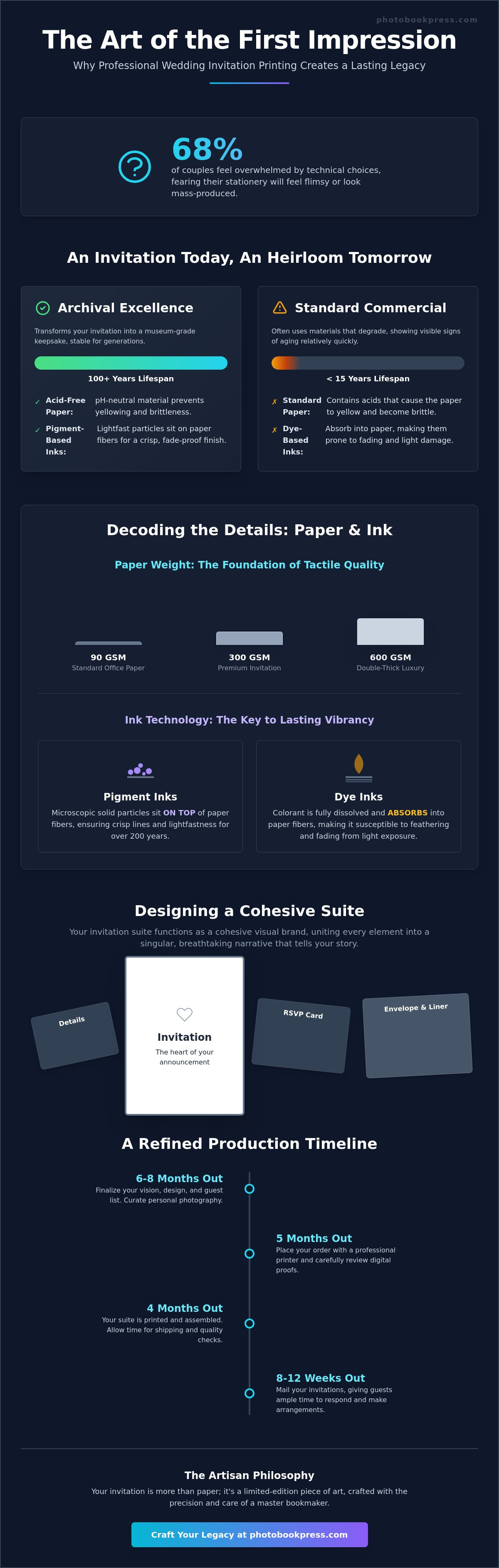
The journey from a digital concept to a physical heirloom requires a deliberate pace. Professional wedding invitation printing isn't a task to be rushed; it's a sequence of artistic decisions that demand respect for the medium. By back-timing from your ceremony date, you ensure every detail, from the paper weight to the ink saturation, meets archival standards. This lifecycle begins long before the first envelope is sealed, extending from the initial Save the Date to the final Thank You card sent after the honeymoon.
Meticulous planning prevents the anxiety of last-minute corrections. When calculating your order, always apply the 10% rule. If your guest list requires 150 invitations, order at least 165. This surplus accounts for traditional calligraphy errors, unexpected additions to the guest list, and the essential keepsakes you'll want to preserve in your family archives. High-end printing runs are most cost-effective when executed once; a small reprint of five or ten cards later can be disproportionately expensive due to press setup requirements.
Excellence lives in the details of the proof. When reviewing digital files, pay close attention to the "bleed lines," which typically extend 0.125 inches (3mm) beyond the trim edge. This ensures that your design reaches the very edge of the paper without unsightly white borders. Simultaneously, keep all critical text within the "safety zone," at least 0.25 inches from the cut line, to maintain a balanced, professional aesthetic.
Your final copy checklist must be exhaustive. Verify the year, the day of the week, and the spelling of every venue name. Technical accuracy is just as vital as visual beauty. A professional second set of eyes often catches a transposed digit in a URL or a missing RSVP date that the couple might overlook. This rigorous verification process ensures your wedding invitation printing results in a flawless first impression.
Inside our Maryland-based facility, the rhythmic hum of state-of-the-art machinery harmonizes with the quiet precision of manual binding. This isn't a factory; it's a studio where technology serves the artisan. We view wedding invitation printing as the first chapter of a couple’s published history. Our "Press" philosophy dictates that every project deserves the same meticulous attention as a gallery-grade art book. We don't cut corners. We don't settle for "good enough." Every sheet is scrutinized for color fidelity and texture consistency to ensure it meets our rigorous standards.
Professional photographers have relied on our expertise for decades. They understand that the transition from a digital file to a physical object requires a master’s touch. This trust is built on our ability to reproduce the finest details of their work on archival-quality substrates. Our commitment to excellence includes a deep respect for the materials we use. Sustainability is woven into our sourcing process. We select papers from mills that prioritize responsible forestry, ensuring your stationery reflects both your style and your values. It’s a marriage of environmental responsibility and uncompromising beauty.
Photobook Press has spent 39 years perfecting the craft of print. This heritage isn't just about time; it's about the collective knowledge of our team. Every wedding invitation printing project benefits from four decades of technical refinement. Our quality-check process is rigorous. Experts examine every invitation for ink saturation and edge crispness, ensuring the human element remains at the heart of our production. This dedication to quality creates a seamless transition from your initial stationery to the high-end wedding albums that will eventually house your favorite memories.
We provide a concierge-level service that balances modern digital convenience with the soul of traditional craftsmanship. You aren't navigating this process alone. Our team acts as a partner, helping you select the ideal paper weights and finishes to match your aesthetic. We believe that the tactile experience of opening an envelope should be as moving as the words printed inside. It's about creating a physical connection between you and your guests. We invite you to begin your journey with Photobook Press, where your story is treated with the prestige it deserves. Start your legacy with a first impression that lasts forever.
Your wedding invitation serves as the definitive prologue to your celebration. It's the first tactile experience your guests will share, setting a tone of elegance and intentionality. By prioritizing archival-quality materials and a cohesive design suite, you're not just sending mail; you're distributing a piece of your history. Professional wedding invitation printing ensures that every texture and hue reflects the gravity of your commitment.
Since 1985, PhotoBook Press has operated as a premier destination for those who refuse to compromise on quality. Our master printers oversee every detail from our US-based facility, where each order is hand-inspected for perfection before it reaches your door. We believe that your milestones deserve the highest level of care, utilizing materials designed to resist the fading of time. You've spent months planning the perfect day, and your stationery should mirror that same dedication to excellence. We invite you to experience the difference that decades of craftsmanship can make in your wedding journey.
Begin crafting your exquisite wedding invitation suite today
You should begin the process 5 to 6 months before your ceremony date. This timeline provides 2 weeks for design proofs and 3 weeks for the artisanal printing process. According to the 2023 Real Weddings Study by The Knot, most couples mail their suites 6 to 8 weeks before the event. Ordering early prevents rushed decisions and preserves the integrity of your stationery.
A paper weight of at least 120lb cover stock, or 325 gsm, provides the substantial feel expected of a premium heirloom. For an even more exquisite tactile experience, many master printers recommend 240lb double-thick cardstock. This density prevents warping and ensures your wedding invitation printing feels like a significant artifact in your guests' hands. The weight conveys a sense of permanence and quality.
You can certainly upload custom designs created in professional software or consumer design tools. To ensure a gallery-quality result, export your files as high-resolution PDFs at 300 DPI with a 0.125 inch bleed on all sides. This technical precision allows our printers to trim your invitations perfectly. Your unique vision deserves the same meticulous care we apply to our handcrafted templates.
Digital printing applies ink directly onto the paper surface, while letterpress uses a physical plate to deboss the design into the fibers. Digital methods offer 100 percent color accuracy and the ability to reproduce intricate gradients or photographs. Letterpress provides a tactile, three-dimensional texture that's been a hallmark of fine stationery since the 15th century. Both methods celebrate the craft of wedding invitation printing in distinct ways.
Order 15 percent to 20 percent more invitations than your final household count. If you have 100 households, an extra 20 suites covers last-minute guest list additions and provides copies for your photographer and family archives. Reordering a small batch later can be 3 times more expensive than including them in your initial print run. These extras serve as precious keepsakes of your story.
Most premium invitation suites include matching envelopes as a standard component of the presentation. We provide high-quality envelopes designed to complement the texture and tone of your selected paper stock. It's essential to verify if your chosen suite includes inner and outer envelopes, a tradition that dates back to the 18th century. This layered approach protects the delicate contents during transit.
Printing a high-resolution engagement photograph on the reverse side is a beautiful way to personalize your stationery suite. We utilize precision color calibration to ensure your imagery looks as vibrant on paper as it does in your memories. This dual-sided approach transforms a simple announcement into a two-sided piece of art. It allows you to share a visual chapter of your journey alongside the formal details.
Archival-quality ink is a pigment-based medium designed to resist fading and chemical decomposition for over 100 years. Unlike standard dye-based inks, these professional-grade materials bond deeply with the paper fibers. This ensures your invitations remain as vivid and crisp for your grandchildren as they're on your wedding day. Investing in archival materials turns a temporary notice into a lasting family legacy.
