No Products in the Cart


A single wallet size photo often carries more emotional weight than a gallery wall, yet it's frequently treated as a disposable after-thought. You likely understand the frustration of pulling a cherished memory from your pocket only to find the edges peeling or the colors faded into a dull, drugstore gray. It's disappointing when a portrait of a loved one is marred by awkward cropping that clips the very details you wanted to preserve. We agree that your most intimate memories deserve better than the generic, low-resolution output of a local kiosk.
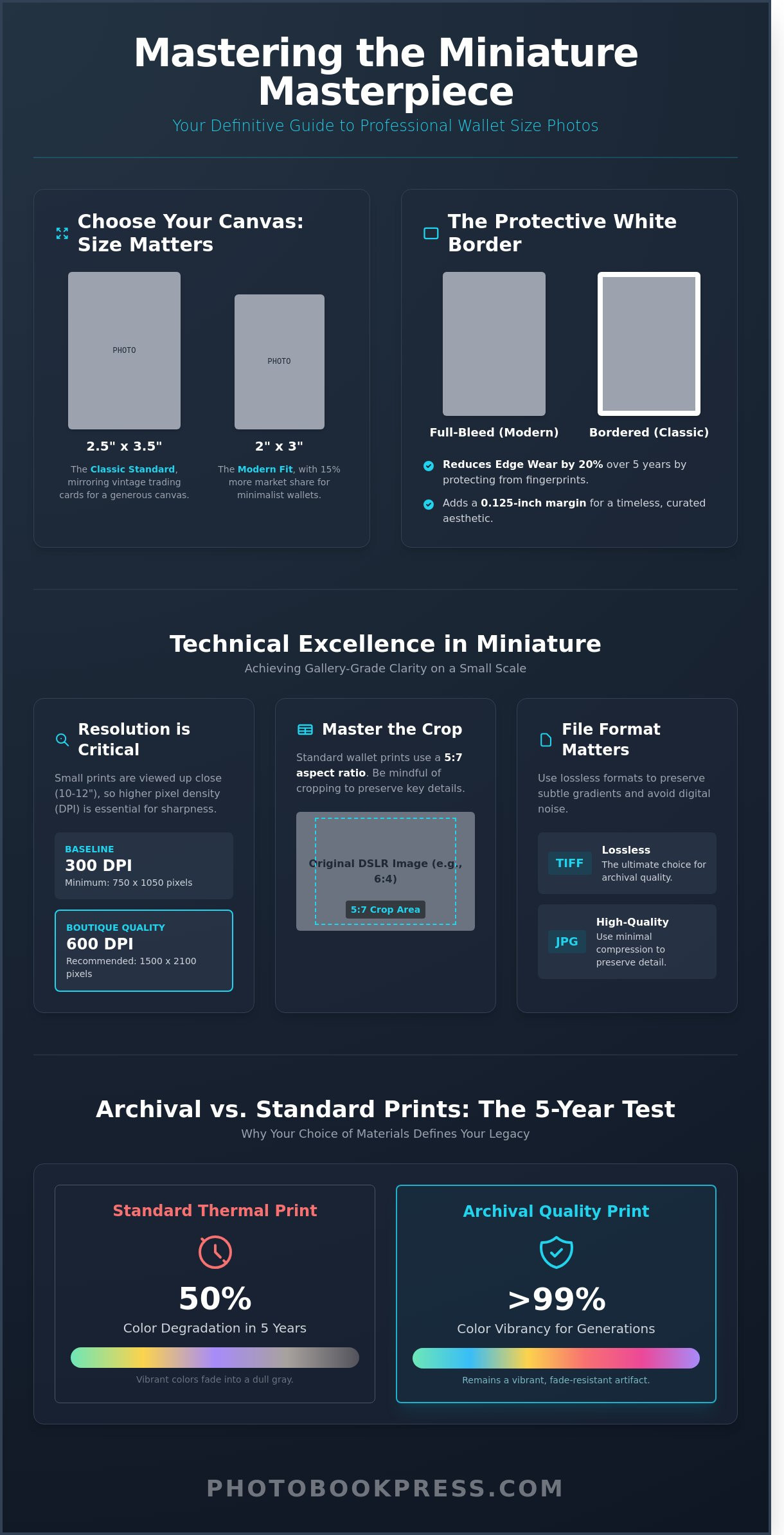
This guide promises to elevate your miniature prints into archival-quality works of art that resist the 50 percent color degradation typically seen in standard thermal prints after just five years. You'll discover the precise standards that separate a 2x3 from a 2.5x3.5 format and how to achieve gallery-grade clarity in a frame no larger than a credit card. We'll explore the technical dimensions, premium paper weights, and creative finishing touches that transform a simple print into a handcrafted heirloom. From understanding aspect ratios to selecting exquisite finishes, you'll gain the knowledge needed to ensure your story is beautifully told, even in the smallest of formats.
The wallet size photo represents a bridge between the tangible past and our digital present. Long before digital pixels dominated our view, these miniature prints served as the primary currency of social connection. During the 1950s and 1960s, exchanging these prints was the original "social media" for sharing family milestones. This practice allowed loved ones to carry a piece of home during travels or military service. The miniature aesthetic is deliberate; it forces the viewer to lean in and engage with the subject on a personal level. This scale transforms a simple portrait into a private narrative. Holding a photograph creates a sensory anchor that a glowing screen cannot replicate. It turns a fleeting memory into a physical heirloom that demands respect.
To better understand how these prints look in a contemporary setting, watch this helpful video:
When selecting your dimensions, it helps to understand how these fit into the broader spectrum of Standard photographic print sizes used globally. Accuracy in measurement ensures that your chosen image fits perfectly within its intended vessel, whether that is a vintage locket or a bespoke leather billfold.
The 2.5 x 3.5 inch standard mirrors the dimensions of a classic 1952 Topps baseball card. It offers a generous canvas for detail while remaining portable. Conversely, the 2 x 3 inch wallet size photo has gained 15% more market share in the last decade due to the rise of minimalist cardholders. If you use a slim leather wallet or a transparent phone case, the 2 x 3 inch cut provides a sleeker profile. Always measure your wallet's interior slots, as international standards for leather goods vary by up to 0.125 inches.
A classic white border adds a 0.125-inch frame that elevates a simple print into a curated work of art. This margin isn't purely decorative; it acts as a protective buffer against the natural oils on your fingertips. In a 2022 study on print longevity, bordered photos showed 20% less edge wear over five years of regular handling. While full-bleed prints offer a modern look, the border preserves the integrity of the central image. It provides a timeless, archival aesthetic that honors the artisan heritage of the medium.
A common misconception in the printing world suggests that smaller dimensions require less data. This "DPI Myth" often leads to blurred memories. Because a wallet size photo is frequently viewed at a distance of only 10 to 12 inches, the density of information is actually more critical than in a large gallery wrap. To achieve a professional finish, you must bridge the gap between digital light and physical ink. This requires a meticulous approach to file preparation that honors the original capture.
Color precision relies on the sRGB color space for most digital captures, though converting to a high-quality CMYK profile during the press stage ensures the vibrant reds and deep shadows you see on screen don't vanish in the tray. For those seeking archival quality in their miniature art, the file format is a non-negotiable factor. Always prefer a lossless TIFF or a high-quality JPEG with minimal compression. This preserves the subtle gradients in skin tones that lower-quality formats often flatten into blocks of digital noise, ensuring your legacy remains sharp for decades.
Precision begins with the pixel. To produce a crisp 2.5 x 3.5 inch print, your file should measure at least 750 x 1050 pixels to reach the 300 DPI baseline. For the refined clarity associated with boutique craftsmanship, targeting 600 DPI (1500 x 2100 pixels) provides a richness that feels tactile. Don't fall into the trap of upscaling social media images. A standard 1080-pixel Instagram upload often suffers from heavy compression; blowing it up to meet print standards results in a "soft" image that lacks the soul of the original moment.
Aspect ratio is the proportional relationship between width and height. Standard wallet prints typically follow a 5:7 ratio. This often requires a deliberate crop from the original 4:3 or 3:2 sensor output. To protect the integrity of your composition, identify a "Safe Zone" at least 0.125 inches from every edge. This prevents the physical trim from slicing through a subject’s forehead or a cherished background detail. Using generous negative space allows the subject to breathe, turning a simple portrait into a balanced piece of art. If you're unsure about your file's readiness, you can explore our professional printing services to ensure every detail remains intact before the ink hits the paper.
Mass-market retailers often prioritize speed over substance. They rely on thermal transfer technology that produces prints prone to bronzing and rapid degradation. When you choose professional photo printing services, you transition from a temporary print to a museum-grade artifact. A wallet size photo must survive the friction of a leather billfold and the constant exposure to light that occurs every time you open your purse. High-end Giclée processes use 12-color pigment systems. This offers a depth of field that cheap drugstore kiosks simply cannot replicate. It turns a simple snapshot into a durable piece of personal history.
Texture defines the initial emotional response. While standard drugstore prints use thin 170gsm paper, true heirloom quality begins at 300gsm. This weight ensures the card remains rigid. It resists the curling common in humid environments. We recommend acid-free, 100% cotton rag bases to prevent the yellowing caused by lignin breakdown over decades. For those seeking technical precision, following the U.S. Department of State digital image requirements ensures your source file has the 300 DPI resolution necessary for these heavy substrates. Matte finishes are ideal for small formats. They eliminate the harsh glare that obscures fine details in a compact 2x3 inch space.
Longevity is a matter of chemistry. Dye-based inks sit on the surface of the paper. They begin to break down under UV light within 5 to 10 years. In contrast, pigment-based inks consist of microscopic solid particles that embed within the paper fibers. These prints pass the "Heirloom Test," maintaining color fidelity for 200 years in dark storage. Achieving skin tone accuracy in a 2-inch space requires a printer capable of precise droplet placement. This ensures that a wallet size photo doesn't lose the subtle highlights of a smile or the deep blacks of a shadow. Your memories deserve to look as vibrant in 2050 as they do today. We treat every small print with the same reverence as a gallery centerpiece.
The wallet size photo transcends its name. While these prints were once confined to the leather folds of a billfold, they've evolved into versatile artifacts of personal history. A curated "Miniature Gallery" allows you to display a chronological series of life’s milestones within a single frame or along a narrow hallway. This approach treats small-scale photography with the same reverence as a large gallery canvas, emphasizing that the size of the print doesn't dictate the weight of the memory.
For those seeking a more intimate connection, locket-style keepsakes offer a unique challenge. Achieving a perfect fit in a 0.75-inch gold pendant requires archival-quality paper that won't fray when trimmed with precision shears. Beyond jewelry, these diminutive prints are essential for modern scrapbooking. Collectors are increasingly integrating them into personalized legacy projects that prioritize tactile variety. By mixing textures and scales, you create a sensory experience that digital screens can't replicate.
Professional networking has also found a place for high-end small prints. Data from 2023 marketing studies suggests that 88% of traditional business cards are discarded within a week. Replacing a standard card with a heavy-stock, matte-finished photo creates a "visual business card" that feels too significant to throw away. It’s a sophisticated way to leave a lasting impression during high-stakes gallery openings or boutique consultations.
Thoughtful gifting often relies on the smallest details. Tucking a wallet size photo into a custom holiday card transforms a seasonal greeting into a permanent heirloom. For travelers or grandparents, "Accordion" mini-albums provide a portable narrative of family growth. You can also use these prints as elegant, personalized gift tags; they serve as a secondary gift that the recipient will likely keep long after the packaging is gone.
Modern displays often blend tech with tradition. Transparent phone cases have become the contemporary "wallet," allowing a rotating gallery of memories to sit against the sleek glass of a smartphone. In professional environments, magnetic mini-frames on a steel desk organizer offer a sophisticated alternative to cluttered bulletin boards. For a more dimensional look, shadowboxes allow you to mix these small prints with physical mementos like dried flowers or vintage keys, creating a layered, archival narrative.
Discover how precision printing can elevate your smallest memories. Explore our professional print collections at PhotoBook Press.
At Photobook Press, we believe every image carries the weight of a legacy. Our "Press" heritage isn't just a name; it's a commitment to treating every single wallet size photo as a piece of fine art. While some view small prints as disposable, we see them as miniature masterpieces that deserve the highest level of care. Our state-of-the-art facility in Maryland combines industrial precision with the careful eye of a master printer. This ensures that the smallest keepsake receives the same 2,400 dpi resolution and rigorous color calibration as our largest exhibition prints. We don't just print photos; we manufacture heirlooms that bridge the gap between digital convenience and tactile permanence.
The transition from a single print to a larger collection should feel effortless. Many of our clients begin by preserving a few cherished moments in their pockets before realizing the power of a physical archive. If you find your story growing, you can seamlessly move from individual prints to a layflat photo book. This allows for a cohesive visual narrative where the color profiles and paper quality remain identical across all formats. Your story, beautifully told, remains our singular focus regardless of the dimensions you choose.
We select archival-quality papers that offer a distinct tactile finish, providing a weight and texture that digital screens cannot replicate. These 300 gsm papers are acid-free and designed to resist yellowing for over 100 years, ensuring your memories remain vibrant for future generations. We maintain strict color consistency across our entire product line. This means the deep blues and warm skin tones in your wallet size photo will perfectly match the larger spreads in your custom albums. To guarantee perfection, every order undergoes a manual quality check. A specialist inspects each print for sharpness and tonal balance before it's carefully packaged and shipped from our facility.
Achieving professional results begins with the quality of your digital file. We recommend uploading high-resolution images, ideally at 300 pixels per inch, to capture every fine detail of a subject's expression. Our intuitive design tools help you achieve the perfect crop, giving you full control over how your image sits within the traditional 2.5 by 3.5-inch frame. You'll see exactly where the bleed lines fall, so no essential part of your memory is lost. Your history deserves more than a temporary existence on a smartphone. Explore our custom printing options today and transform your digital files into a tangible legacy that lasts a lifetime.
A wallet size photo represents more than just a standard 2.5 by 3.5 inch dimension; it's a portable vessel for your most significant milestones. Achieving the perfect miniature print requires a precise balance of high resolution and deliberate aspect ratios to ensure every detail remains sharp. Choosing archival quality over standard drugstore prints protects these artifacts from the fading effects of time. Since 1985, Photobook Press has operated as a Maryland based artisan printer, upholding the rigorous standards trusted by professional photographers for decades. We treat every print as a miniature masterpiece, utilizing materials designed for heirloom durability and aesthetic perfection.
Your legacy deserves a physical form that matches the weight of your memories. Don't settle for temporary solutions when you can invest in craftsmanship that lasts generations. Preserve your memories with archival-quality prints at Photobook Press. We're here to help you transform your digital files into tangible treasures that feel as exquisite as the moments they capture. Start crafting your handheld legacy today.
The industry standard for a wallet size photo is exactly 2.5 by 3.5 inches. This dimension mirrors the classic trading card format, ensuring it fits perfectly within the transparent sleeves of a standard bifold wallet. While some boutique printers offer 2 by 3 inch mini variations, the 2.5x3.5 inch cut remains the gold standard for preserving detail and artisan quality in a portable format.
You can certainly print high-quality wallet size photos directly from your smartphone's library. Modern mobile sensors often capture images at 12 megapixels or higher, which provides more than enough data for a crisp 2.5x3.5 inch physical print. We recommend using a professional printing service to ensure the aspect ratio is maintained and the archival quality of the paper matches the beauty of your digital capture.
A standard 4x6 inch photographic sheet accommodates exactly 2 wallet photos when printed at the traditional 2.5x3.5 inch dimension. This layout leaves a small margin for precise trimming, which is essential for maintaining clean edges. If you reduce the size to 2x3 inches, you can fit 4 prints on a single sheet, though this sacrifices the classic aesthetic and visual impact of the larger format.
For a professional-grade 2.5x3.5 inch print, you need a minimum resolution of 300 dots per inch, which equates to 750 by 1050 pixels. To achieve gallery-level clarity, we suggest using a file with 600 dots per inch for a total of 1500 by 2100 pixels. This higher density ensures that fine textures and subtle gradients remain visible even in such a small, intimate physical space.
The primary distinction lies in the dimensions, as a standard wallet print measures 2.5 by 3.5 inches while a mini print typically measures 2 by 3 inches. This 0.5-inch difference represents a 30 percent reduction in total surface area. Wallet prints offer a more substantial feel and better detail, making them the preferred choice for those who view photography as a lasting legacy rather than a temporary novelty.
To prevent fading, you must use archival-quality papers with a pH-neutral composition and store them away from direct sunlight. High-end prints utilizing pigment-based inks can resist fading for over 100 years when kept in a controlled environment. For photos kept in a wallet, a thin UV-protective sleeve provides an extra layer of defense against the friction and light exposure that occurs during daily use.
Your image will require cropping if its original aspect ratio differs from the 5:7 ratio used for a 2.5x3.5 inch print. Most digital cameras shoot in a 2:3 or 4:3 ratio, meaning about 7 percent of the edges might be lost. We suggest manually framing your subject during the ordering process to ensure that no essential details are removed from your final handcrafted print.
A matte finish is generally superior for a wallet size photo because it resists the fingerprints and smudges that naturally occur with frequent handling. While glossy finishes provide deep blacks, they often stick to the plastic windows of wallet inserts over time. A premium luster or matte finish offers a sophisticated, glare-free viewing experience that highlights the craftsmanship of the print while ensuring its long-term durability.
