No Products in the Cart


What if the most profound piece of art in your home isn't a found object from a gallery, but a fleeting second of your own life? You understand that a photograph is more than just a digital file; it's a physical anchor for your most cherished memories. However, the prospect of creating large canvas prints from photos often brings a sense of hesitation. You might worry about pixelation on a grand scale or wonder if the vibrant colors you remember will eventually succumb to the sun's reach.
It's a valid concern, as a true statement piece requires more than just a printer; it demands the precision of archival craftsmanship. We've designed this guide to give you absolute confidence in your creative choices. You'll discover how to ensure your images meet the 150 to 300 DPI standard for sharp results and why pigment based inks are the only choice for a legacy that lasts centuries. From selecting the perfect dimensions for your wall to understanding the structural integrity of a gallery wrap, we'll help you transform a digital image into a timeless focal point.
A room without a focal point often feels restless, as if the eye is searching for a place to land but finding only fragments of decor. When you introduce large canvas prints from photos, you provide that much-needed anchor. These pieces do more than fill a void on a wall; they establish the room's character and dictate its flow. To truly appreciate the medium, one might ask, What is a canvas print? Beyond the technical definition of an image printed onto fabric, it's a structural element of interior design. It possesses a tactile presence that paper cannot replicate, offering a depth that transforms a simple wall into a curated gallery space.
Certain memories simply demand a larger-than-life presentation to preserve their emotional weight. A sprawling landscape from a milestone journey or a candid moment of joy loses its gravity when confined to a small frame. By elevating these digital captures to a grand scale, you honor the significance of the event. It's about more than just visibility. It's about creating an immersive experience where the viewer can almost step back into the moment itself. The physical size of the print mirrors the magnitude of the memory, ensuring it remains a central part of your home's narrative.
To better understand this concept, watch this helpful video:
In modern, open-concept homes, defining separate living areas can be a challenge. Large-scale art serves as a sophisticated tool for zoning, providing a visual boundary that separates a dining area from a lounge without the need for physical partitions. While a gallery wall offers a playful, eclectic energy, a single, commanding statement piece exudes a sense of quiet confidence and intentionality. It suggests that the chosen image is so vital, so complete, that it requires no accompaniment. This minimalist approach allows the craftsmanship of the print and the beauty of the subject to take center stage. It's a bold choice.
The human brain responds to scale in profound ways. In a windowless room or a cramped office, a large-scale landscape can act as a virtual window, creating an illusion of depth and a perceived connection to the outdoors. Conversely, life-sized portraiture creates an intimate, almost conversational atmosphere, as if the subject is physically present in the room. This sense of scale influences your own physical presence; a large piece can make a space feel more expansive or more grounded, depending on the subject's composition and color. It's a way to manipulate the very energy of your environment.
Not every photograph is meant for the grand stage of an oversized format. Visual hierarchy is crucial, so look for images with a strong central composition or a clear lead-in line that guides the eye. Minimalism often thrives at this scale, as a simple horizon or a single architectural detail becomes a bold, graphic statement. You should also consider room harmony by coordinating the photo's color palette with your existing interior tones. When you create large canvas prints from photos, the goal is to complement the room's aesthetic while providing a striking, sharp contrast that captures attention immediately.
The transition from a digital screen to a physical wall is a transformation that demands technical rigor. Many believe that creating large canvas prints from photos is as simple as clicking 'order', yet the secret to a gallery-quality result lies in the mathematics of resolution. Clarity isn't an accident; it's the result of aligning your image data with the physical dimensions of the canvas. When you stretch a file across several feet of fabric, every imperfection and pixelated edge is magnified, making preparation the most critical step in the creative process.
One of the most vital concepts to understand is the 'Viewing Distance Rule'. Unlike a photobook held inches from your eyes, a massive canvas is typically viewed from several feet away. This distance allows the human eye to blend individual pixels into a seamless image even at lower densities. While a small print requires high density, a massive statement piece can remain stunningly sharp at 150 DPI. It's a common myth that every file must be 300 DPI for large canvas prints from photos. In reality, a native resolution of 150 dots per inch at the final print size is the professional standard for achieving a crisp, professional look without unnecessary file bloat.
Before you finalize your design, checking your image's native resolution is essential. You can find this in your file's properties or through image editing software. If your favorite memory falls short of the required pixel count, modern AI upscaling technologies can often bridge the gap. These tools intelligently add detail where it's missing, though they work best on images that are already clear and well-lit. For those seeking absolute perfection, our team at Photobook Press provides the expert oversight needed to ensure your file is ready for the big stage.
Confusion often arises between PPI (Pixels Per Inch) and DPI (Dots Per Inch). PPI refers to the digital density of your image file, while DPI describes the physical droplets of ink the print head places on the fabric. For prints over 30 inches, targeting a PPI between 100 and 150 is often sufficient for a magnificent result. A resolution of 3600 x 5400 pixels is the ideal 'sweet spot' for a 24x36 inch canvas to maintain vivid detail and depth.
The container for your image matters as much as the content. TIFF files are preferred by professionals for their lossless quality, though a high-quality JPEG with minimal compression is often indistinguishable on canvas. Stick to the sRGB color space for most web-to-print workflows to ensure the colors you see on your screen match the final product. Proper lighting and placing your masterpiece will further enhance these colors, preventing glare from obscuring the intricate details of your high-resolution print.
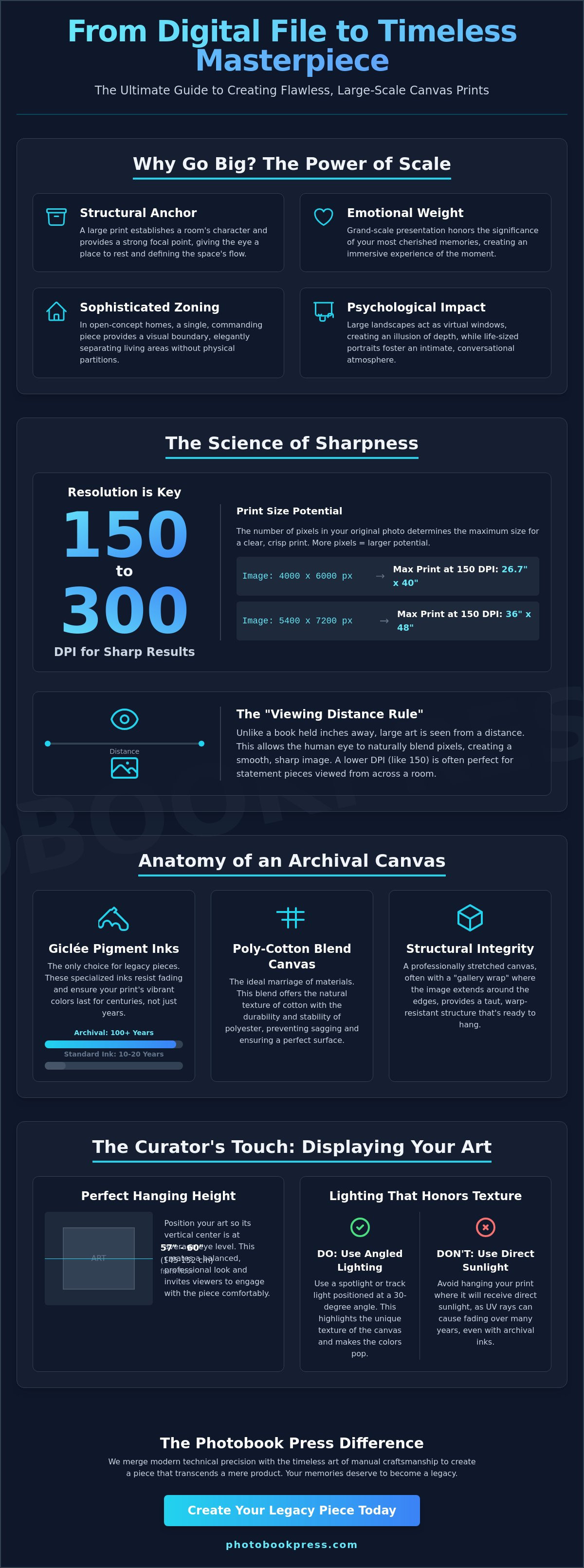
A work of art is only as enduring as the foundation upon which it's built. When you transition your digital memories into the physical world, the materials you choose dictate whether that piece remains a vibrant focal point or a fading relic. High-quality large canvas prints from photos require a meticulous marriage of chemistry and craftsmanship. This isn't merely about aesthetic appeal; it's about structural engineering designed to preserve a legacy for generations. True archival quality ensures that the tactile richness and visual precision you see today will remain unchanged for a century or more.
The choice of substrate is the first step in this preservation journey. While pure polyester is often used for high-volume, lower-cost production, a premium poly-cotton blend is the standard for fine art. This blend, typically weighing between 300 and 400 GSM, provides the perfect balance of texture and tension. It offers the natural look of traditional cotton while the polyester component ensures the canvas won't sag or stretch excessively as humidity levels fluctuate. For oversized pieces, this stability is vital. Machine-stretched canvases often lose their tautness over time, which is why the artisan's touch of hand-stretching is essential for maintaining a drum-tight surface that never ripples.
The Giclée standard is defined by the use of pigment-based inks rather than the cheaper, dye-based alternatives found in standard office printers. Pigment inks consist of tiny, solid particles of color suspended in a liquid carrier, which provide superior resistance to fading and environmental degradation. When paired with a protective UV-resistant archival varnish, these prints are rated to last between 100 and 200 years. It's this dedication to material science that allows premium photo printing services to offer products that transcend simple decoration. A final coating also guards against dust and light moisture, allowing you to clean your masterpiece with a soft, dry cloth without risking damage to the delicate image layer.
What lies beneath the canvas is just as important as the image itself. For large canvas prints from photos, a standard thin frame is insufficient. We utilize heavy-duty, 1.5-inch depth stretcher bars made from kiln-dried wood. The kiln-drying process removes internal moisture, ensuring the wood won't warp, twist, or bow after it's hung on your wall. As dimensions increase, the structural demands grow. Prints exceeding 40 inches require internal cross-bracing to maintain their geometric integrity. This museum-grade approach stands in stark contrast to cheap composite or finger-jointed alternatives, providing a robust skeleton that supports the weight and tension of a massive canvas without compromise.
Once you've secured the technical precision and archival quality discussed in previous sections, the focus shifts to the physical environment. Curation is the final act of the creative process. It's where your large canvas prints from photos stop being mere objects and start being experiences. The goal is to create a sophisticated dialogue between the art and the architecture of your home, ensuring the piece commands the room without overwhelming it.
The most common error in home curation is hanging art too high. Galleries follow a "Golden Rule": the center of the image should sit at eye level, roughly 57 to 60 inches from the floor. For oversized pieces, this ensures the viewer's gaze lands naturally on the most significant details. If the piece is exceptionally large, you might consider a floater frame. This addition provides a slim, elegant boundary that makes the canvas appear to hover, adding a layer of sophistication that anchors the piece to the wall. Large-scale art on 1.5-inch stretcher bars also has a substantial physical weight. You'll need to use heavy-duty wall anchors or secure the hanging hardware directly into wall studs to ensure long-term stability.
Lighting is the silent partner of every great canvas print. While a satin finish offers a soft, painterly glow, a matte finish is better suited for rooms with high-intensity lighting or large windows to minimize distracting glare. Recessed spotlights provide a clean, modern look, whereas traditional picture lights attached to the frame create a more intimate, classic atmosphere. Natural light can beautifully reveal the tactile texture of the weave. However, you should never place your art in the path of direct, sustained UV exposure, as even the highest archival-grade pigments can be stressed by constant sunlight.
Proportion is everything in interior design. When hanging art above a sofa or sideboard, follow the 2/3rds rule; the canvas should cover approximately 60 to 75 percent of the furniture's width. This prevents your large canvas prints from photos from looking like an afterthought or, conversely, overwhelming the seating area. Balance is achieved by leaving enough "negative space" around the piece so the wall can breathe. Before you commit to a specific dimension, use painter's tape to outline the proposed size on your wall. This simple visualization helps you feel the physical weight of the piece in the room before you finalize your order.
Ready to bring your vision to life? Start your custom canvas project today and choose the perfect scale for your space.
The creation of a masterpiece requires more than just high-end machinery; it demands a lineage of expertise. Since 1985, we've dedicated ourselves to the noble craft of production, evolving alongside technology while remaining anchored in traditional mastery. At our Maryland workshop, the process of creating large canvas prints from photos is treated with the same reverence as a museum commission. It's a place where modern technical precision meets the timeless art of manual craftsmanship. This heritage of excellence is why professional photographers consistently entrust us with their most significant works, knowing that their creative vision will be realized with absolute fidelity and structural integrity.
The dedication to physical craftsmanship in a local workshop mirrors the need for a strong real-world presence in any business; you can learn more about Mortar Profits to discover specialized offline marketing strategies for brick-and-mortar success.
Our commitment to quality extends to the very fibers of the substrates we use. We prioritize sustainable, museum-quality materials that respect both the environment and the longevity of your art. By selecting premium poly-cotton blends and kiln-dried hardwoods, we ensure that your investment is protected against the common pitfalls of mass production. We don't believe in shortcuts. Every piece that leaves our workshop is a testament to the belief that your personal history deserves the highest level of care. It's this dedication to the intersection of art and personal narrative that defines our unique position in the world of custom production.
Transforming a digital file into a physical heirloom is a journey of sensory refinement. Our white-glove review process ensures that every order for large canvas prints from photos is scrutinized by a master artisan before it ever reaches the printer. We look for the subtle nuances of color, resolution, and composition that automated systems might overlook. This human touch guarantees your statement piece arrives with the rich, tactile texture that only premium canvas can provide. We achieve a level of color accuracy and depth that honors the emotional weight of your memories, ensuring every hue is as vivid and enduring as the moment it was first captured.
Your journey toward a stunning focal point begins with our intuitive design tool, which allows for precise custom sizing tailored to your specific wall requirements. You aren't just ordering a product; you're partnering with a team that values substance and aesthetic perfection. The peace of mind that comes from artisan-led production means you can focus on the joy of creative expression while we handle the technical complexities of archival engineering. Design your custom large canvas print with Photobook Press and discover the profound difference that decades of print mastery can make in your home.
Creating a focal point that truly commands a room is an act of intentional design. You've explored how technical resolution and archival materials work in harmony to transform a digital memory into a museum-grade artifact. By understanding the nuances of lighting and the structural requirements of oversized frames, you're now equipped to make a choice that balances aesthetic beauty with long-term durability. It's about more than just filling space; it's about honoring the stories that define your life.
Since 1985, we've remained dedicated to the art of the physical print. Our large canvas prints from photos are built on a foundation of archival-grade Giclée ink technology and hand-stretched over kiln-dried wood to ensure they never lose their tension or vibrancy. We treat every image as a precious artifact, applying decades of craftsmanship to ensure your vision is realized with absolute precision. Transform your favorite photo into a stunning large canvas print today and experience the intersection of high-end artistry and personal history. Your walls are waiting for their masterpiece.
The standard for a crisp, professional result is 150 DPI at the final print size. While smaller items require 300 DPI, the increased viewing distance of oversized art allows for this lower density without a loss of perceived clarity. For a 24x36 inch piece, you should aim for a file resolution of at least 3600 x 5400 pixels. Checking these specifications ensures your large canvas prints from photos remain sharp and immersive.
A properly constructed canvas will not sag if it utilizes a premium poly-cotton blend and kiln-dried stretcher bars. We use these materials specifically because they resist the expansion and contraction caused by humidity. For dimensions like 40x60 inches, we also include internal cross-bracing to maintain the frame's structural integrity. This meticulous engineering ensures the fabric remains drum-tight and perfectly square for the life of the print.
You can safely remove surface dust using a soft, dry microfiber cloth or a static duster. If the canvas requires a deeper clean, a slightly damp cloth with plain water is acceptable; however, you must never use chemical solvents or household cleaners. Our archival-grade varnish acts as a protective shield for the pigments, allowing for gentle maintenance while keeping the delicate image layer beneath completely secure from environmental pollutants.
A gallery wrap is a finishing technique where the canvas is stretched around the wooden bars, allowing the image to continue along the sides. A floater frame is an external border that sits away from the canvas edge, creating a narrow gap that makes the art appear to hover. While gallery wraps offer a clean, modern aesthetic, floater frames add a sophisticated layer of depth often found in high-end art galleries.
Archival prints utilizing Giclée pigment-based inks are rated to last between 100 and 200 years when displayed indoors away from direct sunlight. This extraordinary longevity is a result of the chemical stability of the pigments and the UV-resistant topcoats we apply. These museum-grade materials are designed to prevent the fading and yellowing common in consumer-grade prints, ensuring your personal history remains a vibrant part of your home for generations.
Most modern flagship smartphones capture enough detail to create stunning large canvas prints from photos, provided you use the original file. Images captured in well-lit environments often have the pixel density required for prints up to 24x36 inches. You should avoid using photos downloaded from social media or messaging apps, as these platforms compress files significantly, which leads to visible blurring and pixelation when the image is enlarged.
The most secure method is to use heavy-duty wall anchors or to drive your hanging hardware directly into wall studs. Because large-scale art has significant physical weight, standard nails or adhesive strips are rarely sufficient for long-term stability. Using two hanging points rather than one will help distribute the weight more evenly across the wall. This professional approach prevents the frame from shifting and ensures your masterpiece remains level and secure.
