No Products in the Cart


Your family's most profound stories deserve better than a life spent hidden in a cloud server or a forgotten hard drive. While digital records offer convenience, they lack the tactile soul and permanence of a physical object. Creating a family history book is an act of curation; it's a way to bridge the gap between fragmented research and a tangible legacy that your descendants can actually hold. You've likely felt the weight of decades of genealogical data and wondered how to distill it without losing the essence of your ancestors' journeys.
It's common to feel overwhelmed by the technical hurdles of design or the fear that a printed volume won't do justice to the history it contains. You want more than a simple binder. You seek an archival-grade heirloom that reflects the dignity of your heritage. This guide provides a sophisticated path for transforming your research into a professional coffee-table book. We'll walk through the process of selecting premium materials, organizing complex narratives, and ensuring your work survives for generations. Discover how to move from a collector of facts to a curator of a timeless family masterpiece.
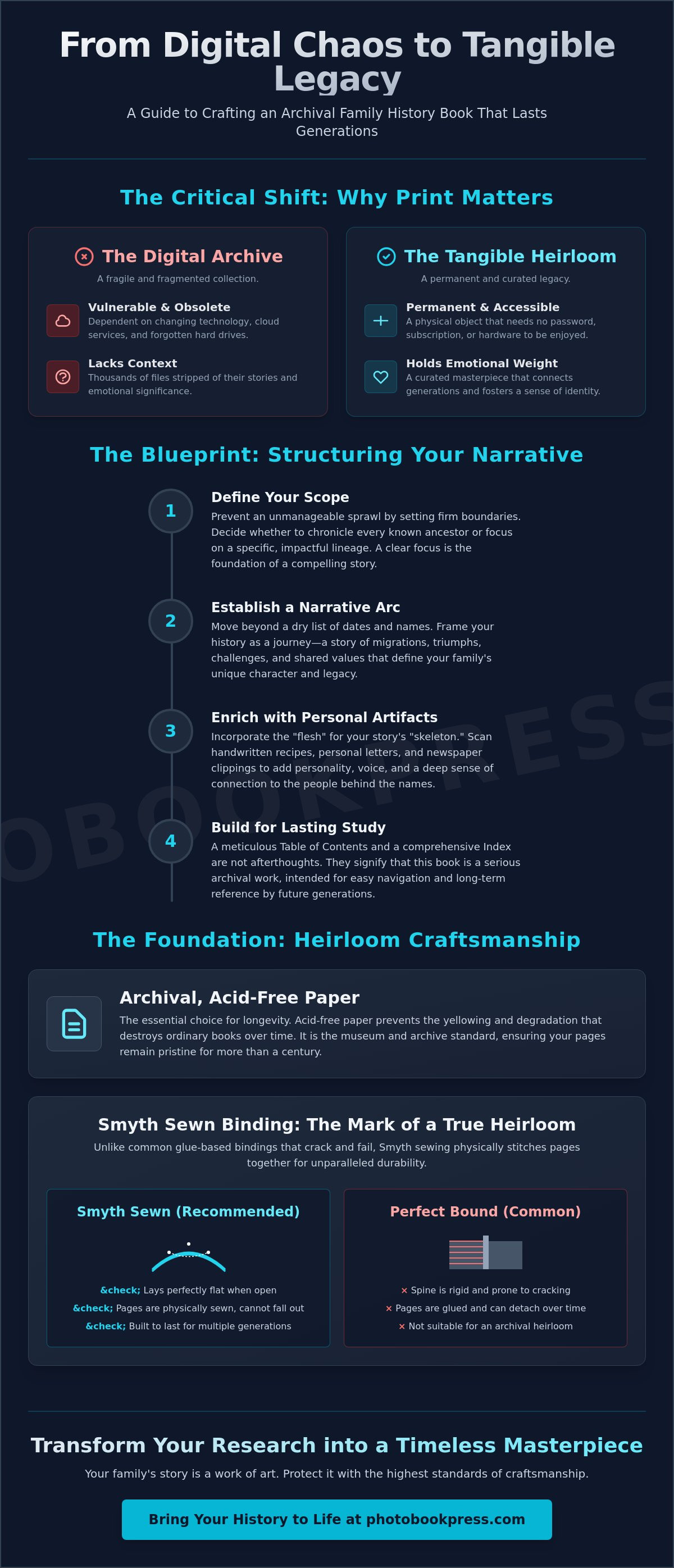
The digital era offered the promise of infinite memory, yet it often yields only a vast, unnavigable clutter. Thousands of images and scanned documents sit on forgotten drives, stripped of their context and vulnerable to the next shift in technology. Creating a family history book is the intentional act of reclaiming these fragments. It transforms a chaotic stream of data into a curated physical artifact that commands presence on a shelf or table. This isn't just about storage. It's about the dignity of a permanent record that your descendants can hold in their hands.
A true legacy requires more than a spreadsheet of ancestors. While the study of families, family history, and the tracing of their lineages provides the structural foundation, an artisan book provides the soul. It captures the specific cadence of a grandmother's stories and the unique grit of a grandfather's journey. By moving beyond cold dates and names, you preserve the personality and voice that make your heritage unique. A physical volume outlasts digital hosting because it requires no password, no subscription, and no hardware to remain accessible.
To better understand how these elements come together in a finished project, watch this detailed walkthrough of a completed family narrative:
Psychological research suggests that children who grow up with a strong sense of their family's past often exhibit higher levels of emotional resilience. When you document oral histories and unwritten lore, you provide a roadmap for younger generations. They see themselves not as isolated individuals, but as characters in a continuing narrative. The book becomes a vessel for these connections, turning abstract history into a tangible sense of belonging. It anchors the family's identity in a medium that invites slow, thoughtful engagement.
There's a profound difference between a casual photo album and a true heirloom. Digital platforms can vanish or change their terms of service, but a physical book exists independently of the cloud. It serves as a central source of truth for your family's provenance. Choosing materials like those found in premium Hardcover Photobooks or Leather Photobooks ensures that this record won't just sit in a drawer. It will survive for a century. It's an investment in the idea that your family's story is a work of art worth protecting with the highest standards of craftsmanship.
Organizing decades of research requires the eye of an editor and the heart of a storyteller. The process of creating a family history book begins with setting firm boundaries to prevent the project from becoming an unmanageable sprawl. You must decide whether to chronicle every known ancestor or focus on a specific lineage that carries a particular weight. Establishing a narrative arc allows you to move beyond a dry recitation of facts. Instead, you can frame your history as a sequence of migrations, triumphs, and shared values that define your family's unique character.
A logical structure is the foundation of any professional-grade volume. Categorizing your data by branch, geographic location, or historical era helps the reader navigate complex lineages without losing the thread of the story. While names and dates provide the skeleton, supplemental materials like handwritten recipes, personal letters, and yellowed newspaper clippings provide the flesh. When Preserving family papers and photographs, one must consider how these fragments will fit into a larger sequence. A meticulous table of contents and a comprehensive index are not merely functional; they signify that this book is a serious archival work intended for long-term study.
The framework you choose dictates the rhythm of the reader's experience. An ancestral approach starts with the present and moves backward, revealing the roots of modern traits. Conversely, a descendancy approach begins with a patriarch or matriarch and follows the expanding branches of the family tree forward through time. For a more evocative record, a thematic approach organizes the book by family trades, military service, or cultural traditions. This structure allows you to integrate professional photo books as the visual backbone of your project, ensuring the design supports the narrative flow.
Census data and birth certificates are often the only remaining evidence of a life, but they contain hidden depths. A simple occupation listing can be expanded into a descriptive narrative of daily life in a specific town or industry. When you encounter gaps in the historical record, handle them with grace by providing historical context about the era. This honesty adds credibility to your research. For those seeking a more substantial feel for their final product, Hardcover Photobooks provide the structural integrity and aesthetic prestige required for a multi-generational archive. The goal is to create a source of truth that feels as significant as the history it contains.
The curation of visual elements is the bridge between a dry genealogical report and an evocative legacy. While the previous section focused on the structure of your narrative, your imagery provides the emotional resonance that allows descendants to truly see their ancestors. Creating a family history book requires a discerning eye to balance high-contrast historical documents with the warmth of personal snapshots. For those beginning this journey, consulting a comprehensive guide to creating a family history can help establish the necessary context before you dive into the visual design phase.
Digitization is the first step in this artistic process. For flat, durable documents, a high-resolution flatbed scanner is the gold standard. However, for fragile, bound journals or three-dimensional artifacts like a great-grandfather's pocket watch, photography with soft, indirect lighting is often safer and more effective. Aim for a resolution of at least 300 DPI for standard photos and 600 DPI for documents with fine script to ensure clarity in the final print. When you begin restoring these images, resist the urge to erase every blemish. The patina of a cracked photograph or a tea-stained letter serves as a testament to the document's survival through time.
The art of the spread involves more than just placing photos on a page. It requires a balance of white space and imagery that allows the viewer's eye to rest. Use captions not just to identify names and dates, but to provide provenance and tell the story of the image itself. Blending formal, posed portraits with candid moments creates a dynamic rhythm that reflects the reality of family life. This thoughtful curation ensures that creating a family history book becomes an exercise in high-end gallery design rather than simple scrapbooking.
Include birth certificates, hand-drawn maps, and letters by using detail crops. This technique highlights specific signatures or geographic locations that might be lost in a full-page view. Detail crops create visual interest and allow you to showcase the texture of the original paper without overwhelming the layout. Ensure all scans are saved in a lossless format like TIFF to preserve the integrity of the archival record for future generations.
Utilizing a professional photo book maker allows you to maintain aesthetic consistency across hundreds of pages. Follow the rule of thirds when placing ancestral portraits to create a sense of balance and sophistication. For particularly evocative landscapes or ancestral homesteads, full-bleed images provide an immersive experience. This approach transports the reader back in time, making the history feel present and alive.
Creating a family history book is as much an exercise in engineering as it is in storytelling. A true heirloom must withstand the rigors of time, surviving through decades of handling and environmental changes. This longevity isn't accidental; it's the result of deliberate choices in material and construction. When you move from digital research to physical production, the focus shifts to the tactile quality and chemical stability of the vessel you're creating. An artisan's approach ensures that the finished volume doesn't just look beautiful today, but remains a permanent record for your great-grandchildren.
When creating a family history book, the choice of paper dictates the lifespan of the work. Archival-quality paper must meet strict acid-free and pH-neutral standards to prevent the yellowing and brittleness that plague standard commercial prints. This is paired with advanced printing technologies like silver halide or high-definition inkjet systems. Unlike standard toner, these methods ensure deep color saturation and photographic longevity. The goal is a visual experience that retains its clarity and depth, preserving the subtle details of ancestral portraits for a century or more.
The structural integrity of the book depends largely on the binding method. While many modern books use simple glue, a premium heirloom often utilizes Smyth sewn binding. This traditional technique involves sewing together groups of pages with durable thread before securing them into the cover. It provides a level of durability that glued "perfect" binding simply cannot match. This mechanical strength is complemented by the use of timeless cover materials like genuine leather or archival linen. These materials age gracefully, developing a character that reflects the history contained within the pages.
Layflat photo books are essential for preserving the continuity of complex family trees. Standard bindings create a "gutter" where the pages curve into the spine, often swallowing names or faces in a panoramic spread. Layflat technology allows the book to open completely flat, providing a seamless view across two pages. This isn't just an aesthetic choice; it reduces the physical stress on the spine, ensuring the book suffers less wear during frequent consultations.
The final touch of an artisan volume lies in its bespoke details. Foil stamping and debossing offer a level of personalized sophistication that standard printing lacks. You might choose a deep navy leather to reflect a naval heritage or a natural linen that evokes a specific historical era. These tactile finishes transform the book into a sensory experience. To begin building your own archival-grade volume, explore our collection of Leather Photobooks and discover the difference of true craftsmanship.
The transition from genealogical research to physical production requires a partner who understands that these pages hold more than ink; they hold a lineage. At Photobook Press, we bring over 40 years of expertise in high-end print production to every project we undertake. This heritage isn't just a number. It's a testament to our commitment to the noble craft of manufacturing. When you're creating a family history book, you aren't just printing a document. You're commissioning a permanent investment in your family's future. Our artisan process involves meticulous, hand-inspected binding and the use of professional-grade materials that exceed standard commercial expectations. We understand that your relatives may be spread across the globe. Our worldwide shipping ensures that your completed legacy reaches every branch of the tree, from local neighborhoods to distant continents.
The distinction between a mass-market book and a boutique print becomes clear the moment you touch the cover. Mass-market options often sacrifice visual clarity and structural durability for the sake of speed. In contrast, our artisan approach preserves the fine details of your historical scans. We ensure that every handwritten note and faint signature remains as legible as the original artifact. This level of care is what transforms a standard photo book into a multi-generational heirloom. By prioritizing archival-grade construction, we ensure that the story you've spent years gathering doesn't fade or fall apart. It remains a vibrant, tactile experience for decades to come.
The journey of creating a family history book concludes with a process that is both structured and deeply rewarding. Once you've curated your narrative and digitized your visual assets, the next step is to bring them into our production environment. Upload your files to our secure platform and select the format that best suits the scale of your story. Whether you require the expansive, seamless spreads of Layflat Photobooks or the timeless prestige of Leather Photobooks, we provide the artisan tools to realize your vision. Each choice, from the specific cover material to the foil-stamped personalization, is an opportunity to honor your ancestors. Don't let your research remain trapped in a digital void where it risks being lost to time. Begin crafting your family history book with Photobook Press today and secure your family's place in history.
The transition from fragmented genealogical research to a finished heirloom is a profound transformation. By prioritizing archival-grade materials and a structured narrative, you ensure that your ancestors' voices aren't lost to the passage of time or the inevitable obsolescence of digital files. Creating a family history book is a deliberate investment in the identity of your descendants, providing them with a tangible, sensory connection to their origins. You've curated the stories and restored the imagery; now, those memories deserve a vessel that reflects their true significance.
Photobook Press has been dedicated to the noble craft of printing and binding since 1985. Every volume we produce is meticulously hand-crafted in our Maryland facility, utilizing premium layflat and leather-bound options that meet the most rigorous technical standards. We take pride in being the trusted partner for historians who refuse to settle for mass-market compromises. Your research has reached its final destination. Preserve your family legacy with an archival-quality history book. It's time to allow your family's unique journey to take its place on the shelf as a work of art that will be cherished for generations.
A compelling family history book should blend raw genealogical data with narrative storytelling. Include ancestral charts, birth certificates, and personal letters alongside high-resolution portraits and candid snapshots. Creating a family history book is about capturing the "why" behind the dates, so ensure you include oral histories and descriptions of the family's cultural traditions to provide a complete picture of your heritage.
Most family history books range between 50 and 200 pages, though the final count depends on the depth of your lineage. For extensive research spanning several centuries, our Hardcover Photobooks offer the structural integrity needed to support a higher page count. It's often better to create a focused, high-quality volume than to overwhelm the reader with repetitive or unvetted data.
When faced with missing generations, focus on the historical context of the era to bridge the gap. Describe the social and political climate your ancestors would have experienced in that specific region or time period. This approach treats the "silence" in your records with grace, providing a narrative flow even when specific names or birth dates remain elusive.
You can use low-resolution photos, but they should be displayed at their original size or smaller to avoid pixelation. Treating these images as small, precious artifacts within a larger layout preserves their dignity. If an image is particularly grainy, consider using it as a secondary visual element alongside a clearer, modern document scan or a descriptive caption.
Smyth sewn binding and Layflat technology are the premier choices for books intended to last a century or more. These methods ensure the spine remains stable and pages don't detach over time. Pairing these techniques with archival-grade, acid-free paper and our premium Leather Photobooks creates a durable heirloom that resists the yellowing and brittleness caused by environmental degradation.
Writing the narrative yourself ensures the book retains your family's unique voice and emotional resonance. However, hiring a professional editor can help refine the structure and correct any grammatical inconsistencies. Many historians choose to write the primary draft and then seek a professional touch to ensure the final product meets the highest heirloom standards.
Use a flatbed scanner or a high-quality overhead camera to digitize fragile documents without causing physical stress. Never use a sheet-fed scanner for historical artifacts, as the mechanical rollers can tear delicate paper. Handle each item with clean, dry hands or archival gloves to prevent natural oils from damaging the original paper fibers.
A genealogy report focuses primarily on the technical study of lineages through names and dates, while a family history book is a curated narrative. The book prioritizes visual storytelling and emotional depth, transforming raw data into a work of art. Creating a family history book allows you to present your provenance as a sophisticated, coffee-table-style heirloom.
