No Products in the Cart


A digital photograph is merely a fleeting data point until it is given the physical weight and permanence of an archival frame. You shouldn't have to settle for prints that yellow or lose their luster within a decade. Choosing framed photo prints is an investment in your personal history, ensuring that your most meaningful moments are preserved with the same meticulous care as a gallery masterpiece.
It's common to feel lost among the technicalities of museum glass and acid-free mounting, especially when you want the final piece to harmonize with your home. We believe your memories are precious artifacts that deserve the highest level of craftsmanship. This guide clarifies the process of creating a museum-quality display, providing you with the confidence to select materials that offer true archival longevity and aesthetic perfection.
You will learn how to navigate a global printing market valued at 27.76 billion dollars in 2026 to find the perfect artisan finish. We'll explore the rising trends in natural wood textures, explain the importance of UV-protective glazing, and help you design a seamless path from a digital file to a finished heirloom that tells your story beautifully.
Digital saturation has rendered our memories nearly invisible, tucked away in cloud storage or lost in an endless scrolling feed. There's a profound psychological difference between viewing a backlit screen and standing before a physical piece of art. A tangible print demands attention. It invites a slower, more deliberate engagement with the past. As the global photo printing market is projected to reach $27.76 billion by 2026, the rising demand for high-end framed photo prints reflects a collective desire to reclaim our digital lives. Archival framed prints represent the definitive intersection of fine art and personal history, transforming a momentary light capture into a permanent legacy.
By selecting specific images for display, you move beyond mere decoration to curate a home that reflects your values and experiences. Wall art serves as a visual narrative, grounding your living space in a sense of identity and continuity. It's the difference between a house filled with objects and a home filled with stories.
To better understand the transformation of a simple image into a gallery-ready display, watch this helpful guide on the framing process:
Mass-produced frames often rely on acidic materials that cause photographs to yellow or "burn" over time. Choosing professional-grade framed photo prints ensures that your imagery is protected by the same standards used in museum archives. This transition from a simple commodity to a handcrafted heirloom is essential for preserving family history. In an era where 61.05% of photo products are purchased through online platforms, the distinction lies in the quality of the photographic printing process and the durability of the materials. A high-quality frame isn't just an accessory; it's a protective vessel for your most precious moments.
Not every digital file is destined for the wall. Selecting a "hero shot" requires looking for images with strong emotional resonance and high technical resolution. Large-scale framing demands clarity, making file quality a primary consideration for any artisan display. While a custom photo book is ideal for a comprehensive chronological narrative, a framed print should be a singular statement piece. It acts as a focal point, drawing the eye and anchoring the room's aesthetic. Whether it's a quiet candid or a grand landscape, the right moment deserves the permanence of archival craftsmanship.
Excellence in print is a silent collaboration between art and chemistry. While mass-market alternatives prioritize speed and cost-cutting, professional framed photo prints are built to endure for generations. The true value of a gallery-quality piece lies in the invisible components that prevent environmental decay. By selecting materials specifically engineered for longevity, you ensure that your investment remains as vibrant in fifty years as it is today.
Giclée printing utilizes sophisticated pigment-based inks that offer a significant leap in durability over standard dye-based systems. While dyes can begin to shift in color within five years, pigment inks are rated for 100 years or more under normal display conditions. This color precision is supported by acid-free, pH-neutral matting. Standard mats often contain lignin, a natural compound that turns acidic over time. This acidity slowly "burns" the photograph, resulting in unsightly yellowing or brittle edges. Using chemically inert materials is a non-negotiable standard for archival preservation.
True artisan frames feature hand-assembled joinery that respects the physical weight of the materials. Machine-glued corners often rely on quick-dry adhesives that become brittle and fail during seasonal humidity shifts. In contrast, manual joinery provides a structural permanence that ensures the frame remains square and secure for decades. This meticulous attention to detail transforms a simple border into a robust vessel for preservation. You can begin curating your own museum-quality display by exploring the handcrafted options at Photobook Press.
The choice of paper finish significantly impacts how an image is perceived. Lustre provides a refined pebbled texture that resists fingerprints and reduces glare, making it ideal for family portraits. Matte finishes offer a deep, velvety depth that is perfect for high-contrast black and white imagery. Selecting archival-quality paper ensures that these textures maintain their integrity without warping. For a deeper dive into these technical nuances, consult our ultimate guide to photo printing services.
UV-protective glass acts as a silent guardian against environmental aging. It filters out up to 99% of harmful ultraviolet rays that cause irreversible fading. When weight is a concern for larger pieces, high-grade acrylic offers comparable clarity with added shatter-resistance. Professional mounting techniques are equally vital; they ensure the print remains perfectly flat. This prevents the "rippling" or warping that occurs when paper absorbs ambient moisture. Every layer must be chemically inert to maintain the absolute integrity of the framed photo prints.
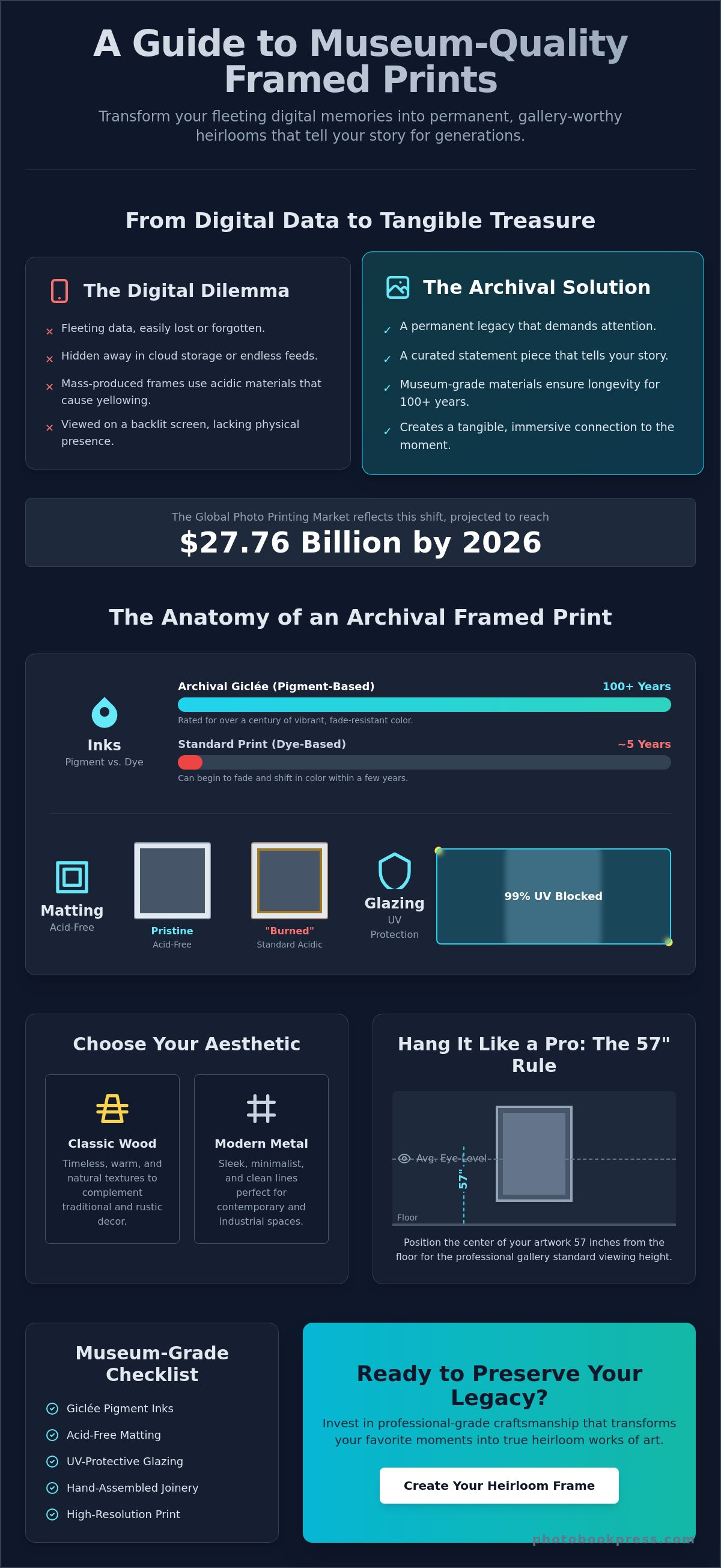
The selection of a frame is the final act of composition. While the previous section detailed the technical necessity of archival materials, the aesthetic choices you make determine how the art interacts with its environment. Framed photo prints should never compete with the image; instead, they should act as a sophisticated transition between the photograph's internal world and the room's decor.
Wood frames remain a cornerstone of heirloom presentation, particularly with the 2026 trend toward natural and organic textures like bamboo and light oak. These materials provide a warmth that complements family portraits and earthy landscapes. Conversely, modern metal frames in brushed gold or champagne metallic finishes offer a sleek, industrial precision that suits architectural photography or vibrant abstract pieces. The soul of the photo often dictates this choice. A candid, sun-drenched moment in a garden feels at home in natural wood, while a sharp, city skyline demands the hard edges of aluminum.
Black-and-white photography finds its most powerful expression in the classic gallery look: a deep black frame paired with a crisp white mat. This high-contrast pairing eliminates distractions, forcing the viewer to focus entirely on the light, shadow, and texture of the print. For color photography, consider pulling a subtle, secondary hue from the image to inform the frame tone. A muted bronze frame can highlight the golden hour glow in a sunset shot without overwhelming the primary subject.
Minimalist gallery frames are the definitive choice for contemporary landscapes. Their thin profiles allow the image to speak for itself. For wedding portraits or vintage family archives, ornate or textured wood adds a layer of historical weight and "press" heritage. If you seek a more modern, three-dimensional effect, deep-set shadow box frames create a sense of theater, making the framed photo prints appear to recede into the wall.
A mat provides essential breathing room for the eye. Single matting offers a clean, modern look, while double matting adds a subtle bevel that suggests depth and professional curation. To achieve a true museum-quality finish, consider a weighted mat. By making the bottom border slightly larger than the top and sides, you create a visual balance that compensates for the optical illusion of the print sinking within the frame. This technique, used by gallery curators for centuries, provides an immediate sense of prestige and deliberate design.
A successful gallery begins with a cohesive vision. Rather than hanging pieces at random, consider a theme that unifies your collection. This might be a chronological journey through a family’s decade, a tonal study in sepias and creams, or a subject-based focus on travel landscapes. By establishing these boundaries, your framed photo prints transform from a collection of images into a curated exhibition that tells a singular, powerful story.
Precision is the hallmark of professional installation. The most common error in home design is hanging art too high. Gallery curators follow the "eye-level" rule, which places the center of the artwork exactly 57 inches from the floor. This standard creates a consistent horizon line that guides the viewer’s eye naturally through the space. Before driving a single nail, create paper templates of your frames. Tape these to the wall to test your layout. This allows you to balance scale by placing large "anchor" pieces first, then surrounding them with smaller supporting prints to create a sense of movement and visual interest.
A gallery wall shouldn't be static; it's a living narrative that grows as your story evolves. To add tactile variety, consider mixing your framed photo prints with custom canvas prints. The interplay between the structured lines of a frame and the soft, textured edges of canvas creates a sophisticated visual rhythm. To maintain unity across diverse photographic styles, use consistent frame colors or identical matting widths. This ensures the overall presentation feels intentional rather than cluttered.
Even with archival glazing, placement matters for the long-term health of your art. Avoid hanging your most precious pieces in direct sunlight where constant thermal expansion can stress the mounting materials. Dedicated picture lights offer a museum-quality finish, casting a focused glow that pulls out the subtle details of the print. In high-traffic areas like hallways, consider slimmer frame profiles to prevent accidental bumps. For intimate spaces like a study or bedroom, deeper frames and more complex matting invite the viewer to step closer and linger. Start your gallery curation today with our boutique framing options designed for the modern home.
Selecting a partner to preserve your memories requires more than just a transaction; it demands a shared commitment to artistry. While many modern services prioritize volume and low-cost materials, Photobook Press operates with the meticulous care of a gallery curator. We treat every order of framed photo prints as a significant investment in your personal history. This boutique approach ensures that the technical precision expected by professional photographers is applied to every project, regardless of its scale.
Our Maryland heritage is the foundation of our work. Since 1985, we've mastered the delicate balance between historical craftsmanship and 2026 printing technology. This decades-long mastery allows us to offer a level of reliability and prestige that mass-market competitors simply cannot replicate. We don't just print images; we create physical artifacts designed to withstand the test of time. Every piece undergoes a rigorous manual inspection process before it leaves our facility, ensuring the joinery is perfect and the archival glazing is flawless.
Shipping a museum-quality piece requires more than a standard box. We utilize white-glove packaging protocols to guarantee that your art arrives in pristine condition. This attention to detail extends from the moment you upload your file to the second the piece is hung on your wall. By combining professional-grade standards with a human touch, we provide a seamless design-to-delivery experience that honors the weight of your most precious moments.
The "press" heritage of our brand is rooted in the physical act of creation. Since our inception in 1985, we've remained dedicated to the noble craft of printing. This history informs our modern approach, where manual hand-finishing remains a vital step in the production of every frame. We understand that we're not just framing a photo; we're supporting the personalized legacy of our clients. This human element ensures a level of soul and character that machine-only processes often fail to capture.
Our intuitive online tools allow you to visualize your framed photo prints with absolute precision. You can experiment with different frame profiles, mat widths, and finishes in real-time, removing the guesswork from the curation process. This interactive experience is built on our core philosophy: "Your story, beautifully told." We act as your trusted partner, providing the expert guidance needed to transform a digital memory into a tangible masterpiece. Begin curating your gallery with Photobook Press today and experience the difference of true artisan quality.
Your digital archives hold a lifetime of stories that deserve to be felt, not just viewed. Transforming these moments into a physical legacy requires a deliberate move away from the temporary nature of screens. By investing in framed photo prints crafted with museum-quality materials, you ensure your personal history remains vivid and protected for generations. We've defined the essential role of acid-free matting in preventing chemical decay and shared the professional curation techniques that turn a standard wall into a sophisticated gallery.
Since 1985, Photobook Press has served as a trusted partner for professional photographers who demand aesthetic perfection. Every piece is handcrafted in our Maryland facility using exquisite archival papers and manual joinery techniques that stand the test of time. This commitment to the craft ensures your memories receive the highest level of care. It's time to honor your history with the prestige it deserves.
Create your archival framed masterpiece with Photobook Press and ensure your most meaningful moments are beautifully told for years to come.
Archival quality is defined by the use of chemically inert materials that prevent deterioration over time. Standard prints often rely on dye-based inks and acidic wood-pulp mats that cause yellowing within 10 years. In contrast, archival framed photo prints utilize pigment-based inks and 100% acid-free cotton rag papers. These premium components ensure the artwork remains pristine for a century or more without chemical "burning" or color shifting.
Archival pigment prints are rated to last between 100 and 200 years when displayed under normal indoor lighting conditions. This longevity is a significant improvement over traditional silver halide prints, which may show signs of fading after 30 to 40 years. By using materials that meet museum standards, your framed photo prints become permanent heirlooms rather than temporary decorations.
UV-protective glass is essential for any piece displayed in a room with natural light. Standard glass only filters about 45% of harmful ultraviolet rays, while archival-grade glazing blocks 99% of UV radiation. This protection is the most effective way to prevent irreversible sun damage and color bleaching, even if the frame is not in direct sunlight.
You should aim for a resolution of 300 pixels per inch (PPI) at the final print size to ensure absolute clarity. For very large displays, such as a 24x36 inch frame, a minimum of 150 PPI is often acceptable because the viewing distance is typically greater. Using a file with at least 25 to 30 megapixels provides the detail necessary for a sharp, professional gallery appearance.
Acrylic is the preferred choice for large-scale pieces because it is 50% lighter than traditional glass and virtually shatterproof. This makes it much safer for hanging in high-traffic areas or over furniture. High-grade acrylic also offers superior optical clarity and is less prone to the green tint sometimes visible in thick panes of standard window glass.
Clean the glazing using a clean, lint-free microfiber cloth and a small amount of ammonia-free cleaner. Never spray liquid directly onto the frame; instead, dampen the cloth first to prevent moisture from seeping under the edges of the glass. For the frame itself, a light dusting with a soft brush every six months is sufficient to maintain the finish without scratching the material.
You can add a mat to almost any frame as long as the rabbet depth is deep enough to hold the glass, mat, print, and backing. A standard mat is typically 1.5mm thick, so the frame interior must accommodate this additional layer. Using a mat is highly recommended because it creates a necessary air gap between the print and the glass, preventing the ink from sticking to the glazing over time.
Heavy frames should be secured directly into a wall stud or supported by toggle bolts rated for at least double the weight of the piece. Avoid using simple nails or adhesive strips for any frame weighing more than 10 pounds. For maximum stability, use two hanging points rather than one; this distributes the weight more evenly and ensures the art remains level during daily household activity.
