No Products in the Cart


A leather photo album isn't just a vessel for images; it's a living archive that breathes with the history it holds. Many collectors treat preservation as a reactive chore, but true conservation is an intentional act of craftsmanship. If you've ever hesitated to touch a family heirloom for fear of leaving oils behind or causing the grain to crack, your caution is well-placed. Learning how to care for a leather photo album involves a delicate balance of moisture and pH management. By mastering these professional techniques, you ensure that the texture and color of your most precious volumes remain pristine for decades.
It's understandable to feel anxious about choosing the wrong product or worrying that a humid summer might damage delicate pages. You deserve the peace of mind that comes with expert knowledge. This guide will teach you how to maintain your albums with the precision of a gallery curator. We'll cover everything from the ideal storage environment of 65 to 70 degrees Fahrenheit to the selection of archival-safe, pH-neutral conditioners. You'll walk away with a clear maintenance schedule and the confidence to handle your legacy with the reverence it deserves.
Leather is essentially a biological archive. It responds to its environment just as it did when it was part of a living being. High-end albums aren't static objects; they interact with the air, absorbing and releasing moisture through microscopic pores. This organic quality is what allows a premium cover to develop a rich patina over time, a graceful aging process that adds character without sacrificing strength. However, this same permeability makes it vulnerable to neglect.
The suppleness of a professional-grade album comes from the natural lipids trapped within the collagen fibers. Understanding how to care for a leather photo album starts with respecting these internal oils. If these lipids evaporate due to poor storage or harsh chemicals, the leather becomes brittle, leading to irreversible structural damage. While consumer-grade "genuine" leather often relies on heavy plastic coatings that eventually peel, archival-grade hides require a more nuanced approach to maintain their delicate pH balance.
To better understand the tactile nature of leather maintenance, watch this helpful routine for cleaning and conditioning:
Not all leather is created equal. Top-grain leather represents the highest quality of the hide, retaining the dense, natural fibers that provide durability. In contrast, bonded leather is a composite of shredded scraps held together by polyurethane. It lacks the breathability required for long-term preservation. The tanning process also plays a critical role. Vegetable-tanned leathers are often favored for heirloom products because they avoid the harsh mineral salts found in some chrome-tanned varieties, which can eventually migrate and damage the photographs within. Dyes and finishes should be pH-neutral to ensure they don't block the leather's ability to regulate moisture.
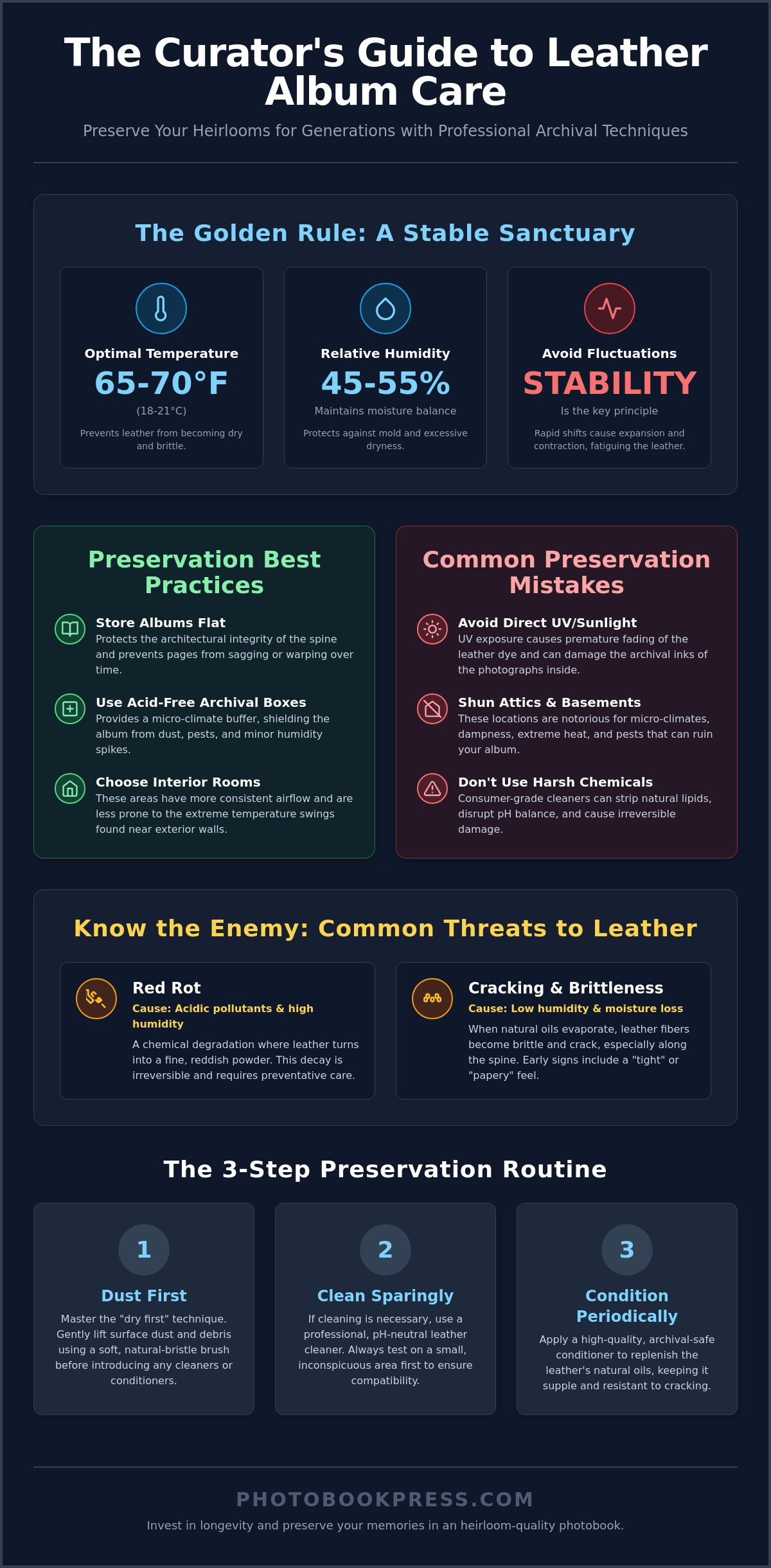
Red Rot is a term that strikes fear into the hearts of archivists. It refers to a chemical degradation where the leather turns into a fine, reddish powder. This occurs when acidic pollutants in the air react with the tanning agents in the leather, a process often accelerated by high humidity. Utilizing proper archival preservation techniques is the only way to prevent this decay.
Environmental factors are equally decisive. When the air becomes too dry, the leather's internal moisture drops below critical levels. This leads to structural cracking, particularly along the spine where the material is most frequently flexed. You can identify early distress by looking for a "tight" or "papery" feel to the surface. Catching these signs early allows you to stabilize the material before the damage reaches the interior pages and their precious contents.
Environmental stewardship is the silent guardian of your family history. While the craftsmanship of a book provides its foundation, the atmosphere surrounding it determines its ultimate lifespan. Professional archivists adhere to a strict "Golden Rule" for preservation: maintain a steady temperature between 65 and 70 degrees Fahrenheit with a relative humidity between 45 and 55 percent. Rapid fluctuations are the true enemy. These shifts cause the organic fibers of the leather to expand and contract, which eventually fatigues the material and weakens the structural integrity of the binding.
Avoid the temptation to store your precious volumes in basements, attics, or against exterior walls. These areas are notorious for micro-climates that harbor dampness or extreme heat. Instead, choose an interior room with consistent airflow and minimal temperature swing. For an added layer of security, utilize acid-free archival boxes. These containers act as a secondary buffer, shielding the cover from dust and minor humidity spikes. When you invest in premium leather photobooks, providing this controlled environment is the most significant step you can take toward a century-long legacy.
Leather is a porous, breathing material. It requires a gentle exchange of air to remain supple. Placing an album in a sealed plastic bin is a mistake; it traps ambient moisture and creates a breeding ground for mold and mildew. If you use larger storage containers, desiccant packs can help manage excess moisture, but they must be monitored and replaced. Never place your collection near HVAC vents or directly on the floor. These locations expose the hide to concentrated dry air or potential rising dampness that can warp the boards.
Light is a silent thief of color. UV radiation breaks down the chemical bonds in both the leather’s pigment and the photographic inks on the interior pages. Even indirect sunlight through a window can cause noticeable "sun-bleaching" over several years. Professional archives rely on "dark storage" as the gold standard for preservation. Position your albums on a shelf that remains in the shade throughout the day to prevent the hide from drying out prematurely.
Consistent care involves more than just climate control; it is about the ritual of mindful maintenance. Following book care tips from the NYPL can help you establish a routine that protects your collection from common household hazards. Understanding how to care for a leather photo album means recognizing that your home is a living museum. By controlling the light and air, you ensure your personal narratives remain as vivid and tactile as the day they were first bound.
Cleaning a masterpiece requires a light touch and a deep respect for the material's chemistry. When you're considering how to care for a leather photo album, the most important rule is the "Dry First" philosophy. Dust may seem harmless, but it's often composed of tiny silica particles that act as microscopic abrasives. If you introduce moisture or oils before removing this grit, you risk grinding these particles into the grain, causing permanent scratches. Always begin your maintenance ritual by gently sweeping the surface with a high-quality microfiber cloth or a soft-bristle goat hair brush.
The chemistry of care is rooted in pH neutrality. Most household cleaners, including "mild" soaps, are far too alkaline for organic hides. These substances can strip away the essential lipids we discussed in earlier sections, leaving the collagen fibers vulnerable to the environment. Avoid any products containing silicones, waxes, or heavy oils. While they might provide a temporary shine, they seal the leather's pores, preventing it from breathing and eventually leading to a suffocating, sticky residue. Before applying any archival-safe treatment, always perform a spot test on a discreet area, such as the inner turn-in of the cover, to ensure the dye remains stable.
Routine maintenance should focus on preventing buildup rather than heavy cleaning. Follow this sequence to keep the surface pristine:
Damp cleaning should be your last resort. If a stain persists, use a cloth that's barely damp with distilled water, then immediately follow with a dry cloth to ensure no moisture lingers.
There is a common misconception that all leather needs frequent oiling. In reality, modern archival leather used in premium wedding albums and photobooks is often sufficiently infused with stable fats during the tanning process. These lipids are designed to last for the first 20 years without intervention. Over-conditioning is a significant risk; it can lead to "spew," a white, cloudy film caused by fatty acids migrating to the surface.
If the leather feels genuinely dry or papery after several decades, only use a pH-neutral conditioner specifically formulated for bookbinding. Apply it sparingly with a soft cloth, allowing the leather to absorb what it needs before buffing away any excess. This measured approach ensures the leather remains supple without becoming oversaturated, preserving the tactile elegance of your heirloom for the next generation.
Every time you lift a leather volume from its place, you engage in a ritual of preservation. While the environmental controls discussed previously provide a foundation, the physical interaction during viewing is where most wear occurs. Mastering how to care for a leather photo album requires a mindful approach to handling that respects the engineering of the binding. It's not merely a book; it's a structural assembly of organic material and precision adhesive that deserves a gentle touch.
The "Clean Hands" protocol is your first line of defense. Even seemingly clean skin carries natural oils and microscopic acids that can, over time, etch into the grain of the leather or leave permanent residues on the page margins. Wash and dry your hands thoroughly before any viewing session. When sharing these moments with guests, take a brief moment to guide them. A simple request to handle the pages by the edges ensures that the oils from their fingertips don't compromise the clarity of your images or the suppleness of the cover.
The physics of the spine is the most critical technical consideration during use. When you open a photo book, the hinge bears the entire weight of the page block. To minimize this stress, always support the album on a clean, flat surface rather than holding it suspended in the air. This distributes the weight evenly and prevents the adhesive from pulling away from the leather backing.
Handling begins with the removal of the album from its storage box or slipcase. Use both hands to support the entire length of the volume, avoiding the common mistake of pulling it out by the top of the spine. When viewing, adopt the "Center-Out" page-turning technique. By gently lifting the page from the middle of the outer edge, you minimize the torque applied to the binding hinge. It's also vital to treat the album as a sacred object. Never use the heavy cover as a writing surface or a place to rest a glass, as the pressure can cause permanent indentations or moisture rings that no amount of conditioning can fully erase.
The orientation of your album on the shelf is a choice between aesthetics and structural longevity. For heavy, high-page-count professional wedding albums, horizontal storage is the superior choice. This prevents "Spine Lean," a condition where gravity slowly pulls the heavy page block downward, causing it to sag and eventually detach from the leather cover.
If you prefer vertical storage for smaller volumes, ensure they're supported by sturdy, smooth bookends that don't pinch the leather. Unlike traditional books that might suffer from being opened fully, modern layflat photo books are specifically engineered to remain perfectly level during viewing, reducing the internal tension that often plagues standard bindings. To ensure your next project is built with this level of structural integrity, consider the artisanal quality of our Leather Photobooks.
The most meticulous routine for how to care for a leather photo album is only as effective as the material's original quality. At Photobook Press, our commitment to archival excellence began in 1985. We understand that a leather volume is a vessel for a lifetime of significance. This is why we select materials designed for a 100-year lifespan, ensuring the foundation is as robust as the memories it protects. Our Maryland workshop serves as a sanctuary for traditional craftsmanship, where every hide is hand-inspected to meet our rigorous standards for grain consistency and material stability.
Our construction process prioritizes chemical neutrality. We utilize professional-grade, acid-free adhesives that eliminate the risk of harmful reactions between the leather cover and the interior pages. This technical precision extends to our binding technology, which is engineered to support the natural movement of the leather spine. By allowing the organic material to flex without compromising the adhesive bond, we create a structure that remains resilient through decades of viewing. Every component is chosen to ensure that the aging process remains a beautiful evolution rather than a structural failure.
The selection of our leather covers is a deliberate process. We prioritize top-grain hides that offer both aesthetic grace and long-term stability. Because our manufacturing environment in Maryland is strictly controlled, every custom photo book begins its life in a low-acid state. This synergy between premium leather and our advanced layflat page technology creates a product that is as functional as it is beautiful. It's designed to lie perfectly level while protecting the integrity of the hinge, reducing the physical stress that often leads to material fatigue in lesser bindings.
In a digital-first world, the weight and texture of a physical archive offer an emotional resonance that a screen cannot replicate. We view our role as a trusted partner to professional photographers and the families they serve. Your album is more than a product; it's a gallery-worthy artifact that documents a unique personal history. We encourage you to treat these volumes with the reverence they deserve, knowing that the craftsmanship within is designed to withstand the passage of time. When you master how to care for a leather photo album, you aren't just cleaning a cover; you're safeguarding a narrative for the next century. When the technical standards of the maker meet the careful stewardship of the owner, a legacy is truly preserved.
True preservation is a quiet, consistent commitment to stewardship. You now possess the specialized knowledge to maintain the delicate balance of moisture, pH, and environmental stability that premium leather requires. By adhering to the "dry first" cleaning method and maintaining a strictly controlled climate, you ensure that the tactile grace of your collection remains uncompromised. Mastering how to care for a leather photo album isn't just about maintenance; it's about honoring the stories held within the grain.
The foundation of a lasting legacy begins with the quality of the vessel itself. Since 1985, we've expertly crafted archival solutions in Maryland, becoming the preferred choice for professional photographers who demand structural stability. Each volume is hand-bound with premium, sustainably sourced leathers designed to age with elegance. We invite you to design your own archival-quality leather photo album today and begin the journey of curation. Your memories are precious artifacts, and they deserve a home that's as enduring as the moments they capture. Trust in the process of creation and the ritual of care.
No, you should avoid using baby wipes because they often contain alcohols, fragrances, and moisturizing oils that can disrupt the leather's delicate pH balance. These chemicals can strip away the natural lipids essential for suppleness, leading to premature drying or a sticky residue. Instead, stick to a dry microfiber cloth or a soft-bristle brush. If a mark persists, a cloth barely dampened with distilled water is a much safer alternative for targeted cleaning.
Storing your album flat is the superior choice for maintaining long-term structural integrity. This horizontal orientation ensures the weight of the heavy page block is supported by the back board rather than pulling downward on the binding. Vertical storage frequently leads to "spine lean," a condition where gravity causes the pages to sag and eventually detach from the leather cover. For heirloom volumes, horizontal placement in an archival box remains the gold standard.
You should only apply a pH-neutral conditioner once every one to two years, and only if the material shows genuine signs of dryness. Modern archival leathers are engineered to retain their internal moisture for decades without frequent intervention. Over-applying products can lead to a cloudy film known as spew, which is difficult to remove. When learning how to care for a leather photo album, remember that a light touch is always preferred over frequent chemical treatments.
Isolate the affected album immediately to prevent spores from spreading to the rest of your collection. Gently wipe away surface growth with a dry, soft cloth while working in a well-ventilated outdoor space to avoid inhaling spores. Once cleaned, you must stabilize your storage environment to a relative humidity between 30% and 50%. If the mold has penetrated the paper fibers or the inner binding, consult a professional conservator to prevent irreversible damage.
Never use a hairdryer or any concentrated heat source to dry leather, as extreme heat causes the organic fibers to shrink and crack. Heat accelerates the evaporation of essential lipids, leaving the cover brittle and permanently warped. If your album becomes damp, blot the excess moisture with a lint-free cloth and allow it to air dry naturally in a cool room with steady air circulation. Patience is the only way to preserve the material's structural grace.
Cracking along the spine is usually the result of consistently low humidity or a lack of physical support during viewing. When the air drops below 30% relative humidity, the leather loses its natural elasticity and becomes prone to structural failure at its primary flex point. Using both hands to support the volume and ensuring the environment remains between 65 and 70 degrees Fahrenheit will mitigate this stress. This is a critical aspect of how to care for a leather photo album.
Clean, dry hands are generally preferred over white cotton gloves for handling premium archival albums. While gloves prevent oil transfer, they significantly reduce your tactile sensitivity and can accidentally snag or tear delicate page edges. Thoroughly washing and drying your hands removes the acids and oils that cause degradation without compromising your grip. Many professional archivists favor this "clean hands" approach because it offers a better balance of safety and control.
To remove a musty odor, place the album in a sealed container with an odor absorbent like activated charcoal or baking soda, ensuring the absorbent material never directly touches the album. Leave the volume in this environment for several days to allow the charcoal to pull the scent from the leather's pores. Improving the airflow in your primary storage area will help prevent the stagnant, humid conditions that allow these odors to develop in the first place.
