No Products in the Cart


A photograph remains a digital ghost until it meets the tangible weight of fine-art paper and the permanence of a master's bindery. Learning how to choose a photo book service is less about selecting a convenient software interface and more about auditing the archival chemistry that will protect your legacy for generations. You've likely felt the quiet anxiety that comes with entrusting your most significant milestones to a printer, fearing that poor color reproduction or a fragile spine might fail the weight of the moment. It's a valid concern; a book that falls apart at the seam is a memory lost twice.
We believe your personal history deserves the same meticulous care as a gallery curation. You'll discover how to evaluate print quality, binding techniques, and material longevity to choose a service that transforms your digital images into a permanent legacy. We will examine the technical standards of museum-quality construction, from the tactile difference in paper weights to the structural integrity of layflat engineering, ensuring your finished product is as enduring as the stories it holds.
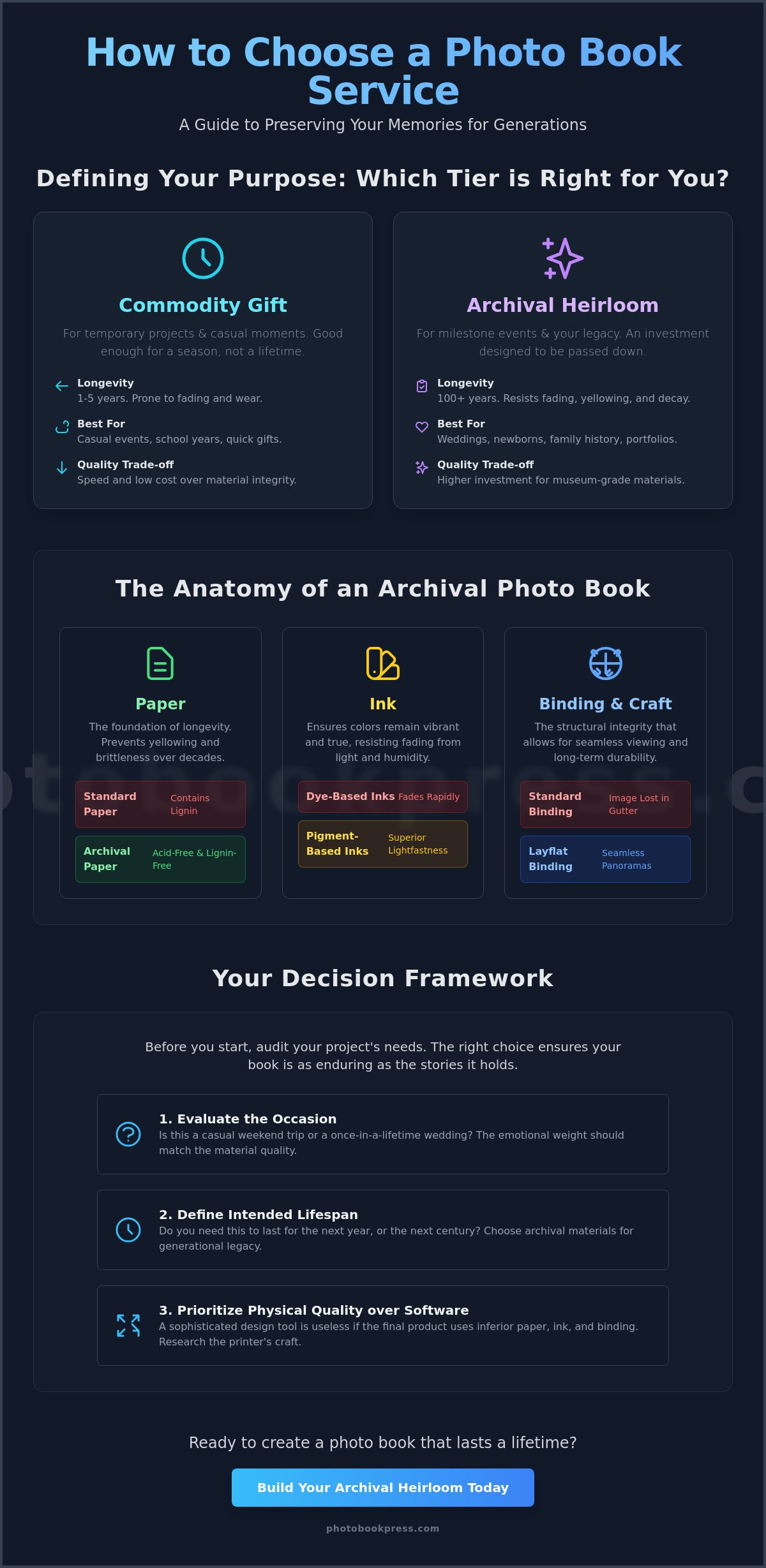
The decision of how to choose a photo book service begins with a single, clarifying question: how long do you intend for this story to last? In a world saturated with digital clutter, the physical page offers a rare sense of permanence. To truly understand what is a photo book in its most elevated form, one must distinguish between a temporary collection of snapshots and a curated vessel for family history. This distinction defines the "Legacy Tier" of your project. It's the difference between a book that sits on a coffee table for a season and one that's passed down through generations.
Archival quality in 2026 is no longer a vague marketing term. It represents a rigorous set of technical standards designed to prevent the yellowing, brittle pages, and structural decay that often plague mass-produced volumes. Choosing a service that prioritizes archival integrity means your images will retain their depth and clarity for a century or more. True artistry requires a marriage of chemistry and craft, utilizing acid-free papers and pigment-based inks that bond with the fiber of the page. This ensures that the vibrant hues of a summer wedding or the delicate shadows of a newborn portrait remain unchanged by the passage of time.
To better understand common pitfalls in the creation process, watch this helpful guide on avoiding frequent mistakes:
There are moments when a "fast print" service is perfectly appropriate. These offerings are ideal for temporary projects like a child's school year, a casual weekend getaway, or a simple gift for an acquaintance. When you opt for these services, you're essentially accepting a "good enough" threshold. You might notice subtle shifts in color accuracy or a thinner paper weight that feels less substantial in the hand. These books serve their purpose beautifully as ephemeral keepsakes, but they aren't designed to survive the rigors of frequent leafing over several decades. If the goal is speed and low cost for a non-essential memory, the budget route is a practical choice.
Milestone events require a different level of craftsmanship. Weddings, the arrival of a new child, or the documentation of a family genealogy are more than just projects; they are investments in your personal legacy. This is where professional photo books become essential. These volumes utilize bespoke bindery techniques and museum-grade materials that digital-first platforms often overlook. For the artist or the professional photographer, a bespoke book is the only way to ensure a portfolio reflects the true artistry of their work. When the emotional weight of the memory is high, the structural integrity of the book must match it. A handcrafted leather or layflat book isn't just a product; it's a tactile experience that honors the gravity of your most significant life events.
True artistry in print is a matter of molecular stability. When you evaluate how to choose a photo book service, you are essentially auditing the materials that will carry your memories through time. The foundation of any heirloom volume is the paper. Standard retail prints often contain lignin, a natural component of wood pulp that eventually oxidizes and turns pages yellow and brittle. To avoid this decay, look for papers that are certified acid-free and lignin-free. These specifications ensure the substrate remains chemically inert, preserving the pristine white of the page and the integrity of the image for decades.
The ink technology used is equally critical to the lifespan of your book. Most budget services utilize dye-based inks, which are essentially liquid stains that can fade rapidly when exposed to light or humidity. In contrast, professional artisans employ pigment-based inks. These consist of solid particles of color that sit on the surface of the paper, offering superior lightfastness and water resistance. While standard retail dye prints may begin to shift in color within fifteen to twenty years, pigment-based prints are engineered to remain vibrant and stable for over a century. This technical precision aligns with established archival digital printing standards, ensuring your photographs are treated with the same care as museum collections.
Tactile experience is governed by paper weight, measured in GSM (grams per square meter). A higher GSM indicates a thicker, more substantial page that resists tearing and minimizes "show-through" from the reverse side. Premium books typically feature papers starting at 190 GSM, while luxury wedding albums may exceed 300 GSM. This physical weight provides a rhythmic flow to the viewing experience, signaling that the content within is significant. Accurate color reproduction also relies on sophisticated ICC profiles and regular color calibration. These tools ensure the deep blues of a twilight sky or the subtle skin tones of a portrait translate perfectly from your screen to the physical page. If you value this level of precision, exploring handcrafted layflat photobooks is a natural next step in your creative journey.
The finish you select dictates the sensory mood of your book. Glossy finishes offer high contrast and vibrant saturation, though they are prone to glare and fingerprints. Matte finishes provide a sophisticated, non-reflective surface that feels contemporary and artistic. Lustre, a favorite among professionals, sits between the two. It offers the rich colors of gloss with the fingerprint resistance of matte, making it ideal for books intended to be handled frequently. Match the texture to your subject; a rugged landscape may benefit from a heavy matte, while a high-fashion portfolio often shines on a lustre finish.
A "Museum Grade" designation is a promise of longevity. It means every component, from the core of the paper to the adhesive in the binding, has been tested for chemical permanence. This rigor protects your investment against the environmental factors that age lesser products. By adhering to these standards, a master artisan ensures that the story you tell today will remain legible and beautiful for the generations that follow, long after digital file formats have become obsolete.
A sophisticated digital interface often masks a mediocre physical workshop. When determining how to choose a photo book service, it is easy to be seduced by an intuitive app or a library of trendy stickers. However, an elegant software experience does not guarantee a museum-quality end product. The primary role of design software should be to facilitate your creative vision, not to compensate for a lack of manufacturing heritage. A service that prioritizes marketing over the actual bindery often produces books that feel lightweight or lack the color depth promised on your screen.
The rise of "Auto-Design" and AI-driven layouts offers a deceptive convenience. While these tools can organize thousands of images in seconds, they lack the soul and intentionality of manual curation. An algorithm cannot understand the emotional weight of a shared glance or the narrative rhythm required to build a coherent story. To create a photo book that serves as a lasting heirloom, you must maintain total creative control. This requires a platform that offers layout flexibility, allowing you to adjust margins, bleed settings, and typography to suit the unique character of your photography.
Professional design software should act as a guardian of your image quality. A major red flag is a service that lacks robust low-resolution warnings or forces you into proprietary formats that prevent you from exporting your work. You should also watch for hidden limitations in font choices and rigid template structures. If a service doesn't allow you to adjust the "gutter" or "safe zones," they're likely using a standardized, high-speed assembly process that prioritizes volume over precision. These constraints are often signs of a commodity printer rather than a dedicated artisan facility.
The most critical stage of production occurs after you click "order." In a commodity print house, your book is one of thousands moving through an automated system with zero human intervention. In contrast, a boutique bindery relies on the "master printer" perspective. This involves manual quality checks at every stage, from inspecting color consistency to ensuring the structural integrity of the spine. By following durable bookbinding guidelines, artisans ensure that the physical construction matches the beauty of the images. At Photobook Press, we balance modern digital precision with traditional craftsmanship; every volume undergoes a rigorous review by a skilled technician who understands that they aren't just printing a book, they're preserving a life event.
The spine of a book is its silent architecture. While paper and ink define the visual experience, the bindery determines how the object lives in your hands and how it survives the passage of time. Understanding how to choose a photo book service requires a close look at the mechanics of assembly. Most retail services rely on high-speed adhesive binding, which can become brittle and crack as the years go by. A premium artisan, however, prioritizes structural integrity through techniques like Smyth sewing or specialized layflat construction. These methods ensure the book remains supple and strong, surviving decades of frequent handling without losing its form.
Manual binding remains the definitive hallmark of a superior service. In a world of automated assembly lines, the steady hand of a craftsman ensures every corner is tucked perfectly and every hinge is aligned with precision. This level of attention to detail is what transforms a simple collection of prints into a gallery-quality artifact. A machine cannot feel the tension of the leather or the grain of the linen; only a human touch can guarantee that the physical construction of the volume is as flawless as the memories it contains.
The primary appeal of layflat photo books is the elimination of the "gutter" loss. In a standard book, the center fold consumes a portion of the image, making panoramic landscapes or wide family portraits difficult to appreciate. Layflat engineering allows for total visual continuity across a two-page spread. Beyond aesthetics, these books are structurally superior because they don't fight against the spine when opened. While hinged layflat pages utilize a physical joint to allow the paper to move, integrated layflat spreads are crafted from a single, continuous sheet of paper that is scored and folded to create a seamless, panoramic experience.
The cover is the first tactile interaction a reader has with your work. It serves as both a protective shell and a visual introduction to the story within. Choosing between Italian leathers and fine linens often depends on the personalized nature of the project. A wedding album might call for the timeless, heavy presence of a leather-bound volume, while a portfolio of architectural photography might feel more at home in a minimalist, textured linen. Hardcovers provide the necessary rigidity to protect the internal page blocks from warping or environmental damage. For the final touch of prestige, debossing or foil stamping allows you to etch your title into the material, creating a physical impression that matches the permanence of the stories inside.
If you are ready to see your work framed by this level of craftsmanship, we invite you to explore our collection of handcrafted leather and layflat books.
Selecting a partner for your creative vision requires more than a casual glance at a pricing table. It is a commitment to the preservation of your personal history. To master how to choose a photo book service, you must move beyond the surface level of digital templates and interrogate the physical soul of the product. By following a disciplined decision framework, you ensure that your final product is not merely a book, but a curated artifact that reflects the weight of your most precious memories. This process begins with a clear understanding of your project's "Legacy Tier," which dictates every subsequent material choice.
Once the purpose is defined, audit the service's material specifications with the eye of a curator. Verify that the substrate is acid-free and the inks are pigment-based; these are the non-negotiable pillars of archival longevity. Next, test the design interface for creative freedom. A service that limits your ability to adjust margins or typography is likely prioritizing high-speed automation over artistic intent. You should also review the production heritage of the facility. A workshop with a deep history in the American print tradition offers a level of reliability that a tech-first startup cannot replicate. Finally, factor in long-term support and professional benefits. If you are a photographer or artist, look for services that offer professional discounts and sample kits to facilitate your client work.
Before you commit your images to the press, perform a final audit of the service's operational transparency. A premium artisan will often provide sample kits or paper swatches, allowing you to feel the GSM weight and texture before the first page is printed. Check for a clear guarantee on color accuracy and manufacturing defects; this reflects the brand's confidence in its own craftsmanship. You should also watch for hidden shipping costs or restrictive digital storage policies that might complicate your design process. A truly professional service is transparent about every detail, from the origin of its leathers to the location of its bindery.
Our Maryland facility serves as a sanctuary for the American print tradition. Since 1985, we have refined the balance between state-of-the-art digital precision and the irreplaceable touch of manual binding. We understand that a photograph is a sacred trust. This heritage of mastery allows us to offer a level of archival excellence that satisfies both the casual hobbyist and the meticulous creator of professional wedding albums. By choosing a partner that treats your memories as precious artifacts, you ensure that your story will remain vibrant and intact for the generations that follow. We don't just print books; we manufacture legacies.
The transition from a digital file to a physical heirloom is an act of curation that requires both technical precision and artistic vision. By prioritizing archival chemistry and structural integrity, you ensure that your most significant milestones aren't just printed, but preserved. Mastering how to choose a photo book service allows you to move past temporary trends and invest in a product that will remain vibrant for a century. Whether you're documenting a wedding or a family genealogy, the materials you select today determine the longevity of your story tomorrow.
At Photobook Press, we've honored the American print tradition through artisan craftsmanship since 1985. Our state-of-the-art Maryland production facility combines modern innovation with the meticulous care of manual binding to create volumes of unrivaled quality. We invite you to design your archival-quality legacy with Photobook Press today, where we also offer specialized discounts for professional photographers seeking to elevate their portfolios. Your stories are the precious artifacts of your life. It's time to treat them with the enduring excellence they deserve.
You should look for the specific mention of "acid-free" and "lignin-free" certifications within the product's material specifications. Archival papers are chemically treated to remain inert, which prevents the yellowing and brittleness that often affects standard wood-pulp papers over time. A premium service will be transparent about these technical details, often highlighting the specific paper mill or the museum-grade standards they follow to ensure long-term preservation.
A layflat album utilizes a specialized binding technique that allows the pages to rest perfectly flat when opened, whereas a standard book features a traditional curved spine that creates a "gutter" in the center. This seamless construction makes layflat volumes the superior choice for panoramic images that span across two pages. While standard books are excellent for casual storytelling, layflat albums offer a more substantial, gallery-style viewing experience without losing any part of the image to the fold.
Digital resolution is critical because even the most sophisticated print facility cannot restore detail to a low-quality file. When you are researching how to choose a photo book service, prioritize platforms that provide clear low-resolution warnings during the design process. For a crisp, professional finish, your images should ideally be 300 DPI at their final print size to ensure that every texture and subtle gradient is rendered with precision on the physical page.
The higher cost of premium services typically reflects the use of superior materials, such as pigment-based inks and handcrafted leather covers, as well as the involvement of skilled artisans. Unlike budget services that rely on high-speed automation, boutique binderies employ manual quality checks and use acid-free substrates that resist fading for a century. You are investing in the structural integrity and archival chemistry required to transform a simple book into a permanent family heirloom.
The choice between matte and glossy depends on your aesthetic goals, though matte is frequently favored for a sophisticated, fine-art appearance. Matte paper offers a non-reflective, tactile surface that excels in soft lighting and resists fingerprints. Glossy paper provides vibrant color saturation and high contrast, which can be striking for high-action or commercial photography. Many connoisseurs select a lustre finish as a middle ground, offering the depth of gloss with the refined texture of matte.
A book constructed with archival-grade materials can remain vibrant and stable for over 100 years when stored in a controlled environment. In contrast, standard retail prints using dye-based inks may begin to shift in color or yellow within 15 to 20 years. Understanding how to choose a photo book service that utilizes pigment-based inks and lignin-free paper is the most effective way to ensure your personal narrative survives long enough to be shared with future generations.
Professional-grade artisan services are designed for anyone who treats their memories as precious artifacts. You don't need professional credentials to access museum-quality paper or bespoke leather binding. These services provide an elevated design experience that allows hobbyists to produce work indistinguishable from a gallery portfolio. It's about the value you place on the story you're telling, rather than the equipment you used to capture the images.
For a wedding album, prioritize services that offer heavy-weight layflat pages and durable, premium cover materials like genuine Italian leather or fine linen. The binding must be exceptionally robust to withstand decades of frequent handling by family and friends. Look for artisan customization options such as foil stamping or debossing, which provide a tactile sense of prestige and ensure the exterior of the volume is as beautiful as the ceremony it documents.
