No Products in the Cart


In an era of infinite digital noise, your finest work is often reduced to a fleeting millisecond on a cold glass screen. You've likely felt the frustration of seeing your most meticulous compositions scrolled past without a second thought. A high-end photo book for professional portfolio presentation changes that dynamic instantly, reclaiming the viewer’s attention through the undeniable gravitas of weight and texture. It's about moving beyond the screen to create a tangible legacy that reflects your technical precision and commands a premium authority.
We understand that a standard consumer book won't suffice for a true artisan. You require the structural integrity of layflat photo books that allow your panoramic spreads to breathe without the interruption of a gutter. Drawing on 40 years of printing heritage, this guide will help you master the art of physical presentation. You'll learn how to select heavy-weight archival paper and professional binding styles that ensure your work remains pristine for decades. We're going to show you how to build a book that doesn't just display your images, but justifies your worth through tactile excellence and perfect color reproduction.
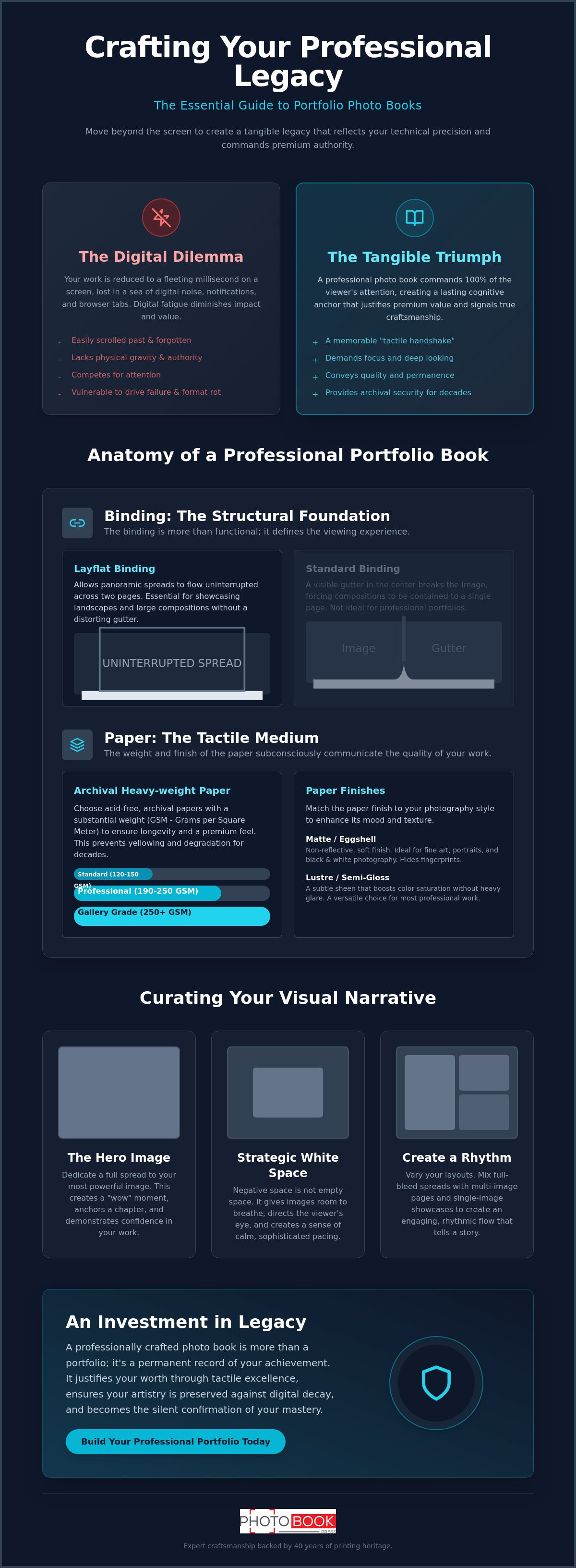
Digital presentations are ephemeral and often lack the gravity required for high-stakes client meetings. A physical photo book acts as a "tactile handshake," a term that describes the immediate connection forged when a client feels the weight of your work. This physical encounter creates a cognitive anchor; while a website is often forgotten as soon as the tab is closed, a tangible object remains in the physical space of an office or a studio. It signals that your work is worthy of space and time, demanding a level of respect that a digital file simply cannot command.
Digital fatigue is a documented reality for many decision-makers who spend their days staring at backlit displays. When you present a photo book for professional portfolio review, you command 100% of the viewer's attention. There are no notifications to distract them or browser tabs to tempt them away. You control the environment, the lighting, and the pace at which your story is told. This focus is rare, and it's incredibly valuable for an artist seeking to make a lasting impression that lingers long after the meeting concludes.
To better understand the creative possibilities of modern print, watch this helpful video:
The sensory impact of weight and texture cannot be overstated. When a client feels the substantial heft of high-grade paper, they subconsciously associate that quality with your technical skill. The deliberate "reveal" of turning a page creates a narrative tension that digital scrolling lacks. It slows the heart rate and encourages deep looking, allowing the viewer to appreciate the fine details of your composition. The tactile authority of a professional portfolio is the silent confirmation of an artist’s mastery over their medium.
There is a critical distinction between a temporary lookbook and a definitive portfolio. A lookbook might be a softcover collection of current trends, but a photo book for professional portfolio use should feel permanent and intentional. Using layflat binding signals that this is a curated career arc, not a fleeting experiment. It shows you've invested in your own legacy and that you value your work enough to present it in its best possible light. For a deeper dive into these concepts, explore our guide on Portfolio Books: The Professional’s Guide to Physical Presentation in 2026.
High-end physical presentation correlates directly with premium service pricing. If your work is presented on a cheap screen, it feels like a commodity. When it's encased in archival paper and professional binding, it becomes an investment. Beyond aesthetics, physical prints offer archival security that digital files cannot match. While hard drives fail and file formats become obsolete, a well-crafted book remains a permanent record of your achievement. It's the only true insurance against the inevitable decay of digital storage, ensuring your artistry remains accessible for decades.
Creating a physical masterpiece requires a transition from the glowing pixels of a calibrated monitor to the steady reality of ink on paper. This shift demands a deep understanding of technical specifications that separate a standard consumer product from a gallery-grade investment. When you commission a photo book for professional portfolio use, the primary goal is chromatic fidelity. Your chosen printer must utilize advanced color management systems that respect the nuances of your highlights and the depth of your shadows. Achieving this level of precision is a cornerstone of the industry, as noted in this Sessions College guide to becoming a photographer, which emphasizes that a professional's presentation must be as current and precise as their technical skill.
Durability is equally critical. A portfolio is a working tool, meant to be handled by creative directors and potential clients. We utilize high-performance adhesives and traditional binding techniques that resist the mechanical stress of frequent opening. Unlike standard retail books that may crack at the spine, a professionally bound volume maintains its structural integrity over hundreds of viewings. It's this marriage of chemistry and craft that ensures your work doesn't just look exceptional today, but remains a robust representation of your brand for years to come.
For landscape, architectural, or commercial photographers, the choice of binding is often the most significant technical decision. Layflat photo books are the industry standard because they eliminate the "gutter" where the pages meet the spine. This allows for seamless, uninterrupted panoramic spreads that command the viewer's full field of vision. This no-gutter architecture is achieved through a specialized hinging process, ensuring your hero images are never compromised by a fold. You can learn more about these construction methods in our article on The Art of the Layflat Photo Book: A Definitive Guide for 2026.
The "heft" of a book is a psychological indicator of quality. We focus on premium paper stocks, often ranging from 170 GSM to over 300 GSM for our most substantial offerings. This weight provides a satisfying tactile resistance that prevents accidental creasing. Beyond the weight, the chemistry of the paper is vital. Acid-free, archival-quality paper is non-negotiable; it prevents the yellowing and brittleness that plague lesser materials. When paired with UV-resistant inks, these archival standards guarantee that your color vibrancy won't fade under gallery lights or office sun exposure. To begin selecting the materials that best suit your aesthetic, you might explore our curated collection of professional formats.
A photo book for professional portfolio presentation is ultimately a promise of quality. By insisting on these technical standards, you're telling your clients that you value precision in every facet of your work. The science of the print becomes the silent partner to your creative vision, providing a stable, high-end platform that elevates your imagery to the status of fine art.
A photo book for professional portfolio use shouldn't be viewed as a storage device for your best work; it's a curated gallery experience. The sequence of your images tells a story about your technical range and creative maturity. To master this narrative, employ the "Hero Image" strategy. Your opening spread must be an undeniable statement of authority that immediately validates the viewer's time. Similarly, your final image should act as a definitive closing argument, leaving a resonant visual afterglow that lingers long after the book is closed.
Visual pacing is just as vital as the images themselves. Many artists make the mistake of crowding every inch of archival paper, but white space acts as a necessary breath between high-density compositions. By allowing a significant piece of work to stand alone on a page, you signal its importance. This deliberate use of emptiness prevents the viewer from feeling overwhelmed and ensures that your most complex images receive the scrutiny they deserve. When you cull your work with conviction, aim for a 20-page masterpiece rather than a 100-page archive. A lean, high-impact volume suggests you have the discernment to edit your own vision, a trait highly valued in professional circles.
Leveraging layflat technology allows you to showcase wide-angle technical skill without the distraction of a central fold. Panoramic spreads are perfect for architectural details or vast landscapes where continuity is paramount. When designing these spreads, be mindful of subject placement; while there's no gutter to swallow detail, centering a face or a fine line exactly on the fold can still feel visually jarring. For more technical insights, see our Professional Photo Books: The Ultimate Guide to Archival Quality & Design (2026).
Typography should never compete with your imagery. A minimalist approach using clean, sans-serif fonts ensures that project titles and descriptions provide context without drawing the eye away from the art. Select a typeface that mirrors your brand’s aesthetic, whether it’s the quiet elegance of a light serif or the modern precision of a geometric sans. In a high-end portfolio, the "less is more" philosophy ensures that your words serve as subtle guides rather than loud distractions.
Thematic sequencing allows you to group work by color, mood, or project type rather than a simple chronology. This approach demonstrates a sophisticated understanding of visual harmony. When a viewer turns the page and finds a transition that feels emotionally or aesthetically logical, they aren't just looking at photos; they're experiencing your unique perspective. This level of intentionality is what transforms a simple collection of prints into a photo book for professional portfolio presentation that wins contracts and builds a lasting creative legacy.
The first interaction a client has with your work isn't visual; it's physical. When they reach for your photo book for professional portfolio review, the resistance of the cover and the weight of the volume set an immediate expectation. This is the "tactile handshake." A heavier book subconsciously signals a more established career, suggesting that your creative output has a gravity that justifies its physical mass. It's about moving beyond the ephemeral feel of digital tablets to something that feels permanent and deliberate.
Premium materials aren't just aesthetic choices; they're brand identifiers. Choosing between leather and linen changes the "voice" of your presentation before a single page is turned. To further elevate the exterior, consider the subtle authority of an embossed finish. Foil stamping or debossing your logo into the cover material provides a high-end presence that feels integrated rather than applied. This level of detail mirrors the precision you bring to your photography, reinforcing your position as a master of your craft—a standard of excellence also practiced by professional aesthetic specialists like Bare Beauty—while ensuring your photo book for professional portfolio presentation leaves no detail to chance.
Leather remains the pinnacle for corporate and high-end wedding presentation. The scent and texture of genuine leather communicate a sense of heritage and luxury that synthetic alternatives cannot replicate. Conversely, linen and fabric covers offer a modern, boutique aesthetic. They suggest an editorial or fine-art sensibility, perfect for photographers whose work feels organic or avant-garde. The choice depends on the emotional response you want to elicit from your specific audience, whether it's the timelessness of a legacy or the freshness of a new perspective.
The interior finish must complement your specific photography style to maintain high-level print quality. Matte archival paper is the standard for fine art, offering a non-reflective surface that allows the viewer to focus on texture and tone. Lustre finishes are often preferred for weddings and portraits because they provide a slight sheen and excellent fingerprint resistance. For commercial portfolios where color "pop" is essential, high-gloss finishes can provide maximum vibrance. For a deeper look at these choices, read The Ultimate Guide to Photo Printing Services: Quality vs. Convenience in 2026.
Every material choice should be a reflection of your professional standards. Whether you're opting for the classic elegance of sewn binding photo books or the modern sleekness of a layflat design, the physical components must work in harmony with your images. To start building your definitive physical presence, explore our full range of professional-grade materials and finishes.
Choosing a partner for your physical presentation is an investment in your own reputation. At Photobook Press, our journey began in 1985, rooted in a period when print was the only medium for professional excellence. This heritage informs every decision we make today. We don't just manufacture products; we preserve artistry through a rigorous blend of state-of-the-art technology and bespoke manual binding. Creating a photo book for professional portfolio use requires a level of scrutiny that automated factories simply cannot provide.
Our dedicated national facility serves as the heart of our operations, ensuring that every volume meets our exacting standards of precision. While we utilize advanced printing systems to achieve perfect color reproduction, the final stages of production remain firmly in human hands. Hand-finished edges and manually inspected bindings ensure that your portfolio arrives with the structural integrity required for years of high-stakes presentations. This commitment to craftsmanship is what allows us to offer a professional advantage that bridges the gap between technical data and emotional impact.
We believe that every professional deserves museum-quality materials. This means utilizing acid-free archival paper and light-fast inks that protect your images from the passage of time. Our manual quality control process involves a page-by-page inspection to ensure that your layflat or sewn binding photo books are flawless. It’s this meticulous attention to detail that transforms a simple book into a definitive career statement. Design your professional portfolio book with Photobook Press today.
We know that your time is best spent behind the lens or in the studio. Our design tools are built for efficiency, allowing you to translate your digital vision into a physical format without unnecessary complexity. Whether you are producing a single masterpiece or a limited run, a photo book for professional portfolio use should be as easy to create as it is impressive to hold. Once finalized, our worldwide shipping options ensure your work can reach international clients with the same level of care it received in our facility. For recurring needs, we offer dedicated support and wholesale tiers that recognize the ongoing requirements of a busy creative practice. Explore our insights on The Art of the Personalized Legacy: A Guide to High-End Customization in 2026 to see how we can further tailor our craft to your brand.
Mastering the physical presentation of your work is the final step in establishing your professional authority. By moving beyond the digital screen, you create a permanent anchor for your creative vision that commands undivided attention. We've explored how archival materials, layflat binding, and intentional curation work together to transform a simple collection into a high-end photo book for professional portfolio use. These elements don't just display your images; they justify your value and secure your artistic legacy for decades to come—a commitment to quality that many professionals also extend to their workspace sustainability when they learn more about Eco Sunpower Pty Ltd.
Since 1985, our team has dedicated itself to the noble craft of hand-bound quality. We use only premium archival-grade materials to ensure your work remains as vibrant as the day it was printed. For busy artisans with recurring needs, we provide professional photographer wholesale discounts to support your growing practice. It's time to let your work be felt as much as it is seen. Elevate your professional presentation with a custom portfolio book from Photobook Press. Your finest work deserves a home that matches its excellence.
The 11x14 inch landscape format is widely considered the gold standard for a photo book for professional portfolio use. This size provides enough surface area to showcase intricate details while maintaining a manageable weight for transport. Smaller 8x10 formats work well for intimate editorial work, but larger dimensions command more presence during a formal review.
Layflat binding is the definitive choice for professional portfolios. It allows your images to flow across a two-page spread without being swallowed by a central gutter. This seamless architecture is essential for photographers who want to present wide-angle shots as uninterrupted visual experiences. High-end layflat photo books provide the structural integrity needed to showcase your technical skill on a grand scale.
Lustre is generally the most practical finish for a working portfolio. It offers a subtle sheen that enhances color vibrance while providing a textured surface that resists fingerprints during frequent handling. Matte is a beautiful alternative for fine-art photographers who prefer a non-reflective, velvet-like finish, though it requires slightly more careful handling to prevent scuffing over time.
A curated selection of 20 to 30 images is the professional standard. Including too many photos can dilute your brand and suggest a lack of discernment. Your photo book for professional portfolio presentation should act as a "greatest hits" collection, featuring only your most authoritative work. Each image must earn its place by demonstrating a specific technical skill or creative perspective.
Leather is exceptionally durable and develops a unique patina over time, making it ideal for high-end corporate or wedding presentations. It naturally resists moisture and wear better than fabric. Linen offers a sophisticated, modern aesthetic but can be more susceptible to fraying or staining if it's placed on unclean surfaces during frequent client meetings.
Minimalist text is a powerful tool for providing context. Including project titles, locations, or brief descriptions in a clean, sans-serif font can help guide the viewer through your narrative. The goal is to ensure the typography remains a quiet companion to the art, providing necessary information without competing for visual dominance on the archival paper.
When constructed with archival-grade materials, a professional book can last for 50 years or more. We use acid-free papers that won't yellow and UV-resistant inks that prevent fading even with regular exposure to light. This longevity ensures that your physical portfolio remains a consistent, high-quality representation of your career for decades.
We provide dedicated wholesale tiers and professional discounts for photographers who require recurring printing services. These programs are designed to help you maintain a current physical presence as your body of work evolves. By partnering with a lab that understands the commercial needs of artists, you can invest in sewn binding photo books while managing your production costs effectively.
