No Products in the Cart


In 2026, the world will capture an estimated 1.95 trillion photos, yet the vast majority of these moments remain trapped behind cold glass screens. It's a staggering volume of history that often feels more like digital clutter than a cherished legacy. You likely feel the weight of these thousands of images and worry that your most precious memories might eventually vanish or lose their luster through poor printing. Choosing the right medium for your story shouldn't be a source of technical confusion.
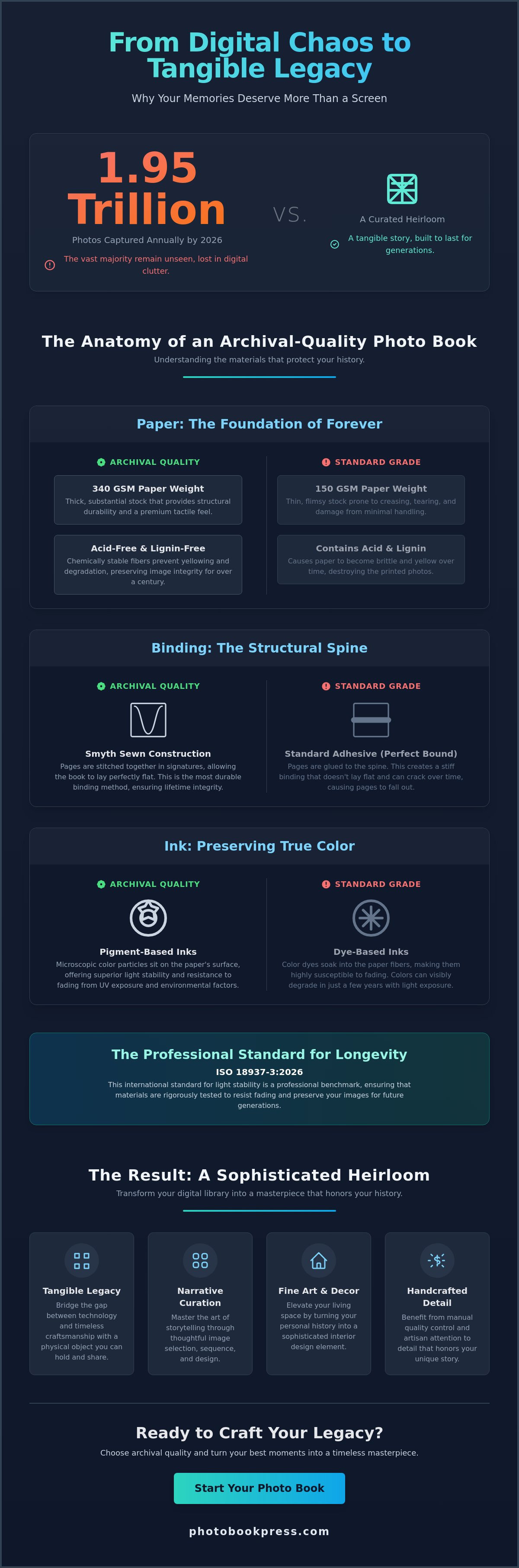
High-quality photo books are not merely products. They are handcrafted vessels designed to preserve your personal history against the test of time. We'll show you how to move beyond the screen to create a sophisticated, gallery-quality heirloom that commands attention. You'll learn how to navigate professional standards like the ISO 18937-3:2026 for light stability and why 340 GSM acid-free paper is the gold standard for longevity. This guide provides a clear path through the complexities of artisan binding and paper weights, ensuring your curated collection becomes a physical masterpiece that lasts for generations.
In 2026, the sheer volume of digital imagery is overwhelming. With 1.95 trillion photos expected to be captured this year, most of our life's most beautiful moments are destined to sit on a server, effectively invisible to the naked eye. This digital clutter creates a paradox; we capture more than ever, yet we feel less connected to the result. A curated, physical volume changes this dynamic by transforming fleeting data into a permanent, tactile experience. It's the difference between a scrolling glass screen and a deliberate, meaningful page turn. When you hold a book, you're holding a physical manifestation of time.
Exploring the history of the photo book reveals its role as a foundational vessel for narrative and artistic intent. Unlike a random folder of jpegs, photo books allow you to dictate the rhythm of a story through sequence, scale, and silence. The weight of the paper and the texture of the binding add a sensory dimension that digital displays simply can't replicate. These physical objects serve as the definitive record for your family, ensuring that your legacy doesn't disappear when a cloud subscription expires or a file format becomes obsolete. It's an investment in a future where your story remains accessible, vivid, and beautifully told.
The "photo dump" culture of the early 2020s is fading. Today's creators are choosing intentional curation over mindless accumulation. This shift reflects a deeper desire to preserve professional and family history with the dignity it deserves. When you hand someone a physical book, the interaction is focused and intimate. It invites a slower, more respectful pace of discovery. You aren't just showing pictures; you're sharing an experience that has been carefully edited to highlight what truly matters. It's about choosing quality over quantity, turning a chaotic digital library into a coherent and lasting legacy.
A well-crafted book is more than a storage device. It's a piece of fine art that enhances your living space. Placing custom photo books on a coffee table or a library shelf turns your personal history into a sophisticated interior design element. This is where personal artistic expression meets home decor. By choosing premium covers and elegant typography, you create a gallery piece that reflects your aesthetic taste while keeping your most cherished memories within reach. It's a subtle yet powerful way to integrate your history into a refined, modern home environment, ensuring your best work is always part of the conversation.
A masterwork isn't accidental. It's the result of meticulous material selection and a deep understanding of the medium's physics. To create photo books that endure for a century, one must look far beyond the surface of a digital image. The foundation of any heirloom lies in its paper weight, measured in grams per square meter (GSM). While standard commercial books often use thin 150 GSM stock, a true heirloom requires the substance of 230 to 340 GSM. This specific thickness provides the tactile "snap" and structural durability necessary for a lifetime of handling. Beyond weight, the chemical composition is vital. Archival quality necessitates paper that is entirely acid-free and lignin-free to prevent the yellowing and brittle degradation that eventually destroys lesser prints.
The choice of ink is equally critical for color longevity. While many consumer-grade printers rely on dye-based inks that can fade rapidly under UV exposure, professional-grade printing utilizes pigment-based inks. These microscopic particles of color sit atop the paper fibers rather than soaking in, offering superior resistance to environmental factors. This technical rigor supports the psychological benefits of photo books, as the permanence of the physical object reinforces the permanence of the memories it contains. For those seeking this level of precision, exploring the artisan options at Photobook Press ensures every material choice meets the highest museum standards.
Premium stocks like Mohawk Superfine are celebrated for their unparalleled consistency and refined texture. The way a paper’s surface catches the light determines the depth of your shadows and the brilliance of your highlights. A matte finish absorbs light for a soft, painterly feel, while silk offers a subtle sheen that enhances contrast without the harsh glare of high-gloss. For panoramic spreads, the choice of layflat paper is essential. These thicker sheets are bonded back-to-back, allowing the book to stay perfectly flat without a gutter, preserving the integrity of wide-angle landscapes.
Achieving true-to-life color requires more than a standard four-color (CMYK) process. Professional artisans often employ six-color printing to capture the subtle gradations in skin tones and sky gradients. This depth is protected by the latest international standards, including ISO 18937-3:2026, which tests print stability under modern LED lighting environments. Archival quality is defined as the use of materials that guarantee a lightfastness rating of 100 years or more without significant fading or color shift. This commitment to science ensures that the visual story you curate today remains a vivid masterpiece for the generations that follow.
The architecture of a book dictates how its story unfolds. While the digital world is fluid and fleeting, the physical format you choose for your photo books provides a permanent structure for your memories. Selecting the right canvas involves balancing aesthetic desire with structural necessity. For instance, the choice between Smyth sewn and adhesive binding isn't merely technical; it's a question of endurance. Smyth sewn binding involves sewing folded groups of pages together with thread, allowing the book to open wider and last significantly longer than standard adhesive methods. This traditional technique ensures that your book remains a cohesive unit even after decades of frequent handling.
Format selection often mirrors the weight of the occasion. A classic hardcover provides a sense of prestige and protection, making it the definitive choice for wedding albums or family genealogies. In contrast, softcover books offer a more approachable, magazine-like feel, perfect for annual "Year in Review" collections or travel journals. When considering the preservation of these objects, the Library of Congress provides essential guidelines for maintaining an archival-quality photo book, emphasizing that the physical housing is just as important as the prints themselves. Whether you choose a grand 12x12 format for high-impact landscapes or a sophisticated 8x10 for intimate portraits, the dimensions should allow your imagery to breathe.
For those who favor expansive landscape photography or cinematic wide shots, layflat binding is the gold standard. This method uses a unique hinge or specialized paper bonding that allows the book to rest completely flat when opened. It effectively eliminates the "gutter" loss that occurs in standard binding, where parts of an image disappear into the center fold. To understand how this technology enhances your visual narrative, consult The Art of the Layflat Photo Book: A Definitive Guide for 2026. It's a seamless way to present panoramic stories without interruption.
The cover is the first tactile point of contact with your history. Choosing materials like genuine leather or fine linen ensures that your book ages gracefully, developing a unique character over time. While vegan alternatives offer modern durability, genuine leather remains a staple for those seeking a traditional heirloom feel. You can further elevate the presentation with custom embossing or foil stamping, adding a professional finish that signals the value of the contents within. These sensory details transform photo books from simple collections of images into sophisticated artifacts of personal art.
Curation is the act of distilling a chaotic digital archive into a focused visual narrative. While modern software often offers automated layout tools, true craftsmanship requires a human eye to identify the emotional thread connecting disparate images. Creating successful photo books starts with a rigorous selection process. You must look for images that serve a specific purpose within a narrative arc. Establishing shots set the scene, detailed close-ups evoke intimacy, and candid moments capture genuine emotion. Embracing the "Less is More" principle is essential. By allowing generous white space to surround an image, you give the viewer's eye a place to rest, ensuring each photograph receives the attention it deserves.
Adding text should be a deliberate, artistic choice. Captions or short passages of prose should illuminate the imagery rather than clutter the page. Choose a minimalist typeface that complements your aesthetic. This ensures the typography feels like a natural extension of the visual story rather than a distracting afterthought. When you treat the layout as a gallery wall, the relationship between images becomes as important as the images themselves.
A compelling layout functions much like a musical composition. It uses varied image sizes and orientations to create a visual rhythm that guides the reader. Every spread should ideally feature a "Hero Image." This is a singular, high-impact photograph that anchors the layout and commands immediate focus. This approach prevents the design from feeling monotonous or overwhelming. For a deeper look at how to structure these narratives, explore The Definitive Guide to the Modern Photo Book: Preserving Legacies. By mastering these principles, you move from merely documenting events to creating a curated experience.
Aesthetic vision must be supported by technical precision. To ensure your prints are crisp and professional, all images should be at least 300 DPI at their final print size. Low-resolution files will appear pixelated on high-quality paper, undermining the premium feel of your work. Understanding "bleed" and "safe zones" is equally vital. Keep essential subjects and text at least 0.25 inches away from the page edges to avoid accidental trimming during the binding process. Finally, calibrating your screen's brightness ensures that the vibrant hues you see on your monitor translate accurately to the physical page. You can start designing your heirloom photo book today to see your story come to life through artisan printing.
Excellence isn't found in mass production. It's earned through decades of practice and a refusal to compromise on the materials of history. Since 1985, Photobook Press has operated with a singular focus on the noble craft of the press, treating each project as a unique investment in a person's legacy. Our Maryland facility is a sanctuary for print where modern precision meets the steady hand of the master artisan. While many competitors rely on fully automated lines to churn out commodities, we treat photo books as individual works of art. Every volume undergoes rigorous manual quality control, ensuring that the alignment, color, and structural integrity meet the exacting standards of the professional photographers who have trusted us for 41 years.
The distinction of our work lies in customization options that go beyond the industry standard. We provide the freedom to select from premium linens, genuine leathers, and specialized papers that reflect the weight of your story. This boutique approach creates an atmosphere of exclusivity where the focus remains steadily on the intersection of art and personal history. By choosing a partner with a deep heritage in artisan printing, you ensure that your digital library is transformed into a sophisticated, archival-quality physical legacy that commands respect on any library shelf.
Inside our facility, technology serves the craftsman, not the other way around. We use high-end digital presses for color precision, but the final assembly is a human endeavor. Manual binding is a deliberate choice because a human touch can sense the subtle tension of a thread or the perfect set of an adhesive in ways a machine cannot. This dedication to the physical act of bookmaking is detailed further in our comprehensive resource, Photo Books: The Ultimate Guide to Creating a Lasting Heirloom in 2026. It's the essential difference between a book that lasts a season and an heirloom that survives a century.
We aren't just a printer; we're a trusted partner in the creative process. For professional photographers, we offer wholesale options and specialized support that respect the business of fine art. Hobbyists aren't left behind. They receive the same expert guidance to transform their first project into a museum-grade artifact. Our commitment to quality extends globally, with worldwide shipping ensuring that your personal history can be shared across continents. Whether you're documenting a wedding or a lifetime of travel, we provide the tools to ensure your story is beautifully told. Your memories deserve the highest level of care, and we're here to provide the craftsmanship they require.
The transition from a crowded digital drive to a physical masterpiece requires a shift in perspective. You've discovered how archival-quality materials and deliberate curation turn scattered images into a profound narrative. By prioritizing technical standards such as 340 GSM acid-free paper and pigment-based inks, you ensure your history remains vibrant for over 100 years. These choices represent more than just aesthetics; they're the structural bedrock of a true legacy that can be passed down through the ages.
Photobook Press has championed the noble craft of artisan printing since 1985. In our Maryland-based professional facility, we blend modern color precision with the timeless durability of handcrafted layflat and leather-bound options. High-quality photo books serve as the definitive record of your life's most meaningful chapters, providing a sensory experience that no digital file can match. It's time to move beyond the fleeting nature of the screen and give your memories the tactile elegance they deserve. Your story is ready to be told with the weight and grace it deserves.
Begin Crafting Your Custom Photo Book Heirloom and preserve your history today.
A photo book features images printed directly onto professional-grade paper using high-end presses, while a traditional album involves mounting individual prints onto cardstock or into sleeves. This distinction allows for sophisticated layout control and a more refined, library-ready profile. The result is a cohesive, published volume that feels like a curated gallery piece rather than a bulky storage folder.
A custom volume can range from a minimal 20 pages up to approximately 400 pages, depending on the chosen binding style and paper weight. Thicker archival papers, such as 340 GSM stock, may require a lower page count to maintain structural integrity. Conversely, standard paper weights allow for extensive narratives that capture every detail of a significant life event.
A silk or matte finish is the definitive choice for wedding collections because of their elegant texture and lack of distracting glare. Silk provides a subtle sheen that enhances color depth and contrast, while matte offers a soft, painterly feel that is highly resistant to fingerprints. These finishes ensure that the focus remains on the emotional weight of the imagery rather than a reflective surface.
You can integrate typography directly into your layout to provide essential context or share personal reflections. We recommend selecting a minimalist, sophisticated typeface that complements your aesthetic without cluttering the visual design. When used sparingly, text serves as a powerful anchor for your story, turning a collection of images into a complete, narrated history.
Your image files should ideally maintain a resolution of 300 dots per inch (DPI) at their final printed dimensions to ensure a crisp, professional result. For a grand 12x12 format, this means your photograph should be at least 3600 pixels on its shortest side. Using high-resolution files prevents the pixelation and blurring that can occur when smaller digital images are scaled for large-format printing.
Layflat binding utilizes a specialized hinge or back-to-back bonding technique that allows the book to rest perfectly horizontal when opened. This is the gold standard for panoramic photo books, as it eliminates the "gutter" loss found in standard binding. It allows your most expansive landscape shots to flow across two pages without any visual disruption in the center fold.
Every book is constructed using acid-free, lignin-free materials and pigment-based inks to prevent yellowing and degradation over time. These materials adhere to the ISO 18937-3:2026 standards for light stability, which are designed for museum and gallery environments. This commitment to science ensures that your prints remain vibrant and fade-resistant for a lifespan exceeding 100 years.
The artisan printing and handcrafted binding process typically requires 5 to 7 business days for production in our facility. This timeframe allows for the meticulous manual quality control necessary for a premium product. Once your book is ready, domestic shipping generally takes an additional 3 to 5 business days, ensuring your heirloom arrives safely and promptly.
