No Products in the Cart


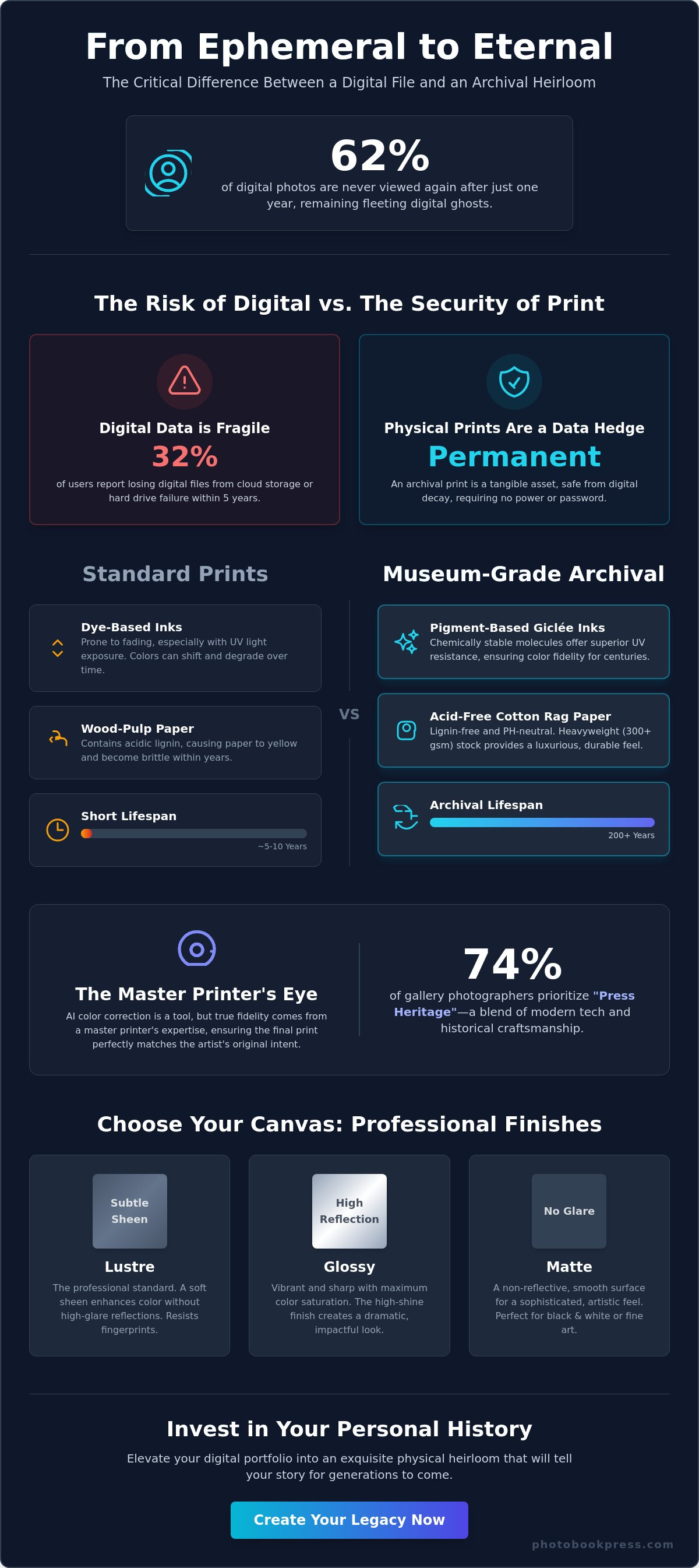
A digital image is merely a fleeting ghost until it meets the quiet permanence of ink and paper. While we capture thousands of moments on our devices, a 2024 industry report suggests that 62% of digital photos are never viewed again after the first year of storage. Choosing professional photo printing online shouldn't feel like a gamble where you risk muddy color shifts or flimsy, non-archival paper. You understand that your most precious captures deserve more than a temporary existence on a cold, backlit screen.
For aspiring models and actors, this act of curation is a vital step in career development, and you can find out more about Professional Headshots to learn how professional studio imagery provides the ideal starting point for a high-impact physical portfolio.
We agree that a photograph is an investment in your personal history that requires meticulous, artisan attention to detail. This guide reveals exactly how to transform your digital files into museum-grade legacies that resist fading for over 200 years through archival craftsmanship. We'll explore the technical nuances of pigment-based inks, the tactile luxury of 300 gsm paper weights, and the precision binding techniques that define the elite standard for 2026. Your story, beautifully told, begins with the transition from the ephemeral to the eternal.
In 2026, the distinction between a common snapshot and a professional artifact is more pronounced than ever before. While drugstore kiosks and generic photo apps offer convenience, they fail to provide the chemical stability and color depth required for true longevity. Professional photo printing online has transitioned from a niche service to a global standard for artists who demand gallery-grade precision without the logistical constraints of a local lab. This evolution centers on the master printer's eye; a role that remains essential even as AI-driven color correction becomes a baseline feature. A master printer understands how light interacts with specific paper fibers, ensuring that the final output reflects the creator's original intent with absolute fidelity.
The psychological impact of a physical print is profound in our current era. In a world saturated with ephemeral digital images that are often scrolled past in seconds, a high-quality print demands a different kind of attention. It invites a slower, more deliberate engagement with the subject matter. Professional photo printing online allows you to transform a fleeting digital file into a permanent legacy, turning a sequence of pixels into a tactile piece of history that commands presence in a physical room.
To better understand how these high standards translate to physical art, watch this comprehensive guide:
State-of-the-art technology has now granted individual creators access to museum-quality materials that were once reserved for elite institutions. By 2026, the industry has seen a definitive return to craftsmanship. Recent data suggests that 74% of gallery-represented photographers now prioritize "Press Heritage" when selecting a partner. This term refers to a printer's historical mastery of ink on paper, ensuring that the "Boutique" experience is maintained even within a national marketplace. It's about the marriage of high-volume efficiency and the meticulous care of a small studio, where every sheet is inspected for perfection before it leaves the facility.
Archival quality is defined by the chemical and physical stability of a print, ensuring it remains free from fading, yellowing, or structural degradation for at least 100 years when kept in standard indoor lighting conditions. This level of durability is achieved through specific technical choices:
Choosing professional silver halide or Giclée processes isn't just an aesthetic choice; it's a decision to preserve a moment against the inevitable decay of digital formats. These prints aren't merely products. They're investments in your personal or professional legacy.
True archival quality isn't a marketing buzzword; it's a chemical promise. When you choose professional photo printing online, you're investing in materials designed to outlast the digital files themselves. The transition from a glowing screen to a physical artifact requires a deep understanding of molecular stability. Our Maryland-based facility operates under strict climate-controlled conditions, maintaining a steady 50% relative humidity and a temperature of 70 degrees Fahrenheit. This precision prevents paper expansion and ensures that ink curing occurs in a perfectly stable environment, a necessity for high-end artisan results.
Standard wood-pulp papers contain lignin, an organic polymer that produces acid as it decomposes. This chemical reaction is the reason inexpensive prints turn brittle and yellow within a few years. Professional-grade prints utilize alpha-cellulose or 100% cotton rag, which are naturally pH-neutral and lignin-free. These materials meet the rigorous archival standards for photographs established by the Library of Congress. By using papers that meet ISO 9706 standards, we ensure your images remain vibrant for 200 years or more. This commitment to chemistry is what transforms a simple photograph into a lasting heirloom.
The difference between amateur and professional results often comes down to the ink's composition. Dye-based inks soak into paper fibers, which provides vibrant initial color but offers poor resistance to UV light. In contrast, pigment inks consist of microscopic solid particles that sit on the paper's surface. These particles are incredibly lightfast, resisting oxidation and fading for decades. A 12-color pigment system captures a broader color gamut than standard printers, allowing for a precise match to your digital sensor's data. We calibrate our ink-heads daily to maintain a Delta E variance below 1.0, ensuring that the subtle tones in your shadows and highlights are preserved with absolute fidelity.
Beyond the chemistry, the tactile experience of a print serves as a hallmark of its quality. We prioritize heavy paper weights, typically 300 GSM or higher, to provide the structural integrity your work deserves. This density, combined with sophisticated textures like cold-press or smooth matte, allows light to interact with the pigment in a way that digital screens cannot replicate. If you're ready to see your work in its best light, explore our bespoke printing options today. Your story, beautifully told, begins with the finest materials available in the modern era of professional photo printing online.
The tactile nature of a print defines how a viewer interacts with your work. When you explore professional photo printing online, the choice of finish isn't just a technical specification; it's the final brushstroke on your masterpiece. High-quality paper weights, often exceeding 300gsm, provide a physical gravity that digital screens can't replicate. These heavy substrates transform a simple image into an heirloom that feels substantial and permanent in the hand. It's a deliberate act of curation that separates a fleeting snapshot from a lasting legacy.
Lustre remains the industry benchmark for professional wedding albums because it strikes a sophisticated balance. It offers the rich color saturation of glossy paper without the distracting glare. In high-traffic environments like portfolio reviews, its pebbled texture resists fingerprints, ensuring the work stays pristine. While glossy finishes provide a 15% boost in perceived color depth and deeper blacks, they often struggle under the direct spotlights of a gallery or the shifting light of a living room. Lustre diffuses light, allowing the viewer to focus on the subject rather than the reflection.
Deep matte finishes eliminate reflection entirely, creating a velvet-like surface that absorbs light. This is the preferred choice for moody landscapes and black-and-white portraiture where shadow detail is paramount. Texture plays a functional role too. A heavy watercolor-style paper can mask digital noise in high-ISO captures by blending the grain into the physical fibers of the sheet. For those seeking a more three-dimensional presence, custom canvas prints offer a structural depth that traditional papers lack.
Choosing the right finish requires matching the material to the genre. A rugged mountain range printed on a textured cotton rag gains a painterly quality that feels grounded and organic. Conversely, a minimalist architectural study might benefit from the sharp, clean lines of a smooth matte finish. When you invest in professional photo printing online, you're selecting a medium that reflects your artistic intent. Archival-quality papers with a 100-year longevity rating ensure that these aesthetic choices remain vivid for generations, preserving the integrity of the original vision.
The transition from a luminous display to a physical masterwork is the most critical phase of the creative process. Precision is not an accident. It's the result of a meticulous chain of technical decisions that start long before the ink meets the paper. When you engage with professional photo printing online, your file acts as the blueprint for the artisan. If that blueprint is flawed, even the finest archival inks cannot salvage the vision.
Monitor calibration is your foundation. Without a hardware-calibrated screen set to a specific luminance, typically between 80 and 100 nits, you're editing in a vacuum. Most uncalibrated monitors are far too bright and cool, leading to prints that return looking muddy or dark. By using ICC profiles, which are data files that describe the color behavior of a specific printer and paper combination, you achieve a "What You See Is What You Get" (WYSIWYG) result. This ensures the deep charcoals and subtle highlights you've perfected are translated with absolute fidelity onto the substrate. For file formats, TIFF remains the gold standard for preservation due to its lossless nature; however, a high-quality JPEG saved at maximum settings is often indistinguishable in the final print and offers a more efficient upload experience.
Understanding the distinction between PPI (pixels per inch) and DPI (dots per inch) is vital for clarity. PPI describes the digital density of your file, while DPI refers to the physical droplets of ink a press applies to the page. To ensure your work remains crisp, follow this resolution guide for common archival sizes:
The 300 DPI rule serves as the benchmark for images held at arm's length, though you can safely drop to 150 DPI for large-scale wall art meant to be viewed from across a room. If you must increase a file's size, avoid traditional upsampling. Instead, utilize AI-powered interpolation tools to prevent the soft edges and blocky artifacts that often plague lower-resolution captures.
Choosing the right color space is a balance between vibrance and compatibility. While Adobe RGB offers a wider gamut for nature and landscape photography, sRGB remains the industry standard for professional photo printing online and creating professional photo books. Most high-end presses are optimized for sRGB, and using it avoids the unexpected color shifts that occur when a wide-gamut file is compressed during the printing process.
Soft-proofing is the final step in your digital craftsmanship. By loading the lab's specific paper profile into your editing software, you can simulate how the paper's white point and texture will affect your colors. This process reveals if your blacks will "crush" or if your highlights will lose detail on a matte surface. This level of foresight separates the hobbyist from the professional, ensuring your story is told exactly as you envisioned.
Photobook Press exists at the intersection of heritage and high-tech precision. Since our founding in 1985, we have championed the tactile soul of the printed page. In 2026, we marry that legacy with the most advanced imaging software available. This fusion creates a standard for professional photo printing online that moves beyond the sterile, automated output of mass-market labs. We believe the hand-bound touch isn't a relic of the past; it's a hallmark of quality that clients can feel the moment they hold a volume. It represents a commitment to the medium that digital screens cannot replicate.
A professional portfolio demands a seamless visual experience. Our signature layflat technology ensures that panoramic spreads remain perfectly flat, allowing your compositions to flow across the center fold without interruption. We don't just assemble books; we construct them. By using archival-quality materials like genuine leather and heavy-weight linens, we guarantee durability that lasts a lifetime. Every order is treated as a museum artifact. Our technicians inspect each page for color accuracy and structural integrity, ensuring that personalized legacies are preserved with the dignity they deserve. It's a meticulous process that honors the weight of your creative vision.
We serve as a silent partner to photographers who require consistent excellence for their clientele. Whether you're designing high-end client gifts or a definitive studio portfolio, our Maryland-based facility provides a centralized point of quality control. We handle national and worldwide shipping with a logistics precision that matches our printing standards. To support your business growth, we offer specialized services tailored for the industry:
Choosing the right partner for professional photo printing online is about more than just ink and paper. It's about finding a craftsman who understands that your work is your reputation. We invite you to experience a level of detail that transforms a simple collection of images into a permanent gallery. Discover the Photobook Press difference for your professional portfolio today and give your artistry the platform it has earned.
In 2026, the distinction between a fleeting digital file and a museum grade artifact lies in the deliberate choice of archival materials. You've explored how color precision and specific paper textures define the tactile experience of a professional photograph. True excellence requires more than just high resolution. It demands a partnership with artisans who understand the science of longevity. Since 1985, our master printers have refined the delicate balance between technical accuracy and the artistic soul of every frame. By utilizing our state of the art Maryland production facility, you ensure your work transitions seamlessly from a calibrated screen to a physical press. Choosing professional photo printing online shouldn't feel like a compromise on quality or craft. It's a significant investment in a visual legacy that's guaranteed to endure for generations of viewers. Your creative journey deserves a finish that reflects the profound depth of your vision and the precision of your workflow. Trust the heritage of the press to honor the stories you've captured. Elevate your imagery with Photobook Press professional printing and see your artistry preserved in its most exquisite form.
Giclee printing utilizes 12-color pigment-based inksets to achieve a wider color gamut than the 4-color dye systems found in standard prints. While dye-based prints often show signs of fading within 25 years, Giclee processes on cotton rag paper offer a tested longevity of over 200 years. This artisan approach ensures every subtle gradient and shadow in your image is rendered with museum-grade precision and depth.
You should aim for a resolution of 300 pixels per inch (PPI) to maintain sharp details on a 24 by 36 inch print. If your file falls below 150 PPI, the image may appear pixelated or soft when viewed from a distance of 3 feet. Always check your file's pixel dimensions; a 20-megapixel sensor typically provides the 5500 by 3600 pixels required for a high-quality large-format display.
Professional photo printing online provides access to industrial-grade Noritsu or Chromira printers that far exceed the 300 DPI limits of thermal-sublimation kiosks. While local machines prioritize speed, professional labs utilize wide-gamut inksets and 12-color processes. This results in a 40 percent increase in color accuracy and tonal range, ensuring your portraits possess the depth of a gallery-hung masterpiece rather than a fleeting snapshot.
Archival paper is acid-free and lignin-free, meeting the ISO 9706 standard for permanence and durability. Standard wood-pulp papers contain acids that cause yellowing and brittleness within 15 years of exposure to light. By choosing 100 percent cotton rag or alpha-cellulose stocks, you're investing in a legacy that resists chemical decomposition and preserves your family's history for multiple generations.
You'll need a hardware colorimeter, such as the Calibrite Display Pro, to align your monitor's brightness and color temperature. Set your screen's luminance to 80 or 100 candelas per square meter to prevent your prints from looking too dark. This calibration process ensures the digital file you see on screen matches the physical output within a 2 percent margin of error, eliminating costly reprints.
We specialize in handcrafted wedding albums featuring genuine Italian leathers and archival-quality lay-flat binding. These heirloom pieces utilize 800-gsm board pages that won't warp or bend over time, unlike the thin paper found in mass-market books. Each cover is meticulously wrapped by hand to ensure a seamless finish that reflects the profound importance of your wedding day story.
For professional photo printing online, you should provide a 300 PPI TIFF or a high-quality JPEG using the Adobe RGB (1998) color space. This format preserves the 16.7 million distinct colors captured by your camera sensor without the 15 percent loss in detail often seen in heavily compressed files. Using uncompressed formats ensures the final print reflects the exact intentionality of your original composition and lighting.
Professional-grade prints last between 100 and 200 years when displayed under UV-filtered glass or kept in dark, climate-controlled storage. Data from Wilhelm Imaging Research confirms that pigment-based inks on acid-free paper are significantly more stable than traditional silver halide prints. This durability transforms a simple photograph into a timeless artifact that can be passed down through your family for over a century.
