No Products in the Cart


What if the greeting you send this December survived long after the holiday decorations were packed away? While the average household receives over 25 greetings each year, the tradition of sending custom holiday cards has been cheapened by standard 80lb paper and digital artifacts that blur the soul of a photograph. You deserve a medium that honors your history rather than discarding it. We believe a card isn't just mail; it's a tactile connection between you and those you love.
You've likely felt the disappointment of a printer failing to capture the deep crimson of a winter coat or the subtle gold of a sunset. It's frustrating when a generic template diminishes a professional-grade image. This guide promises to transform your seasonal outreach into a collection of archival keepsakes. We'll explore the sophisticated design principles and 300 GSM materials required to ensure your 2026 greetings remain on display for years. You'll learn how to achieve gallery-level color accuracy and choose textures that evoke the quiet luxury of a handcrafted book.
A custom holiday card is more than a seasonal greeting; it is a bespoke, press-printed artifact designed to endure. While digital messages vanish into crowded inboxes, a physical card commands attention through its weight and texture. This tactile experience creates a lasting psychological connection that pixels cannot replicate. By 2026, the trend toward high-quality print has accelerated as families seek to reclaim a sense of permanence. People are exhausted by the fleeting nature of social media updates. They want something they can hold, display, and eventually tuck away in a cedar chest for the next generation.
To better understand the creative potential of these physical keepsakes, watch this helpful video:
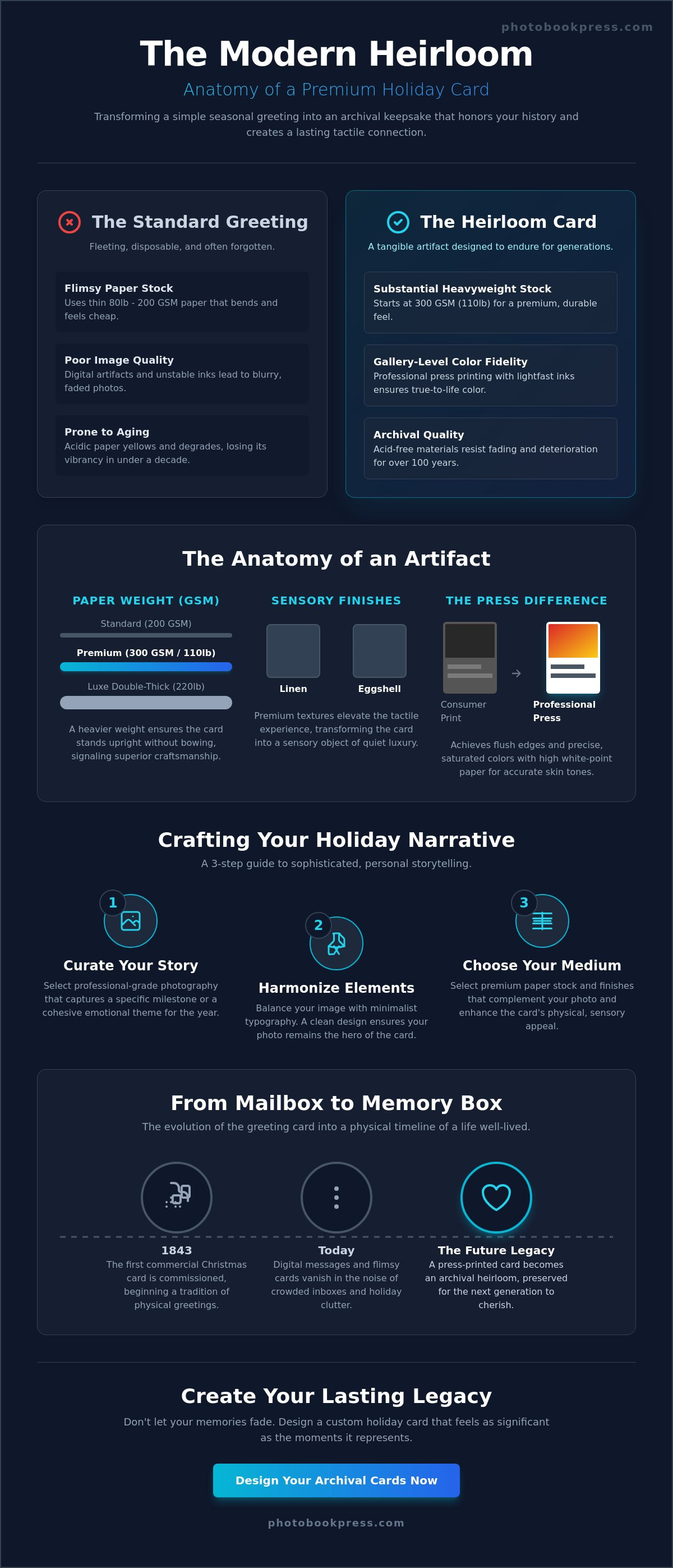
Distinguishing between mass-market photo cards and archival-quality press cards is essential for the discerning sender. Standard consumer prints often rely on thin paper and unstable inks that degrade within a decade. In contrast, professional press cards utilize heavy-weight cardstock and lightfast inks. This ensures the image remains as vivid as the day it was printed. The difference is felt immediately. The snap of the paper and the matte finish of the ink signal that this is an investment in legacy, not a disposable flyer.
The history of the Christmas card began in 1843 when Sir Henry Cole commissioned the first commercial greeting. Since those early Victorian lithographs, the medium has evolved into a sophisticated tool for personalized storytelling. Modern custom holiday cards now integrate professional-grade photography to document a family’s growth. These cards act as a physical timeline. They capture specific milestones, such as a child's first steps or a new home, that digital folders often bury. It is a curated history of a life well-lived.
Preserving family history requires materials that resist the passage of time. Consumer-grade prints frequently suffer from yellowing caused by acidic paper or fading due to UV exposure. Our press heritage ensures color fidelity by using acid-free stocks and pigment-based processes. This meticulous attention to detail transforms a simple greeting into a lasting legacy. Quality demands time and superior materials. Archival quality defines a print produced with chemically stable, acid-free materials and lightfast pigments designed to resist fading and deterioration for at least 100 years.
The tactile experience of a holiday greeting begins long before the recipient reads your message. It starts the moment they lift the envelope from the mailbox. For those designing custom holiday cards that stand the test of time, the foundation of excellence lies in the physical weight and technical specifications of the paper stock. A card's substance is often measured in GSM (grams per square meter) or "cover stock" weight. While standard cards may use a flimsy 200 GSM, a premium heirloom card typically begins at 300 GSM or 110lb cover stock. This thickness ensures the card stands upright on a mantel without bowing, signaling a level of craftsmanship that demands attention.
According to the Greeting Card Association, the tradition of exchanging physical greetings has evolved significantly since the 1840s, yet the sensory impact of paper remains the hallmark of a sincere gesture. Beyond weight, the "white point" or brightness of the paper plays a critical role in visual fidelity. A high white point ensures that skin tones are reproduced with absolute accuracy, preventing the sallow or grey undertones often found on lower-grade, recycled stocks. When paired with professional press-printing rather than standard home inkjet technology, the result is a rich, saturated image where the ink becomes an integral part of the paper fiber.
The choice between heavyweight cardstock and double-thick (220lb) options depends on the desired level of luxury. A double-thick card feels like a piece of art, offering a rigid, gallery-like presence. For photography, matte finishes are the preferred choice for 2026, as they eliminate the harsh glare of overhead lights and provide a sophisticated, velvety texture. This finish is particularly effective for candid, lifestyle photography. Conversely, an ultra-smooth finish may better suit high-contrast studio portraits where every sharp detail must be preserved. If you're weighing these options, you can find deeper quality comparisons in our guide to photo printing services.
To transform a simple greeting into a keepsake, consider the addition of dimensional finishes. Foil stamping, available in traditional gold, silver, or modern rose copper, adds a reflective brilliance that catches the light. Debossing creates a physical indentation in the paper, providing a subtle, architectural quality that invites the recipient's touch. For a truly cohesive presentation, the "final flourish" often includes:
Every choice, from the tooth of the paper to the precision of the foil, contributes to the story you're telling. To begin curating your own archival-quality greetings, explore our collection of bespoke stationery and discover the difference that artisanal materials can make.
Creating custom holiday cards is an exercise in intentional storytelling. It requires a shift from simply sharing a photo to curating a visual legacy. The most effective designs for 2026 rely on a cohesive emotional thread that connects every element, from the paper texture to the ink color. This process begins with curating your annual highlights; don't just select the clearest photos. Choose images that share a common light or a specific sentiment, like quiet reflection or vibrant joy. This consistency creates a professional, gallery-like feel that distinguishes your card from mass-produced alternatives.
Sophistication often lives in the space between elements. Balancing generous white space with precise typography creates a minimalist, high-end look that allows your message to breathe. Color theory also plays a vital role. While red and green are timeless, moving toward a palette of charcoal, champagne, or deep navy provides a contemporary edge. To achieve a truly bespoke feel, consider incorporating a family crest or a custom monogram. These personal branding elements transform a seasonal greeting into a formal announcement of your family's unique identity. According to the Greeting Card Association, the history of physical greetings is rooted in deep social traditions, and using archival-quality materials ensures your contribution to this history lasts for generations.
The "Hero Shot" uses one powerful image to command attention, while a "Grid" layout allows for a chronological narrative of your year. To maintain visual hierarchy, ensure your primary image is at least 50% larger than supporting shots so the viewer's eye knows where to land first. Technical precision is non-negotiable for custom holiday cards. Your imagery must meet the 300 DPI standard for press-print to ensure every detail is crisp and every shadow has depth. Lower resolutions often result in a 15% loss of clarity on heavy cardstocks.
Pairing a timeless serif with a modern sans-serif creates a balanced aesthetic that feels both established and current. Pay close attention to letterspacing, also known as kerning; increased spacing between characters in a header can significantly elevate the perceived value of the print. The choice of a delicate, high-contrast serif whispers of tradition and grace, while a clean, geometric sans-serif projects a forward-thinking, modern warmth. This typographic "voice" sets the stage before a single word is read, signaling the level of care you've invested in your greeting.
A holiday card is often the first tangible connection friends and family have with your home's story each year. While local drug-store kiosks or home inkjets offer convenience, they can't replicate the structural integrity of a professional press. Retail machines often produce shaggy edges or inconsistent margins because they lack industrial-grade hydraulic cutters. At a professional level, cards are trimmed with a precision of 0.1mm, ensuring every edge is perfectly flush and every fold is crisp. This isn't just about aesthetics; it's about creating an archival object that won't warp or yellow by the time the next season arrives.
Choosing a professional path also addresses the ethical side of production. Supporting American-based artisanal presses ensures your custom holiday cards are made under fair labor standards using responsibly sourced materials. Domestic production reduces shipping distances, which can lower associated carbon emissions by 25 percent compared to overseas bulk manufacturing. The price difference reflects a commitment to quality that mass-market retailers simply don't prioritize. When you invest in a professional press, you're paying for the longevity of your memories and the sustainability of the craft.
Most digital photos exist in an RGB color space, which is designed for glowing screens. Printing requires a transition to CMYK inks. Without expert calibration, this shift often results in muddy shadows or blown out highlights where detail is lost in the snow or bright winter skies. Professional artisans use high-end color profiles to ensure the vibrancy of your personalized legacy is preserved. They treat each print run as a gallery-grade production, maintaining a consistency that consumer-grade hardware can't sustain over a high-volume order.
The experience begins the moment the recipient touches the envelope. Standard retail envelopes often use 60lb paper, which feels flimsy and translucent. A professional presentation utilizes 80lb or 100lb text weight paper, providing a tactile sense of importance. Digital recipient addressing should be treated as a design element, using typography that complements the card inside rather than a utilitarian label. For the 2026 season, aim to finalize your custom holiday cards by November 12th. This allows for meticulous production and ensures your greetings arrive well before the mid-December postal surge.
Since 1985, Photobook Press has remained steadfast in its commitment to archival excellence. We believe that a printed memory should be more than a temporary gesture; it should be a lasting artifact. Our Maryland-based facility operates at the intersection of modern innovation and time-honored manual craftsmanship. While we utilize the latest in high-fidelity printing technology, the final touch on every order comes from a skilled artisan who understands the weight of your history. We don't just produce paper goods. We curate artifacts.
This dedication to quality is why professional photographers and discerning hobbyists choose us for their most important projects. We don't just print images, we preserve them. Our 39-year history in the industry has taught us that the difference between a simple greeting and a family heirloom lies in the materials and the meticulous care taken during production. When you choose custom holiday cards from our press, you're investing in a legacy that will be felt and seen for generations.
The journey doesn't need to end with a single envelope. Many of our clients find a seamless transition from sending seasonal photo cards to curated annual photo books. This practice allows you to expand the narrative of your year, moving from a singular highlights reel to a comprehensive, bound volume that captures the quiet, everyday moments in between. It’s a rhythmic approach to storytelling that builds a library of your life, one year at a time.
Our suite of customization options is designed for those who appreciate the tactile nature of fine paper. We offer a selection of premium stocks, ranging from soft-touch matte to rich, textured eggshell finishes. Every choice reflects our "Your Story, Beautifully Told" philosophy, ensuring that your 2026 holiday project is as unique as the memories it contains. You can begin crafting your vision today by selecting from our handcrafted binding options and signature finishes that elevate your custom holiday cards to the level of gallery art. Starting your project early ensures every detail is polished to perfection.
The path to an exquisite holiday season begins with a single design choice. We invite you to explore our gallery of sophisticated holiday templates, each crafted to provide a minimalist, elegant frame for your photography. If your vision requires something truly unique, our print experts are ready to assist with bespoke material requests and technical guidance. Our team ensures that every detail, from color calibration to paper weight, meets our rigorous standards. We treat your memories with the same reverence you do.
Design your custom holiday cards with Photobook Press today.
The holiday season represents more than a calendar date; it's an opportunity to curate artifacts that endure. Since 1985, Photobook Press has specialized in the art of the permanent, operating a Maryland-based professional production facility dedicated to archival excellence. By prioritizing the "press" difference and museum-grade materials, you ensure your custom holiday cards serve as sophisticated narratives rather than fleeting greetings. These pieces are engineered to last for generations, preserving the tactile beauty of your family's history through superior paper weights and precise color calibration. You've explored the strategy behind a modern heirloom; now it's time to apply those professional standards to your own creative process. Don't let your most meaningful moments fade into digital obscurity. It's time to invest in the artisanal craftsmanship your story deserves. Your recipients will feel the weight of your intention in every hand-finished detail.
Craft your archival-quality holiday cards at Photobook Press
We're ready to help you tell your story beautifully.
For a premium feel, 110 lb to 130 lb cover stock is the ideal weight for custom holiday cards. This thickness ensures the card stands upright on a mantle without curling or bending. It provides a substantial, tactile experience that reflects the quality of your chosen imagery. Heavier stocks like 130 lb offer a luxurious rigidity that transforms a simple greeting into a lasting heirloom for your recipients.
You should place your order by November 10, 2026, to ensure a stress-free holiday season. This timeline accounts for a 7 day production window and 5 days for standard shipping. Ordering at least 45 days before December 25 allows you to address and mail your keepsakes by the first week of December. Early preparation ensures your story's told without the rush of peak seasonal logistics.
You can certainly use smartphone photos if they're captured on devices with at least 12 megapixel resolution. Most flagship phones released after 2022 provide the clarity needed for a sharp 5x7 print. Ensure you're using the original file rather than a compressed version from a messaging app. High resolution files preserve the delicate details and color depth required for professional-grade custom holiday cards that look crisp and vibrant.
Press-printing uses a traditional four color process for high volume consistency; inkjet printing utilizes up to 12 pigment based inks for superior color range. Our artisan approach favors the depth and precision of high end inkjet processes for gallery quality results. While press-printing is efficient for large runs, the inkjet method provides a richer, more painterly finish. This distinction is vital for those seeking a true fine art aesthetic.
Custom holiday cards are considered archival quality when printed on acid-free, 100 percent cotton or alpha-cellulose papers. These specific materials are designed to resist fading and yellowing for over 100 years under standard display conditions. By choosing pH-neutral stocks and pigment inks, you're creating a permanent record of your family's history. These aren't temporary greetings; they're handcrafted artifacts meant for long-term preservation in a family album or archive.
A sophisticated holiday card typically features one to three carefully curated photographs. Limiting the selection allows each image to breathe and maintains a clean, minimalist layout. Too many photos can clutter the design and diminish the visual impact of your most meaningful moments. A single, striking portrait often communicates more elegance than a dense collage of 10 smaller images that lack a clear focal point.
The 5x7 inch portrait or landscape format remains the standard for premium cards in 2026. This size offers 35 square inches of design space, which is perfect for showcasing high resolution photography. Other popular options include the 6x6 inch square for a modern look or the 4.25x6 inch size for a classic feel. Each dimension provides a balanced canvas for your personal narrative and elegant, legible typography.
Every set of custom holiday cards includes matching 80 lb text weight envelopes to complete the presentation. These envelopes are crafted from the same high quality paper mills to ensure color and texture consistency across the entire suite. You can choose between classic square flaps or elegant pointed Euro-flaps for a more formal touch. This attention to detail ensures the recipient's experience begins the moment they hold the envelope.
