No Products in the Cart


A photograph is a fragment of time, but a premium photo book is its sanctuary. Too often, the transition from a luminous screen to the physical page results in a loss of soul, leaving you with muddy colors and a binding that feels fragile rather than foundational. To bridge this gap between digital capture and a tangible legacy, you need a definitive photo book printing quality checklist that honors the artistry of your work. It's about more than just resolution; it's about the deliberate harmony of material chemistry and technical precision.
We understand the desire to hold a memory that feels as substantial as the moment it commemorates. You want a tactile, durable heirloom that stands the test of time without yellowing or fading. This guide will transform your approach to print, moving you from the confusion of digital prep to the quiet confidence of a master artisan. We'll explore the technical nuances of archival paper, the chemistry of pigment-based inks, and the physical standards required to ensure your book becomes a museum-grade heirloom. By the end, you'll have the expert guidance needed to ensure every page reflects your vision with absolute clarity and grace.
The journey of a museum-grade photo book begins long before the first drop of ink touches the paper. It starts within the digital file, where every pixel serves as a building block for your future legacy. To ensure your work withstands the scrutiny of time, your photo book printing quality checklist must prioritize a "capture-to-print" workflow that preserves the depth of your original vision. This foundation is not merely about size, it's about the integrity of the data you provide to the press.
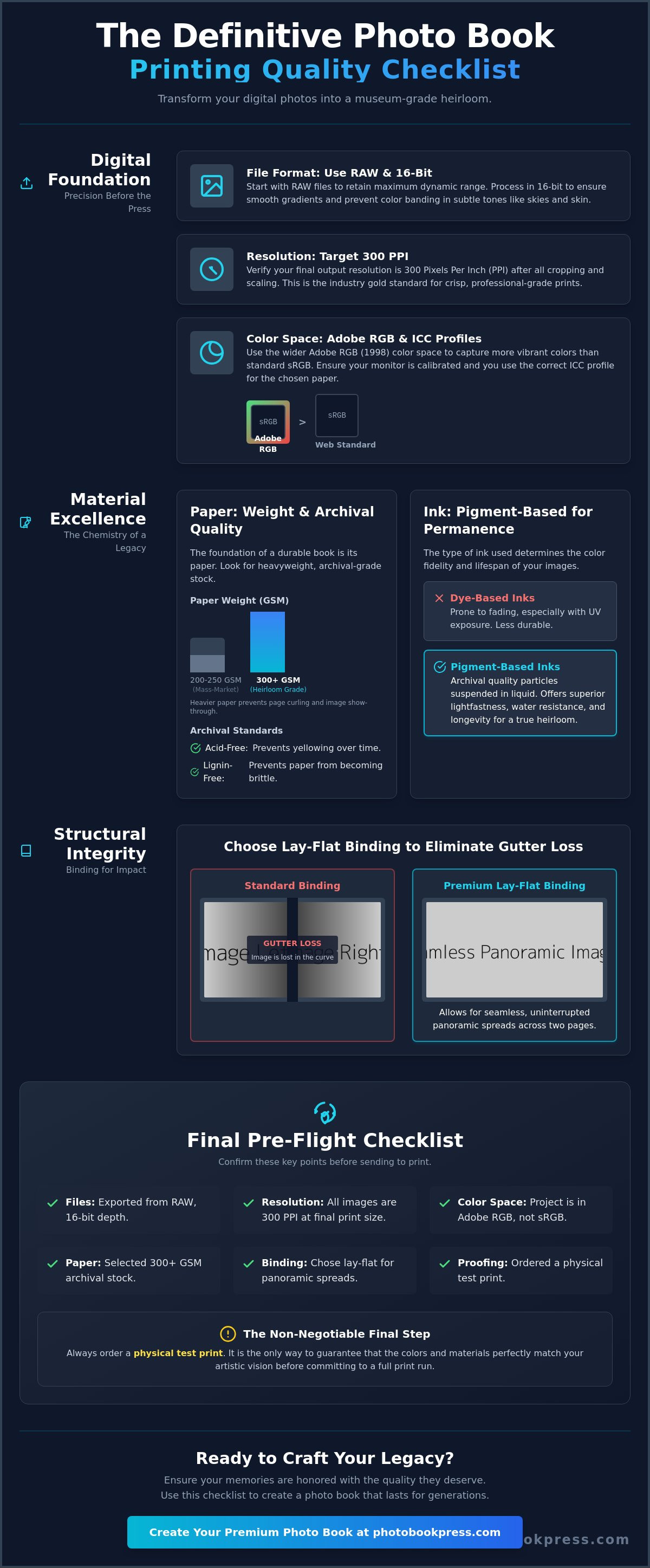
Starting with RAW files is non-negotiable for the discerning artisan. Unlike compressed formats, RAW data retains the full dynamic range of your camera's sensor, allowing for nuanced adjustments in highlights and shadows that would otherwise be lost. When paired with a high bit depth, specifically 16-bit processing, you ensure that subtle gradients in a twilight sky or the soft texture of a bridal gown remain fluid and free from the jarring "banding" often seen in lower-quality productions. This technical overhead provides the "breathing room" necessary for the printing press to render colors with absolute grace.
To visualize how these technical choices manifest in the final product, watch this expert perspective on the importance of the print medium:
Many creators focus solely on the 300 PPI "gold standard," yet true clarity requires a deeper understanding of pixel density. While 300 PPI remains a reliable benchmark in 2026, the relationship between screen pixels and printer dots (DPI) is where the real magic happens. You should calculate your maximum print size based on your sensor's native dimensions to avoid interpolation. Be wary of the "effective resolution" trap in layout software; scaling a small image to fill a large page silently degrades the quality until it falls below the threshold of professional excellence. A robust photo book printing quality checklist always verifies the final output resolution after all crops and layouts are finalized.
The transition from digital light to physical ink is a delicate translation. Utilizing the Adobe RGB color space offers a wider gamut than the web-standard sRGB, capturing the vibrant saturations necessary for high-end portfolios. However, this wider gamut is only effective if your monitor is calibrated to a known standard. Without an accurate ICC profile tailored to your specific paper choice, the final result may appear "muddy" or disconnected from your intent. While this digital precision is the first step, these files eventually require the support of time-honored bookbinding methods to transform from mere data into a permanent, tactile artifact that can be passed down through generations.
Once the digital file is perfected, the focus shifts to the physical alchemy of print. A comprehensive photo book printing quality checklist must prioritize the chemistry of the materials used, as these determine whether your work survives for decades or fades within a few years. The selection of paper and ink is not a mere utility; it is the final act of creative expression. It transforms a fleeting image into a permanent artifact.
The sensory impact of paper begins with its weight, measured in grams per square meter (GSM). While many mass-market producers in 2026 have moved toward lighter 200 to 250 GSM stocks to reduce production costs, an heirloom-grade book requires the substance of 300 GSM or higher. This thickness provides the rigidity necessary to prevent page curling and ensures a satisfying, rhythmic flow as the reader moves through your narrative. High-weight paper also offers superior opacity, which is essential for preventing "show-through," where the ghost of an image on the reverse side of a page distracts from the current composition.
Finish selection acts as the final lens through which your audience views your work. There is a notable resurgence in 2026 of gloss-finish interior pages, favored for their ability to achieve deep blacks and vibrant color contrast. However, the choice remains deeply personal. A luster finish provides the color saturation of gloss with a subtle texture that resists fingerprints, while a true matte finish offers a sophisticated, glare-free experience that mimics the feel of a fine-art gallery. For those crafting bespoke portfolio books, the interplay between these finishes and the ambient light of a room can fundamentally alter the viewer's emotional response.
Texture influences the emotional weight of a photograph just as much as the subject matter itself. Coated stocks are engineered to minimize "dot gain," a phenomenon where ink spreads into the paper fibers and softens the image. By keeping the ink on the surface, coated papers maintain the surgical sharpness of your digital file. Conversely, uncoated stocks offer a raw, organic feel that many find more intimate, though they require a master's touch to manage the higher ink absorption rates without losing detail in the shadows.
True archival integrity is non-negotiable for a legacy piece. Your photo book printing quality checklist should strictly mandate the use of acid-free and lignin-free materials. Lignin is a natural component in wood pulp that, if not removed, causes paper to turn yellow and brittle when exposed to light and oxygen. To ensure your memories remain vibrant, the printing process must utilize pigment-based inks rather than cheaper, dye-based alternatives. Pigment inks consist of tiny, solid particles that sit atop the paper, offering a level of UV resistance and stability that allows a print to remain unchanged for over a century when stored in a stable environment.
Achieving this level of archival stability requires advanced technology; Print It ZA print and packaging utilizes high-quality litho and digital printing solutions to ensure that these material standards are met with every page of a premium book.
The physical architecture of a book is the silent guardian of its contents. While paper and ink provide the sensory experience, the binding ensures that experience remains intact for decades. Any professional photo book printing quality checklist must examine the structural integrity of the volume, moving beyond the surface to the skeleton of the piece. A book that fails to open fully or loses its shape after a few viewings cannot be considered an heirloom.
Gutter loss is perhaps the most common disappointment in custom printing. In standard "perfect binding," the pages are glued directly into the spine, creating a deep crease that swallows the center of your compositions. For panoramic landscapes or intricate group portraits, this "silent killer" of design ruins the visual flow. This is why many artisans insist on layflat photo books. This construction method allows pages to rest completely level, offering a seamless, uninterrupted view of every spread.
The viewing experience is transformed when the physical barrier of the spine is removed. Technical construction varies between hinged pages, which use a physical joint, and continuous sheets that are folded and bonded back-to-back. The latter provides a sophisticated, museum-grade feel that is essential for professional wedding albums and high-end portfolios. It allows the story to breathe across the entire width of the book without distortion or interruption. It's the difference between looking at a picture and stepping into a scene.
True excellence is found in the details of the spine and corners. While mass-market products rely on rapid machine-gluing, a premium heirloom often features hand-bound elements that offer superior flexibility and strength. Spine reinforcement and the inclusion of heavy-duty endpapers are critical for maintaining the book's squareness over time. These components prevent the block of pages from sagging or pulling away from the cover.
When you hold a well-balanced book, you feel the weight of the genuine leather or archival linen covers, which should be wrapped with meticulous corner construction. A master artisan ensures that the corners are tucked and folded with surgical precision, avoiding the bulky, uneven edges found in lesser products. This balance of weight and structural resolve is what makes a book feel significant in your hands, confirming its status as a permanent investment in your personal history. Your photo book printing quality checklist should always include a tactile inspection of these joints and materials to ensure they meet the standards of archival excellence.
The transition from creative vision to physical masterpiece requires a moment of disciplined pause. Before the presses begin their rhythmic dance, a final, meticulous review is the hallmark of the true professional. This photo book printing quality checklist serves as your pre-flight map, ensuring that no technical oversight compromises the integrity of your legacy. It's the final bridge between the luminous digital world and the enduring reality of print.
While previous stages focused on the "why" of materials and resolution, this phase is about the "how" of execution. You aren't just checking boxes; you're performing a ritual of quality control that honors the hours spent behind the lens. A single oversight in the digital file can manifest as a permanent flaw in the physical heirloom, making this final audit the most critical step in the artisanal process.
Verification starts at the pixel level. As we established in our digital foundation, you must ensure every image maintains at least 300 DPI at its final scaled size within your layout. Beyond resolution, audit your histograms one last time. You're looking for "blown" highlights or "crushed" blacks that might appear as flat, ink-heavy patches on the page. Confirm all fonts are either embedded or converted to outlines. This prevents the printing software from substituting a generic typeface that could shatter your design's aesthetic harmony.
A gallery-curated feel depends on mathematical precision. Check your bleed lines with surgical care. Any image intended to reach the edge of the page must extend beyond the trim line to prevent unsightly white slivers after the final cut. Simultaneously, keep focal points and text away from the "danger zone" of the gutter, even when utilizing the superior architecture of layflat binding. Consistent margins provide the visual "breath" necessary for the viewer to absorb each image without feeling crowded by the page's edge.
Your choice of cover must match the thematic weight of the contents. A leather-bound volume suggests a different narrative than a minimalist linen cover. Review the established standards for professional photo books to ensure your archival coatings and paper finishes harmonize with the lighting in your photographs. Before you finalize the order, perform a sensory audit of your choices: does the paper weight feel substantial enough for the story you're telling? If the answer is yes, you're ready to begin the crafting process for your next heirloom.
Finally, consider the mandatory step of physical proofing. While digital soft-proofing is efficient, it cannot replicate the way light reflects off a specific luster or matte finish. Ordering a single test print or a sample book is a non-negotiable investment for those who demand absolute perfection in color reproduction and material feel.
Excellence is never a matter of chance; it's the result of a steadfast commitment to the noble craft of manufacturing. Since 1985, our Maryland facility has served as a sanctuary for the medium of print. We believe that every image deserves a home that is as durable as it is beautiful. While the industry often chases fleeting trends and rapid turnarounds, we remain anchored in the belief that quality requires time, patience, and a master's touch. This heritage of craftsmanship is the foundation of the Photobook Press standard, where state-of-the-art printing technology meets the quiet soul of manual artisanal binding.
For the discerning professional, every project is an investment in legacy. Our internal protocols mirror the rigorous photo book printing quality checklist we've shared, ensuring that every page, joint, and cover meets our uncompromising standards for archival excellence. We don't merely print books. We curate personal histories, treating each wedding album and portfolio book with the reverence a museum-grade heirloom deserves. This meticulous approach is why artists and historians trust us to preserve their most significant moments.
Boutique service is defined by the depth of attention given to the details that mass production overlooks. In a world of automated, high-volume workflows, our quality control remains deeply human. Every custom order undergoes a series of manual inspections, where we verify the structural integrity of the spine and the visual precision of the color reproduction. We utilize only durable, museum-quality materials, from acid-free papers to genuine leathers, ensuring that your work doesn't just look beautiful today, but remains pristine for a century or more. This individualized attention ensures that your creative vision is never lost in a sea of generic templates.
The true return on investment for a perfectly printed memory isn't measured in technical specifications, but in the emotional resonance of holding a story in your hands. Whether you are designing bespoke photo books or a high-stakes professional portfolio, the physical experience of the medium is what anchors the narrative. We offer global shipping to bring our local artisanal quality to creators everywhere, bridging the gap between our Maryland workshop and your library. Your work is a fragment of history, and it deserves a presentation that reflects its worth. Begin your journey toward a flawless photo book today and experience the intersection of technical perfection and artistic soul.
The transformation from a digital image to a museum-grade heirloom is a journey of meticulous choices. You've explored how technical foundations, material chemistry, and structural integrity harmonize to create a lasting artifact. Utilizing a rigorous photo book printing quality checklist isn't just a technical necessity; it's an act of reverence for the memories you've captured. It ensures that every color remains true and every binding stays firm for generations to come.
At Photobook Press, we've honored this commitment to excellence in our Maryland-based facility since 1985. By blending professional-grade materials with state-of-the-art layflat binding technology, we provide the quiet confidence that your work is protected by the highest standards of craftsmanship. We invite you to move beyond the screen and experience the tactile weight of your own history. Your artistry deserves a sanctuary that is as enduring as the moments themselves.
Design Your Archival-Quality Photo Book and begin the process of crafting a legacy that will be cherished for a lifetime. We're honored to be your partner in this creative pursuit.
PPI refers to the digital pixels per inch in your file, while DPI describes the physical dots of ink the printer places on the paper. For a professional result, your digital images should be set to 300 PPI to ensure the printer has enough data to produce a high DPI output. Maintaining this ratio is a fundamental step in any photo book printing quality checklist to prevent blurred or pixelated images in your final heirloom.
You should generally use sRGB or Adobe RGB because modern premium digital presses are designed to interpret these wider color gamuts. While traditional offset printing relies on CMYK, high-end artisanal printing often uses sophisticated ink systems that exceed the limitations of a standard four-color process. Starting with a wide RGB profile allows you to preserve the vibrant saturations and nuanced tones captured by your camera's sensor.
Bleed is the additional image area that extends beyond the final trim line to ensure your photos reach the very edge of the page. By including a bleed zone, typically 0.125 inches, you provide a safety margin for the mechanical cutting process. This prevents unsightly white slivers from appearing at the edges of your spreads, ensuring a clean, professional finish that honors your compositional intent.
Calculate the required resolution by multiplying your desired print dimensions in inches by 300. For instance, a full-page image in a 10x10 inch book requires a file that is at least 3000x3000 pixels. If you crop an image significantly, you must check the "effective resolution" in your layout software. If that number drops below 250 PPI, the image will likely lose the surgical sharpness required for museum-grade quality.
Layflat binding utilizes a specialized construction that allows the book to rest completely level, removing the deep crease known as the gutter. This architecture is essential for panoramic images, as it allows the composition to flow across two pages without being swallowed by the spine. Unlike standard binding, which forces the paper to curve, layflat books offer a seamless viewing experience perfect for high-impact wedding albums and portfolio books.
Achieving a perfect match requires you to calibrate your monitor and utilize specific ICC profiles for your chosen paper stock. Because a screen emits light and paper reflects it, prints often appear slightly deeper than their digital counterparts. Including a physical test print in your photo book printing quality checklist is the most reliable way to verify that your highlights, shadows, and skin tones translate accurately from the screen to the page.
A paper weight of 300 GSM or higher is the standard for professional, archival-quality books. This thickness provides the tactile substance and rigidity necessary for a premium feel while ensuring the pages are opaque enough to prevent "show-through" from images on the reverse side. While mass-market products often use 200 GSM or thinner stocks, these lighter papers lack the structural integrity and durability required for a long-term legacy piece.
Matte paper is superior for glare-free viewing and a sophisticated, fine-art aesthetic, while glossy paper is better for achieving maximum color saturation and deep black levels. Glossy finishes are often favored for vibrant landscapes where contrast is key. However, many artisans prefer luster or matte finishes for wedding albums and portfolios because they resist fingerprints and provide a timeless, gallery-like quality that doesn't distract from the imagery.
