No Products in the Cart


While 93% of our images are captured on mobile devices, a striking 65% of people in 2026 still choose a physical book for their most significant milestones. It's a testament to the fact that digital files are fleeting, while a custom layflat photo album offers a tangible connection to the past. However, the path from a digital gallery to an archival heirloom is often fraught with technical frustrations. You've likely felt the sting of a software crash mid-design or the anxiety of a vague low-resolution warning that leaves the final print quality to chance.
We believe your memories deserve the quiet confidence of a high-end artisan rather than the flimsy finish of a generic print house. This guide will show you how to look beyond sleek marketing to identify professional-grade builders that prioritize color precision and structural integrity. You'll learn to evaluate material specifications and ISO light-stability standards to ensure your pages won't yellow or fade with age. We will explore the essential features of a museum-quality design experience, from intuitive interfaces to the artisan craftsmanship that defines a truly timeless legacy.
A professional online photo book builder is far more than a utility for arranging snapshots. It serves as a digital atelier, a bridge between your digital files and a physical masterpiece. While the history of the photo book reveals a tradition of manual binding and darkroom precision, the modern professional builder translates those artisanal standards into a high-performance interface. It isn't merely about convenience; it's about the meticulous translation of high-resolution imagery into archival art. Choosing a custom layflat photo album requires a tool that understands the weight of your legacy. Unlike generic software that prioritizes speed over substance, a professional-grade builder offers the granular control necessary for museum-quality results.
To witness the tangible result of this digital-to-physical translation, observe the detail in this professional unboxing:
Restrictive grids are the hallmark of consumer-grade apps. In contrast, an archival builder provides an open-canvas environment. Professional designers demand advanced alignment and spacing tools to ensure every image sits with intentionality. Bleed and margin controls are not optional extras; they are essential for high-end binding. These tools prevent essential details from being lost in the fold or trimmed during the manufacturing process, ensuring your narrative flows seamlessly across the page. This level of precision allows for a custom layflat photo album that feels curated rather than manufactured.
Handling high-resolution files requires a robust engine. A professional interface manages large data sets without the performance lag that leads to software crashes. This reliability is paired with cloud-based project management and sophisticated auto-save features, protecting your work over the weeks or months it takes to curate a life story. The preview mode must offer a faithful representation of the final product. It provides the confidence that the colors and compositions seen on screen will mirror the physical artifact delivered to your door. Ultimately, the software is only as capable as the facility behind it. A builder’s precision is wasted if it doesn't communicate perfectly with state-of-the-art printing technology. This synergy ensures that every digital choice reflects in the tactile quality of the paper and the vibrancy of the ink.
Designing a custom layflat photo album is an exercise in both artistic vision and technical discipline. While a digital screen offers a backlit glow, a physical page relies on the intricate interplay of ink and fiber. A professional builder acts as a guardian of your visual history, ensuring the emotional weight of a photograph isn't lost to technical neglect. The transition from a glowing pixel to a permanent ink droplet requires a deep understanding of material science. When you're curating your album, you're commissioning a piece of archival furniture for your library. This process begins with the raw data of your images.
Clarity is the cornerstone of any heirloom. Professional builders require high-resolution uploads because they refuse to compromise on the final output. A standard consumer app might accept low-quality files to speed up the user experience, but a premium builder will alert you if an image falls below the recommended 300 DPI (dots per inch). This threshold is necessary for high-definition print clarity. Without it, the fine-art textures of the paper can highlight digital artifacts rather than the subtle details of your subject. High-resolution files allow the ink to settle into the paper with precision, preserving the sharpness of a gaze or the delicate weave of a fabric.
The science of color is where many digital projects falter. Most screens operate in an RGB (Red, Green, Blue) color space, which uses light to create vibrancy. Physical printing utilizes CMYK (Cyan, Magenta, Yellow, Black) pigments. This shift can lead to disappointing results if a builder doesn't manage color profiles correctly. Professional-grade software handles these conversions behind the scenes. It ensures the warm gold of a sunset or the deep navy of a suit remains true to life, bridging the gap between the luminous display and the matte finish of an archival page.
Beyond the pixels, the builder helps you visualize the sensory qualities of your custom layflat photo album. Choosing between the supple grain of leather or the organic weave of linen is a tactile decision made in a digital environment. These materials aren't just covers; they're the protective shells for your history. If you're ready to begin this journey of preservation, you can explore the possibilities of a bespoke photo book project to see how these technical standards manifest in physical form.
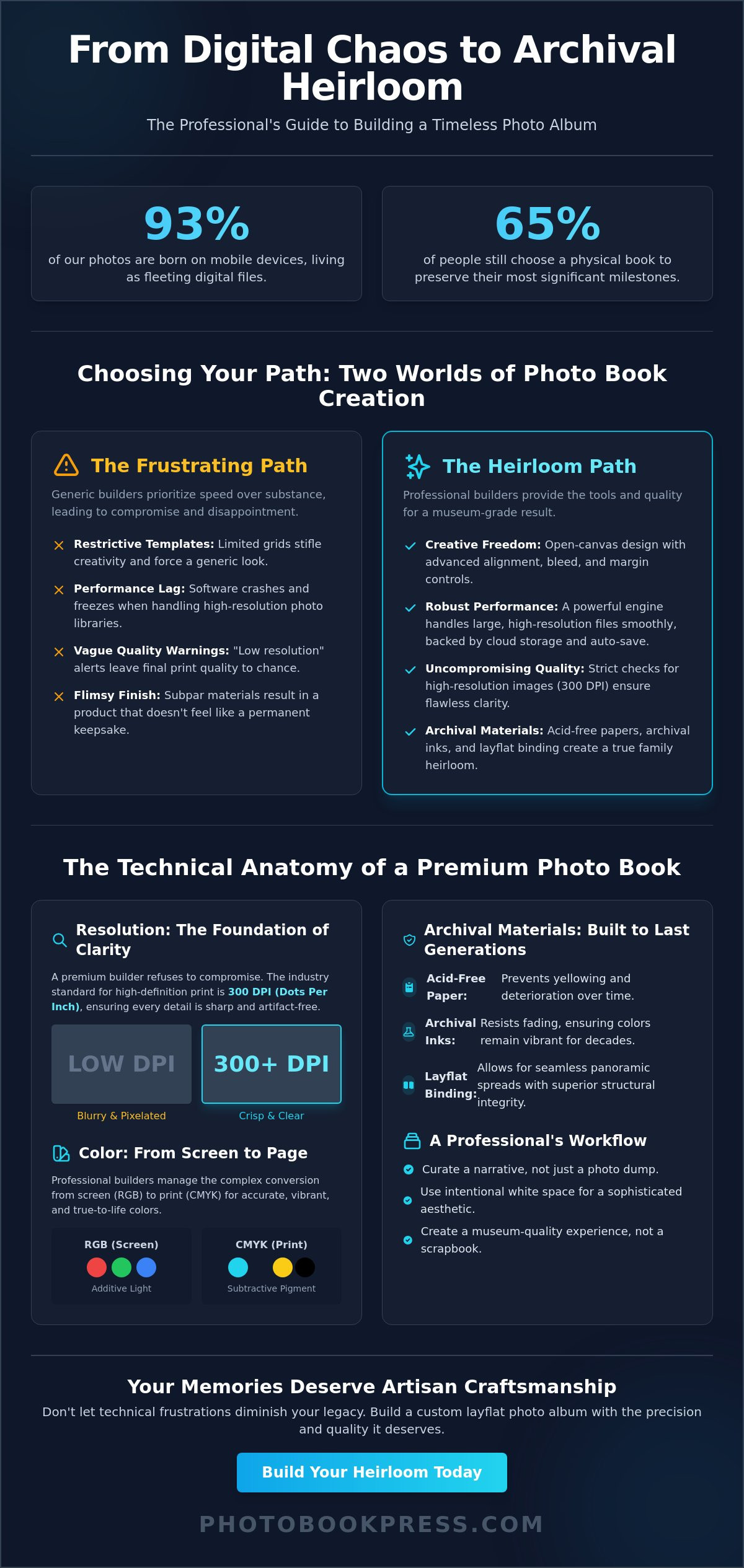
Consumer apps are designed for the immediate gratification of the digital age. They prioritize a frictionless, five-minute creation process that often results in a product built for the present, not the future. Archival builders, however, operate on a different timeline. They treat the final physical artifact as a work of art that must withstand the passage of years. This distinction is most evident in the choice of materials. While mass-market apps might use standard inks that fade within a decade, professional builders utilize archival inks and acid-free paper. These materials meet rigorous standards, such as ISO 18937-3:2026 for measuring the light stability of photographic prints, ensuring that your images remain as vibrant as the day they were captured.
When evaluating the investment, it's helpful to look past the initial price tag. Consider the cost per decade of preservation. A flimsy, glue-bound book that yellows and falls apart in five years is a poor steward of your memories. A bespoke volume designed to last for generations offers far greater value. This shift from template-driven speed to bespoke layout construction allows you to move beyond generic themes and create a narrative that is uniquely yours.
The architecture of a book determines its survival. Most consumer products rely on standard glue binding, which can become brittle and crack over time. Professional-grade manual binding techniques provide a structural superiority that is immediately apparent. This is particularly vital for custom layflat photo albums designed for panoramic spreads. In these volumes, the pages are not merely tucked into a spine; they are engineered to lie perfectly flat. This allows a single image to breathe across two pages without a distracting gutter, elevating the book from a simple collection of prints to a professional portfolio. The result is a substantial, heirloom-quality volume that feels secure in the hand.
Sophistication is found in the details of the cover and the texture of the page. Professional builders offer a curated selection of leather and textile covers, moving away from the generic glossy finishes found in mass-market apps. There is a profound tactile difference between a standard gloss and a fine-art matte finish. The latter absorbs light rather than reflecting it, providing a depth of color and a velvety feel that invites touch. Selecting materials that complement the specific theme of your photo book ensures the exterior of the volume is as meaningful as the story within. Whether it's the supple grain of premium leather or the organic weave of linen, these materials serve as the protective shell for your history.
Creating a museum-quality book requires a shift in perspective. You aren't just filling pages; you're curating a legacy. A professional designer approaches a custom layflat photo album as a gallery exhibition, where every placement is intentional. This workflow begins with the understanding that a book’s power lies as much in what you omit as what you include. By adopting a curator's mindset, you transform a collection of digital files into a cohesive narrative that will resonate for generations.
Layout strategy is the silent partner of great photography. While it's tempting to crowd pages with as many memories as possible, the most impactful albums utilize white space to provide visual rest. This allows the eye to focus on the emotional core of each image. A sophisticated custom layflat photo album relies on this balance of imagery and silence. Typography should also be a deliberate choice. The fonts you select act as the tone of voice for your story; a delicate serif might convey the elegance of a gala, while a clean sans-serif offers a modern, minimalist feel. Your choices here define the personality of the finished volume.
The "less is more" philosophy is the hallmark of professional design. Instead of a chronological dump, look for hero images that capture the essence of a moment. Grouping photos by color palette or lighting creates a sense of visual harmony that feels effortless. This approach is particularly effective when designing custom wedding albums, where the goal is to preserve a timeless narrative rather than a simple sequence of events. When your spreads share a consistent aesthetic language, the book feels like a single, unified work of art.
Before committing your work to print, a rigorous final review is essential. Use the builder’s zoom tool to inspect the fine details of your most important shots. You're looking for focus and clarity that might be missed at a distance. Check that all text and critical image elements remain within the safe zone, well away from the trim lines. Consistent margins across every spread are the final touch that ensures a gallery-quality finish. If you're ready to apply this professional workflow to your own memories, you can begin your bespoke design journey here and see how craftsmanship meets your creative vision.
Our dedicated production facility acts as a sanctuary for the medium of print. Here, we maintain a heritage of excellence that began in 1985, long before the digital revolution transformed the industry. This dedicated space allows for a level of quality control that is simply impossible in mass-production environments. We don't view your project as a mere file in a digital queue. We see it as a custom layflat photo album that deserves the highest level of care. By keeping our manufacturing in-house, we ensure that every material, from the archival paper to the premium leather covers, meets our exacting standards for durability and aesthetic beauty. Precision is our heritage, and quality is our promise.
The artisan difference is rooted in the belief that excellence requires time and attention to detail. Our builder is designed specifically for those who seek to create professional photo books without the typical limitations of consumer software. While the interface provides the precision of a digital atelier, the physical construction is where our history truly shines. Manual binding ensures that each page is secured with a level of integrity that machines cannot replicate. Our meticulous inspection process involves a human eye checking for color accuracy, alignment, and structural perfection. We blend this technical precision with a deep respect for the emotional weight of your memories, treating each custom layflat photo album as a precious artifact.
Our solutions extend to every level of the creative community. We offer wholesale opportunities for professional photographers who need portfolio books that mirror the quality of their own work. This allows them to build a brand centered on prestige and substance, offering their clients something far beyond the reach of mass-market apps. At the same time, we provide the same premium craftsmanship for high-end holiday cards, desk calendars, and wall calendars. This integrated ecosystem means you can maintain a consistent aesthetic across all your physical keepsakes. Every product we manufacture is an investment in your personal or professional legacy, built to be shared and admired for generations. It is where your creative vision finally meets its physical equal.
Begin designing your legacy with our online photo book builder.
Selecting an online builder is the defining moment in the life of your photographs. It's the choice between a fleeting digital display and a museum-quality artifact that will be passed through generations. By prioritizing technical precision, from 300 DPI clarity to sophisticated color management, you ensure your memories retain their original emotional resonance. A custom layflat photo album is more than a simple collection of prints; it's a structural investment in your family's heritage.
Since 1985, we've dedicated ourselves to the noble craft of manufacturing. Every volume is proudly produced in our Maryland facility, where professional-grade materials meet the meticulous care of manual binding. This fusion of heritage and technology ensures your story remains secure, vibrant, and timeless. We invite you to step into the role of curator and begin the rewarding process of physical creation. Your history deserves a home that is as enduring as the moments themselves.
Design Your Archival Heirloom Today
Trust in the slow, careful process of creation. Take the first step toward preserving your legacy in print and experience the quiet confidence of true craftsmanship.
Aim for a minimum resolution of 300 DPI at the specific dimensions you intend to print. While lower resolutions might appear acceptable on a backlit screen, they often lose their crispness when translated to physical ink and paper. High-resolution files ensure that every subtle texture and fine detail is preserved with the clarity your memories deserve.
You can certainly save your progress and return to your project whenever inspiration strikes. Professional-grade builders utilize secure cloud-based management to store your layouts and uploaded imagery indefinitely. This allows you to curate your narrative at a measured pace, ensuring that every design decision is made with the steady composure required for a true heirloom.
The primary distinction lies in the architectural construction of the spine. A standard hardcover uses a traditional glue binding that creates a visible gutter or fold between pages. In contrast, a custom layflat photo album is engineered with a specialized hinge that allows pages to rest perfectly level. This seamless transition is essential for panoramic photography, as it prevents any portion of the image from being lost in the center seam.
A professional-grade volume typically features between 50 and 100 carefully curated images for a standard 20-page book. While it's tempting to include every snapshot, a museum-quality aesthetic relies on intentional white space and visual rest. We recommend featuring only one to three hero images per spread to allow your most significant moments the room they need to breathe and resonate.
Most professional builders are designed to accept high-quality RGB files and perform the necessary conversion to CMYK during the manufacturing process. This ensures that the vibrancy you see on your display is accurately translated into physical pigments. Sophisticated systems manage these color profiles behind the scenes, maintaining the integrity of skin tones and landscapes with the precision of a gallery curator.
If the builder identifies a low-resolution file, it serves as a critical safeguard against poor print quality. You should consider reducing the image's size on the page or replacing it with a higher-quality original to maintain high-definition clarity. Ignoring these warnings often results in a pixelated or soft final product that lacks the professional finish expected of an archival investment.
We recommend builders that prioritize production heritage and the use of premium materials like full-grain leather and acid-free paper. For wedding albums, the structural integrity of the binding is paramount. Seek out an artisan partner that offers a custom layflat photo album to ensure your ceremony spreads are displayed without interruption, reflecting the timeless elegance of the event itself.
The design phase is entirely personal and may span several hours or several weeks of careful curation. Once you submit your project, the physical act of manufacturing and manual binding typically requires five to ten business days. This deliberate tempo reflects the meticulous attention to detail required to produce a bespoke artifact that is built to last for generations.
