No Products in the Cart


In 2026, we are expected to capture a staggering 2.3 trillion photos, yet nearly all of them will remain trapped behind glass screens, vulnerable to the quiet decay of digital obsolescence. You likely feel the weight of this digital clutter, possessing thousands of images but owning very few tangible pieces of your own history. It's a common anxiety to fear that a lost cloud password or a corrupted drive could erase a decade of milestones in an instant. The process of turning digital photos into heirlooms is more than a simple printing project; it's an act of intentional preservation that treats your memories as precious artifacts.
You will learn how to refine your vast digital library into museum-quality treasures, such as handcrafted leather photobooks or luminous metal prints, designed to stand as permanent witnesses to your family's story. We'll provide a streamlined path for curation, utilizing the latest 2026 archival standards to ensure your memories transcend the digital screen. This guide explores the intersection of modern resolution requirements and traditional craftsmanship to help you create a physical legacy that feels like a genuine work of art.
We live in an era of unprecedented visual abundance, yet our personal histories have never been more fragile. The concept of the "Digital Dark Age" describes a future where historians may find no record of our lives because our data formats became obsolete or our hardware simply failed. By turning digital photos into heirlooms, you're making a conscious choice to rescue your narrative from the ether. Digital files are essentially strings of code; they lack the soul and the permanence of a physical artifact that can be passed from hand to hand. An heirloom must be tangible to survive across multiple generations, existing as a constant in an ever-changing digital landscape.
Social media platforms offer a dopamine hit of instant validation, but those images often disappear into an endless scroll within hours. In contrast, a printed legacy remains. It doesn't require a password, a subscription, or a specific software update to be viewed. The weight of a book in your hands provides a sense of gravity that a smartphone simply cannot replicate. To better understand the shift from pixels to permanent records, watch this helpful video:
The reality of digital storage is often masked by the convenience of the cloud. Bit rot, the slow decay of data on storage media, is a silent threat that can render files unreadable over decades. Hardware failure is a matter of "when," not "if." While cloud services provide a temporary safety net, they aren't a substitute for the rigorous standards of photograph preservation found in the physical world. Many people fall into the "set it and forget it" trap, assuming their images are safe simply because they've been uploaded. True stewardship requires moving beyond the temporary nature of a hard drive to ensure your children's children can see your face without needing a legacy tech adapter.
There is a profound psychological shift when you move from swiping a cold screen to turning the heavy, textured page of an album. Physical objects occupy a space in our homes and our hearts; they become part of the room's aesthetic and the family's shared ritual. A meticulously crafted photo book serves as a curated gallery, inviting quiet reflection and storytelling during a rainy afternoon or a holiday gathering. This process of turning digital photos into heirlooms transforms a chaotic library of snapshots into a deliberate, beautiful investment in your own legacy. These books aren't just containers for images; they're tactile experiences that evoke the sensory details of the moments they capture, making the past feel present once more.
Creating a legacy requires more than a simple printout; it demands a deep understanding of material science and traditional bookbinding. When turning digital photos into heirlooms, the distinction between a mass-market consumer book and a professional archival piece lies in the structural integrity of the components. Consumer-grade options often rely on "glue-and-paper" methods that deteriorate within a decade. In contrast, an artisan heirloom utilizes pH-neutral adhesives and premium cover materials, such as ethically sourced Italian leathers and fine linens, to provide a protective sanctuary for your images. These materials don't just look beautiful; they act as a physical barrier against environmental wear, ensuring the spine doesn't crack and the pages don't warp as they're passed down through the family.
Precision is the hallmark of the artisan. Every choice, from the weight of the thread to the grain of the leather, is made with a century-long perspective. This commitment to quality transforms a collection of digital files into a permanent fixture of your family's history, capable of withstanding the literal and metaphorical heat of time.
Traditional bookbinding often results in "gutter loss," where the inner edges of your photos disappear into the fold of the spine. This is particularly detrimental for expansive landscapes or intimate family portraits that span two pages. The solution is the implementation of layflat photo books, which utilize a sophisticated hinge technology. This method allows every page to rest completely flat, providing an uninterrupted, cinematic view of your photography. Beyond the aesthetic benefit, reinforced hinges offer superior durability. While standard bindings may weaken with frequent use, a high-end layflat album is engineered to be opened and closed thousands of times without compromising the book's structure.
The longevity of a physical photograph is determined by its chemistry. To meet the rigorous standards established in early 2026, such as ISO 18937-3:2026 for print stability under modern LED lighting, we must look beyond standard inkjet technology. Professional heirlooms frequently employ giclée printing with pigment-based inks or traditional silver halide processes. These methods, combined with a resolution of 600 DPI, ensure that every detail remains crisp and vibrant for over 100 years.
The paper itself must be acid-free and pH-neutral. Acidic papers, common in budget printing, are the primary cause of yellowing and brittleness. By selecting a high GSM (grams per square meter) paper, you add a tactile sense of luxury and "heft" to the book. This weight isn't just for show; thicker, archival-grade paper is less prone to tearing and handles the ink with greater precision. If you're ready to begin this transformation, exploring the tactile options at Photobook Press can help you visualize the final masterpiece.
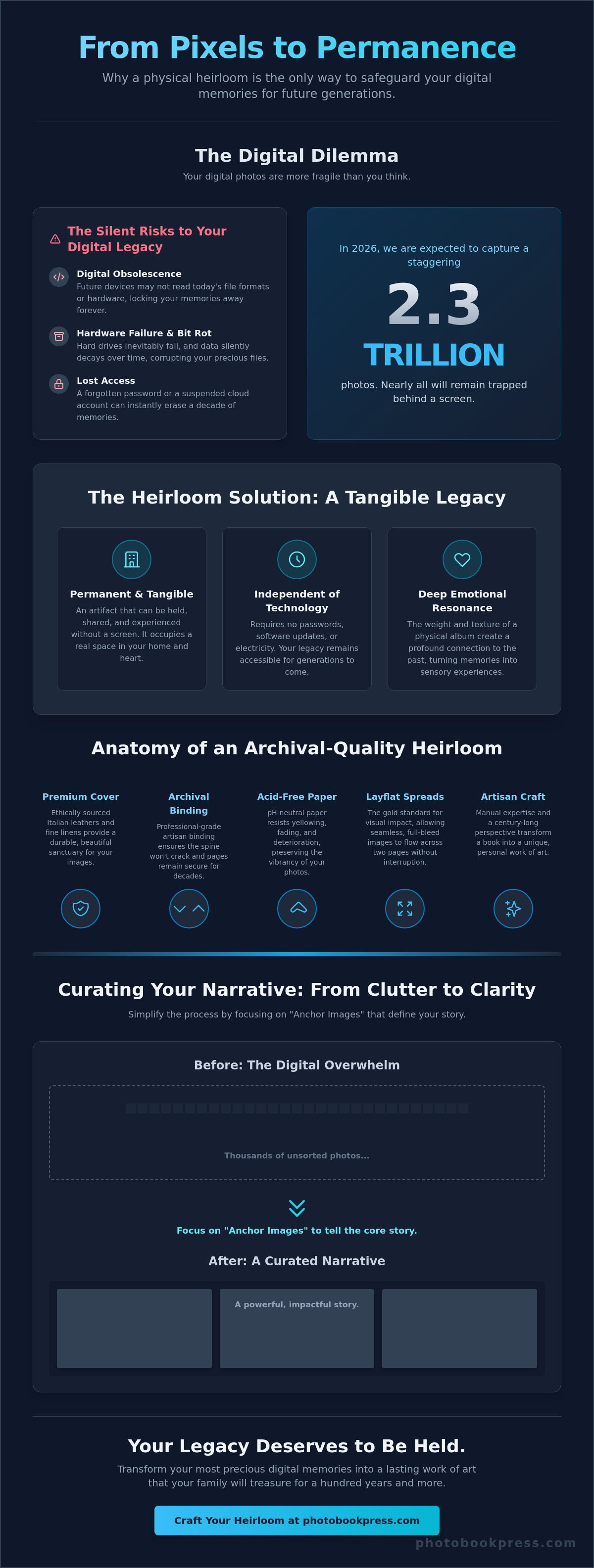
The challenge of turning digital photos into heirlooms isn't a lack of material, but an excess of it. With over 2 trillion photos taken annually, the modern archive is often a cluttered digital warehouse rather than a curated history. To create a legacy, you must act as a gallery curator rather than a data archivist. This requires a ruthless distillation. A collection of 40 evocative, high-impact images will always resonate more deeply than a 400-page volume of repetitive snapshots. By identifying "Anchor Images", those singular frames that encapsulate the spirit of a person or the atmosphere of a decade, you provide the foundation for a story that endures. These photos don't just record what happened; they evoke how the moment felt.
Don't overlook the power of the candid moment. While posed portraits have their place, the unscripted laughter or the quiet, unguarded glance often holds the most authentic personality. This deliberate approach to turning digital photos into heirlooms ensures your book feels like a curated gallery rather than a generic folder of files. Whether you organize your book chronologically or by theme, ensure there's a consistent thread connecting each page. This narrative flow guides the viewer through your history with grace and intention, making the experience of reading the book as significant as the memories it contains.
Professional designers often use a "Wide, Medium, Close-up" rhythm to maintain visual interest and variety. Start with a wide shot to establish the setting, move to a medium shot for the subjects, and finish with a close-up on a small detail, like a pair of weathered hands or a child's favorite toy. Before you select a single file, write a one-sentence thesis for your book. If your goal is "The quiet beauty of our first decade together," every image must serve that specific vision. This clarity prevents the project from becoming a dumping ground for every photo on your phone and keeps the focus on quality over quantity.
A sophisticated heirloom understands the importance of silence on the page. White space isn't empty; it's a design choice that gives your most significant memories room to breathe. Don't feel pressured to fill every square inch of your book. Sometimes, a single image on a stark white page carries the most emotional weight. To add layers of history, consider including scans of non-photo artifacts. A handwritten letter, a vintage ticket stub, or a child's drawing can be integrated as high-resolution scans, adding a tactile dimension to the digital history. Finally, use minimal, elegant typography to provide context. A simple date or a brief location tag is often all that's needed to anchor the memory without distracting from the visual artistry of the prints.
True artistry in book design is found in what you choose to omit. When turning digital photos into heirlooms, the temptation to use contemporary filters or complex, busy layouts is often strong. However, these trends frequently age poorly, tethering your memories to a specific, fleeting moment in digital fashion. A timeless heirloom relies on a minimalist aesthetic that allows the imagery to remain the focal point. Professional designers and photographers often favor personalized touches that feel organic to the book's construction, such as blind debossing or subtle foil stamping, rather than loud, distracting graphics.
The architecture of the page matters as much as the photo itself. Utilizing a full-bleed spread, where a single image stretches across the entire width of the open book, creates a cinematic impact that feels both modern and classic. This technique is particularly effective for "Anchor Images" that define the emotional core of your story. Your choice of cover material should also reflect this commitment to longevity. Whether you select a supple Italian leather or a textured fine linen, the exterior should complement the refined atmosphere of a curated home library. It's a piece of art that invites touch and commands respect on a coffee table or a mantle.
Deciding between color and black-and-white photography is a pivotal design choice. Monochromatic images often lend a "fine art" quality to a book, stripping away the distraction of color to focus on light, shadow, and raw emotion. This is a classic strategy for turning digital photos into heirlooms that feel like heritage pieces. If you choose color, accuracy is paramount. Professional-grade color calibration ensures that the vibrant hues of a sunset or the specific shade of a loved one's eyes are reproduced with absolute fidelity. Consistency is the key; maintaining a unified editing style throughout the volume creates a cohesive visual narrative that feels intentional and polished.
The fonts you choose act as the voice of your legacy. Serif fonts, with their traditional roots, often suggest a sense of archival elegance and history. Sans-serif fonts offer a cleaner, more contemporary feel that works well with minimalist layouts. Regardless of style, the text should be used sparingly. The primary role of typography in an heirloom is to provide essential context for future historians. Including specific dates, names, and locations prevents your family's story from becoming a mystery to the next generation. A few lines of well-placed, elegant text can enhance the imagery without cluttering the visual field. If you are ready to transform your digital archive into a physical masterpiece, you can browse our collection of artisan photobooks to find the perfect canvas for your story.
Excellence in print is rarely the result of speed; it's the product of time, patience, and a deep respect for the medium. Since 1985, Photobook Press has functioned as a bridge between traditional artisan standards and the evolving digital landscape. Our heritage is rooted in the belief that a photograph only reaches its full potential when it's given a physical form that matches its emotional weight. At our Maryland facility, we've created a sanctuary for the craft of bookmaking. It's a space where state-of-the-art imaging technology meets the meticulous, steady hands of binders who understand that turning digital photos into heirlooms is a sacred act of stewardship. This intersection of modern precision and manual expertise is why the world’s most discerning professional photographers trust us with their wedding album production.
Our commitment to quality extends across every medium we touch. Whether we are crafting a classic leather-bound volume that feels heavy with history or a modern metal print that vibrates with contemporary clarity, the standard remains unchanged. We don't view these as mere products; they're investments in your family’s legacy. Every piece that leaves our facility is designed to endure, ensuring that the vibrancy of your life’s most significant moments doesn't fade with the passing of the seasons.
We provide a refined palette of materials designed to satisfy both the technical requirements of archival preservation and the aesthetic desires of a curated home. Our selection includes ethically sourced Italian leathers, fine European linens, and sophisticated Portfolio Books. We employ a "White Glove" approach to every order. This means your project is inspected by human eyes and handled by human hands at every stage of the process, ensuring perfection before it ever reaches your door. This level of boutique exclusivity is available to everyone, from the discerning traveler who chooses to discover YAL’OOU Exclusive Yachting & More and preserve their Aegean voyage to the high-volume professional building an international brand. We believe every story deserves the same level of artisan care.
The journey of turning digital photos into heirlooms begins with a single, intentional choice to move away from digital clutter and toward physical pride. Our design interface is built to be intuitive, allowing you to curate your narrative with ease while still achieving professional-grade results. It's a streamlined process that respects your time without compromising on the complexity of the final artifact. As you begin, remember that an heirloom isn't just a gift for yourself or your current family. Much like the custom treasures found at The Wrapped Parcel, these volumes are a message sent forward in time; it's a gift to the generations you haven't met yet, providing them with a tactile connection to their origins that no cloud account could ever offer.
The transition from a cluttered digital archive to a refined physical legacy is one of the most significant creative acts you can undertake. By focusing on intentional curation and selecting timeless design elements, you ensure your history remains accessible long after digital formats have faded into obscurity. Turning digital photos into heirlooms requires a partnership with craftsmen who respect the weight of your memories. It's about choosing materials that defy time and a binding process that honors the integrity of every page.
Since 1985, our master printers have dedicated themselves to this noble craft. In our Maryland-based artisan production facility, we combine state-of-the-art precision with manual expertise to produce volumes that are as durable as they are beautiful. When you choose premium archival-grade materials and binding, you aren't just making a book; you're preserving a life lived. We invite you to Design Your Custom Heirloom Photo Book Today and give your story the permanent home it deserves. Your legacy is ready to be captured with the care it deserves.
An heirloom is defined by its structural integrity and the use of archival-grade materials that meet international preservation standards. While a standard album often relies on acidic adhesives and thin paper, an heirloom utilizes pH-neutral components and reinforced binding. This meticulous approach to turning digital photos into heirlooms ensures the physical object remains a permanent witness to your family's history rather than a temporary novelty.
Focus on a curated selection of 40 to 60 high-impact images to maintain a powerful, cohesive narrative. Including an excessive number of photos can dilute the emotional resonance of the volume and clutter the visual experience. A sophisticated book design prioritizes white space and "Anchor Images," allowing each significant memory the room it needs to breathe as a standalone work of art.
Both materials offer exceptional longevity, though they cater to different aesthetic preferences. Genuine Italian leather provides a robust, classic protection that ages gracefully, developing a unique character over decades of use. Fine linen offers a refined, contemporary texture that is equally durable when stored in a proper environment. Your choice should complement the tactile experience you wish to create for future generations.
High-quality results depend on sufficient resolution, ideally aiming for the 2026 industry standard of 600 DPI for crisp, fine-art detail. While modern smartphone sensors capture incredible data, heavily compressed or low-light images may lose clarity when printed in a large format. It's best to use original, uncompressed files to ensure that turning digital photos into heirlooms results in a sharp, museum-quality finish.
Store your heirloom in a cool, dry place away from direct sunlight and fluctuating humidity levels. Light and moisture are the primary catalysts for print degradation over long periods. Handle the pages with clean, dry hands to prevent the transfer of natural oils. By treating the book as a precious artifact, you ensure its vibrant colors and structural integrity remain pristine for your descendants.
Layflat binding utilizes a specialized hinge technology that allows the pages to rest completely level when the book is open. Standard binding creates a curved "gutter" where parts of your images can be lost in the fold of the spine. For cinematic panoramas or intimate portraits that span two pages, layflat construction is the essential choice for an uninterrupted and immersive viewing experience.
Acid-free paper is non-negotiable because it prevents the chemical decay that causes pages to become yellow and brittle over time. Many mass-market papers contain lignin, which creates an acidic environment that eventually destroys the paper fibers and the ink itself. Using pH-neutral, archival-grade paper ensures your book remains supple and brilliant for over 100 years, even under modern LED lighting conditions.
The creation of a true heirloom requires a deliberate, steady pace to accommodate manual binding expertise and rigorous quality inspections. Unlike mass-produced items, these books are treated as individual works of art that require time for adhesives to set and materials to be perfectly aligned. This composed process reflects the artisan's commitment to excellence, ensuring your legacy is manufactured with the attention to detail it deserves.
