No Products in the Cart


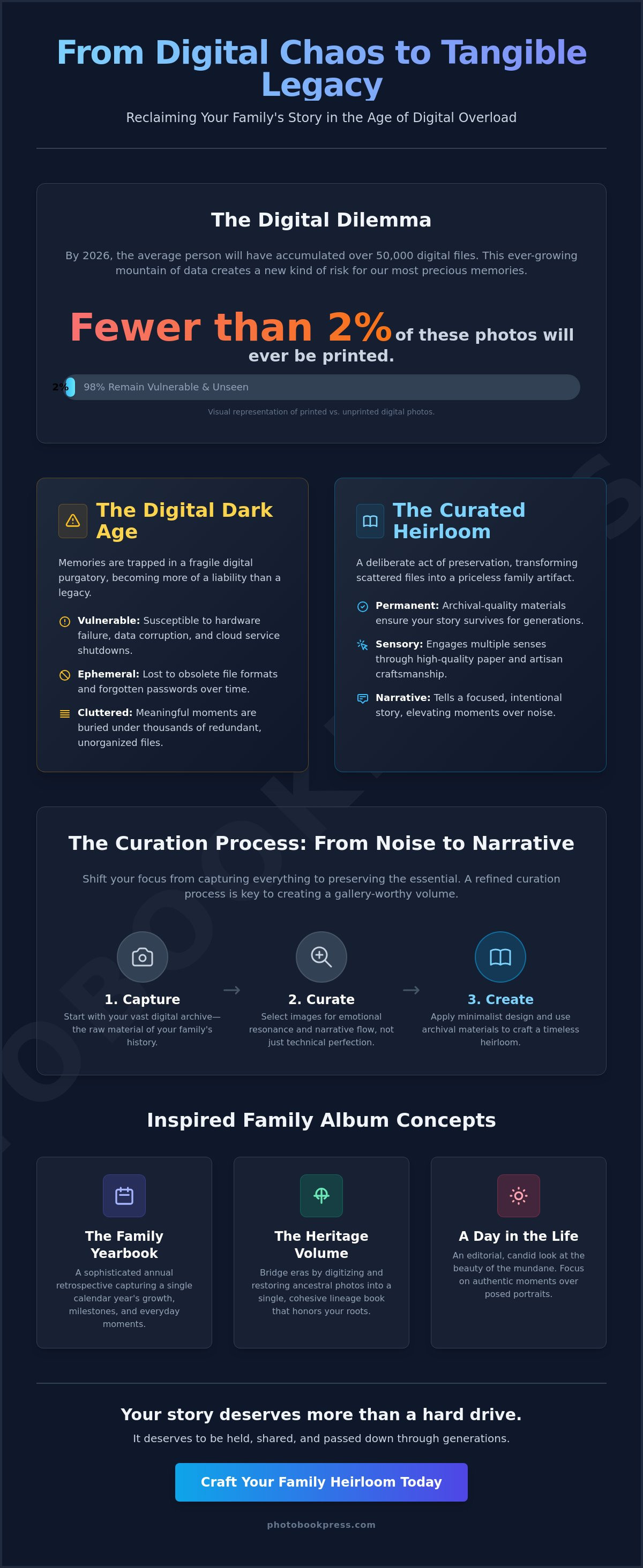
What if your family’s most profound moments are currently trapped in a digital purgatory, vulnerable to the next hardware failure? By the start of 2026, the average person will have accumulated over 50,000 digital files, yet fewer than 2% of these images will ever be printed. You likely understand the quiet anxiety of scrolling through endless, unsorted folders while fearing your children’s early years might simply disappear. It’s time to reclaim those memories. By exploring elevated family photo album ideas, you can transform your digital archives into sophisticated, handcrafted volumes that bridge generations.
We’ll help you move past the cluttered aesthetic of traditional scrapbooking toward a more refined, design-forward approach. You’ll discover how to create a physical legacy that commands attention on a mahogany coffee table while ensuring your story remains beautifully told. This guide provides 21 inspired concepts to help you master annual photo organization and select the archival-quality materials your history deserves. From minimalist chronologies to thematic heritage collections, we’re providing the roadmap to curate your life’s work with the precision of a gallery curator.
In a world increasingly defined by the ephemeral, the "Heirloom Photo Book" stands as a curated physical vessel for a family's unique history. It's more than a collection of images; it's an intentional archive designed to survive the shifting tides of technology. While digital files remain susceptible to the "digital dark age" where formats expire and cloud services vanish, the permanence of archival-quality printing ensures that your legacy remains tangible. An exquisite photo album provides a physical bridge between generations, offering a sense of continuity that a glowing screen cannot provide.
To better understand how simplifying your collection leads to a more meaningful legacy, watch this helpful video:
Physical books facilitate deeper emotional connections by engaging multiple senses simultaneously. Children, in particular, benefit immensely from seeing their place within the family unit displayed prominently in the home. The tactile experience of premium paper weights and artisan textures invites a slower, more meditative pace of reflection. Tactile memory in child development is the cognitive process where physical interaction with an object reinforces the emotional permanence of the memory it represents. This physical connection transforms a simple afternoon of browsing into a profound lesson in identity and belonging.
The danger of photo hoarding in the cloud is that the most meaningful moments often get buried under thousands of redundant screenshots and blurry bursts. Recent industry data suggests that while we take more photos than ever, we revisit them less frequently than previous generations. A single, handcrafted photo book is vastly more valuable than 10,000 unorganized files because it represents a choice. By shifting your focus from capturing everything to preserving the essential, you can explore sophisticated family photo album ideas that prioritize narrative over noise. This transition ensures that your story is not just stored, but beautifully told through professional craftsmanship and meticulous design.
A curated photo book is more than a collection of images; it’s a deliberate narrative. When exploring family photo album ideas, consider the Family Yearbook. This sophisticated annual retrospective captures a single calendar year, documenting the subtle shifts in height, the evolution of personal style, and the quiet triumphs of everyday life. By committing to a consistent format each December, you create a shelf of matching volumes that tell a multi-generational story with visual continuity and grace.
The Heritage Volume serves as a bridge between eras. Digitizing faded 19th-century tintypes or mid-century Polaroids allows you to restore ancestral lineage into a single, archival-quality book. For those beginning this journey, the U.S. National Archives provides essential guidance on Preserving Family Archives to ensure original physical assets remain protected while their digital counterparts live on the page. This approach transforms scattered boxes of history into an exquisite heirloom that honors those who came before us.
If you prefer an editorial aesthetic, the "Day in the Life" framework offers a candid look at the beauty of the mundane. Instead of posed portraits, focus on the morning light in the kitchen or the organized chaos of a playroom. These Milestone Anthologies, dedicated to specific events like weddings or a child’s birth, allow for deep dives into life's most transformative chapters. They provide the space to include every meaningful detail that a general album might overlook.
A "First Year" volume should evoke the senses. Include macro shots of tiny hands or the texture of a favorite blanket to ground the memories in physical reality. For older children, utilize graduation photo album ideas to celebrate the transition from student to professional. Integrating the "Letter to the Future" concept by scanning handwritten notes or sketches adds a layer of intimacy that digital text cannot replicate. These elements turn a simple book into a time capsule of personal growth.
The Destination Chronology focuses on the specific culture and landscape of a family journey. Whether it’s a 10-day trek through the Alps or a weekend at a coastal retreat, use panoramic spreads to do justice to vast horizons. Don't overlook the "Staycation" Book; these volumes celebrate the local adventures that define your home life. Selecting an artisan-grade binding ensures that your family photo album ideas are rendered with gallery-level precision, making them a reality that lasts for generations.
Creating a legacy requires more than a simple upload of digital files; it demands the discerning eye of a curator. When exploring family photo album ideas, the process of selection is where your personal history transforms into a cohesive narrative. This editorial journey ensures that every page turned feels like a deliberate step through time rather than a cluttered archive.
Step 1: The First Pass. Begin by selecting images based on emotional resonance. Ignore technical imperfections like slight motion blur or imperfect lighting if the moment feels vital. If a photograph makes your heart race or brings a smile to your face, it belongs in the initial collection.
Step 2: The Editorial Cut. Be ruthless in your refinement. If you have five nearly identical shots of a graduation ceremony, choose the single frame that captures the most authentic expression. Removing repetitive shots improves the narrative flow and prevents the viewer from experiencing visual fatigue.
Step 3: Sequencing. Arrange your photos to create a rhythmic experience. A grand, multi-generational portrait should be followed by a series of smaller, quieter moments. This variation in scale and energy guides the reader’s eye across the spread with grace.
Step 4: Incorporating Breathers. Detail shots act as the punctuation marks of your story. A close-up of a child’s scuffed shoes, the texture of a hand-knit blanket, or the specific bloom of garden peonies sets the scene. These "breathers" provide the eye a place to rest and ground the larger events in a specific time and place.
The most enduring family photo album ideas often center on the power of the candid shot in photography. While staged portraits have their place, unposed moments reveal the true spirit of your family. Balance wide-angle scene setters that establish the environment with intimate close-ups that focus on connection. Identify your "hero images," those breathtaking shots that define a year or an era, and grant them the prestige of a full-page or layflat spread to maximize their impact.
As a master printer, we understand that the tactile quality of an heirloom depends on the integrity of the digital file. To ensure your memories remain sharp for decades, always prioritize high-resolution files. Color consistency is equally vital; when compiling a multi-year project, subtle color grading can unify disparate photos into a singular aesthetic. For those designing a signature centerpiece, a minimum resolution of 3600 x 3600 pixels is required to achieve a sharp, professional-grade 12x12 print at 300 DPI. This attention to detail ensures your story is told with the clarity it deserves.
Creating a lasting legacy requires a transition from digital clutter to curated art. Professional designers treat every page as a gallery wall, where the goal is to highlight the emotion of the moment rather than crowding the space. Sophisticated family photo album ideas often center on the concept of white space. By allowing images to breathe, you draw the viewer’s focus to the subject's expression. A 2024 analysis of visual design trends suggests that minimalist layouts enhance emotional engagement by 40% compared to dense, collage-style pages. Use a consistent grid system to maintain a professional rhythm throughout the book. This structure ensures that even when photo sizes vary, the overall aesthetic remains balanced and intentional.
Typography functions as the silent narrator of your family’s history. Selecting timeless fonts is essential for longevity. Opt for classic serifs or clean sans-serifs that have remained relevant for over 60 years, such as Garamond or Futura. These choices ensure your captions and dates won't feel dated by 2036. The art of the spread also involves designing across the gutter. With modern printing technology, you can feature a single, breathtaking landscape or a panoramic family portrait across two pages without losing any detail in the center fold.
Selecting the physical structure is a foundational step in the archival process. Many families prefer layflat photo books because they allow images to rest perfectly flat, providing a seamless viewing experience for wide-angle portraits. Size significantly alters the book's impact. A 12x12 inch volume serves as a commanding coffee table statement, while an 8x8 inch format offers an intimate, handheld experience. For those with professional-grade photography, portfolio-style layouts with wide margins mimic the feel of a high-end art monograph.
The tactile experience defines the book's character before the first page is turned. Linen offers a modern, organic feel that suits candid, outdoor sessions. Leather suggests a classic, heirloom quality that matures beautifully over time. For maximum durability, Smyth-sewn bindings are the gold standard. This traditional method involves sewing folded groups of pages together; it's a technique used for centuries to ensure books remain intact through generations of handling. Adding foil stamping or debossing provides a bespoke, tactile finish that identifies the volume as a handcrafted artifact. It's these small, deliberate details that transform a collection of images into a family treasure.
Start preserving your history today by exploring our handcrafted photo book collections.
Since 1985, PhotoBook Press has refined the art of the printed page, transforming digital memories into physical legacies. Our Maryland-based production facility combines state-of-the-art printing technology with the meticulous care of traditional bookbinding. We don't view your photos as mere files; we treat them as precious artifacts that deserve a permanent, tactile home. This commitment to the craft ensures that when you explore various family photo album ideas, the final result feels like a gallery-quality publication rather than a standard retail product.
Our platform serves a diverse community of storytellers, from hobbyists documenting a child's first year to seasoned pros. We provide the same high-end specifications to every client through our professional photo books, bridging the gap between technical excellence and user-friendly design. The interface allows you to build complex, beautiful layouts with ease, giving you total creative control over how your history is presented. You can focus on the narrative while we handle the precision of the press.
Quality at PhotoBook Press is measured in centuries, not seasons. We utilize archival-quality inks and premium papers specifically engineered to resist fading for over 100 years. This ensures the vibrant colors of a summer reunion or the subtle tones of a vintage portrait remain true for future generations. Every book undergoes a rigorous hand-inspection process where our experts examine the binding, page turns, and cover finish. Because family legacies often span the globe, we offer reliable worldwide shipping to help you share your history with relatives regardless of their zip code.
Initiating your project is a seamless process designed to honor your time and creativity. Our intuitive tools allow you to upload and organize your curated selections quickly, making it simple to experiment with different family photo album ideas until the flow feels right. We recognize the value of consistency, which is why we offer professional discounts for recurring family yearbooks. This allows you to build a uniform library of your life’s milestones year after year. Your story is unique, and it deserves to be told with the quiet confidence of a handcrafted masterpiece. Begin building your legacy today.
In 2026, the shift from digital clutter to tangible history represents a profound commitment to your family story. You've discovered how a thematic approach and careful curation turn a chaotic digital library into a cohesive narrative. By implementing these family photo album ideas, you're not just organizing pictures; you're building a bridge between generations. Moving beyond the thousands of forgotten files on a hard drive requires a deliberate return to the craft of print.
Photobook Press has been a leader in this craft since 1985, producing volumes handcrafted in the USA with meticulous attention to detail. We utilize museum-grade archival materials to ensure your images remain vibrant for decades. Our signature layflat binding provides a seamless canvas for your panoramic memories, allowing every detail to shine without interruption. It's an investment in a physical heirloom that demands to be held and shared.
Begin crafting your family legacy with Photobook Press today. Your history is unique, and it's time to give it the exquisite home it deserves.
A curated family photo book typically thrives with a selection of 50 to 150 images to maintain a focused narrative. Limiting your selection ensures each portrait receives the space it deserves on the page. Professional curators suggest a ratio of two images per page to maintain visual elegance. This approach prevents visual clutter and allows your most significant family photo album ideas to breathe. Your legacy is best preserved through quality, not sheer volume.
Organizing by month remains the most effective method for an annual retrospective. Create 12 digital folders on your drive to sort images as the year progresses. Industry experts suggest selecting 10 definitive photos from each month to create a balanced 120 page narrative. This structured workflow simplifies the design process. It transforms a year of digital files into a cohesive, handcrafted archive that feels intentional and complete for the entire family.
Matte paper is the preferred choice for sophisticated heirlooms because it eliminates glare and resists fingerprints. Its smooth texture offers a tactile experience that feels like a gallery collection. Glossy paper provides a 15 percent higher color saturation, which suits vibrant vacation snapshots. However, for a timeless family legacy, the muted elegance of archival matte paper ensures the focus remains on the emotional depth of the subjects rather than a shiny finish.
You should definitely include scanned artifacts like hand drawn sketches or 50 year old letters to add historical layers to your book. Scan these items at a minimum of 600 DPI to capture every texture and ink stroke accurately. These elements transform a standard book into a multidimensional family archive. They provide a tangible connection to the past that photos alone cannot convey. Your story becomes a rich tapestry of visual and written history.
A layflat book uses a specialized binding technique that allows pages to rest perfectly level when opened. This eliminates the traditional gutter where images often disappear into the center fold. It's essential for panoramic shots or spreads featuring 24 inch wide landscapes. This professional grade construction ensures your family photo album ideas are displayed without distortion. It offers a seamless viewing experience across every inch of the spread for a truly cinematic feel.
Longevity depends on the use of acid free, archival quality materials that prevent yellowing and paper degradation over time. Choose books printed with pigment based inks rather than dye based alternatives, as they resist fading for over 100 years in typical home conditions. Store your volume in a climate controlled environment where humidity stays below 50 percent. These technical standards protect your investment. They ensure your handcrafted legacy survives for future generations to admire.
A chronological arrangement is ideal for yearbooks to showcase 365 days of growth and change in a logical sequence. For milestone events like a 50th wedding anniversary, a thematic approach focusing on "Legacy" or "Travel" creates a more poignant narrative. Research suggests 70 percent of families prefer a timeline structure for annual books. This logical flow mirrors the natural passage of time. It makes the story easy for children and grandchildren to follow.
Your images must have a resolution of 300 dots per inch (DPI) at the final print size to ensure crisp, professional results. An 8 by 10 inch page requires a file that's at least 2400 by 3000 pixels. Printing images with lower resolutions often results in visible pixelation and loss of detail. High resolution files allow the printer to reproduce the subtle nuances of skin tones and textures. This precision distinguishes a premium heirloom from a standard print.
