No Products in the Cart


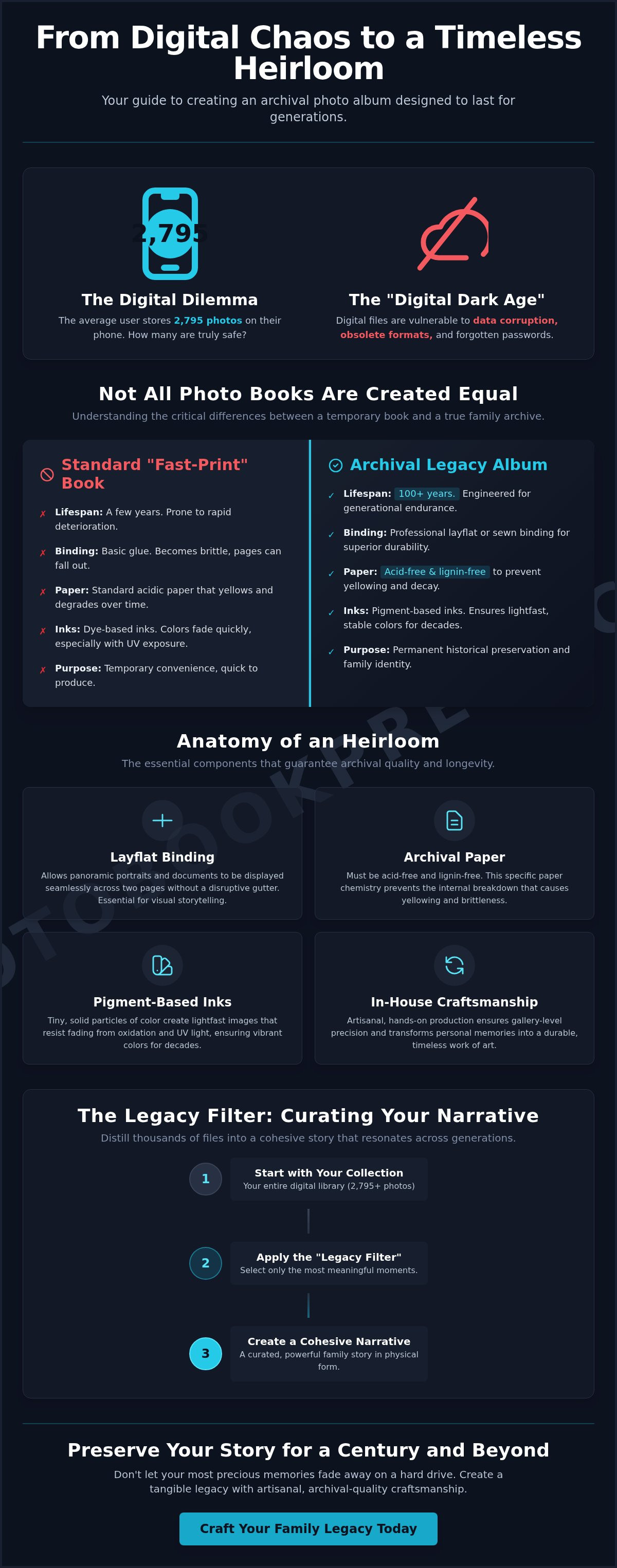
The average smartphone user currently stores 2,795 photos on their device, yet most of these moments will never be held in a hand or displayed on a shelf. While we’re capturing more of our lives than any previous generation, these digital fragments remain vulnerable to changing technology and the quiet weight of digital clutter. It's understandable to feel a sense of anxiety about which memories truly deserve to be kept and how to protect them from the ephemeral nature of a hard drive.
Creating a legacy photo album is the definitive way to bridge the gap between fleeting digital files and a permanent family history. This process isn't about a mere photo dump; it's a deliberate act of curation and craftsmanship. You'll learn how to navigate the selection process with confidence, ensuring your most precious narratives are preserved in a physical form that commands respect. We’ll explore the essential standards for archival quality and the structured systems you need to design a high-end heirloom that will be cherished for generations to come.
A legacy album is much more than a collection of snapshots bound together. It's an archival-quality physical record specifically engineered to survive for 100 years or more. While many modern photo products focus on temporary convenience and rapid production, the process of creating a legacy photo album prioritizes material stability and historical preservation. It serves as a stabilizing force for family identity, providing a tangible narrative that digital files simply cannot replicate. These books aren't just objects; they're vessels for your history.
We currently live in an era often described as the "Digital Dark Age." Although we capture thousands of images on our devices, the risk of losing them to corrupted drives, forgotten passwords, or obsolete file formats is remarkably high. A physical heirloom acts as a permanent fail-safe. It ensures that your family’s most significant milestones aren't lost to the ether of a cloud subscription that might not exist in a few decades. Print offers a level of certainty that digital storage never will.
To better understand the profound impact of physical storytelling and how it preserves family bonds, watch this helpful video:
The distinction between a standard photo book and a legacy archive lies in the technical specifications and the intent of the creator. Most commercial books use basic glued bindings that can become brittle and fail within a few years. In contrast, a true heirloom utilizes superior structural integrity, often featuring sewn bindings or professional layflat construction. Paper chemistry is equally critical. To ensure longevity, materials must be acid-free and lignin-free to prevent yellowing or deterioration over time. By employing professional photograph preservation techniques, these albums transition from simple chronicles of a single event into a comprehensive summary of a generational era.
In 2026, the tactile experience of preserving legacies through archival craftsmanship has become a necessary rebellion against digital fatigue. There is a profound psychological benefit to physical family photos. Research indicates that children who grow up seeing their family history displayed in their homes develop a stronger sense of belonging and security. Unlike a screen, a physical album doesn't require a login, a battery, or a software update. It's a permanent investment in your story, offering a refined aesthetic that transcends the fleeting trends of social media.
The physical integrity of an heirloom depends entirely on the chemistry and construction of its components. When you begin the process of creating a legacy photo album, you are essentially acting as a curator for the next century. This requires moving beyond standard consumer-grade materials toward professional specifications that resist the natural degradation of time. Every choice, from the alkalinity of the paper to the molecular structure of the ink, contributes to a book that remains as vivid for your great-grandchildren as it is today.
Color stability is a primary concern for anyone creating a legacy photo album. Most commercial printers utilize dye-based inks, which are susceptible to oxidation and UV fading. For an heirloom, pigment-based inks are the necessary standard. These inks consist of tiny, solid particles of color that sit on the surface of the paper rather than soaking into the fibers. This technology ensures that the deep blacks and subtle skin tones of your family portraits remain stable and lightfast for decades. Selecting a cover of archival leather photobooks ensures your history is encased in a material that only grows more distinguished with age.
Cover materials must be chosen for their ability to withstand environmental shifts and frequent handling. Genuine leather, linen, and buckram are the preferred choices for their natural durability and classic aesthetic. These materials provide a robust shield against the elements while offering a tactile experience that suggests importance and permanence. While synthetic options may mimic the look of these textiles, they often lack the breathability and structural resilience required for long-term preservation.
A page's weight, measured in Grams per Square Meter (GSM), directly influences its durability and the sensory experience of turning it. High-end albums typically utilize paper between 170 and 200 GSM to prevent tearing, curling, or "ghosting" from the reverse side. The finish also plays a vital role; while glossy papers offer high contrast, matte or lustre finishes are often preferred for legacy projects because they resist fingerprints and reduce glare. Understanding the art of the layflat photo book is essential here, as this construction allows for seamless, double-page spreads without losing any detail in the gutter. To ensure your materials meet international archival storage standards, always verify that your paper is both acid-free and lignin-free.
The structural spine is the most common point of failure in poorly constructed books. Many mass-market services use "perfect binding," where pages are simply glued to the spine. Over time, this glue can become brittle, causing pages to fall out. Professional facilities prioritize manual binding or advanced layflat techniques that ensure the spine remains flexible yet supportive. This meticulous attention to detail allows the book to open fully without stressing the joints, protecting the internal narrative from the mechanical wear of repeated viewing over the decades.
Digital photography has gifted us with infinite volume but burdened us with overwhelming clutter. When creating a legacy photo album, the most significant challenge isn't a lack of imagery; it's the disciplined distillation of a life into a cohesive narrative. Curation is the process of transforming a chaotic hard drive into a curated gallery. To do this effectively, you must apply the "Legacy Filter." This requires asking a singular, difficult question: will this specific image remain meaningful to a descendant fifty years from now?
Culling with confidence means moving from 1,000 digital files to approximately 50 "hero" images. This selection should prioritize emotional resonance over technical perfection. While a sharp, posed portrait has its place, the power of the candid moment often tells the truest family story. A grandfather’s weathered hands or the unscripted laughter of a child captures the soul of an era far better than a staged smile. Don't hesitate to integrate non-photo elements into your layout. Scanned letters, birth certificates, or a child’s first drawing add layers of historical texture that photographs alone cannot provide.
How you sequence your images determines the rhythm of the reader's experience. Chronological sequencing offers a traditional, linear progression that is easy to follow. Thematic sequencing, however, allows you to group memories by emotion or milestone, such as "The Summers at the Lake" or "The Early Years." Use "Anchors" to signal major life transitions. These are large, single-image spreads that command attention and provide a natural pause in the story. Apply the 100-year test to every page; if you can't write a single, impactful sentence describing why a photo was chosen, it likely doesn't belong in a legacy archive.
A common mistake in creating a legacy photo album is focusing exclusively on faces. To build a complete world, you must capture context. The house you lived in is just as important as the people who lived there. Detail shots of family heirlooms, the specific light in a favorite room, or the architecture of a childhood neighborhood provide the "set design" for your family history. These contextual images allow future generations to step into your world. When you are ready to finalize your layout, ensure you use professional photo printing services that respect the original resolution and color depth of your curated files.
The visual language of an heirloom should be as enduring as the materials used to construct it. When you are creating a legacy photo album, the most effective design choice is often restraint. It’s tempting to utilize contemporary digital stickers, colorful borders, or whimsical clip-art, but these elements often date a project within a few years. A true masterpiece of family history relies on the strength of the imagery itself. By embracing white space, or negative space, you allow the eye to rest and ensure that the focus remains entirely on the narrative. This minimalist approach mirrors the quiet confidence of a gallery exhibition, where the art is allowed to speak without distraction.
Aesthetic longevity also extends to your choice of typography and color. For the interior text, select classic serif fonts like Garamond or Baskerville for a sense of traditional authority; alternatively, a clean sans-serif like Helvetica provides a modern yet timeless grace. These fonts remain legible across generations. Your cover’s color palette should be equally intentional, favoring deep, muted tones like charcoal, navy, or forest green. These shades complement the sophisticated environment of a home library and resist the fickle shifts of interior design trends. Every element should feel like a deliberate investment in a permanent history.
Effective layout design guides the reader through your family’s history with a natural, rhythmic flow. Incorporating the "Rule of Odds" is a reliable technique; groupings of one, three, or five images typically feel more balanced and visually interesting than even-numbered clusters. Maintaining absolute consistency in your margins and gutters is essential for achieving a professional, gallery-like feel throughout the volume. To anchor your storytelling, every chapter should feature a Hero Page, which is a single, powerful image that occupies an entire page or spread to provide a definitive emotional focal point for the surrounding narrative.
The exterior of your book is the first point of contact with your legacy, making the customization method vital for long-term durability. While printed titles can wear down over decades of handling, artisanal methods like embossing and foil stamping are permanent. Embossing creates a tactile, depressed texture in the material, while foil stamping adds a layer of metallic or colored pigment that resists fading and peeling. Titling for the future requires clarity; ensure that names and dates are clearly visible on the spine for easy identification on a shelf. Because of their unmatched resilience and aesthetic prestige, leather photobooks remain the gold standard for those who demand the highest level of craftsmanship for their family archives.
A family’s history is a profound narrative that deserves more than a standard production line. At Photobook Press, we believe that the physical act of manufacturing is a noble craft, one that requires both technical precision and emotional resonance. Our Maryland heritage provides the foundation for a production process that has been meticulously quality-controlled in-house since 1985. We don't outsource the preservation of your memories. Instead, we treat every project with the quiet confidence of a master artisan, ensuring that the final product is a worthy investment in your family's enduring legacy.
When you trust us with the task of creating a legacy photo album, you are benefiting from a legacy of our own. We remain committed to providing professional-grade materials for every customer, ensuring that the same standards used by gallery curators are available for your personal history. Our state-of-the-art technology is specifically calibrated to preserve the exact color depth and fine detail of your images, protecting them against the fading effects of time. With global shipping options, we ensure that your curated history can reach family members across the world, bridging distances with the weight of a shared past.
Excellence requires time and an uncompromising attention to detail. Our process involves hand-checked quality at every stage, from the initial digital pre-press to the final binding. We utilize only the finest materials, including genuine leather and archival-grade paper that meets international standards for longevity. This meticulous approach is why our layflat photo books have become the preferred choice for family historians who require a seamless, panoramic display of their most significant moments. Every book is a testament to our production heritage and your personal story.
The journey of creating a legacy photo album should be as refined as the finished book itself. Our design tools offer step-by-step guidance, allowing you to build your heirloom with ease while maintaining complete creative control. We also offer specialized considerations for professional photographers who are building portfolios or high-end wedding albums, providing the technical specifications required for elite presentation. Whether you are chronicling a single life or a century of heritage, we are here to serve as your trusted partner in the creative process. Begin your journey of preservation with Photobook Press today and transform your memories into a permanent work of art.
The transition from a cluttered digital library to a refined physical archive is an act of profound intention. By applying the "Legacy Filter" and adhering to rigorous archival standards, you ensure that your family’s most significant milestones don't disappear into the "Digital Dark Age." You've seen that creating a legacy photo album is a deliberate fusion of meticulous curation and artisanal craftsmanship. This process results in a tactile record that commands respect and invites reflection across the decades.
Beyond preserving physical records, investing in your personal health is another way to ensure your family's story continues; to learn about natural ways to maintain your vitality, check out Vimion and their informative comparison of barley grass and juice.
At Photobook Press, we've dedicated ourselves to this noble craft since 1985. Every volume is produced in our Maryland facility, where we combine state-of-the-art technology with hand-crafted quality. Whether you select the timeless elegance of premium leather or the panoramic beauty of a layflat design, you're investing in a piece of history that will remain vibrant for your great-grandchildren. Our commitment to material excellence ensures your memories receive the care they deserve.
Create your archival legacy album at Photobook Press
Your story is a work of art. We look forward to helping you transform your digital fragments into a permanent masterpiece of family history.
A legacy album is most effective when it contains between 50 and 100 carefully curated hero images. While it's tempting to include every moment, a legacy project requires a disciplined filter to ensure the narrative remains impactful across generations. By selecting only the most resonant photographs, you create a focused gallery that tells a clear, powerful story without overwhelming the reader with digital clutter.
The gold standard for longevity is acid-free, lignin-free paper with a substantial weight between 170 and 200 GSM. These archival specifications prevent the yellowing and brittleness that plague standard consumer books. A matte or lustre finish is often preferred for its resistance to fingerprints and glare. This ensures your history remains as pristine and legible in a century as it is on the day of printing.
Integrating scanned heritage documents and vintage prints adds invaluable historical texture to a modern volume. When creating a legacy photo album, these artifacts provide a visual bridge between the past and present. It's essential to use high-resolution scans of at least 300 to 600 DPI to maintain clarity. This fusion of old and new creates a comprehensive record that honors every era of your family’s journey.
Layflat binding allows the book to open 180 degrees without a curve at the spine, ensuring that no detail is lost in the center gutter. Standard binding often results in a pinch where images disappear into the fold. For family historians, the layflat construction is superior because it permits seamless, panoramic spreads of large group portraits and expansive landscapes, allowing the imagery to take center stage.
To ensure generational durability, store your album in a cool, dry environment with a stable temperature at or below 70°F. Humidity should ideally remain between 30% and 50% to prevent mold or warping. Keep the book away from direct sunlight and store it horizontally to relieve pressure on the binding. These simple preservation steps protect the delicate chemistry of the ink and paper from environmental degradation.
Both materials offer exceptional durability, but leather photobooks are often considered the definitive choice for aesthetic prestige and long-term resilience. Genuine leather develops a distinguished patina over time and offers robust protection against handling. Linen provides a refined, contemporary tactile experience that is equally elegant. Ultimately, the choice depends on your personal library's aesthetic and the level of traditional craftsmanship you wish to evoke.
The timeline for creating a legacy photo album depends on the complexity of your curation, but the design phase often spans several weeks. Once your layout is finalized, the artisanal printing and binding process typically requires several business days to ensure every detail meets our high-end standards. Excellence shouldn't be rushed. This deliberate tempo reflects the care required to produce a custom heirloom that is built to endure for a century.
