No Products in the Cart


What if your most cherished digital memories weren't meant for a heavy, gilded tome, but for the effortless grace of a curated gallery catalog? Many creators hesitate to explore custom softcover photo books because they fear a flimsy aesthetic or bindings that crack after only a few sittings. It's frustrating to see vibrant screen colors turn dull in print, or to worry that a lightweight book won't stand the test of time. You deserve a medium that respects your vision, treating every snapshot as a precious artifact rather than a disposable print.
This guide shows you how to transform your digital library into a sophisticated, professional-grade volume that balances tactile elegance with archival durability. You'll learn how to achieve professional-grade color reproduction and a velvet-like matte finish that feels undeniably premium in the hand. We will examine the specific materials and design choices that elevate these books from simple keepsakes to editorial-grade storytelling pieces. By the end, you'll understand why the right softcover isn't a budget compromise; it's a deliberate choice for the modern, discerning archivist who values both substance and style.
Many people view the softcover format as a compromise, a mere placeholder for its hardcover counterparts. This perspective misses the true artistry of the medium. The modern softcover is an editorial masterpiece, a tactile volume that mirrors the sophisticated feel of a high-end gallery catalog or a bespoke fashion lookbook. It's built for those who value a minimalist aesthetic and a deep physical connection to their imagery. It speaks with a quiet confidence that does not rely on bulk to convey importance.
To better understand the distinct physical qualities of this format, watch this helpful comparison:
Professionals often favor this format for its magazine-style fluidity. It's lightweight and flexible, inviting a level of intimacy that a rigid, heavy album cannot provide. Whether it's a portfolio of architectural work or a deeply personal family yearbook, custom softcover photo books offer a rhythmic flow that feels both contemporary and timeless. The pages turn with a gentle grace, making the act of viewing your photography a sensory experience rather than a chore. This format excels in high-volume storytelling, where the goal is to capture the breadth of a year or a specific project without overwhelming the shelf.
While a leather-bound album carries the weight of a formal heirloom, a softcover book feels like a conversation. It encourages frequent handling and shared experiences on a coffee table or a bedside stand. In 2026, we've seen a distinct shift toward these minimalist photography collections. People are moving away from monolithic archives in favor of curated, portable volumes that are easy to revisit and display. The craft of bookbinding has evolved to ensure these flexible covers remain resilient, protecting your narrative without the bulk of traditional casing. It's an intimate way to hold your history.
Softcover is the superior choice for projects that demand a lighter touch. Think of a vivid travelogue from a month in Kyoto, an artist's portfolio that needs to be easy to ship, or a "day-in-the-life" series. Because they are more portable, they make exceptional gifts for family members or clients who appreciate understated luxury. Many collectors choose to integrate custom softcover photo books into a larger professional photo book library. They use softcovers for thematic sub-series that complement their primary hardcover archives, creating a diverse, multi-textured collection that captures every nuance of a personal or professional legacy.
Crafting a premium volume requires more than just high-resolution files. It demands a marriage of technical precision and artistic intent. At Photobook Press, this process unfolds in state-of-the-art Maryland-based production facilities, where master artisans oversee every stage of creation. The excellence of custom softcover photo books rests upon three foundational pillars: the grade of the paper, the technology behind the binding, and the precision of the ink. When these elements align, the result is a piece that feels substantial and intentional.
Beyond these technical specifications, the tactile finish defines the reader's experience. Cover lamination is an essential, though often overlooked, feature that provides a necessary barrier against fingerprints and moisture. A matte finish offers a velvet-like, sophisticated touch that eliminates glare, while a gloss finish provides a striking pop of color and luminosity. These choices elevate the medium, supporting the concept of artistic expression in photobooks as a legitimate and enduring art form. If you're ready to start your own project, exploring our softcover photo books is the first step toward creating a lasting legacy.
The weight of your paper, measured in GSM (grams per square meter), dictates the hand of the book. High-GSM papers provide a luxurious opacity that prevents images from ghosting through to the reverse side. This isn't just about thickness; it's about the page-turn feel. Archival-grade paper is non-negotiable for those looking to preserve memories across decades, as it resists the yellowing and brittle degradation common in mass-market prints. The subtle texture of the paper also influences how we perceive depth. A slightly toothy surface adds a painterly quality to landscapes, while a smoother finish preserves the sharp contrast of architectural photography.
Longevity in a softcover book depends entirely on the spine. While budget services often use standard EVA (Ethylene Vinyl Acetate) glue that can become brittle and crack over time, professional-grade production utilizes PUR (Polyurethane Reactive) adhesive. PUR binding remains flexible even after the glue has fully cured, allowing the book to be opened repeatedly without the spine losing its structural integrity. Perfect binding is a specific method that ensures pages remain secure even with frequent use, creating a clean, squared-off spine that looks beautiful on any shelf. This meticulous approach to construction ensures your custom softcover photo books don't just look professional on day one, but stay that way for years.
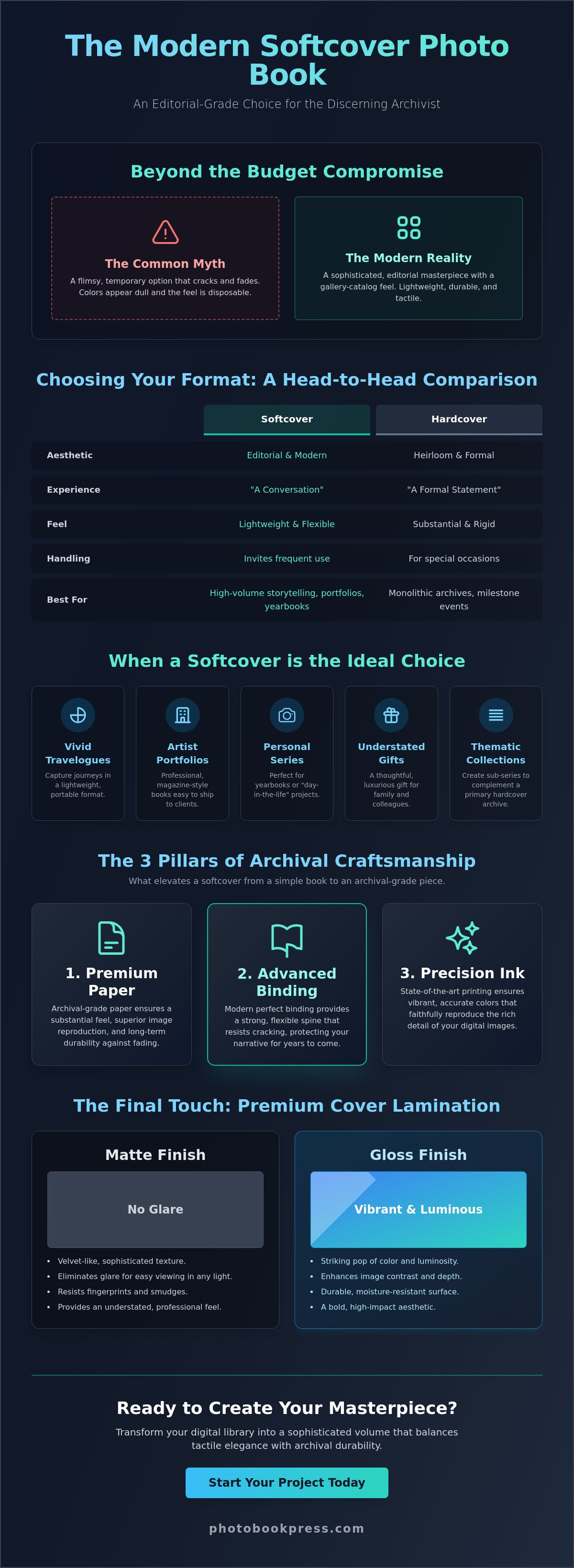
Selecting the ideal format for your project is a decision of intent. It's about matching the physical weight of the book to the emotional weight of the story. While the architectural presence of a hardcover commands attention on a library shelf, custom softcover photo books offer an accessible, rhythmic experience that invites the reader to linger. The choice isn't merely about price; it's about how you want the narrative to be consumed. For grand, panoramic imagery that requires uninterrupted spreads, layflat photo books remain the gold standard. However, for a sequence of intimate portraits or a chronological travelogue, the softcover format provides a fluid, editorial pace that feels undeniably modern.
There's a common myth that softcover volumes are less durable than their rigid counterparts. With modern archival materials and flexible PUR binding, a premium softcover rivals the shelf-life of a traditional hardcover. It doesn't crack under pressure; it moves with the reader. This flexibility makes it a superior choice for high-volume storytelling, such as annual family yearbooks or quarterly business portfolios, where a sophisticated cost-to-quality ratio allows for a more expansive collection of memories.
The lighter profile of a softcover book transforms it from a stationary object into a portable art piece. It's the perfect medium for sharing across a coffee table or mailing to loved ones. There's a distinct sensory pleasure in the way a flexible cover yields to the hand, creating a smooth transition between pages that feels more like a high-end magazine than a heavy archive. This format is particularly effective for creating a series. When you produce multiple volumes of a single event or a "day-in-the-life" series, the softcover format allows the collection to feel cohesive and manageable rather than bulky and overwhelming.
To help you determine the best fit for your next project, consider how these formats compare across key characteristics:
| Format | Aesthetic Style | Ideal Use Case | Durability |
|---|---|---|---|
| Softcover | Editorial / Magazine | Portfolios, Yearbooks | High (Flexible) |
| Hardcover | Classic / Academic | Commemorative Gifts | Very High (Rigid) |
| Layflat | Grand / Seamless | Weddings, Landscapes | Premium (Ultra-Thick) |
Whether you choose a pocket-sized 6x6 volume for a curated "mini-series" or a grand 12x12 book for a comprehensive retrospective, the goal remains the same. You're creating a vessel for your history. By choosing custom softcover photo books, you embrace a medium that prioritizes the act of viewing and the joy of a shared, tactile narrative.
Developing an editorial eye is the essential bridge between a simple collection of images and a curated masterpiece. It requires a shift in perspective, moving from a desire to include every photo to a focus on the narrative arc. When you design custom softcover photo books, you aren't just filling pages; you're directing a sensory experience. This begins with the deliberate use of white space. In high-end design, negative space is a luxury marker. It acts as a visual palate cleanser, allowing each photograph to breathe and command the reader's full attention without the clutter of competing elements.
Visual rhythm is achieved through contrast and scale. Try pairing a vast, wide-angle landscape with a macro close-up of a specific detail, such as the texture of a hand-woven rug or the intricate veins of a leaf. This juxtaposition creates a dynamic energy that mimics the experience of a physical gallery walk. For your typography in 2026, lean into minimalist elegance. Understated, clean fonts on the spine and title pages reinforce the sophisticated, artisan nature of the volume. If you're ready to curate your own story, you can start designing your softcover book today to see these principles in action.
Every compelling story needs a definitive start and a thoughtful conclusion. Your opening shot should serve as an invitation, setting the emotional and visual tone for what's to come. Conversely, the closing frame should offer a sense of resolution or a quiet moment of reflection. Between these bookends, group your photographs by a shared color palette or emotional resonance. This creates a cohesive flow that feels intentional rather than accidental. When using full-bleed images, be mindful of the gutter. While softcover books have excellent flexibility, critical details should stay clear of the central fold to maintain the integrity of the composition.
Professional-grade results depend on meticulous technical preparation. Understanding bleed and safety zones is critical for softcover trimming, as these margins ensure your images extend perfectly to the edge without losing vital content. Always export your files at the highest possible resolution to maintain clarity and depth in the final print. Utilize sRGB color profiles for the most accurate print reproduction. These small, technical steps are what separate a standard print-on-demand product from an artisan-level volume that you'll be proud to display for years to come.
True excellence in print isn't achieved through automation alone; it requires a legacy of dedication. At Photobook Press, we draw upon a 40-year heritage of printing excellence that began in 1985. While many modern services prioritize speed and volume, we remain committed to the quiet confidence of the high-end artisan. This history allows us to treat every project as a unique work of art rather than a generic product on an assembly line. The creation of custom softcover photo books within our walls involves a meticulous human touch, where manual binding and rigorous quality control ensure that every page meets our exacting standards of beauty and durability.
Professional photographers and curators find a trusted partner in our process. We offer specialized wholesale opportunities that allow creators to scale their vision while maintaining the boutique exclusivity their clients expect. This professional-grade reliability extends to our logistics. We provide worldwide shipping and utilize premium, protective packaging for every order, ensuring your work arrives in pristine condition regardless of its destination. It's a comprehensive approach to craftsmanship that respects the emotional resonance of your memories.
The journey of your book begins with a digital upload and ends as a hand-packed delivery. By maintaining our production within our Maryland facility, we ensure a level of oversight that outsourced operations simply cannot match. Local, US-based production means faster turnarounds without compromising on the high standards we've refined over four decades. We select only premium materials that stand the test of time, from archival papers to flexible, resilient adhesives. This local dedication ensures that when you're ordering your custom softcover photo books, you're investing in a product built to last for generations.
Transforming your digital archives into a physical legacy is a profound act of preservation. Our intuitive design tools are built to guide you through this creative process, offering expert control without the complexity of traditional publishing software. While you curate your narrative, consider how other bespoke elements might complement your collection. We offer a sophisticated range of photo cards and wall calendars that share the same artisan DNA as our books. These pieces allow you to extend your storytelling across different formats, creating a cohesive visual history. Don't let your most significant life events remain trapped behind a screen. Reach out to the artisans at Photobook Press and begin the journey of turning your personal history into a tangible masterpiece today.
Choosing the right medium for your memories is an act of curation that defines how your story will be remembered. We've explored how custom softcover photo books offer a modern, editorial aesthetic that balances portability with professional-grade durability. By prioritizing archival materials and the "editorial eye" in your design, you transform a digital library into a tactile art piece that invites frequent sharing and quiet reflection.
At Photobook Press, we treat every volume as a precious artifact. Our books are hand-bound in the USA, a tradition of excellence we've maintained since 1985. By utilizing professional-grade archival paper and meticulous construction techniques, we provide the same quality trusted by world-class photographers. It's time to move beyond the screen and hold your history in your hands. Design Your Custom Softcover Photo Book and begin the journey of creating a physical legacy that truly reflects your vision. Your stories deserve nothing less than artisan perfection.
A softcover photo book is defined by its archival quality and construction, whereas a magazine is often an ephemeral, mass produced item. Our books utilize premium, high GSM paper and durable perfect binding. Magazines typically use thinner, non archival stocks and saddle stitching. This ensures your book feels like a permanent addition to your library rather than a disposable publication.
Most custom softcover photo books can accommodate between 20 and 150 pages. This range provides ample space for comprehensive yearbooks or detailed portfolios without compromising the integrity of the spine. If your project exceeds this length, the physical weight might suggest a shift to a hardcover format to ensure the best long term preservation of your narrative.
The spine of a premium softcover book will not crack if it is constructed with professional grade PUR adhesive. This specific binding remains flexible for decades, allowing the book to open easily without the glue becoming brittle. Budget options often use standard EVA glue, which is prone to failure, but our artisan approach prioritizes flexibility and structural resilience.
You can certainly print text on the spine of your softcover book, provided it has a minimum page count to create sufficient surface area. This usually requires at least 40 to 50 pages depending on the paper weight selected. Adding a title or date to the spine allows your volume to be easily identified on a bookshelf, enhancing its professional, editorial appearance.
A matte finish is generally the superior choice for black and white photography. It offers a deep, velvety texture that enhances the tonal range and prevents distracting glares. This finish allows the viewer to appreciate the subtle gradients and contrasts of your imagery, creating a timeless look that mirrors the aesthetic of traditional darkroom prints.
Proper storage involves keeping your books in a climate controlled environment away from direct sunlight. Store them flat rather than upright to prevent the covers from bowing over time. Excessive humidity or rapid temperature changes can damage the archival paper, so a stable, dry bookshelf is the ideal home for your growing collection.
Designing from scratch allows for a truly artisan result that reflects your unique narrative. While templates offer convenience, they can sometimes feel generic. Starting with a blank canvas gives you the freedom to utilize white space and varied layouts, ensuring your custom softcover photo books stand out as bespoke pieces of editorial grade storytelling.
Production typically takes several business days as each book undergoes a meticulous manual quality check in our Maryland facility. Once the artisan binding and inspection are complete, shipping times vary based on your location. We prioritize precision over haste to ensure your memories arrive in perfect condition, reflecting our 40 year heritage of printing excellence.
