No Products in the Cart


If your digital device were to fail tomorrow, how many of your most cherished milestones would simply vanish into the ether? The average person now maintains a library of over 2,100 digital images, yet few of these moments ever graduate to a physical form. You likely feel the burden of this digital accumulation, perhaps hesitating to design your own photo book because you fear poor print quality or the complexities of binding types. It's a common tension between the desire to preserve history and the technical hurdles of the professional printing world.
When you approach this process with an artisan’s perspective, you're not just arranging images; you're curating a tactile legacy. This guide will show you how to transform your digital archives into a sophisticated, handcrafted heirloom using professional design principles and premium materials. We will explore the selection of archival papers and the meticulous craftsmanship required to ensure your story is told with the grace it deserves.
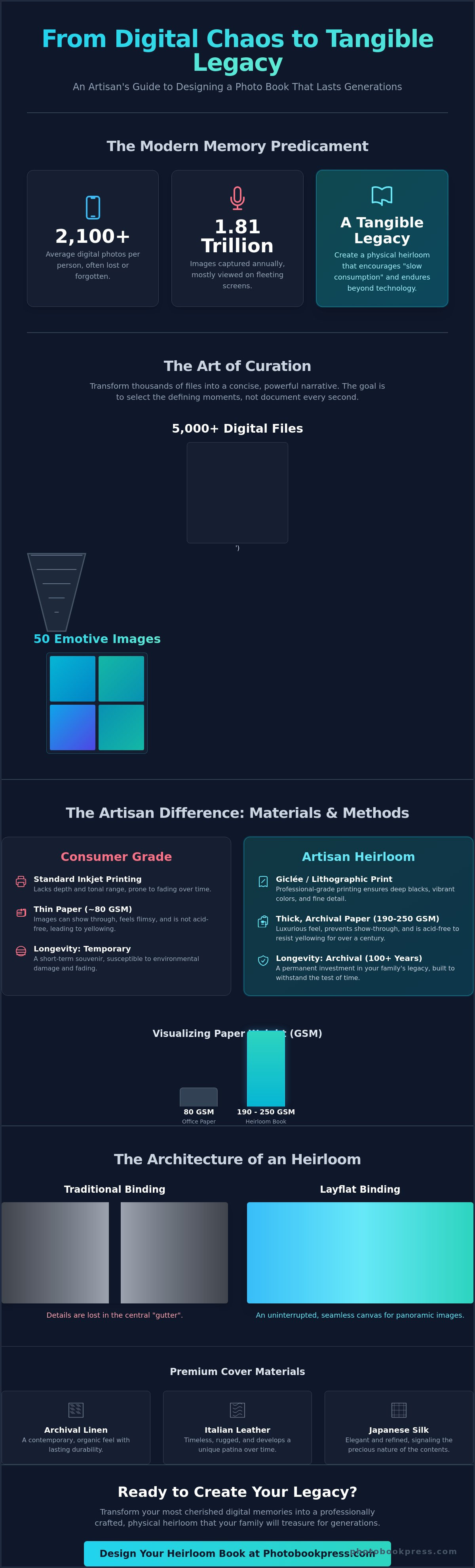
In a world where we capture an estimated 1.81 trillion images annually, the digital screen has become a temporary resting place for our most vital memories. We scroll, we double-tap, and we eventually forget. Choosing to design your own photo book is an act of quiet defiance against this ephemeral culture. It represents the transition from a fleeting pixel to a tangible legacy. This isn't a mere collection of snapshots; it's the creation of an Heirloom Book, a vessel for personal history that demands the same reverence as a gallery installation.
Unlike the frantic pace of a social media feed, a physical volume invites the luxury of slow consumption. There is a profound psychological weight to a printed page that a glass screen cannot replicate. It forces the eye to linger and the mind to reflect. When you design your own photo book through an artisan lens, you're investing in a medium that survives the obsolescence of technology. This intentionality separates the artisan work from the mass-produced album. Every choice, from the gutter width to the tactile quality of the cover, contributes to a larger story. Your story, beautifully told.
Digital amnesia is a modern phenomenon where we outsource our memories to the cloud, only to have them vanish in the sheer volume of data. Designing a book corrects this trajectory. It requires you to sit with your history, selecting the 50 images that define a season rather than the 5,000 that clutter your phone. This process of curation is a meaningful review of life’s milestones. Beyond the personal value, the finished book becomes a decorative art piece. A refined volume on a coffee table serves as a permanent, physical invitation to reconnect with your past.
The distinction between consumer-grade products and professional artisan work begins with the press. Standard inkjet prints frequently lack the depth and tonal range required for sophisticated storytelling. By applying the foundational principles of book design, you elevate your project to a professional lithographic or Giclée standard. This level of craftsmanship ensures true archival quality. In the world of fine art printing, archival quality is defined as the ability of the materials to resist yellowing and fading for 100 years or more. It's the difference between a temporary souvenir and a permanent investment in your family’s legacy.
When you begin to design your own photo book, the tactile choices you make are as vital as the images themselves. The physical foundation dictates the design possibilities. A heavy, textured paper might demand minimalist layouts, while a sleek, high-gloss finish thrives on vibrant, high-contrast imagery. Cover materials like Japanese silk, archival linen, or Italian leather don't just protect the pages; they signal the weight of the memories within. It's a deliberate choice that transforms a collection of digital files into a physical legacy.
The structural integrity of your book ensures these stories endure. Leather offers a timeless, rugged durability, while linen provides a contemporary, organic feel. Before committing to a layout, it's helpful to seek expert advice on photo book creation to ensure your narrative flow matches your material choices. Every element should serve the story. Your choice of canvas is the first chapter in that narrative.
Traditional binding creates a gutter, a lost valley where details disappear into the center of the book. Layflat photo books utilize a specialized hinge mechanism that allows each spread to rest perfectly level. This is the gold standard for landscape photography and wedding albums. You can design across the fold without losing a single pixel of a panoramic horizon or a sweeping bridal train. It transforms two pages into a singular, immersive canvas. When you design your own photo book using this method, you gain the freedom to let your most impactful images breathe across the entire width of the volume.
Quality is measured in GSM, or grams per square meter. A standard sheet of office paper is typically 80 GSM, but a premium photo book often features 190 GSM to 250 GSM. This thickness prevents show-through and provides a luxurious hand-feel. Archival standards require acid-free paper. Over 50 or 100 years, acid-free stock prevents yellowing and preserves color accuracy. Selecting the right finish is equally critical:
The weight of the paper and the clarity of the finish are the silent narrators of your work. Explore our range of handcrafted cover options to find the perfect match for your legacy. Your story, beautifully told, begins with the right materials.
When you choose to design your own photo book, you're doing more than just organizing files; you're acting as both the author and the curator of a personal legacy. This process begins with the physical foundation of your story. You'll need to select a format that mirrors the spirit of your imagery. Landscape orientations are the traditional choice for sweeping travel vistas, while square formats offer a contemporary, gallery-like feel. If your collection focuses on intimate portraiture or fashion, a vertical portrait orientation provides the necessary height to capture every detail of the subject.
The technical integrity of your book relies on the quality of your source files. Professional artisans adhere to a 300 DPI (dots per inch) standard to ensure every print is crisp and free of digital noise. Once your high-resolution images are uploaded, apply the "Rule of Thirds" to your compositions. Instead of centering every subject, place focal points along the imaginary grid lines of the page. This creates a natural tension and movement that keeps the viewer engaged. Keep captions minimal; a single date or a quiet sentence of context often carries more weight than a paragraph of explanation. Finish your design with a meticulous proofread, paying close attention to image alignment and the 1/8th inch bleed zones where the paper meets the binding.
Choosing between a pre-made template and a blank canvas depends on your desired level of creative control. Templates provide a sophisticated framework for those who appreciate guided symmetry. If you prefer total autonomy, a blank canvas allows you to manipulate white space as a design element. Always respect the "Safety Zone," which is the area at least 0.25 inches from the trim line. Keeping vital details like eyes or horizon lines away from these edges prevents them from being lost during the handcrafted binding process. For multi-photo spreads, ensure that horizons are perfectly level across the gutter to maintain a seamless visual flow.
Identifying a low-resolution image is vital before you commit to a full-page print. If a file size is under 2MB, it likely won't sustain the clarity required for a large-scale display. You must also account for the inherent difference between screen brightness and print reality. Digital screens are backlit, while paper reflects light; this means your printed photos may appear slightly darker than they do on your monitor. Increasing the exposure of your images by 5% to 10% can often bridge this gap. For a deeper understanding of how professional equipment handles these nuances, consult our guide on photo printing services to ensure your heirloom meets archival standards.
Creating a book is a slow, rewarding ritual that transforms digital data into a tactile experience. By following these technical steps, you ensure that your creative vision is matched by the physical durability of the final product. Your memories deserve a home that reflects the care you put into capturing them.
Ready to transform your gallery into a professional volume? Start your project with PhotoBook Press today.
Since 1985, Photobook Press has cultivated a legacy of excellence within its Maryland-based artisan facility. This isn't a high-speed assembly line. Every project reflects a commitment to the "press" heritage, where manual binding techniques ensure your photo book remains intact for decades. When you decide to design your own photo book, you're entering a creative partnership with a master printer who views your memories as precious artifacts that deserve the highest level of care.
The difference lies in the bespoke details that mass-market services simply can't replicate. You can specify finishes such as deep leather embossing or intricate custom foil stamping to give your project a signature look. By prioritizing archival-quality materials, the Maryland facility produces books that resist the wear of time; they maintain their structural integrity and color precision long after digital files have been lost to outdated hardware or forgotten cloud accounts.
You don't need a gallery exhibition to justify professional-grade printing. Photobook Press brings the same meticulous standards used by world-class artists to personal family albums. For those who curate extensive libraries or document multiple events per year, professional photographer discounts are available to support high-volume creators. The experience is deeply sensory. You'll notice the substantial weight of the archival paper, the subtle aroma of premium leather, and the effortless, smooth page turn that defines a true heirloom.
The journey from a digital file to a physical heirloom is a profound transformation. Your images deserve more than a fleeting existence on a smartphone screen; they belong in a format that invites touch and quiet reflection. To design your own photo book is to create a gift for future generations, ensuring that your family’s unique narrative is preserved with clarity and grace. It's time to move your most meaningful moments from the cloud to the coffee table where they can be shared and celebrated.
A digital archive is merely a beginning, yet a physical book is a definitive destination. When you choose to design your own photo book, you're transitioning from fleeting pixels to a permanent legacy that commands attention. You've explored the art of curating a narrative that flows with intention and learned how to select premium materials that honor your unique vision. Every choice you make reflects a commitment to quality that transcends the limitations of a digital screen. By organizing your archives with a focus on storytelling, you ensure your most precious moments aren't just stored, but celebrated.
Since 1985, our studio has remained dedicated to the noble craft of the press. Each volume is handcrafted in the USA using archival-quality materials guaranteed to preserve your images for generations to come. We treat your memories as precious artifacts, ensuring every page turn offers the tactile grace of a gallery exhibition. Your story deserves the meticulous attention of a master printer who understands that excellence requires both time and precision. It's time to bring your most meaningful moments into the physical world with the care they've earned. We look forward to seeing your vision take shape.
Start Designing Your Heirloom Photo Book
To design your own photo book with a professional finish, aim for an average of three to five images per page. For a standard 20-page heirloom volume, this equates to a curated selection of 60 to 100 photographs. Selecting fewer, high-impact images allows each frame to breathe. This approach ensures your narrative remains focused and avoids the visual clutter of overstuffed layouts that can distract from your story.
Layflat photo books utilize a specialized binding technique that allows pages to rest perfectly flat at a 180-degree angle. This construction eliminates the traditional center gutter, making it ideal for panoramic landscapes or spreads that span two pages. Standard hardcovers use a conventional glued or sewn binding where the pages curve into the spine. While both offer durability, the layflat design provides an uninterrupted visual experience for your most expansive compositions.
You can certainly use smartphone images, provided they meet the minimum resolution of 300 dots per inch for print. Most modern devices, such as the iPhone 15 or Samsung Galaxy S24, capture 12 to 48 megapixel files that translate beautifully to paper. We recommend avoiding images sent via text message, as these are often compressed to less than 100 kilobytes. Instead, use original files to ensure your book maintains its sharp, professional clarity.
The investment for a custom volume varies based on dimensions, paper weight, and cover materials. According to 2023 industry market reports, premium archival books typically range from 50 to 300 dollars depending on the complexity of the artisan finishes. Choosing luxury upgrades like genuine leather or heavy 200 GSM paper will influence the final total. This investment secures a permanent legacy piece that preserves your history for decades rather than months.
The best software provides a balance of creative freedom and technical precision, such as our intuitive online designer or professional tools like Adobe InDesign. For those who want to design your own photo book without a steep learning curve, browser-based editors offer pre-set grids and drag-and-drop functionality. These platforms ensure your margins and bleed lines are technically perfect. Using these specialized tools prevents common alignment errors that occur in generic programs.
You can expect to receive your custom book within 10 to 14 business days after you finalize the design and submit your order. This timeline accounts for the meticulous hand-assembly and quality control checks required for archival-quality products. Each volume undergoes a 24-hour drying period for adhesives to set properly before shipping. We provide tracking information the moment your book leaves our press, ensuring you stay informed throughout its journey.
Archival-quality paper is acid-free and pH-neutral material designed to resist yellowing and deterioration for over 100 years. These papers are often treated with calcium carbonate to neutralize atmospheric pollutants that cause paper to become brittle. By choosing these materials, you're ensuring that your photographs retain their original color accuracy and structural integrity. It's the difference between a temporary print and a permanent heirloom that future generations will cherish for a lifetime.
You have the complete freedom to integrate text, captions, and dates into your layout to enhance the storytelling aspect of your book. Adding a few lines of elegant typography can provide essential context, transforming a collection of images into a cohesive narrative. Our design interface supports a curated selection of refined fonts that complement the aesthetic of high-end photography. This allows you to document names, locations, or personal reflections alongside your visual memories.
