No Products in the Cart


What if the 2,100 digital images the average person stores on their devices in 2024 were actually the raw materials for a museum-grade legacy? Most of us feel the weight of a growing digital archive, yet we hesitate to print because we fear the vibrant colors on our screens will turn dull and flat on the page. You recognize that your most precious milestones deserve a home more permanent than a cloud server. Learning how to make a photo book is not simply about clicking a button; it's an intentional act of preservation that requires the eye of an artisan and the precision of a master printer.
Organize your book chronologically for life events like weddings or a child's first year to show a clear progression of time. If you're looking for an even more immersive way to engage children in their own history, MIBOOKO creates personalized storybooks and audiobooks where they become the hero of the adventure. For travel or artistic portfolios, a thematic arrangement based on color palettes or locations often creates a more compelling visual rhythm. Data suggests that 70 percent of family historians prefer the linear approach for clarity. Either method works as long as the flow remains consistent throughout the pages.
This guide provides the professional framework you need to transform your digital library into a sophisticated, handcrafted heirloom. You'll discover how to master the technical details of archival-quality materials and gain expert-level design knowledge that removes the guesswork from the creative process. We'll walk through the essential steps of professional curation, the tactile importance of premium paper weights, and the structural integrity of artisan binding techniques to ensure your story is beautifully told for generations.
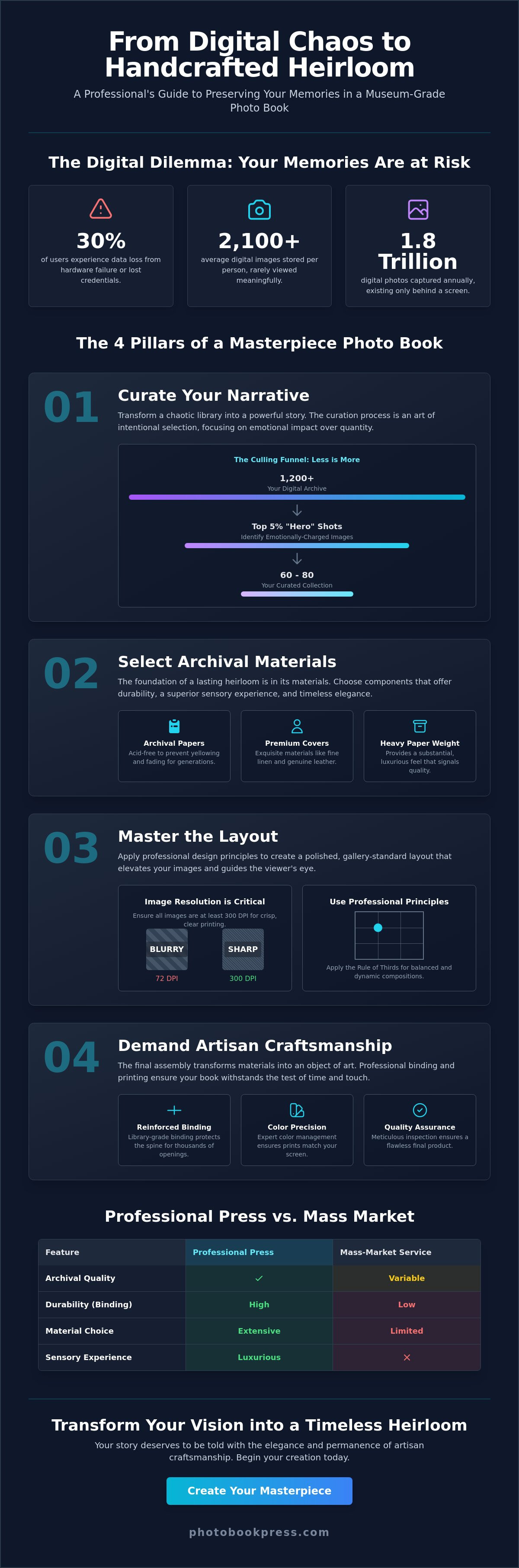
In an era where the world captures over 1.8 trillion digital images annually, the vast majority of our lived experiences are relegated to a cold, flickering existence behind glass. We scroll through thousands of moments, yet we rarely pause to truly see them. Learning how to make a photo book is a radical act of curation in 2026. It transforms a chaotic stream of data into a physical, handcrafted legacy that demands attention. A Photo book serves as more than just a collection of images; it is a structured narrative that captures the essence of a personal history, preserved in a format that does not require a battery or a software update to appreciate.
To better understand the practical steps of this creative process, watch this helpful video:
Digital storage is surprisingly fragile. With 30% of users experiencing data loss due to hardware failure or forgotten cloud credentials, the permanence of print offers a necessary sanctuary for our memories. Physical books encourage a slower, more rhythmic reflection that digital devices cannot replicate. When you hold a volume in your hands, the weight and texture signal to your brain that these moments matter. This tactile experience is the foundation of photo books as family heirlooms, ensuring that your heritage remains accessible to future generations without the barrier of evolving technology.
There is a profound difference between a mass-market product and a boutique, artisan-crafted book. While basic services offer convenience, a professional press utilizes high-end materials that elevate the emotional resonance of every image. Craftsmanship is the cornerstone of a great book. It involves a meticulous selection of paper weights, color precision, and binding techniques that transform a simple project into an exquisite artifact.
Mastering how to make a photo book requires an appreciation for this "press" heritage. By choosing superior materials, you aren't just printing pictures; you're investing in a durable vessel for your most precious stories. The result is a sophisticated piece of art that feels at home on a gallery shelf or a coffee table. It's your story, beautifully told through the lens of timeless craftsmanship.
The journey of learning how to make a photo book begins long before you select a cover material or a paper weight. It starts in the quiet, disciplined moments of curation. You aren't just selecting files; you're harvesting a legacy from a digital harvest. To create an heirloom that resonates, follow a structured five-step audit. First, identify your "hero" shots. These are the images that stop you in your tracks, representing the 5% of your library that carries the heaviest emotional weight.
Next, develop a narrative arc. While a chronological flow is traditional for weddings or travel, a thematic arc grouped by emotion or color often feels more like a gallery exhibition. Culling requires an editorial mindset where "less is more" becomes your mantra. If you're starting with a folder of 1,200 images, your goal is to distill that down to a potent selection of 60 to 80. Group these remaining shots by color palette or sub-topic to ensure visual harmony. Finally, prepare your files. For an archival result, every image must be at least 300 DPI. This technical precision ensures your handcrafted photo book remains crisp and vibrant for generations.
An artisan editor distinguishes between an image that records a fact and one that tells a story. A snapshot of a dinner table is a fact; a close-up of a grandmother’s hands breaking bread is a story. To make this process efficient, employ the "Three-Star" system. Assign one star to images you like, two stars to strong compositions, and three stars to your absolute hero shots. This method can reduce a cluttered library of 500 images into a refined selection in approximately 45 minutes. Maintaining a consistent visual tone is equally vital. Whether you prefer high-contrast black and white or soft, desaturated pastels, a unified aesthetic creates a professional finish that mirrors the quality of a museum monograph.
Don't rush into the design software immediately. Mapping your book on a physical or digital grid allows you to see the "rhythm" of the pages. Effective design principles for photo books suggest balancing scale to keep the viewer engaged. Pair a sweeping, panoramic landscape with a quiet, intimate detail shot on the opposite page. This contrast prevents visual fatigue. Use white space as a deliberate narrative tool. It acts as the silence between musical notes, giving your most powerful images the room they need to breathe. When you understand how to make a photo book with this level of intentionality, you transform a simple collection of pictures into a sophisticated piece of art.
Understanding how to make a photo book that survives for generations requires a focus on chemistry and physical construction. A true heirloom isn't merely printed; it's engineered. The weight of the paper dictates the sensory experience of the reader. We recommend a minimum of 100lb text weight or 200gsm to ensure the pages feel substantial and resist tearing. Scholars at the Rhode Island School of Design emphasize The Art of the Photo Book as a complex intersection of sequencing and physical form, where the choice of substrate is as vital as the image itself. Acid-free, archival papers are essential because they prevent the yellowing and brittleness that plague standard commercial prints over time.
The choice between archival pigment inks and standard digital toners is the difference between a legacy and a temporary record. While standard toners often sit on the surface of the paper and can crack or fade within 15 years, archival pigment inks penetrate the fibers. These inks are rated by organizations like Wilhelm Imaging Research to maintain color fidelity for over 100 years in typical display conditions. When you master how to make a photo book, you realize the cover is the first tactile handshake with the reader. Options range from the organic warmth of European linen to the timeless prestige of personalized leather, each providing a protective sanctuary for the pages within.
Layflat photo books represent the gold standard for high-end photography. Traditional binding creates a "gutter" that swallows the center of your images, but layflat construction utilizes a specialized hinge or a continuous sheet method. This allows the book to rest completely flat at a 180-degree angle. It's the only way to showcase panoramic landscapes or intricate group portraits without losing a single pixel to the spine's curve.
The finish you select defines the mood of your narrative. Consider these three professional standards:
Transitioning from a digital gallery to a physical heirloom requires a shift in perspective. You aren't just placing images; you're orchestrating a visual symphony where every margin and alignment matters. When you're learning how to make a photo book that functions as a piece of art, spatial harmony is your primary objective.
Bleed refers to the extra area around the edge of a page that is trimmed off during the binding process to ensure images extend perfectly to the very edge of the paper. This technical margin is essential for creating high-impact, full-bleed visual statements. To protect your narrative, keep essential elements like faces or text at least 0.5 inches away from the gutter, which is the center fold where the pages meet. Consistent alignment across facing pages creates a sense of intentionality and craftsmanship.
Use leading lines within your photography to point toward the center of the spread or the subsequent page. This technique guides the reader's eye through your story with grace. Creating a visual rhythm is equally vital; you can achieve this by varying image sizes and orientations. A single large image on the left paired with three smaller detail shots on the right establishes a clear narrative hierarchy. Mastering the nuances of how to make a photo book involves understanding how images interact across a physical fold. This meticulous attention to detail is what separates a simple album from a professional photo book designed for a legacy.
The transition from a digital collection to a physical legacy requires more than just a printer; it demands a partner who respects the weight of your memories. Since 1985, Photobook Press has upheld a tradition of excellence from our Maryland-based production facility. We don't view ourselves as a high-volume manufacturer. Instead, we operate as a boutique press where every project is treated with the meticulous attention of a gallery curator. Our heritage is rooted in the belief that a book is a vessel for history, requiring archival-quality materials that won't fade or degrade over the coming decades.
When you explore how to make a photo book that stands the test of time, creative control is paramount. Our professional design tools provide the flexibility needed to execute a specific vision, whether you're compiling a minimalist portfolio or an expansive family chronicle. We offer a diverse range of formats, from exquisite wedding albums featuring lay-flat binding to custom portfolios designed for the discerning artist. Every page reflects a commitment to color precision and tactile luxury, ensuring the finished product feels as significant as the moments it contains.
Every order placed with Photobook Press undergoes a rigorous quality check by our expert team. We offer personalized support to ensure your files are optimized for the best possible print outcome. For those seeking professional photo books, we provide dedicated workflow solutions and volume discounts tailored to the needs of working photographers. Once your heirloom is perfected, we utilize reliable worldwide shipping to deliver your work safely to your doorstep, no matter where you are located.
Before you finalize your design, it's helpful to run through a brief checklist. Ensure your image resolution is consistent, verify that your margins allow for a clean bleed, and double-check your chronological flow. Choosing the right cover material is the final step in defining the book's character. Consider the classic resilience of leather for a wedding album, the sophisticated weight of a linen hardcover for a travelogue, or the modern accessibility of a premium softcover for everyday storytelling. Each choice offers a different sensory experience that complements your narrative.
Your legacy deserves a home that matches the brilliance of your life's work. Begin your journey and create your custom photo book with Photobook Press.
Transforming a digital gallery into a physical legacy requires a blend of intentional curation and master-level craftsmanship. You've explored the essential foundations of archival storytelling, from selecting acid-free materials to mastering the visual rhythm of a professional layout. Learning how to make a photo book that lasts for generations means prioritizing structural integrity alongside aesthetic beauty. By choosing premium layflat binding or hand-stitched leather-bound covers, you ensure your narrative remains as vivid in fifty years as it's today.
Since 1985, Photobook Press has operated from its Maryland-based production facility, blending state-of-the-art archival printing technology with the meticulous touch of traditional bookmaking. We treat every image as a precious artifact, utilizing materials designed to withstand the passage of time. Your memories deserve a home that reflects their significance, crafted by artisans who value the permanence of the printed word and image. Create your archival-quality photo book today with Photobook Press.
The journey from a screen to a finished volume is a profound transition. It's time to give your most meaningful moments the tactile elegance they've earned. Your story, beautifully told, starts with a single page.
A high-quality photo book typically requires 50 to 100 carefully curated images for a standard 20-page volume. This allows for a balanced layout where 2 or 3 photos share a page, alongside 4 full-bleed statements. Selecting fewer, more impactful shots ensures each memory has room to breathe. When you learn how to make a photo book that feels like a gallery, restraint becomes your most powerful tool.
You should aim for a resolution of 300 dots per inch (DPI) at the final print dimensions to ensure crisp, professional results. While a 150 DPI image might look acceptable on a digital screen, it often appears soft or pixelated when transferred to physical paper. For an 8x10 inch spread, your file should ideally be 2400 by 3000 pixels. This technical precision preserves the fine textures of your subjects.
Choose a layflat binding if your project features panoramic landscapes or wide group shots that span 2 pages. This construction uses a continuous sheet of paper, so no imagery is lost in the center fold. Standard hardcover books utilize a traditional glued or sewn spine, which is ideal for portrait-heavy volumes. Layflat books provide a seamless 180-degree viewing experience that transforms your book into a permanent exhibition piece.
You can certainly incorporate text, titles, and captions to add narrative depth to your custom photo book. Approximately 45 percent of our clients include a 1-paragraph introduction or brief date markers to anchor their visual stories. We recommend using a 10-point or 12-point serif font for readability and elegance. Adding names and locations ensures that 75 years from now, the context of every smile remains perfectly preserved.
The journey from digital files to a finished heirloom typically spans 10 to 14 business days. Designing the layout may take 5 to 10 hours of focused creative time; meanwhile, the physical printing and hand-binding process requires 5 to 7 days of expert craftsmanship. Rushing this timeline can compromise the meticulous quality checks required for archival products. Patience ensures your book arrives as a flawless masterpiece that lasts for decades.
Archival paper is acid-free and chemically stable, designed to resist yellowing or fading for 100 years or more. Standard photo paper often contains lignins or acidic compounds that degrade after 10 to 15 years of light exposure. Our archival selections feature a heavy weight of 190 gsm or higher, providing a tactile richness that standard papers cannot match. It's the difference between a temporary print and a permanent legacy.
Organize your book chronologically for life events like weddings or a child's first year to show a clear progression of time. For travel or artistic portfolios, a thematic arrangement based on color palettes or locations often creates a more compelling visual rhythm. Data suggests that 70 percent of family historians prefer the linear approach for clarity. Either method works as long as the flow remains consistent throughout the pages.
Look for a maker that offers 8-color printing processes and a selection of 5 premium paper finishes. A true professional provides Smyth-sewn or high-end adhesive bindings that won't crack over time. When researching how to make a photo book, prioritize companies that emphasize manual quality control over automated mass production. This ensures that a human eye inspects every page for color fidelity and structural integrity before it ships.
