No Products in the Cart


With over 380 million photobooks printed worldwide in 2024, the desire to preserve our history in a physical form has never been more profound. However, the transition from a cluttered digital gallery to a refined volume often feels daunting, leaving many to fear their final product will lack professional polish. You deserve a book that mirrors the significance of the moments it holds. Mastering storytelling with photos in an album is the key to creating a narrative that feels like a curated gallery rather than a simple archive.
We treat your memories as precious artifacts that deserve the highest level of craftsmanship. This guide will teach you how to transform a collection of images into a cohesive, professional-grade narrative that speaks with quiet confidence. We'll provide a clear framework for curation and share the layout principles used by artisans to ensure every page maintains a sense of grace and balance. These steps allow you to design a beautiful, durable heirloom that preserves your legacy for generations to come.
Visual storytelling is the intentional arrangement of images to evoke a specific emotional arc. It's a craft that goes beyond simply placing pictures on a page; it's about the rhythm of memory and the deliberate pacing of a narrative. When you engage in storytelling with photos in an album, you're acting as a biographer for your own life. The concept of narrative photography provides the foundation for this art, treating each individual image as a critical sentence in a much larger, more resonant poem.
To better understand how professionals approach the medium of visual narrative, watch this insightful guide:
Creating a truly professional-grade album requires a shift from a "hoarder mindset" to a "curator mindset." A hoarder saves every frame regardless of quality, leading to digital overwhelm. A curator, however, meticulously selects only the images that serve the soul of the story. This transformation turns a collection of data into a multi-sensory heirloom. An album is a tactile experience where the weight of the paper and the texture of the cover add gravity to the memories inside. It's an investment in a legacy that gains value as the years pass.
We're currently living in what historians call the "digital dark age." Cloud storage is convenient, but it's fragile. Files corrupt, passwords are forgotten, and platforms disappear. Digital scrolling is a passive, fleeting act that doesn't encourage deep memory retention. In contrast, a premium photo book serves as a permanent archival strategy. By using professional-grade printing and acid-free materials, you're ensuring that your curated legacy remains accessible to your family long after digital formats have become obsolete.
Most people default to a strict date-order arrangement, but this often results in a disjointed experience. A "photo dump" is just a chronological archive; a "photo story" is a cinematic journey. To master storytelling with photos in an album, you should challenge the calendar. Try grouping images by theme, color, or emotional tone. For instance, a wedding album shouldn't just show the ceremony followed by the party. It could be grouped by "The Quiet Moments," "The Shared Laughter," and "The Celebration." Thematic grouping creates a more compelling reader experience because it focuses on the feeling of the event rather than just the timeline.
To tell a story that resonates, you've got to look beyond the individual frame and consider the architecture of the entire volume. Effective storytelling with photos in an album relies on a proven framework: the Three-Act Structure. By organizing your memories into The Invitation, The Experience, and The Reflection, you transform a simple gallery into a cinematic journey. This method ensures your book has a clear beginning, a vibrant middle, and a resonant end, preventing the common pitfall of a cluttered or aimless layout.
The culling process is where the artisan's hand is most visible. Reducing a chaotic folder of 500 digital files down to a refined selection of 50 requires a commitment to quality over quantity. Start by identifying your "Hero Images." These are the singular, breathtaking captures that anchor each chapter of your story. You'll then weave in "Supporting Details," such as macro shots of floral textures, the grain of a wooden table, or a fleeting candid smile. These elements act as the connective tissue, providing the sensory context needed for deep immersion. When you're ready to begin culling, our premium design interface makes it simple to visualize these narrative arcs.
Every narrative begins with an invitation. In a professional wedding album, your opening image sets the emotional frequency for everything that follows. A quiet, wide-angle environmental shot of the setting or a minimalist title page creates a dignified entry point. This is your hook; it establishes the "where" and "when" while preparing the reader's eye for the intimacy to come.
The middle arc represents the heart of the experience. Here, you balance the formal with the spontaneous to maintain a steady momentum. Grouping images by emotional sub-events, like the anticipation before a ceremony or the unbridled joy of a celebration, creates a visual rhythm. It's often effective to alternate between the grandeur of a full-page portrait and the rhythmic energy of smaller, candid groupings. This variety keeps the viewer engaged without overwhelming the senses.
The resolution must offer a sense of profound completion. A closing image shouldn't just be the last photo taken; it should linger in the mind as a final reflection on the journey. When designing a layflat photo book, the final spread is your opportunity for a cinematic finale. A panoramic landscape or a quiet, close-up portrait often works best to seal the story. Adding a brief, personal note or a summary of the event provides a human touch that turns the book into a true heirloom.
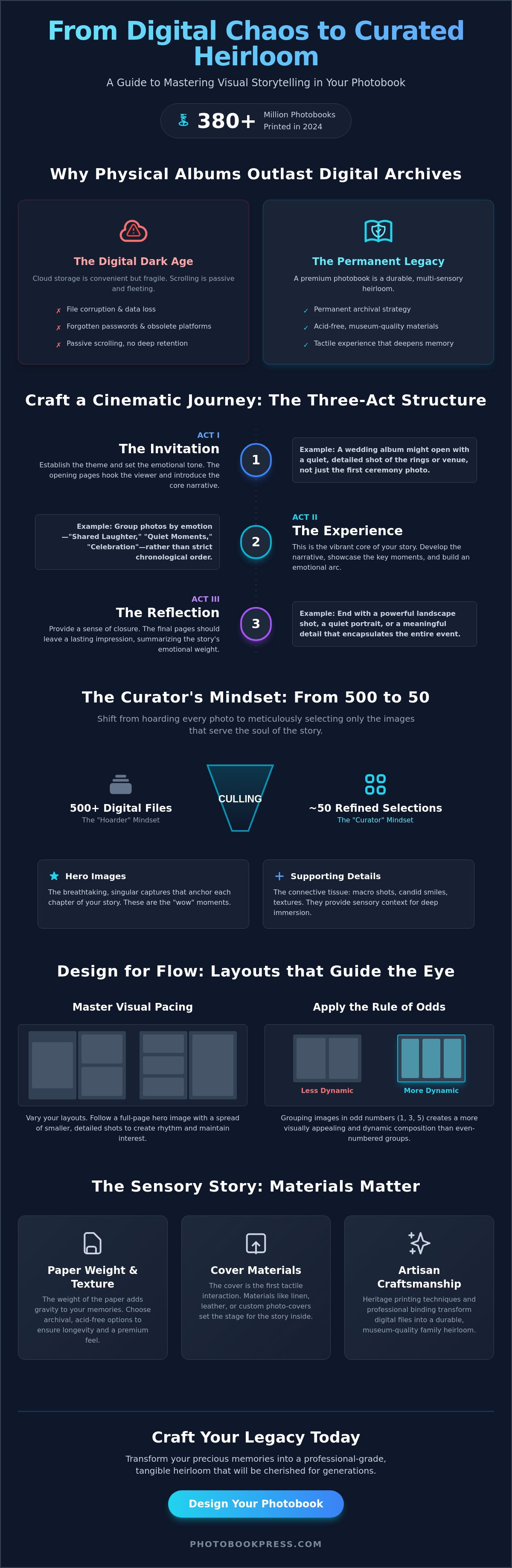
Visual storytelling requires a deep understanding of how the human eye travels across a physical surface. Once you've culled your collection, the next step in storytelling with photos in an album is to engineer the visual flow. This is where "Visual Pacing" becomes your most powerful tool. Think of your album like a piece of music; it needs crescendos and quiet moments. You achieve this by alternating busy spreads featuring multiple candid shots with minimalist pages that highlight a single, poignant image. This intentional variation prevents visual fatigue and ensures that your most significant memories receive the attention they deserve.
The "Rule of Odds" is another essential principle for sophisticated layouts. Grouping photos in odd numbers, such as three or five, often feels more organic and visually pleasing than even-numbered grids. It creates a natural focal point that guides the viewer's gaze through the narrative. Equally important is the use of white space, or negative space. Many creators feel the urge to fill every square inch of the page, but leaving empty space around an image gives it room to breathe. It acts as a visual palate cleanser, allowing the viewer to process one emotional beat before moving to the next with clarity and grace.
A single image stretched across two pages creates a cinematic impact that defines the high-end artisan style. However, standard binding often results in the "severed head" problem, where the center of your photo disappears into the deep crease of the spine. This is why layflat photo books are the gold standard for landscape photography and panoramic storytelling. They allow your images to flow uninterrupted across the gutter, preserving the integrity of your wide-angle environmental shots and ensuring every detail remains visible and perfectly aligned.
Establishing a visual hierarchy tells the reader where to look first. You can signal an image's importance by varying its size relative to others on the spread. A large, full-bleed photo that runs to the very edge of the page suggests a high-impact, immersive moment. In contrast, smaller photos with generous borders evoke a sense of preciousness and intimacy. Maintaining consistency in your margins and alignment is what separates a professional, gallery-style volume from a cluttered archive. When every element is aligned with precision, the focus remains steadily on the artistry of your personal history.
The art of storytelling with photos in an album extends far beyond the digital screen. It’s an immersive, tactile experience where the choice of materials dictates the emotional weight of the narrative. When you hold a physical book, the texture of the cover and the gravity of the pages act as the silent narrator of your history. Selecting the right components is a deliberate act of craftsmanship. It’s about ensuring that your chosen photo printing services offer the color depth and archival longevity required to preserve your legacy for a lifetime.
Every material choice should reflect the "genre" of the story you're telling. A presentation box, for instance, isn't merely a storage solution; it's a protective sanctuary that elevates the act of opening the album into a significant event. It signals to the reader that the contents inside are precious artifacts, deserving of the highest level of care and attention.
The exterior of your book provides the first clue to the story’s soul. Leather photo books are the definitive choice for milestones like weddings, anniversaries, and family legacies. The scent and feel of genuine leather suggest tradition, durability, and a connection to the past. In contrast, softcover photo books offer a modern, approachable aesthetic perfect for casual travel logs or annual year-in-review volumes. The physical weight of the book in your hands directly influences how the story is perceived. A heavier, substantial volume carries a sense of permanence and prestige that digital files can never replicate.
The interior pages are where your visual narrative truly comes to life. Choosing between a lustre or matte finish depends on the mood of your photography. Lustre finishes provide a subtle sheen and vibrant color saturation, making them ideal for high-contrast storytelling and celebratory events. Matte finishes offer a sophisticated, non-reflective surface that suits intimate portraits and quiet, artistic landscapes. Regardless of the finish, archival-grade paper is essential to prevent the yellowing and fading that plague lesser products. Utilizing heavy-weight paper is a technical necessity that prevents "ghosting" from the reverse side, ensuring each spread remains a pristine work of art.
Ready to transform your digital archive into a tangible masterpiece? Explore our curated selection of archival materials and begin building your heirloom today.
Since 1985, Photobook Press has stood at the intersection of traditional craftsmanship and modern precision. Our Maryland-based artisan production facility is more than just a manufacturing space; it's a studio where your personal history is treated with the reverence it deserves. We believe that storytelling with photos in an album is a noble pursuit, one that requires the finest materials to ensure its longevity. Every book we produce reflects a heritage of excellence, blending the quiet confidence of a master artisan with the technical standards of a gallery curator.
Our commitment to quality is evident in every choice we make. From the selection of premium genuine leather to the implementation of seamless layflat binding, we prioritize substance and aesthetic perfection. We understand that these aren't merely products. They're investments in your legacy. By focusing on durability and visual precision, we provide a reliable home for your most significant life events, ensuring they remain as vibrant in fifty years as they are today. It's our mission to help you move beyond the fleeting nature of digital scrolls and into the permanent, tactile world of fine print.
We don't just cater to professional photographers; we offer the same museum-quality standards to every passionate hobbyist. Creating custom photo books shouldn't be a source of digital overwhelm or design anxiety. Our intuitive tools are designed to simplify the curation process, allowing you to focus on the emotional arc of your narrative while we handle the technical complexities. Our dedication to manual binding ensures a human touch in every volume, supported by state-of-the-art technology that captures the true depth and clarity of your original captures. This fusion of the technical and the personal defines our unique position in the custom production market.
Don't let your most precious memories remain trapped in a cluttered digital archive. We encourage you to begin your curation process today, perhaps by starting with a smaller project to find your creative rhythm. Mastering storytelling with photos in an album is a journey that becomes more rewarding with every page you design. Whether you're documenting a single weekend or a multi-generational family history, we provide the framework to share those stories with loved ones around the world. With our reliable worldwide shipping, your legacy can reach family across the globe with ease. It's time to transform your digital clutter into a tangible masterpiece that speaks with grace. Explore our collection of premium photobooks and begin your creative expression now.
Transforming a digital archive into a physical heirloom is an act of intentionality that honors your personal history. By applying a cinematic three-act structure and mastering the nuances of visual pacing, you move beyond a simple collection of images. You create a rhythmic journey that captures the soul of your experiences. Every choice, from the silent space of a minimalist layout to the tactile richness of a leather cover, serves to elevate your story into a work of art.
Mastering storytelling with photos in an album ensures that your memories aren't just seen; they're truly felt. At Photobook Press, we've upheld an artisan print heritage since 1985, providing the professional-grade archival materials your legacy deserves. Whether you choose the seamless flow of premium layflat options or the timeless elegance of leather, our craftsmanship guarantees a durable vessel for your history. Don't let your moments fade in the digital cloud. It's time to give them the permanence they require.
Begin Crafting Your Heirloom Story at Photobook Press. Your journey deserves to be told with grace.
Aim for 50 to 100 meticulously selected images for a standard 20 to 40 page book to maintain a focused narrative. Quality always takes precedence over quantity in professional-grade volumes. Including too many frames can lead to visual clutter, while a refined selection ensures each image has the breathing room it needs to contribute to the larger theme of storytelling with photos in an album.
Organize your collection using a narrative arc rather than a strict chronological timeline. Grouping images by emotional sub-themes or using the three-act structure of invitation, experience, and reflection creates a cinematic flow. This approach keeps the viewer engaged by focusing on the feeling of the event, allowing the story to unfold with a sense of purpose and grace.
Use text with restraint to ensure the imagery remains the primary focal point of your heirloom. Minimalist captions or elegant title pages can provide essential context, such as dates or locations, without distracting from the visual story. Often, a single, impactful quote or a brief personal note at the beginning or end is all that's required to frame the narrative beautifully.
Layflat binding allows the pages of your book to stay perfectly flat when opened, eliminating the deep crease or "gutter" found in standard binding. This feature is vital for panoramic storytelling with photos in an album, as it permits a single image to span across two pages without any loss of detail. It creates a seamless, immersive viewing experience that is essential for high-impact landscape photography.
Select a cover material that aligns with the emotional "genre" of your project. Genuine leather is the definitive choice for milestones like wedding albums or family legacies, suggesting tradition and durability. For modern travel logs or annual reviews, linen or a refined softcover provides an approachable, contemporary aesthetic that still reflects the quiet confidence of superior artisan craftsmanship.
Phone photos can certainly be included, provided they are used as smaller supporting details rather than full-page spreads. Most modern mobile devices capture images that look stunning when printed at a modest scale. However, for panoramic or high-impact hero images, high-resolution files are preferred to maintain the visual precision and clarity expected of a museum-quality heirloom.
Curation typically requires the most time, often taking several days of thoughtful selection, while the actual layout process can be completed in a few hours using intuitive design tools. Once your design is finalized, production times generally range from 2 to 5 business days. You should expect a total turnaround time of approximately 7 to 14 days for standard orders to arrive at your door.
