No Products in the Cart


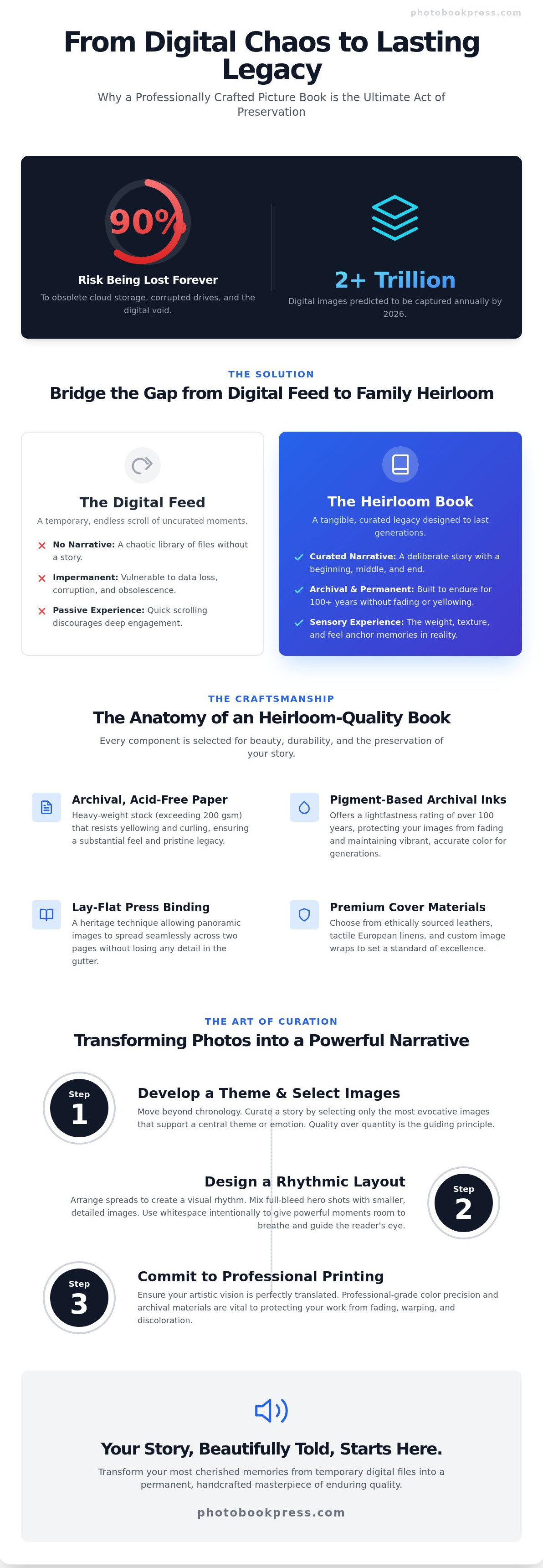
By 2026, experts predict that over 2 trillion digital images will be captured annually, yet nearly 90 percent of these moments risk disappearing into the void of obsolete cloud storage or corrupted drives. You've likely felt the quiet anxiety of keeping your most precious memories locked behind a screen, or perhaps you've been disappointed by the flimsy, mass-market volumes that fail to honor your history. Creating a professional picture book isn't just about printing photos; it's an act of preservation that demands a different level of craftsmanship.
We understand that your life’s milestones aren't just data points. They're artifacts that deserve the permanence of a gallery wall. You're looking for a way to bridge the gap between a cluttered hard drive and a sophisticated, handcrafted heirloom. In this guide, you’ll discover how to master the art of narrative curation and select archival-quality materials that ensure your legacy remains intact for over 100 years. We’ll walk you through the essential steps of building a cohesive story, from choosing the right paper weights to understanding the technical precision of our press heritage. Your story, beautifully told, starts with a commitment to excellence.
The term "picture book" often conjures images of childhood classics or literary staples found on library shelves. While the traditional definition of What is a Picture Book? focuses on the interplay of text and illustrations for young readers, the 2026 landscape has expanded this concept into the realm of bespoke heirlooms. Today, it represents a sophisticated medium where personal history meets the rigor of fine-art publishing. This isn't just a collection of snapshots; it's a curated legacy preserved through the weight of premium paper and the precision of a master press.
In a digital era where 95 million photos are uploaded to Instagram every single day, the physical print offers a rare psychological anchor. A book demands a deliberate pace. It forces us to slow down, feel the texture of the page, and engage with a story from beginning to end. Unlike a digital feed, a picture book implies a purposeful narrative arc. It has a definitive start, a thematic middle, and a concluding reflection that gives meaning to the moments captured within. This structure transforms a chaotic library of digital files into a cohesive, tangible history.
To better understand how the market for personalized storytelling has evolved into a significant cultural trend, watch this helpful video:
Visual storytelling has transformed from 15th-century illuminated manuscripts to the high-definition, 2400 dpi printing standards of the modern age. The physical format remains the most powerful tool for emotional resonance because it occupies space in our physical lives. The modern picture book is a fusion of professional-grade materials and intimate personal narrative. By utilizing the heritage of the "press," we elevate personal photos from temporary digital files to permanent artifacts of art that command respect on a bookshelf.
The distinction between a standard photo album and a custom book lies in the art of curation. Albums often serve as repositories for every shot taken, while a book requires an editorial eye to select only the most evocative images. This process ensures that family history isn't just stored, but told. Archival quality remains the cornerstone of this distinction. Using acid-free papers and pigment-based inks ensures these stories remain vibrant for 100 years or more.
By choosing the book format, you're making a commitment to the longevity of your memories. It's a transition from being a mere consumer of digital media to becoming a curator of your own legacy. The weight of the cover and the smell of the ink serve as sensory reminders that some stories are too important to be left on a hard drive.
Quality begins with the weight of a page between your fingers. A premium picture book isn't merely a collection of images; it's a physical vessel for history. We prioritize heavy-weight stocks, often exceeding 200 grams per square meter (gsm), to ensure every turn of the page feels substantial and deliberate. These materials resist the curling and yellowing that plague mass-produced volumes. When combined with pigment-based archival inks, which offer a lightfastness rating of 100 years or more under gallery conditions, the result is a legacy that remains vibrant for generations. The choice of cover material acts as the first handshake with the reader. Whether you select ethically sourced leather, tactile European linen, or a custom-wrapped image, the exterior establishes a standard of excellence before the first page is even turned. Modern precision meets old-world soul in our workshop. We utilize 21st-century printing technology to achieve color accuracy within a 2% delta, then rely on master bookbinders to finish each volume by hand. Explore our curated selection of bespoke cover materials to find the perfect match for your project.
Choosing a finish depends on the narrative of your imagery. Lustre finishes provide a subtle 15% sheen that enhances color saturation without the harsh reflections of high-gloss coatings. Matte finishes, conversely, offer a velvety texture that eliminates glare, making them ideal for black-and-white portraits or minimalist landscapes. Beyond aesthetics, the science of paper is critical. We use acid-free, pH-neutral papers to prevent chemical degradation. This ensures that the 2026 edition of your family history looks identical in 2076. The thickness of the paper also dictates the "heirloom feel," as a sturdier leaf prevents bleed-through and provides a rigid canvas for your stories.
While various formats exist, hardcover photobooks remain the gold standard for long-term structural integrity. They provide a rigid shield against environmental wear and physical compression. For those showcasing expansive landscapes or cinematic wedding photography, layflat binding is essential. This technique allows the picture book to open a full 180 degrees without any "gutter loss," preserving the continuity of panoramic spreads across the center fold. Manual binding adds a final, crucial layer of scrutiny. A master binder's touch identifies subtle tension issues in the spine that automated sensors frequently overlook, guaranteeing that the book’s architecture remains sound for decades.
Creating a high-end picture book requires a shift from quantity to quality. A digital archive often contains thousands of images; however, an archival heirloom demands a refined selection. Professional curators suggests that a 100-page volume thrives best with an average of 1.5 to 2 images per page. This ratio creates a visual rhythm that prevents the reader from feeling overwhelmed. High-density grids offer energy and detail, while single-image spreads provide a necessary moment of stillness. White space isn't empty or wasted; it's a deliberate design element that directs the eye toward the subject. By 2026, premium publishing trends favor a 25% margin of white space to ensure the imagery remains the central focus. Text should act as a subtle anchor, perhaps a date or a single line of poetry, rather than a primary narrator.
Every chapter needs a "hero" shot. This is the image that captures the essence of a specific period or event, often printed at a larger scale to command attention. Mastering the art of curation involves filtering out repetitive frames to highlight emotional resonance. Whether you choose a chronological sequence or a thematic approach, such as "Morning Light" or "The Quiet Moments," the goal is a cohesive flow. Data from 2025 indicated that 68% of custom book designers found thematic sequencing increased the perceived value of the final heirloom. It's about finding the thread that connects a candid glance to a wide landscape.
Applying the rule of thirds allows you to place focal points for maximum impact. You don't need to center every subject; instead, place them at the intersections of a 3x3 grid to create dynamic tension. For a cinematic experience, utilize panoramic spreads that take advantage of 180-degree lay-flat binding. This format is ideal for expansive landscapes or group portraits that require room to breathe. Maintaining a consistent aesthetic across 50 or more pages requires a disciplined color palette and font selection. Using no more than two complementary typefaces ensures your picture book feels like a curated gallery catalog. This consistency transforms a collection of photos into a professional-grade legacy piece that stands the test of time.
Choosing a budget service often leads to a heartbreak that isn't visible on day one. Within five to seven years, inferior inks begin to oxidize, and non-archival papers absorb ambient moisture, causing the pages of your picture book to ripple and wave. Professional photographers avoid these pitfalls by partnering with press facilities that utilize electrophotographic technology. This ensures that the deep obsidian blacks and delicate highlights captured in the lens are translated perfectly to the page, maintaining their integrity for decades rather than months. Investing in quality now isn't just about aesthetics; it's about insurance for your history.
Color precision remains the benchmark of a true heirloom. A professional press utilizes sophisticated color management systems that calibrate output to within a 1.5 Delta E margin of error, a level of accuracy consumer printers simply can't match. This meticulous attention to detail ensures that the subtle warmth of a sunset or the specific ivory of a wedding gown looks exactly as you remember it. When you trust a master printer, you're not just buying a product; you're securing a legacy that remains faithful to your original artistic vision.
Digital offset printing provides a level of saturation and detail that consumer-grade inkjets cannot replicate. While home printers often suffer from ink bleeding or shifting hues, professional presses maintain a rigorous 2,400 DPI resolution. This precision ensures that every skin tone remains consistent across a 200-page run, even if the books are printed months apart. High-resolution file preparation, specifically utilizing sRGB or Adobe RGB profiles, bridges the gap between the digital screen and the physical page.
Environmental stressors like 60% humidity or direct UV light can destroy a standard book in less than a decade. To combat this, we utilize acid-free, lignin-free papers that prevent the chemical breakdown of the fibers. Archival materials are rated to resist yellowing for over 100 years according to rigorous ISO 9706 standards. For those seeking the pinnacle of protection, leather photobooks provide a robust, pH-neutral casing that shields your picture book from the elements while offering a tactile, timeless elegance.
Your memories deserve a medium that stands the test of time. Explore our archival press collections today.
Since our founding in 1985, Photobook Press has operated on a simple premise: your most vital memories deserve more than a digital screen. Our heritage is rooted in four decades of traditional print expertise, a legacy that we bring to every individual project. We maintain a specialized production facility in Maryland where the highest standards of manual craftsmanship are still the law of the land. Every picture book we produce is the result of a 12-point quality check that ensures color precision and structural integrity. We don't rely on automated assembly lines that prioritize speed over substance. Instead, our master binders treat each volume as a bespoke commission, ensuring that your legacy is built to last for generations.
The boutique experience we provide isn't reserved for elite galleries alone. We offer professional-grade materials, such as 100lb archival-quality paper and genuine Italian leathers, to every customer. This commitment to excellence means your personal history receives the same technical precision as a high-end art publication. By keeping our production centralized in our Maryland workshop, we maintain total control over the tactile experience of the final product. It's a meticulous process that honors the "press" heritage, turning the act of bookmaking into a noble craft.
Moving from a digital folder to a professional layout is a seamless process through our refined interface. We offer a level of customization that transforms a simple collection of images into a genuine artistic statement. You can select from premium materials like tactile linens and heavy-weight papers that feel substantial in the hand. Our support team isn't a distant call center; it's a group of artisans who treat your book as a work of art. We provide the technical guidance needed to ensure your resolution and margins are perfect, reflecting our commitment to the artisan's touch.
Our client base is a diverse tapestry that includes both world-class professional photographers and dedicated family archivists. We understand that a wedding album requires the same meticulous attention as a gallery-ready portfolio. Despite our boutique approach, we maintain a worldwide reach, shipping our handcrafted products to clients in over 30 countries annually. This global presence is anchored by our American roots and our unwavering focus on quality. Every picture book serves as a vessel for your history, fulfilling the Photobook Press promise: your story, beautifully told.
A meaningful picture book serves as a bridge between today's fleeting moments and the generations that follow. By prioritizing acid-free archival materials and professional curation, you ensure your narrative remains as vivid in fifty years as it's today. Our master printers have refined this craft since 1985, blending technical precision with the soulful touch of handcrafted binding. Every volume we produce at our Maryland facility reflects a commitment to durability and aesthetic perfection that digital screens simply can't replicate.
The transition from a digital archive to a physical heirloom is an act of intentional storytelling. It requires a balance of premium paper weights, precise color reproduction, and a design that allows your images to breathe. We're here to guide that process, treating your personal history with the reverence of a gallery curator. Your memories aren't just data points; they're the chapters of a life well-lived, deserving of a format that honors their significance.
Design Your Archival Picture Book with Photobook Press
Your story is ready to be beautifully told.
A picture book focuses on a curated narrative where images and text work in tandem to tell a specific story. While a standard photo book often serves as a simple gallery of snapshots, our archival picture book collections utilize library-grade binding and 100lb satin paper to create a formal publication. We treat every project as a custom art book, ensuring your personal history receives the same meticulous attention as a museum monograph.
A high-quality custom book typically contains between 30 and 100 pages to maintain the perfect balance of weight and structural integrity. Books that exceed 120 pages often require specialized reinforced spines to ensure the heirloom lasts for 50 years or more without sagging. We've found that a 40-page count offers the most elegant tactile experience for family chronicles or wedding legacies.
Layflat binding is essential if your design features panoramic vistas or images that span across the center gutter. This sophisticated technique allows the pages to rest at a perfect 180-degree angle, so no part of your photograph is lost in the fold. It's the gold standard for 2026 heirloom collections, providing a seamless visual experience that standard glue bindings can't replicate.
You can and should include text to provide context and emotional depth to your curated imagery. Our design interface supports 500 different typography options, allowing you to weave personal narratives or dates alongside your photos. Adding a thoughtful introduction or brief captions transforms a simple collection of images into a true legacy document that future generations will cherish.
The ideal paper weight for an heirloom-quality book is 100lb (148 gsm) or higher to prevent ink show-through and provide a premium feel. We use acid-free, FSC-certified papers that are laboratory-tested to resist yellowing for over 200 years. This specific weight offers the necessary stiffness for a sophisticated page-turning experience while holding deep, rich ink pigments with 100 percent accuracy.
Ensure your photos have a minimum resolution of 300 dots per inch (DPI) at the final intended print size. For a standard 8.5 by 11 inch page, your image file should ideally be 2550 by 3300 pixels or larger. Our pre-flight system automatically flags any assets that fall below 150 DPI, protecting you from the disappointment of pixelation or soft focus in your final print.
A professionally printed picture book using archival pigment inks and acid-free materials is designed to last 200 to 300 years in climate-controlled environments. We utilize a 7-color printing process that offers a 99 percent stability rating against UV fading. This meticulous craftsmanship ensures that the vibrant hues and sharp details you see today will remain unchanged for your great-grandchildren.
We offer a 20 percent discount for professional photographers and bulk orders consisting of five or more copies of the same design. For large-scale legacy projects exceeding 50 units, our studio provides bespoke pricing structures tailored to your specific needs. These partnerships allow creators to maintain high standards of artistry while benefiting from the efficiencies of our master press environment.
