No Products in the Cart


According to 2023 data from Keypoint Intelligence, we capture 1.8 trillion photos annually, yet fewer than 1% of these images are ever transformed into a physical print or a piece of custom wall art. It's a quiet tragedy of the digital age to leave our most meaningful stories tucked away on a hard drive. You likely feel the desire to bring these moments into your home, but the fear of a pixelated enlargement or the confusion between acrylic and metal finishes can be paralyzing.
You deserve a living space that reflects your history with the clarity of a professional gallery. We promise to help you bridge the gap between a digital file and a breathtaking statement piece. By understanding the nuances of archival printing, you'll gain the confidence to select materials that won't just decorate a room; they'll endure as a legacy for over 100 years. This guide provides a clear path through image resolution requirements and material selection, ensuring your memories are preserved with the artisan care they deserve.
Custom wall art represents the sophisticated evolution of home decor, moving beyond mass-produced imagery toward a curated expression of personal history. It's defined as personalized imagery rendered on professional-grade substrates such as metal, acrylic, or canvas. While budget-friendly decor often serves a temporary purpose, true custom wall art is an archival-quality statement piece designed to anchor a room. This shift toward intentionality reflects a growing desire for homes that feel like private galleries rather than showrooms. Our heritage in the press industry, dating back to 1985, informs every decision we make regarding color precision and fine detail. We view the physical act of printing as a noble craft, ensuring that your story is beautifully told through a physical presence that commands attention. Selecting the right medium is the first step in this creative journey, turning a simple photograph into a focal point that defines the atmosphere of your living space.
A 2024 industry report indicated that 62% of digital photos are never printed, leaving our most precious milestones trapped behind glass screens. Physical prints resonate more deeply because they occupy our shared physical space, inviting quiet contemplation that a flickering smartphone cannot provide. Wall art serves as a silent guardian of family legacies. It transforms fleeting digital files into tangible, handcrafted artifacts that ground us in our own history. When a memory is elevated to a large-scale print, it ceases to be data and becomes an heirloom. This physical presence creates an emotional anchor in the home, providing a daily reminder of the people and places that define your life's narrative. It's the difference between a scrolling gallery and a permanent tribute to your journey.
The distinction between a standard print and an archival one lies in the chemistry and longevity of the materials used during production. Archival quality is defined by a print's ability to remain vibrant and intact for over 100 years without significant fading or deterioration. This durability is achieved through the use of UV-resistant, pigment-based inks and acid-free substrates that lack optical brighteners. By utilizing archival digital printing methods, artisans can ensure that color accuracy remains museum-grade even in high-traffic home areas. Mass-market prints often use dye-based inks that may begin to shift in color within a decade; choosing archival materials is an investment in the permanence of your visual legacy. It ensures that the deep blacks and subtle gradients of your image remain as striking on day 36,500 as they were on day one. This commitment to quality protects your custom wall art from the environmental stressors that cause lesser products to yellow or brittle over time.
Selecting the right medium for your custom wall art requires a balance between technical specifications and the unique atmosphere of your home. While mass-market providers often treat all surfaces as simple vehicles for ink, an artisan approach recognizes that the substrate fundamentally alters how light interacts with the image. Understanding the difference between traditional inkjet processes and advanced dye-sublimation is crucial for achieving museum-level results. In 2026, discerning collectors increasingly look beyond the image itself to the tactile and reflective properties of the material, ensuring their investment matches their interior vision. Choosing the wrong medium can lead to unwanted glare or a lack of depth that diminishes the impact of your most cherished memories.
Canvas remains a timeless choice for those who appreciate a painterly, organic feel. The woven texture of premium canvas adds a layer of depth that softens digital sharp edges, making it ideal for family portraits or sweeping landscapes. High-quality canvas should be acid-free and heavy-duty to prevent sagging over time; a common failure in budget prints. For a deeper look at this medium, read The Artisan’s Guide to Custom Canvas Prints: Elevating Memories to Fine Art. This material works best in rooms with soft, diffused lighting where glare might otherwise distract from the subject matter. As of April 2026, quality-focused providers typically start prices for these handcrafted pieces around $39.95 for standard sizes.
Metal prints offer a level of luminosity that other mediums cannot match. Unlike standard inkjet printing, our metal pieces utilize a dye-sublimation process. This technique involves infusing pigment directly into the specialized coating of an aluminum sheet using temperatures often exceeding 350 degrees Fahrenheit. The result is an image that appears to glow from within, characterized by high contrast and vivid color saturation. Because the ink is bonded to the metal, the surface is waterproof and scratch-resistant, making it a durable choice for kitchens or high-traffic hallways. When considering archival quality and preservation, metal stands out for its resilience against environmental humidity and temperature shifts.
For those seeking a truly immersive 3D effect, acrylic prints represent the pinnacle of modern display. We use a second-surface printing technique, where the image is mounted behind a thick, polished acrylic sheet. This layer of clear polymer enhances light refraction, causing colors to pop with a brilliant, glass-like finish. It's the definitive choice for high-end modern interiors or professional portfolios. As of early 2026, a custom 8x10 inch acrylic print is priced at approximately $55.00, reflecting the premium materials and precision required for assembly. If you're ready to transform your space with these sophisticated materials, you can explore our curated wall art collection to find the perfect match for your aesthetic.
Achieving a gallery standard for your custom wall art requires more than just a beautiful memory; it demands technical precision before the first drop of ink touches the substrate. While modern smartphones capture incredible detail, the transition from a five-inch screen to a thirty-six-inch canvas reveals every hidden imperfection. A common pitfall for many enthusiasts is relying on images downloaded from social media platforms, which often strip away 90% of the original data through aggressive compression. To ensure your centerpiece remains crisp and professional, you must act as your own curator, evaluating both the digital integrity and the visual weight of your chosen file.
To be considered a giclée print in 2026, the industry standard requires a resolution of at least 300 DPI (dots per inch). This benchmark ensures that even when viewed from a few feet away, the transitions between colors remain seamless and the edges stay sharp. Perceived sharpness is a direct result of the relationship between the print's pixel density and the distance from which you'll view it. As viewing distance increases, the human eye becomes less sensitive to micro-details, allowing for slightly lower resolutions on massive statement pieces, yet 300 DPI remains the gold standard for heirloom quality. You can verify your file's potential by checking the properties in your image editor to confirm the pixel dimensions match your desired output. For a deeper look at navigating these technical choices, see The Ultimate Guide to Photo Printing Services: Quality vs. Convenience in 2026.
Composition plays a vital role in how custom wall art interacts with your living space. A 'busy' photograph with excessive small details can feel overwhelming when enlarged to a 24x36 inch format, potentially creating visual clutter rather than a focal point. Instead, look for images with strong leading lines or a clear subject that can breathe within the frame. Consider the lighting of your room as well. A dark, moody portrait might lose its soul in a sun-drenched hallway, while a bright landscape could feel washed out under soft, warm artificial lights. The goal is to choose an image that complements the existing color palette of your furniture and walls, creating a harmonious dialogue between the art and the architecture of the room.
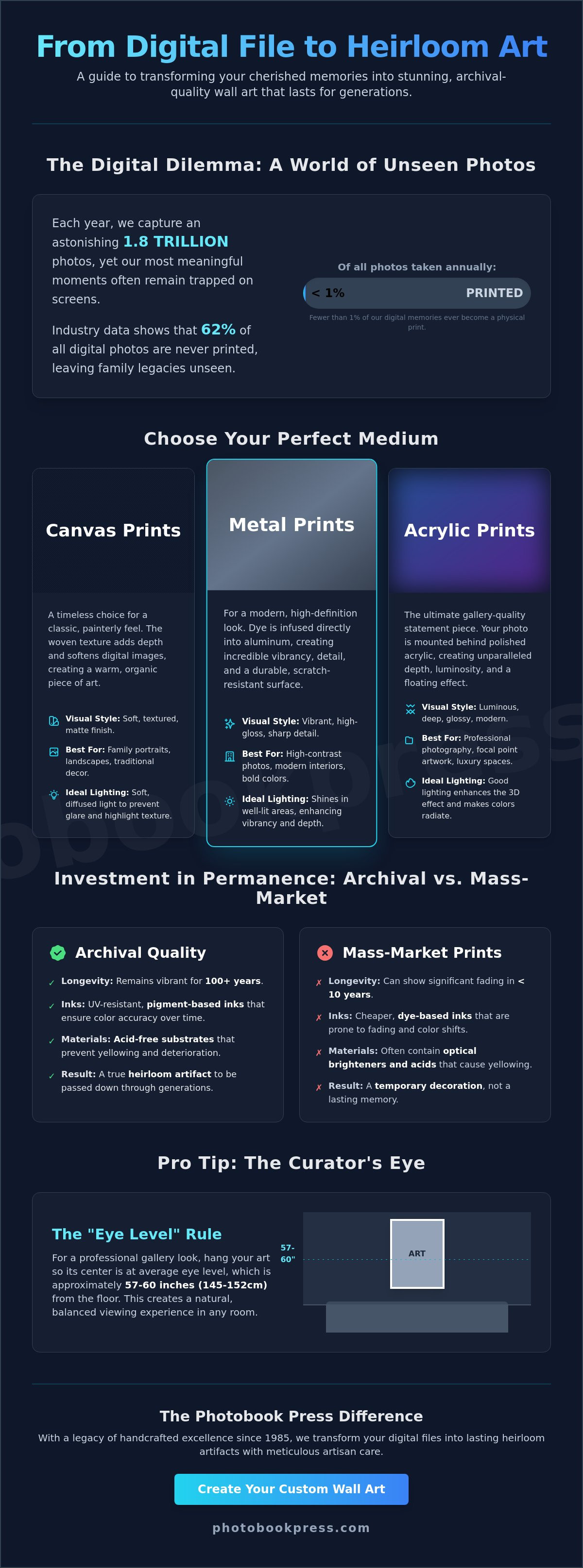
Creating a professional gallery wall is an exercise in both geometry and storytelling. While the quality of the print is paramount, the arrangement of your custom wall art determines how it breathes within your living space. A common mistake is hanging pieces too high, which disconnects the art from the room's architecture. To achieve a museum-grade feel, follow the "Eye Level" rule used by curators worldwide. This standard dictates that the center of your artwork, or the center of a grouping, should sit exactly 57 inches from the floor. This height mirrors the natural line of sight for the average adult, creating an immediate sense of balance and accessibility. By establishing this consistent horizon line, you ground the collection and allow the viewer to move through your visual narrative without strain.
Rhythm is established through the negative space between your pieces. For a cohesive look that avoids visual clutter, maintain a strict 2 to 3 inch gap between every frame or substrate. This spacing remains effective even when you choose to mix mediums. You might pair the deep, liquid-like finish of an acrylic print with the understated elegance of a traditional framed piece. As long as the pieces share a common color palette or a unified thematic thread, the variation in texture adds sophisticated depth rather than confusion. If you're ready to begin your collection, you can start designing your wall art using our professional design tools.
Choosing a layout depends on the emotional energy you wish to project. A formal grid layout, featuring identical sizes in perfect alignment, offers a clean and disciplined aesthetic. It works exceptionally well for a series of related architectural shots or black-and-white portraits. Conversely, the "Salon Style" allows for an organic, evolving collection of different sizes and orientations. When building a salon wall, start with a "central anchor" piece that is at least 20% larger than the surrounding art. Place this anchor slightly off-center to create a dynamic focal point, then build outward while maintaining your consistent 2 to 3 inch spacing. This approach allows your wall to grow as new milestones occur, turning your home into a living archive.
Scale is often the most difficult element to master in residential design. To avoid a piece looking "lost" on a large wall, apply the 60% rule: your custom wall art should occupy between 60% and 75% of the available wall space above a piece of furniture, such as a sofa or bed. For example, if your sofa is 80 inches wide, your art grouping should span approximately 48 to 60 inches in total width. Before driving a single nail into the plaster, create a mock-up by cutting brown craft paper to the size of your prints. Tape these templates to the wall with painter's tape and live with the arrangement for 24 hours. This simple step prevents the 67% of portrait clients who never order prints from feeling the "fear of the blank wall" and ensures your final installation is flawless.
Excellence in the medium of print is never an accident; it's the result of decades spent perfecting the intersection of chemistry, color science, and tactile craftsmanship. While many online services prioritize high-volume automation and lower costs, our Maryland-based artisans approach every piece of custom wall art as a unique archival project. This commitment to professional-grade materials ensures that our products stand apart from hobbyist sites, offering a level of substance and aesthetic perfection that transforms a simple room into a curated sanctuary. We don't just print images. We preserve the textures and tones of your life's most meaningful moments with the quiet confidence of a master printer.
Our team has been deeply immersed in the custom printing industry since 1985, bringing a legacy of technical expertise to every substrate we handle. This deep-seated knowledge allows us to transition seamlessly from the intricate construction of layflat photo books to the expansive scale of high-end wall displays. Whether you're a professional photographer seeking gallery-standard results for a client or a family looking to anchor your home with a stunning heirloom, we serve as your trusted partner in the creative process. Your story deserves to be told with clarity and grace, using materials that will endure for generations.
At our Maryland facility, we've cultivated a unique environment where state-of-the-art printing technology is balanced by the discerning eye of the human artisan. Every order undergoes a rigorous manual inspection before it leaves our doors. We don't rely solely on software to judge color accuracy; our experts evaluate the warmth, contrast, and saturation of every custom wall art piece to ensure it meets our exacting standards. This meticulous quality control process is why we can confidently offer worldwide shipping, knowing that our products arrive in flawless condition, whether they are destined for a local home or an international gallery. It's a level of care that machines alone cannot replicate.
Professional photographers have trusted us with their most precious memories for over 41 years because they understand that quality is an investment in legacy. We use only the finest archival-quality inks and acid-free materials, ensuring that the vibrancy of your milestones remains unchanged by time. This dedication to the "press" heritage is what defines Photobook Press as the definitive choice for those who value both technical specs and sentimental appeal. We invite you to move beyond the digital screen and experience the profound impact of a physical masterpiece in your own space. Explore our custom wall art collection and start your legacy today.
Transforming a digital collection into a physical legacy requires a partnership with artisans who treat your history as a precious artifact. By adhering to the 300 DPI standard and choosing a medium that interacts beautifully with your home's natural light, you ensure your custom wall art remains a vivid, meaningful focal point for decades. These pieces aren't mere decorations; they're enduring anchors for the stories that define you. Our Maryland-based artisans have refined this noble craft since 1985, utilizing professional-grade materials that are guaranteed to last for generations.
We invite you to move beyond the temporary nature of screens and embrace the tactile elegance of a handcrafted heirloom. Professional photographers worldwide trust our meticulous process to preserve their most significant works, and we bring that same museum-quality standard to your personal milestones. Design your museum-quality custom wall art at Photobook Press and begin the journey of telling your story with the sophistication it deserves. Your memories are ready to take their place on your walls. Let's make them timeless.
The ideal material depends on your specific aesthetic goals and the lighting of your room. Canvas provides a classic, painterly texture that excels in soft light, while metal and acrylic offer a luminous, high-definition finish for modern spaces. We recommend choosing a substrate that complements the mood of your photograph, whether it's a soft portrait or a vivid landscape.
You can verify your image's quality by dividing its pixel dimensions by the width of your desired print. For professional-grade custom wall art, aim for a density of 300 DPI to ensure the details remain crisp. If your calculation results in less than 150 DPI, the image may lose its sharpness and appear soft when viewed at a close distance.
The primary difference lies in the texture and the ink delivery system. Canvas uses an inkjet process on woven fabric to create an organic, glare-free look with a tactile feel. Metal prints utilize dye-sublimation to fuse pigment into aluminum sheets, resulting in a waterproof, scratch-resistant surface that appears to glow with internal light.
Yes, you can achieve stunning results with a phone photo if you use the original, uncompressed file. Most smartphone sensors in 2026 capture enough detail for 16x20 or 24x36 inch enlargements. It's vital to avoid images downloaded from social media, as these platforms strip away 90% of the data required for large-scale printing.
Archival-quality prints are engineered to endure for over 100 years without significant color shifting or fading. By using pigment-based inks and acid-free substrates, we ensure your custom wall art remains a vibrant heirloom. This longevity is a hallmark of professional craftsmanship, far outlasting mass-market prints that often deteriorate within 10 to 15 years.
The standard height for hanging art is 57 inches from the floor to the center of the print. This follows the "Eye Level" rule used by gallery curators to create a consistent, comfortable viewing experience. Maintaining this height across different rooms helps unify your home's aesthetic and keeps the focus on the artwork itself.
We provide a specialized partnership program designed for professional photographers who require museum-grade consistency for their clients. This program includes tiered pricing and expert support to ensure every handcrafted piece meets your professional standards. Our Maryland artisans treat every professional order as a reflection of your own brand's commitment to quality.
You should use a clean, dry microfiber cloth to gently remove dust from the surface of your art. For stubborn fingerprints on acrylic or metal, a lightly dampened cloth with water or an ammonia-free cleaner is effective. Avoid using paper towels or abrasive scrubbers, as these can leave micro-scratches on the polished finish of your piece.
