No Products in the Cart


What if the most critical decision in your creative process isn't the lens you chose, but the texture of the page where your story finally rests? You want your memories to feel substantial. You want them to possess the quiet gravity of a gallery piece. It's natural to feel anxious that colors might shift or that pages will yellow and tear before they can be shared with the next generation. We believe your history deserves better than a flimsy, mass-market finish.
This guide will help you discover the best paper for photo books so you can transform digital files into tactile, museum-quality heirlooms. We'll show you how to achieve vibrant, true-to-life color reproduction that remains faithful to your original vision. With the global photobooks market projected to reach 3.72 billion dollars in 2026, the shift toward premium, archival materials has never been more vital. We'll explore the technical beauty of 300 gsm weights and ISO 9706 standards, ensuring your book feels heavy and expensive in the hands. It's time to honor your legacy through the noble craft of the press.
The choice of paper is the silent narrator of your story. It's the difference between a fleeting glance and a long, meaningful pause. When we discuss the best paper for photo books, we aren't simply looking at a list of technical options. We are seeking the perfect intersection of color accuracy, tactile weight, and archival chemistry. A high-quality substrate doesn't just hold an image; it elevates it. It provides a physical presence and a sense of permanence that a digital screen can't hope to match. This focus on craftsmanship is why flush mount products are projected to hold a dominant 68.77% market share by 2026. People want substance. They want a book that feels as significant as the life events it contains.
Psychologically, the weight of a page communicates value before a single photo is even seen. When a reader feels a substantial, heavy page, their brain registers the object as an heirloom. This is the hallmark of artisanal substrates compared to commercial-grade press paper. While commercial options are often thin and prone to curling, professional photographic paper offers a rigidity that ensures a smooth, cinematic storytelling flow throughout your album. At Photobook Press, we believe the physical foundation of your book should be as intentional as the photographs themselves.
There is a profound intimacy in the act of turning a thick, premium page. Your fingers catch the edge, feeling the subtle resistance and the soft texture of the finish. This tactile interaction creates a compositional depth that screens lack. A physical book anchors your memories in the real world, transforming a collection of pixels into a permanent artifact. It's an investment in a legacy that your family will hold in their hands decades from now. By selecting the best paper for photo books, you ensure the physical experience matches the emotional weight of your photographs.
Most people have seen old photographs that have turned yellow or become brittle to the touch. This happens because standard papers often contain lignins and acids that cause chemical breakdown over time. In contrast, museum-grade materials are engineered for permanence. Archival paper is an acid-free substrate designed to resist chemical decomposition for over 100 years. This standard ensures that your wedding album or travel portfolio maintains its vibrant clarity and structural integrity for a century or more. Choosing artisanal quality means your story won't fade; it will only grow more precious with time.
The way light dances across a printed page determines how we perceive the depth and emotion of a photograph. It isn't merely a technical choice; it's the final layer of your creative vision. The best paper for photo books allows the viewer to immerse themselves in the imagery without the distraction of harsh reflections or dull colors. Each finish offers a unique sensory profile that can either whisper with understated elegance or shout with high-impact vibrancy. Understanding how these surfaces interact with your environment is key to selecting a substrate that honors your work.
Lustre is the definitive choice for those who demand professional results. It features a fine, pebbled texture that diffuses light, effectively eliminating the harsh glare often found in brightly lit rooms. This texture also provides a practical benefit by resisting the oils from fingertips, which is why it's the cornerstone of professional wedding albums. Because it maintains incredible skin tone accuracy and rich color saturation, it remains the industry standard for portraiture and family histories. It's a finish that feels sophisticated to the touch and looks impeccable under any lighting condition.
Matte paper offers a modern, non-reflective surface that mimics the aesthetic of a fine art gallery. It's the preferred medium for portfolio books where the focus is on composition, texture, and soft tonal transitions. The surface feels like velvet under the hand, providing a quiet, tactile experience that doesn't compete with the art. While matte excels in bright environments, it can sometimes soften the deepest blacks. For images that require maximum "punch" and high contrast, some artisans still turn to a glossy finish.
Glossy paper mimics the traditional darkroom prints of the 20th century. It provides the highest level of sharpness and color brilliance, making vacation landscapes or high-fashion shots leap off the page. However, this slick surface is a magnet for fingerprints and can be difficult to view in rooms with overhead lighting. To keep these delicate surfaces in pristine condition, many collectors follow National Archives guidelines for proper handling and climate-controlled storage. Whether you prefer the velvet hush of matte or the brilliant shine of glossy, you can explore our handcrafted options to find the substrate that speaks to your unique story.
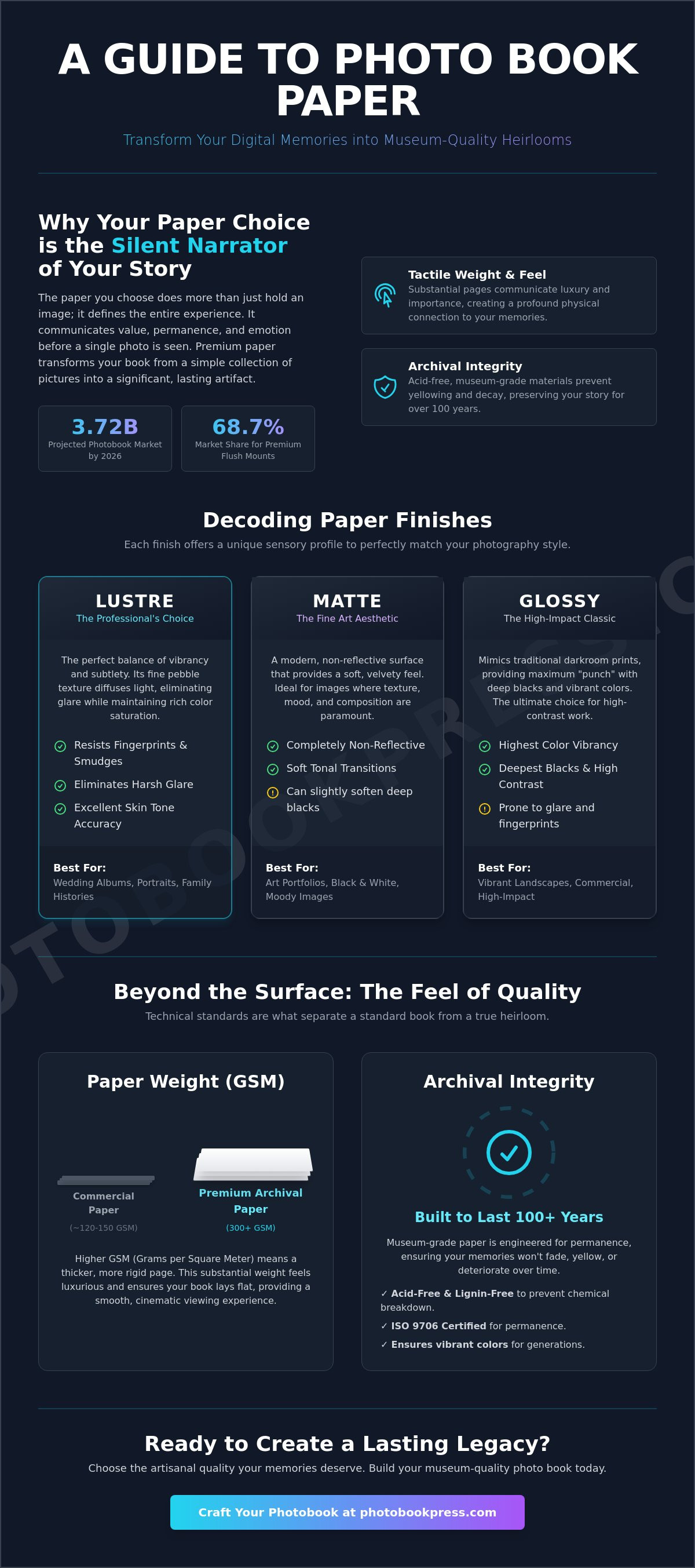
Artisanship is often measured in the invisible details that standard printing services overlook. While the visual finish captures the immediate gaze, the internal architecture of the page ensures your memories survive the test of time. GSM, or Grams per Square Meter, is the metric used to determine paper density. It isn't just a technical specification; it's a promise of durability. Standard commercial books often use 80lb paper, roughly 118 GSM, which can feel flimsy and susceptible to wear. However, the best paper for photo books usually starts at 100lb (148 GSM) and reaches much higher for premium collections. This weight provides the structural integrity needed to support the spine and prevent the micro-tears that occur during decades of browsing.
Premium fibers also dictate how ink behaves on the surface. Lower-quality, porous papers allow ink to "bleed" or spread, which softens the edges of your high-resolution images. Artisanal substrates are engineered with sophisticated coatings that trap the ink precisely. This prevents color migration and maintains the sharpness of every fine detail, from the delicate lace of a wedding gown to the sharp peaks of a mountain range. It's this level of precision that separates a simple print from a professional artifact.
Choosing a heavier substrate changes the entire tactile experience of your story. A page with a high GSM doesn't just resist damage; it feels expensive and deliberate. This is particularly vital for layflat photo books, where pages are often bonded together to create seamless, panoramic views. Heavier paper prevents warping and ensures the book's "gutter" remains strong over years of use. When you hold a book with 300 GSM pages, the weight translates into a perceived value that digital screens can't emulate. It's a physical gravity that tells the reader these moments are worth the extra care.
The true enemy of any family heirloom is chemistry. Standard wood-pulp paper contains lignin, a natural polymer that becomes acidic as it ages. This acidity is the primary cause of yellowing and brittleness in old books. To avoid this degradation, professional printers insist on museum-quality archival paper that is completely acid-free. pH-neutral paper ensures your black-and-white photos stay crisp and your whites never turn yellow. When these stable fibers are paired with archival inks, the bond becomes permanent. This chemical stability is why the global photobooks market is seeing a 6.8% CAGR through 2034, as more consumers realize the value of long-term preservation. Your legacy shouldn't have an expiration date.
Every story possesses a unique visual vocabulary. A wedding is a celebration of soft light and intimate detail, while a mountain landscape is a study in raw contrast and vivid hues. Choosing the best paper for photo books requires an understanding of how your subject matter lives on the page. You're not just picking a surface; you're selecting the stage for your story. When the substrate matches the mood of the imagery, the book becomes a cohesive piece of art rather than a mere collection of prints.
For wedding albums, the industry standard remains Lustre paired with heavy-weight layflat pages. This combination provides the color saturation required for vibrant florals while maintaining the delicate, natural skin tones essential in portraiture. Travel and landscape photography, however, often demand the high-impact vibrancy of Glossy or high-saturation Lustre. These finishes capture the brilliance of nature, from the deep azure of a glacial lake to the fiery orange of a desert sunset. For those creating family yearbooks, a premium semi-matte option offers a perfect balance. It provides the durability needed for frequent handling by little hands while retaining a sophisticated, professional appearance.
The "tooth" or texture of the paper should mirror the emotional intent of your work. Fine art and moody black-and-white photography thrive on the understated elegance of Deep Matte. This finish absorbs light completely, lending a velvet-like depth to shadows and a timeless quality to the composition. Architectural photography, with its focus on clean lines and structural precision, requires the sharp detail found in premium coated papers. If you're a professional building portfolio books, your choice of paper is your first introduction to a client. It signals your technical standards and your respect for the medium before they even see your best shot.
When designing panoramic spreads that span two pages, the physical properties of the paper become even more critical. The best paper for photo books with layflat binding must have high opacity. This ensures that dark images on one side don't "ghost" or show through to the reverse, which can ruin the visual flow of a professional album. Thicker, rigid paper is the secret to a truly seamless, gutter-free experience. It allows the eye to travel across the fold without a distracting dip or break in the image. To see how these artisanal materials can elevate your specific project, you can browse our custom photobook options and select the substrate that best fits your vision.
The philosophy of the "Press" at Photobook Press is rooted in the belief that every volume is a unique piece of art. At our Maryland-based facility, we've spent decades refining the delicate balance between state-of-the-art technology and manual binding expertise. While many services prioritize speed and volume, we prioritize the rhythmic flow of a perfectly bound spine. Finding the best paper for photo books is only half the battle; the other half is the human touch that ensures every fold is crisp and every cover is perfectly square. We treat your memories as precious artifacts that deserve the highest level of care.
Our team sources materials for their ability to withstand a lifetime of use. Every page is hand-inspected to ensure it meets the rigorous standards expected of premium photo printing services. This meticulous attention to detail is what separates a boutique experience from mass-market production. We don't believe in "good enough" when it's your family history on the line. Our artisans verify color precision and structural integrity at every stage of the process, ensuring your book arrives as a flawless heirloom.
Our heritage dates back to 1985. Since then, we've mastered the noble craft of the print, developing a curated selection of professional-grade papers that you won't find in standard retail shops. There's a specific synergy between our archival inks and premium paper fibers. When the ink meets the substrate, it creates a bond that is both vibrant and permanent. This commitment to durability means your investment is protected against the fading and wear that plagues lesser products. We've seen digital trends come and go, but the demand for exquisite, handcrafted quality remains constant.
It's time to move your memories from digital clutter to physical permanence. Digital files are fragile; they're often lost to hardware failure or forgotten in the depths of cloud storage. A physical book, however, is a resilient artifact. Our design tools are built to help you navigate these choices, allowing you to select the best paper for photo books based on your specific vision. Whether you're a professional curator or a family storyteller, we act as a trusted partner in your creative process.
Design your custom photo book with our artisan paper selections today. Your story, beautifully told.
Selecting the best paper for photo books is a commitment to the permanence of your personal history. We've explored how the intersection of tactile weight and chemical stability ensures your memories remain vibrant for generations. Whether you choose the fingerprint-resistant clarity of Lustre for a wedding album or the velvet depth of Matte for a fine art portfolio, the substrate you select is the foundation of your legacy. It's the difference between a temporary print and a lasting artifact.
Since 1985, our Maryland-based facility has focused on the intersection of professional craftsmanship and museum-grade archival quality. We don't believe in mass production. Instead, every book is hand-bound by master craftsmen who treat each page as a unique artifact. This meticulous approach ensures your photographs aren't just seen; they are truly felt. It's time to transform your digital archives into a physical masterpiece that will withstand a century of use. You've captured the moments; now give them the home they deserve.
Experience the tactile beauty of our archival papers; start your book today. We invite you to embrace the noble craft of print and ensure your most meaningful moments are honored with aesthetic perfection. Your story, beautifully told.
Lustre is the definitive choice for wedding photo books because it offers a versatile balance of color saturation and texture. It maintains skin tone accuracy while resisting the fingerprints that naturally occur during family viewings. For a truly professional result, we recommend pairing this finish with heavy-weight layflat pages. This ensures your most cherished memories are presented with the quiet confidence they deserve.
Matte is widely considered superior for professional portfolios due to its sophisticated, non-reflective surface. It allows the viewer to focus entirely on your composition and tonal range without the distraction of glare. While glossy finishes provide a high-contrast punch, they often require specific lighting to be viewed properly. A deep matte finish creates a gallery-inspired experience that feels modern and refined under the hand.
GSM stands for Grams per Square Meter, a metric that measures the density and thickness of a substrate. In the context of finding the best paper for photo books, a higher GSM indicates a more substantial, premium feel. While standard books often use 118 GSM paper, artisanal books typically feature 300 GSM stock. This increased density provides the rigidity needed for a durable, long-lasting spine.
Yes, the weight of your paper directly influences the maximum page capacity of your book's binding. Thicker, premium substrates like 300 GSM bond take up significantly more space in the gutter than thin commercial papers. Most layflat albums are designed to hold between 20 and 100 pages to maintain structural integrity. Using thinner stock allows for more pages but often sacrifices the tactile heirloom quality of the final product.
Lustre features a fine, pebbled texture that diffuses light, whereas Silk has a more pronounced, cross-hatched texture resembling fine fabric. Both finishes are designed to resist fingerprints and glare, making them excellent choices for books that will be handled frequently. Silk is often chosen for its unique, vintage aesthetic. Lustre remains the versatile industry standard for its ability to maintain incredible sharpness and color depth.
You can write on your pages, provided you select the appropriate ink for the paper's specific coating. Matte papers are the most receptive to standard pens, while Lustre and Glossy finishes require permanent, archival-quality markers. Using a quick-drying pen prevents smudging on these non-porous surfaces. This allows you to add personal notes or signatures to your book without compromising the integrity of the print.
Archival paper is an essential investment for any project intended to serve as a family legacy. It is the best paper for photo books because it is chemically stable and resistant to the acids that cause standard paper to fail. With the global photobooks market projected to grow at a CAGR of 6.8% through 2034, more creators are prioritizing these premium materials. The extra cost ensures your story remains vibrant for over 100 years.
To prevent yellowing, you must choose paper that meets ISO 9706 standards for permanence. This ensures the substrate is acid-free and pH-neutral, protecting it from the chemical decomposition that turns pages brittle. Storing your book in a climate-controlled environment away from direct UV light also preserves the paper's original brilliance. These professional preservation techniques ensure your whites stay crisp and your colors remain true for decades.
