No Products in the Cart


A photograph left on a hard drive is a silent legacy, but a poorly printed album can be even more damaging to a professional brand. In 2026, the distinction between a mass-market product and a handcrafted volume is sharper than ever, making the search for the best photo book for photographers a quest for technical perfection. You already know that your clients don't just want a collection of images; they desire a tactile heirloom that justifies their investment. It's frustrating when a meticulously edited session is undermined by inconsistent color or a flimsy cover that feels like a common magazine.
We'll show you how to bridge the gap between digital excellence and physical permanence through a deep dive into archival papers and artisanal binding. This guide promises to help you identify the specific materials that prevent yellowing and ensure structural integrity for over 200 years. We'll explore the sophisticated workflows and museum-grade standards that will elevate your offerings into the realm of fine art.
In 2026, the distinction between a simple digital album and the best photo book for photographers lies in the convergence of chemistry and craftsmanship. A professional-grade volume isn't merely a collection of images; it's a structural masterpiece that pairs museum-grade archival materials with meticulous manual binding. While the history of the photo book began with simple pasted-in prints, today's boutique press houses use sophisticated engineering to ensure every spread remains a pristine artifact for generations. This evolution transforms a book from a product into a legacy.
Photographers now view these volumes as heirloom investments. In an era where humans capture an estimated 1.8 trillion photos annually, the physical book serves as a curated sanctuary for a creative legacy. It's a deliberate choice to elevate digital data into a tactile experience that demands attention. This isn't a commodity. It's the final, essential stage of the photographic process.
To better understand the profound impact of moving your work from the screen to the page, watch this helpful video:
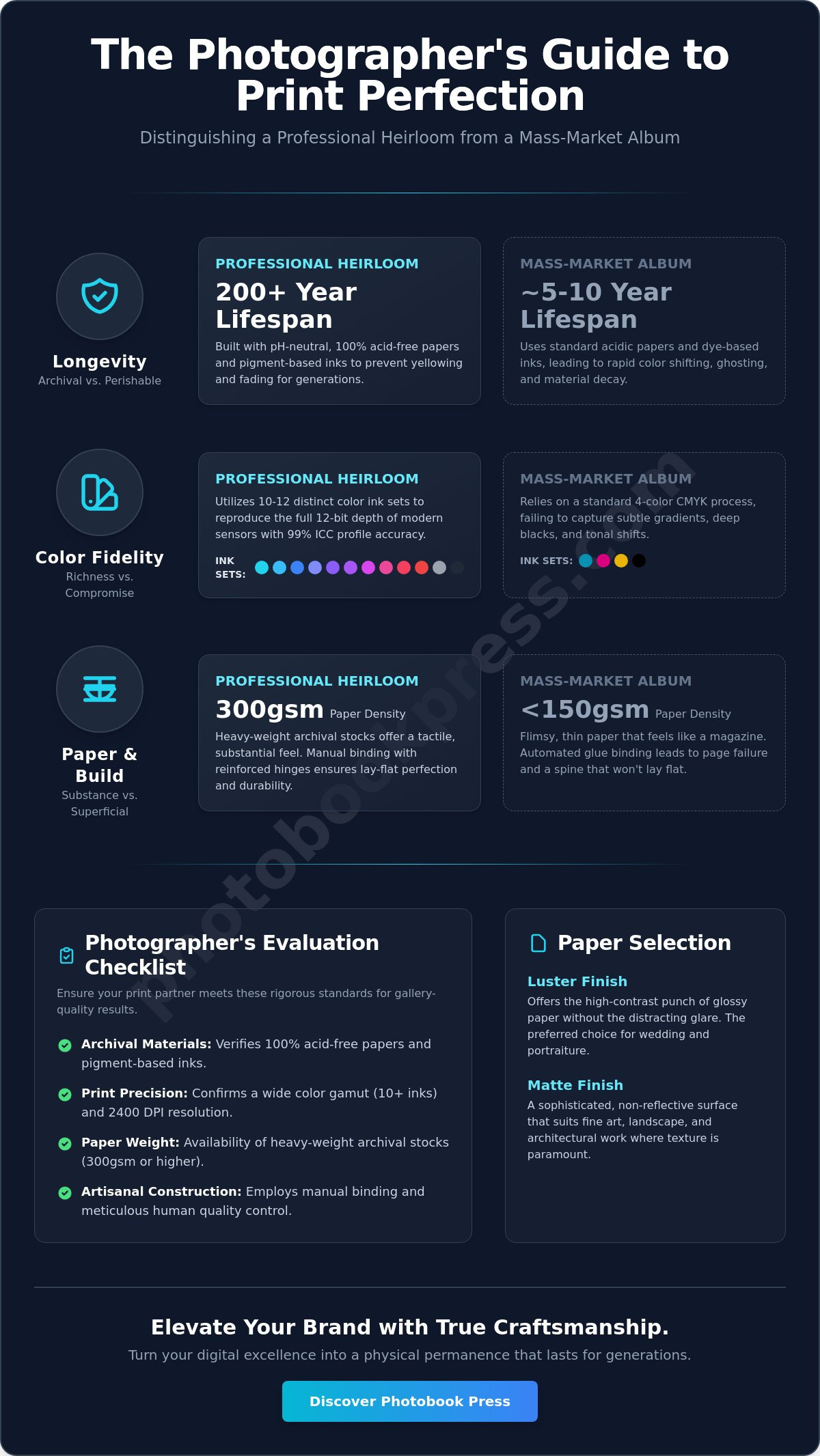
Mass-market printers often rely on standard four-color CMYK processes that fail to capture the 12-bit color depth of modern sensors. Professional boutique presses utilize high-fidelity ink sets, often featuring 10 to 12 distinct colors, to achieve smooth gradients and deep, tonal blacks. To find the best photo book for photographers, one must look for strict ICC profile management. This ensures the "soft proof" on a calibrated monitor matches the physical page with 99% accuracy. Quality is also felt in the tactile markers: 300gsm paper density and reinforced hinge strength that prevents page failure after years of viewing.
Archival quality is a chemical reality defined by pH-neutral, acid-free papers and pigment-based inks. These materials resist the yellowing and "ghosting" common in cheap consumer prints. Current standards for professional books require lightfastness ratings exceeding 200 years under gallery conditions. PhotoBook Press maintains this museum standard, ensuring that humidity and UV exposure don't erode the artist's vision. Your work deserves a vessel that outlasts the hardware it was created on. By choosing materials that meet these rigorous benchmarks, you protect your professional reputation and your clients' most precious memories.
Selecting the best photo book for photographers requires looking beyond the digital preview on a computer screen. A professional volume is an architectural feat that must balance aesthetic beauty with structural permanence. When evaluating a pro-level maker, use this technical checklist: verify the use of 100% acid-free materials, confirm a wide color gamut that captures subtle tonal shifts, and ensure the availability of heavy-weight archival stocks. These elements are the foundation of a book that survives the test of time.
While state-of-the-art technology in our Maryland-based production facility allows for 2400 dpi precision, the human element remains the ultimate arbiter of quality. Handcrafted is not a marketing flourish; it is a technical requirement for archival excellence. A master printer’s eye detects minute ink density variations that automated sensors might overlook. Manual quality control during the binding process ensures that every fold is crisp and every spine is perfectly aligned, providing a level of boutique exclusivity that mass-production cannot replicate.
Paper selection defines the sensory experience of the reader. Luster finishes offer the high-contrast punch of glossy paper without the distracting reflective glare, making them a preferred choice for wedding and portrait photographers. Matte stocks provide a sophisticated, non-reflective surface that suits fine art, landscape, and architectural studies where texture is paramount.
Weight is equally vital. For a premium feel, select papers exceeding 190 GSM. Heavier weights provide the necessary opacity to prevent "show-through" and ensure the pages withstand decades of handling. Adhering to established archival standards for photo preservation ensures your work remains as vibrant in 2050 as it is today. Choose textures that complement your genre; a toothy, felt-textured paper adds organic depth to black and white film photography, while a smooth silk finish preserves the sharp details of digital macros.
The physical construction of the book determines how a visual story unfolds. Traditional library stitching is durable but creates a "gutter" that can swallow the center of a composition. For professionals, layflat photo books are the essential standard. This method uses a specialized hinge or substrate-to-substrate bonding that allows the book to open completely flat. It is the only way to display expansive panoramas without losing critical detail in the fold.
Durability depends on the chemistry of the binding. While some consumer books use basic hot-melt glues, professional volumes utilize high-strength adhesives or reinforced spines to prevent sagging in larger, 100-page volumes. This structural integrity ensures the book maintains its shape even when stored upright on a shelf for years. Your story, beautifully told, deserves a vessel that reflects the same care you put into the original exposure. You can begin your archival journey by selecting a binding style that matches your creative vision.
The physical architecture of a book dictates how a viewer interacts with your art. Selecting the best photo book for photographers depends entirely on the specific narrative you intend to weave. A large-format landscape book creates a panoramic, cinematic experience that demands the viewer's full attention. It forces a slower pace. Vertical orientations feel more intimate and fashion-forward, often mirroring the elegant proportions of a gallery wall. Square formats provide a contemporary balance, offering a neutral stage where the composition of the photograph remains the primary focus.
The weight of the paper and the texture of the cover serve as silent communicators of craftsmanship. When a client feels the substantial 200gsm weight of an archival page, they immediately grasp the value of the work held within. The choice of materials reflects the photographer's brand identity, moving beyond simple aesthetics into the territory of professional branding. For those seeking a deep dive into technical specifications like binding types and ink longevity, our ultimate guide to professional photo books provides the granular details required for 2026’s archival standards.
Wedding photography requires a format that survives the passage of decades. These aren't just collections of images. They're family archives. Premium professional wedding albums utilize genuine leather or fine Italian linens to establish a timeless aesthetic. The addition of protective gilding on page edges prevents moisture damage while adding a subtle, sophisticated luster. A bespoke presentation box ensures the album remains a protected centerpiece in a home for generations, preserving your story, beautifully told.
Commercial photographers face a distinct set of requirements. Their work must withstand frequent handling by busy agencies and creative directors during review sessions. Physical portfolio books serve as tangible proof of professional competence in a digital world. Finding the best photo book for photographers in the commercial sector involves prioritizing high-durability coatings that resist fingerprints and scuffs. Storytelling in this context is about immediate impact. A 12x12 inch square format offers a modern, versatile canvas that accommodates both vertical and horizontal crops effectively. This format makes a bold, professional statement during high-stakes presentations where first impressions are everything.
The most significant barrier to completing a professional volume isn't a lack of talent; it's the sheer time required for meticulous design. Many photographers find themselves stalled by the daunting task of organizing thousands of frames into a cohesive narrative. The best photo book for photographers is rarely the one with the most images. Instead, it's the one that embraces a "Less is More" philosophy. High-end books thrive on breathing room, allowing a single, powerful image to command an entire spread without distraction.
Precision in layout requires a deep understanding of the physical book's anatomy. You must respect the gutter, the area where pages disappear into the binding. Unless you're utilizing a premium lay-flat binding system, keep essential subjects and horizons at least 0.5 inches away from this center line. Similarly, managing safe zones is vital. Keep all critical text and visual elements 0.25 inches inside the trim line to avoid accidental cropping during the handcrafted finishing process. While DIY software has become increasingly sophisticated in 2026, professional design services remain a superior choice for those who value their time. Outsourcing the layout can save a creator upwards of 40 hours of technical labor while ensuring a gallery-standard result.
Effective sequencing transforms a collection of photos into a story. Start with a definitive "hook" image that establishes the mood, then vary your pacing by alternating between wide establishing shots and intimate details. This creates a rhythmic flow that guides the viewer through your narrative arc. Don't fear white space. It serves as a visual palate cleanser, emphasizing the importance of the photographs it surrounds. To ensure clarity in large-format prints, verify that every selected image maintains a resolution of at least 300 DPI at its final printed size.
Exporting for a high-end press requires different parameters than digital sharing. Use the highest quality JPEG or TIFF settings to preserve data integrity. While Adobe RGB is excellent for the editing suite, most professional presses are calibrated for the sRGB color space to ensure predictable, vibrant results on physical paper. You'll want to apply a subtle amount of output sharpening specifically for print, as the ink absorption on premium paper can slightly soften the appearance of digital files. Soft proofing is the essential final step for professional accuracy to ensure your monitor's light translates perfectly to the printed page.
Selecting the best photo book for photographers involves finding a balance between technical precision and emotional impact. Photobook Press operates as a dedicated partner for professionals who refuse to settle for mass-market quality. Our Maryland-based facility isn't just a print shop; it's the home of a "Press" heritage that traces its roots back to 1985. This 40-year history informs every decision we make, from the selection of archival papers to the calibration of our state-of-the-art presses. We bridge the gap between digital innovation and the timeless feel of a physical heirloom.
We've built our reputation on a unique workflow that combines high-speed precision with slow, deliberate finishing. Your work deserves a presentation that reflects your brand's value. By choosing a partner with deep roots in the American printing tradition, you ensure that your clients receive a product that feels as significant as the moments captured within its pages. The reliability of our US-based production means you aren't waiting on international shipping lanes or dealing with inconsistent offshore quality standards. Our team understands that for a professional, a delayed or damaged book is more than a mistake; it's a risk to your reputation.
The tactile experience of a Photobook Press volume begins the moment you touch the cover. Our leather-bound books offer a sensory richness that synthetic materials simply can't replicate. You'll notice the subtle scent of genuine hides and the perfect tension in the binding. This excellence isn't accidental. It's the result of a meticulous inspection process where every single unit is reviewed by a human eye before it's cleared for shipping. We check for page alignment, color accuracy, and structural strength to ensure the book lasts for generations.
This hands-on approach is essential for the personalized nature of high-end custom printing. We treat every project as a unique artifact. Whether you're designing a minimalist portfolio or a complex family history, our artisans ensure that the custom elements are integrated seamlessly. This level of care transforms a simple collection of images into a professional statement of quality. Every book undergoes a final multi-point check, ensuring the finished product meets the exacting standards of a master printer.
Efficiency is just as vital as aesthetics for a working photographer. We've streamlined our professional program to provide tangible business advantages. Members gain access to wholesale benefits, including recurring discounts that help maintain your margins without sacrificing the premium nature of your offerings. We also provide comprehensive fulfillment services. With our worldwide shipping capabilities, you can send finished albums directly to clients across the globe, knowing they'll arrive in pristine condition. We use heavy-duty, reinforced packaging designed to withstand international transit.
Our commitment to archival excellence makes us a top contender for the best photo book for photographers who specialize in weddings, fine art, and luxury portraits. We handle the logistical heavy lifting so you can spend more time behind the lens. You're not just buying a book; you're investing in a production partner that values your brand's reputation as much as you do. Explore our professional portfolio and wedding album collections.
Your digital archives deserve a physical home that mirrors the precision of your lens. Selecting the best photo book for photographers in 2026 means prioritizing archival-quality materials that resist the passage of time. It's about the tactile weight of the paper and the structural integrity of the spine. Since 1985, Photobook Press has operated from its Maryland-based production facility, refining the art of manual binding to meet the exacting standards of the professional creative community. We've spent 41 years ensuring that every layout reflects the artist's original intent with absolute color fidelity. This dedication to the craft turns a simple portfolio into a sophisticated brand statement that resonates with high-end clientele.
Professional photographers can now access exclusive trade discounts that make high-end craftsmanship a sustainable part of their business model. Our commitment to boutique excellence ensures your work transitions from a fleeting digital file to a permanent artifact. Don't let your finest captures remain trapped behind a glass screen. It's time to transform your curated collections into a tangible legacy that your clients will cherish for decades to come. Design Your Professional Heirloom with Photobook Press. Your vision is ready for its definitive, handcrafted form.
A professional wedding album utilizes flush-mount pages on rigid boards, while a photo book features flexible, press-printed pages. Albums typically limit page counts to 80 sides to maintain their structural integrity and weight. Photo books offer more versatility, allowing for up to 400 pages in a single volume. This makes books ideal for extensive travelogues and albums perfect for singular, momentous events.
Layflat binding is the gold standard because it allows your images to transition across the spine without any loss of detail in the gutter. This construction enables a full 180 degree opening, which is essential for panoramic landscapes or wide group shots. When searching for the best photo book for photographers, this feature ensures your work remains the focal point without distracting physical interruptions.
You can achieve perfect color synchronization by using a calibrated monitor set to a brightness of 80 to 120 cd/m2. We recommend using the sRGB color space for all uploads to ensure consistency across our calibrated presses. This technical alignment prevents the 15% shift in saturation that often occurs when viewing unmanaged files on consumer-grade screens. Your vision stays true from screen to print.
A paper weight of at least 100lb (148 gsm) is the professional standard for a high-end photography portfolio. Heavier stocks, such as our 145lb (216 gsm) option, provide a luxurious, tactile experience that resists creasing during frequent client reviews. These archival-grade materials ensure your portfolio feels substantial and commands respect the moment it's held. It's a physical testament to your artistic commitment and professional standards.
A professional-grade photo book will last over 200 years when stored in a climate-controlled environment. We use acid-free, archival papers that meet the rigorous standards set by the Wilhelm Imaging Research institute. These materials prevent the yellowing and brittle degradation common in consumer products. Your work becomes a permanent heirloom, resisting the fading that usually affects standard prints after 20 years of light exposure.
We offer tiered volume pricing for photographers who order 10 or more copies of a single design. This structure supports professionals creating limited edition runs or providing multiple parent albums for wedding clients. Our concierge team manages these bespoke orders to ensure every copy meets our 100% quality guarantee. It's an efficient way to scale your studio's physical offerings while maintaining our exquisite handcrafted standards.
High-resolution JPEGs saved at 300 DPI are the optimal file format for uploading your project to our system. This format balances exceptional detail with manageable file sizes for a smooth transfer. Ensure your files are flattened and saved with the sRGB ICC profile embedded. This process guarantees that our digital presses interpret your data with the highest degree of precision and clarity for the final print.
Leather is the superior choice for timeless heirlooms, while linen offers a sophisticated, contemporary feel for editorial portfolios. Our genuine Italian leathers are sourced for their 50 year durability and classic appeal. Conversely, European linens provide a tactile, organic texture that fits the 2026 aesthetic for minimalist art books. Both materials represent the pinnacle of archival excellence, though leather remains the most resilient against heavy handling.
