No Products in the Cart


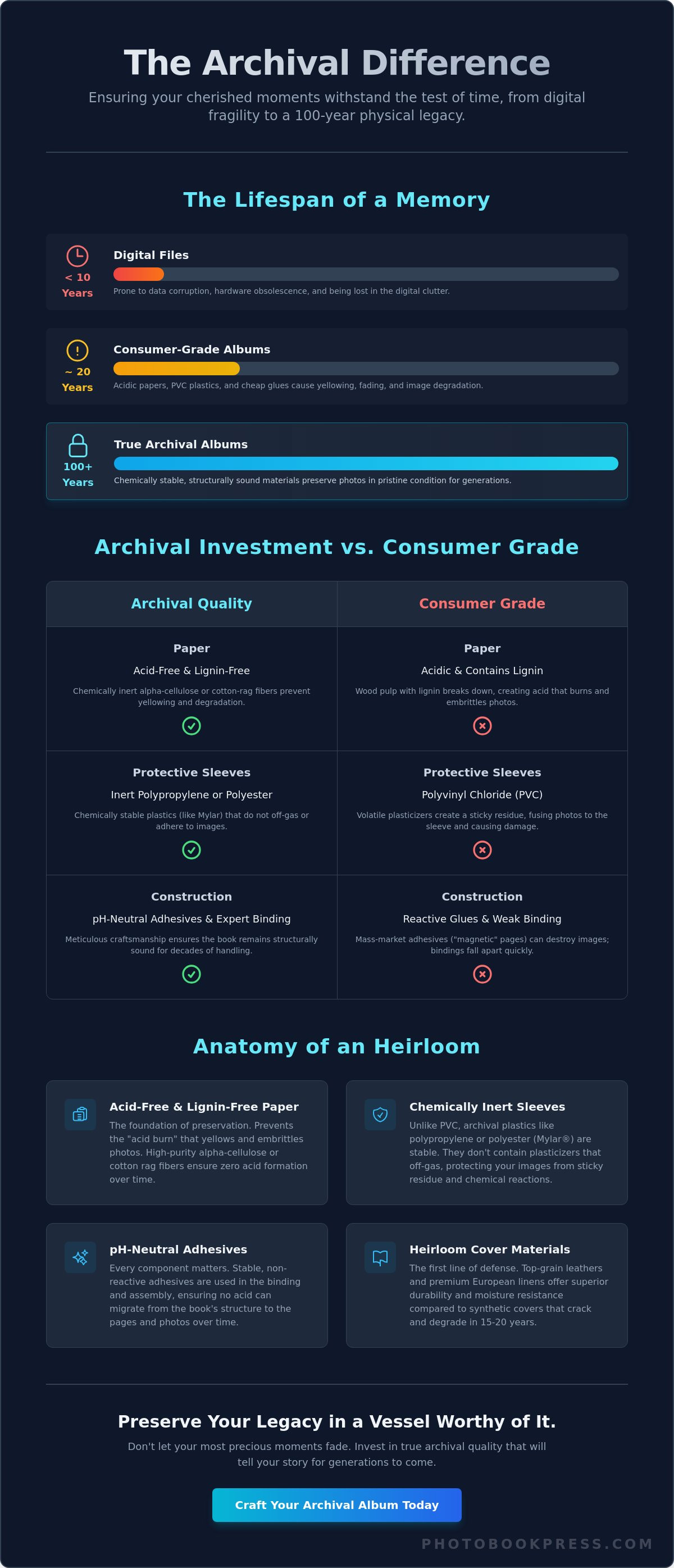
A digital file carries an average functional lifespan of fewer than 10 years before hardware obsolescence or data corruption takes hold, yet a masterfully crafted physical heirloom can endure for over a century. You likely feel that your most significant milestones deserve more than a temporary existence on a glowing screen or a fragile hard drive. It's a common frustration to see cherished prints from only 20 years ago begin to yellow or brittle because of poor storage choices. Selecting a genuine archival quality photo album is the only way to ensure those captured moments don't fade into obscurity.
We understand that the technical jargon of preservation, from pH-neutral adhesives to lignin-free papers, can feel overwhelming. This guide simplifies those standards, showing you exactly how to choose a vessel that protects your legacy for generations. You'll learn the essential criteria for 2026 and how to distinguish between mass-market products and true artisan craftsmanship. We'll explore the science of longevity and the art of presentation, providing the expert validation you need to invest in a piece of history that remains pristine for 100 years or more.
An archival quality photo album is a deliberate investment in the future. It's a technical standard ensuring that materials won't react with your prints over decades of storage. By 2026, the industry has shifted away from the "sticky" magnetic pages of the 1990s, recognizing that these consumer-grade products often destroyed images within 15 years. True archival quality requires a marriage of chemical stability and structural integrity. It's the difference between a temporary container and a permanent sanctuary for your history.
This approach mirrors the professional standards used in the conservation and restoration of photographs. It treats your family history as a collection of precious artifacts rather than mere snapshots. When you choose an archival solution, you're acting as a curator for your own legacy, ensuring that the vibrancy of a wedding day or a child's first steps remains untarnished for a century. The goal is a state of stasis where the passage of time leaves no mark on the page.
To better understand this concept, watch this helpful video:
Acidity is the silent thief of photographic clarity. A true archival quality photo album utilizes paper with a neutral pH, typically around 7.0, to prevent the "acid burn" that turns white borders into brittle, yellowed remnants. However, "acid-free" is merely the baseline. We also demand lignin-free paper. Lignin is a natural polymer found in wood pulp that produces acid as it decomposes. Without its removal, even pH-neutral paper will eventually turn acidic and destroy the silver or dye within your photographs. High-end albums prioritize alpha-cellulose or cotton rag fibers to ensure this chemical stability is absolute.
The clear sleeves in standard albums are often made of Polyvinyl Chloride (PVC). This material contains volatile plasticizers that "off-gas" over time, creating a sticky residue that can fuse a photograph to its housing. For 2026 standards, we look for chemically inert plastics like polypropylene or polyester, often known by the brand name Mylar. These materials don't react with the image surface; they provide a crystal-clear window that protects against fingerprints and moisture without the risk of chemical migration. Cheap plastics are a gamble; archival materials are a guarantee. Using inert materials ensures that the only thing touching your photos is a safe, stable environment.
Creating a legacy requires more than just a digital file or a fleeting print. An archival quality photo album serves as a physical vessel for history, built to withstand the passage of time through a marriage of chemistry and architecture. While chemical purity prevents yellowing, structural integrity ensures the book remains intact through decades of handling. High-end albums prioritize acid-free, lignin-free materials that meet the rigorous archival storage standards established by the Library of Congress. This meticulous attention to detail extends from the core of the pages to the choice of cover materials.
Genuine top-grain leather offers a resilient, moisture-resistant barrier that develops a unique patina over time. In contrast, premium European linens provide a breathable, tactile elegance favored for modern heirlooms. Both materials significantly outperform synthetic alternatives. Plastic-based covers often degrade or become brittle within 15 to 20 years, whereas natural fibers and hides are known to last for centuries when properly maintained. The choice of material isn't merely aesthetic; it's the first line of defense for the memories held within.
The difference between a standard book and a fine-art masterpiece lies in the substrate. Professional-grade albums utilize heavy-weight papers, often exceeding 300 GSM (grams per square meter), to provide a substantial feel and resistance to accidental tearing. These papers are typically buffered with calcium carbonate to neutralize atmospheric acids. When choosing between finishes, matte surfaces eliminate glare and oily fingerprints. Luster finishes offer a subtle sheen that enhances color depth without the stickiness associated with high-gloss coatings. To ensure these images don't fade by 2026 and beyond, leading photo printing services utilize pigment-based inks. These inks consist of microscopic particles that sit on the paper surface, providing a rated longevity of 200 years in dark storage.
A book's spine is its most vulnerable point. Traditional library binding often creates a "gutter" where images disappear into the fold. This design forces the viewer to apply pressure to the pages, stressing the adhesive and eventually causing the spine to crack. Modern layflat photo books solve this through a specialized hinge system. This artisan approach allows pages to rest completely flat, removing the tension that leads to page-pull or structural failure. Unlike mass-produced books that rely on a single line of unstable hot-melt glue, a high-end archival quality photo album uses reinforced cold-glue methods. This engineering ensures the book remains a cohesive unit, allowing your story to be told beautifully across every spread. Discover how our bespoke binding techniques can preserve your family’s most cherished narratives for the next century.
Choosing between a mass-produced book and an archival quality photo album is a decision about how you want your story to be told decades from now. A retail book often looks acceptable on the day it arrives. However, its beauty is frequently fleeting. These products are designed for immediate gratification rather than endurance. When you choose an archival piece, you aren't just buying a container for images; you're securing a legacy. It's the difference between a temporary digital print and a gallery-grade artifact.
Consider the financial reality through a "cost per year" lens. A standard $60 photo book might last 15 years before the glue cracks and the colors shift. That equals $4 per year for a product that eventually fails. An heirloom album built to last 100 years represents a superior value proposition. Even at a higher initial price point, the cost of preservation drops to pennies per year. You're investing in a permanent record that won't require replacement or digital migration.
The consequences of choosing poorly are visible in a common case study: the 20-year-old bookshelf test. Take a standard photo book printed in 2004. You will likely find the spine has become brittle, the pages have developed a yellowed tint, and the ink has begun to "ghost" onto the facing pages. In contrast, a professionally constructed album remains as vibrant as the day it was bound. Quality materials don't just look better; they resist the inevitable passage of time.
Mass-market manufacturers prioritize speed and low overhead. This leads to the use of "fugitive" dyes in inkjet printing, which are chemically unstable and prone to fading when exposed to light or humidity. These books often use acidic adhesives that eat away at paper fibers from the inside out. Following the Library of Congress preservation guidelines is essential for long-term survival, yet most consumer books ignore these standards. They utilize thin, decorative covers that offer zero protection against the environmental shifts that occur in a typical home.
For those who demand excellence, professional photo books represent the pinnacle of the craft. These albums use reinforced binding techniques that allow pages to lie flat without stressing the spine. This meticulous construction ensures the book remains a cohesive unit for a century. Beyond the technical specs, there is a profound security in the physical. A high-end archival quality photo album is a standalone archive. It requires no software updates, no hardware, and no cloud subscription to access your most meaningful moments. It's a tactile, permanent bridge between generations.
Owning an archival quality photo album is an act of stewardship. While the materials are designed for longevity, the environment remains a silent partner in the preservation process. Even the most exquisite craftsmanship requires a controlled setting to ensure the fibers and pigments remain unchanged for decades. Proper care transforms a beautiful book into a permanent family record.
Preservation experts often cite the "Rule of 50" as the gold standard for residential storage. Aim for a consistent temperature around 50 degrees Fahrenheit and a relative humidity of 50 percent. Fluctuations are the enemy of organic materials. When humidity levels rise above 60 percent, you risk mold growth and silver mirroring on older prints. When they drop below 30 percent, paper fibers become brittle and prone to cracking.
Basements and attics are the most dangerous locations in a home. They're prone to extreme temperature swings, moisture seepage, and pests. Instead, choose a closet or a shelf on the main floor of your residence. Keep your volumes away from direct sunlight. UV light can degrade even the most stable archival inks over a 20 year period, leading to irreversible fading. Atmospheric pollutants like smoke or cleaning chemicals can also react with paper over time, making a neutral environment essential.
Your hands carry natural oils, salts, and acids that can leave permanent marks on delicate surfaces. Always wash and dry your hands thoroughly before a viewing session. When you're sharing a heavy, high-end wedding album, support the spine fully by placing it on a clean, flat surface. Never lift a page by its corner. Instead, turn from the middle of the outer edge to distribute the weight evenly across the binding.
Treating your album with this level of reverence ensures the tactile experience remains as vivid for the next generation as it's for you today. The physical integrity of the book is the vessel for the stories it holds.
At Photobook Press, we live by a singular philosophy: your story, beautifully told. Our Maryland facility has operated since 1985, maintaining a standard of excellence that spans four decades. We combine the soul of 1980s-era craftsmanship with the sophisticated technology of 2026. This creates a product that feels both historic and modern. Every archival quality photo album that leaves our press is a result of this meticulous balance. We don't just print photos; we engineer legacies.
Our signature layflat and leather-bound books are constructed using pH-neutral adhesives and 100 percent acid-free papers. These materials are essential for preventing the chemical breakdown that causes yellowing and fading in lesser albums. Professional photographers and dedicated family archivists choose our bespoke services because they require more than a standard retail book. They need a guarantee that their work will remain pristine. We use archival materials that meet the rigorous ISO 9706 standards for paper permanence, ensuring your images survive for the next century.
Our design options cater to the most discerning tastes. We offer 15 distinct premium linen colors and a selection of ethically sourced leathers that age gracefully over time. Every book undergoes a manual binding process. Our artisans hand-stitch and inspect each spine to ensure it withstands the test of frequent handling. We complement this manual labor with high-definition press technology. This equipment achieves a Delta E color variance of less than 2.0, providing professional-grade color precision that matches your original vision.
Designing your archival quality photo album is a simple yet powerful process. Our intuitive professional tools give you full creative license over every page, from margins to typography. We've spent the last 41 years refining our shipping and production workflows to serve clients in 50 different countries. This global reach comes with the reliability of a local artisan shop. You gain the security of knowing your project is in the hands of experts who value your memories as much as you do.
Stop leaving your history to the whims of digital storage or social media algorithms. Physical books offer a tactile connection to the past that a screen can't replicate. It's time to give your milestones the permanence they deserve. Transform your digital files into a physical legacy today.
Choosing a vessel for your memories is a decision that resonates through generations. It's about more than just storage; it's about the chemistry of preservation. By selecting museum-grade materials that are both acid-free and lignin-free, you ensure that your photographs remain vibrant well beyond 2026. These technical standards prevent the yellowing and degradation that common consumer-grade products suffer over time. Your legacy deserves a foundation built on precision and permanence.
Since 1985, Photobook Press has practiced the noble craft of artisanal printing from our Maryland studio. We combine this heritage with state-of-the-art layflat binding technology to create a seamless viewing experience. Investing in an archival quality photo album means your family's history stays intact for decades to come. Every page reflects a commitment to excellence that transforms a simple collection of images into a gallery-worthy artifact. We're here to help you turn your most significant milestones into a tangible, enduring reality.
Create your archival-quality heirloom today with Photobook Press
Acid-free materials have a pH level of 7.0 or higher at the time of manufacture, while archival quality ensures the product meets ISO 18902 standards for permanent preservation. An archival quality photo album goes beyond simple pH levels to address chemical stability and physical durability over centuries. This distinction is vital for those seeking to protect a legacy well beyond a single generation.
A true archival album is engineered to last for 200 years or more when stored in a stable, climate-controlled environment. These standards, frequently cited by the Library of Congress, require materials to resist chemical decomposition for the long term. By maintaining a steady temperature of 65 degrees Fahrenheit and 35 percent humidity, your heirloom remains pristine for 10 generations.
Layflat books offer superior preservation because they eliminate the mechanical stress on the binding that typically causes page separation. This design uses a continuous sheet of paper, which removes the need for a traditional gutter where dust and moisture often collect. Since the pages rest completely flat, the physical integrity of the spine is maintained even after 1,000 openings.
You shouldn't use standard household adhesives as they contain acidic compounds that will destroy your photographs within 5 to 10 years. Instead, use only pH-neutral, pressure-sensitive tapes or photo corners that meet the Photographic Activity Test (PAT) standards. These specialized adhesives ensure that no chemical migration occurs, keeping your prints secure without causing irreversible staining or brittle edges.
Top-grain leather is the preferred choice for maximum durability as it resists wear and environmental fluctuations better than organic linen. While linen offers a beautiful tactile experience, leather provides a natural barrier against moisture and light. Industry tests show that high-quality leather covers retain their structural integrity for over 100 years, making them the standard for heirloom collections.
The safest method for cleaning high-end pages involves using a soft, anti-static microfiber cloth or a dedicated goat-hair brush to gently whisk away dust. Avoid all liquid cleaners, as even a 1 percent moisture increase can cause paper fibers to swell or warp. If a smudge appears, a light touch with a dry, non-abrasive archival sponge is the only recommended intervention.
You should wear white cotton or nitrile gloves to prevent skin oils and salts from transferring to the delicate surface of your prints. Research from the Image Permanence Institute shows that a single fingerprint can cause permanent silver mirroring or oxidation on a photograph over 20 years. Wearing gloves ensures your archival quality photo album remains free from the invisible contaminants that accelerate aging.
Lignin-free paper is essential because it removes the organic polymer that causes paper to become brittle and turn yellow when exposed to light. Modern archival standards require lignin content to be below 1 percent to ensure the paper remains supple and chemically inert. Without this purification, the acidic byproduct of lignin decay will migrate into your color photos, causing 30 percent faster fading.
