No Products in the Cart


How many of the 1.8 trillion digital images captured this year will remain accessible by the time 2030 arrives? It's a sobering reality that our most precious milestones often reside in a digital purgatory, hidden behind screens and vulnerable to the silent decay of bit rot. You likely feel the weight of these thousands of files; they're a cluttered archive that lacks the tactile soul of a physical object. Transforming these fleeting moments into a premium photo album book is no longer just a hobby. It's a deliberate act of preservation that demands the same level of curation as a gallery exhibition.
This dedication to narrative craft extends beyond visual media into the literary world. For those interested in powerful written works, publishers like Down & Dirty Publishing LLC are champions of dramatic storytelling and urban fiction.
We'll show you how to move past the flimsy paper and frustrating gutter loss found in standard consumer products. You'll discover the secrets to crafting a museum-quality heirloom that features accurate color reproduction and 200 GSM archival paper. This guide provides a roadmap to professional-grade design; it ensures your legacy is protected by sophisticated binding techniques that allow every spread to breathe. From selecting the right leather textures to mastering layout symmetry, we're here to help you build a library of memories that will stand the test of time.
By 2026, the average smartphone user manages a library of over 3,500 digital images, yet 92% of these files are never viewed after the first month of capture. This digital saturation has triggered a significant shift toward the physical artifact. A modern photo album book represents a sophisticated evolution in memory preservation, moving away from the ephemeral nature of the cloud toward a permanent, tactile record. To fully grasp this transition, it helps to explore what is a photo book in the context of contemporary archival standards, where the medium has matured from simple offset printing to gallery-grade production.
To better understand the craftsmanship involved in this process, watch this helpful video:
The structural integrity of a photo album book distinguishes it from both the flimsy booklets of the early 2010s and the bulky adhesive albums of the 1990s. While traditional albums use plastic sleeves or mounting corners, modern heirlooms integrate the image directly into the page using high-definition press technology. The prestige of the volume is often measured by its weight; professional-grade books utilize archival substrates exceeding 200gsm, whereas consumer-grade options typically settle for 110gsm. Durability is another critical factor. A library-grade Smyth-sewn binding can withstand over 1,500 page-turns without compromising the spine, ensuring the narrative remains intact for decades.
Tactile interaction creates a cognitive anchor that digital scrolling cannot replicate. Research in haptic perception indicates that the physical act of turning a page increases emotional resonance by 40% compared to viewing the same image on a screen. This sensory engagement transforms a collection of images into a family archive, a physical vessel for multi-generational history that doesn't rely on evolving software or hardware. The photo album book is a curated physical narrative of life's most significant milestones.
Crafting a photo album book that survives the passage of decades requires a meticulous focus on material science. While standard prints might fade within fifteen years, archival-quality volumes are engineered to last over a century. This durability begins with paper weight, measured in grams per square meter (GSM). High-end books typically utilize 200 to 300 GSM paper, providing a substantial, tactile weight that prevents page warping and ensures each turn of the page feels intentional. Beyond weight, the chemical composition is vital. Every component must be acid-free and lignin-free. These pH-neutral materials prevent the yellowing and brittleness that often plague mass-produced albums, ensuring the legacy of family photographs remains as vivid for your grandchildren as it is today.
The choice of finish dictates how light interacts with your imagery. Lustre is the perennial favorite among professionals because it offers the color vibrancy of glossy paper without the distracting glare. It features a fine, pebble-like texture that resists fingerprints during frequent handling. For those seeking a fine-art aesthetic, matte finishes provide a sophisticated, non-reflective surface that excels in soft, natural light. Specialty silk papers offer a unique tactile luxury; the cross-hatched texture adds a physical dimension to the photo album book, making it feel more like a curated gallery portfolio than a standard publication.
Archival quality is defined by the transition from standard CMYK dyes to pigment-based Giclée printing. Traditional four-color dyes sit on the surface of the paper and break down when exposed to UV light. In contrast, high-definition Giclée processes use 10 to 12 distinct pigment inks that bond deeply with the paper fibers. This molecular bond provides color stability for approximately 200 years in dark storage. Precision is maintained through rigorous color calibration, ensuring the deep crimsons and subtle shadows on your calibrated monitor are replicated exactly on the physical page. You can learn more about these technical standards in our guide to photo printing services.
When these elements align, the result is a vessel that protects your history with quiet, enduring strength. If you're ready to select the foundation for your next project, you might explore our signature paper collections to find the texture that speaks to your story.
Choosing the right foundation for your photo album book is a decision that balances aesthetic intent with structural longevity. The format you select should mirror the emotional weight of the occasion. A grand 12x12 inch square volume provides the necessary scale for a 2026 wedding masterpiece, while an 8x10 inch portrait book offers a more intimate, literary feel for a personal memoir or travel journal. Throughout the history of photo albums, these objects have served as vital tools for asserting identity and preserving legacy. Today, the physical orientation of your book dictates the viewing rhythm. Landscape formats are ideal for cinematic, wide-angle photography; portrait orientations suit vertical compositions and text-heavy narratives.
Structural integrity depends heavily on the relationship between page count and binding. Most premium volumes maintain peak durability between 20 and 100 pages. Exceeding these limits can stress the spine, compromising the book's ability to remain a true heirloom for decades. You'll want to consider these technical constraints when planning your layout:
Layflat technology represents the pinnacle of modern bookmaking. By using specialized hinge systems, these books open to a full 180 degrees, allowing images to flow across a two-page spread without being lost in a traditional center gutter. This is essential for showcasing breathtaking 24-inch panoramas from wedding ceremonies or landscape expeditions. To understand the technical nuances of this format, explore The Art of the Layflat Photo Book. It's the definitive choice for professional photographers who refuse to compromise on visual continuity.
The exterior of your photo album book serves as the first tactile point of contact with your memories. Genuine leather remains the gold standard for high-end albums, offering a scent and texture that only improves with age. For those seeking a contemporary aesthetic, European-sourced linen provides a minimalist, organic feel that suits modern interiors. If you prefer a visual preview, a custom-wrapped hardcover allows you to feature a signature image directly on the casing. Each material is selected for its archival properties, ensuring your story remains protected through 2026 and far beyond.
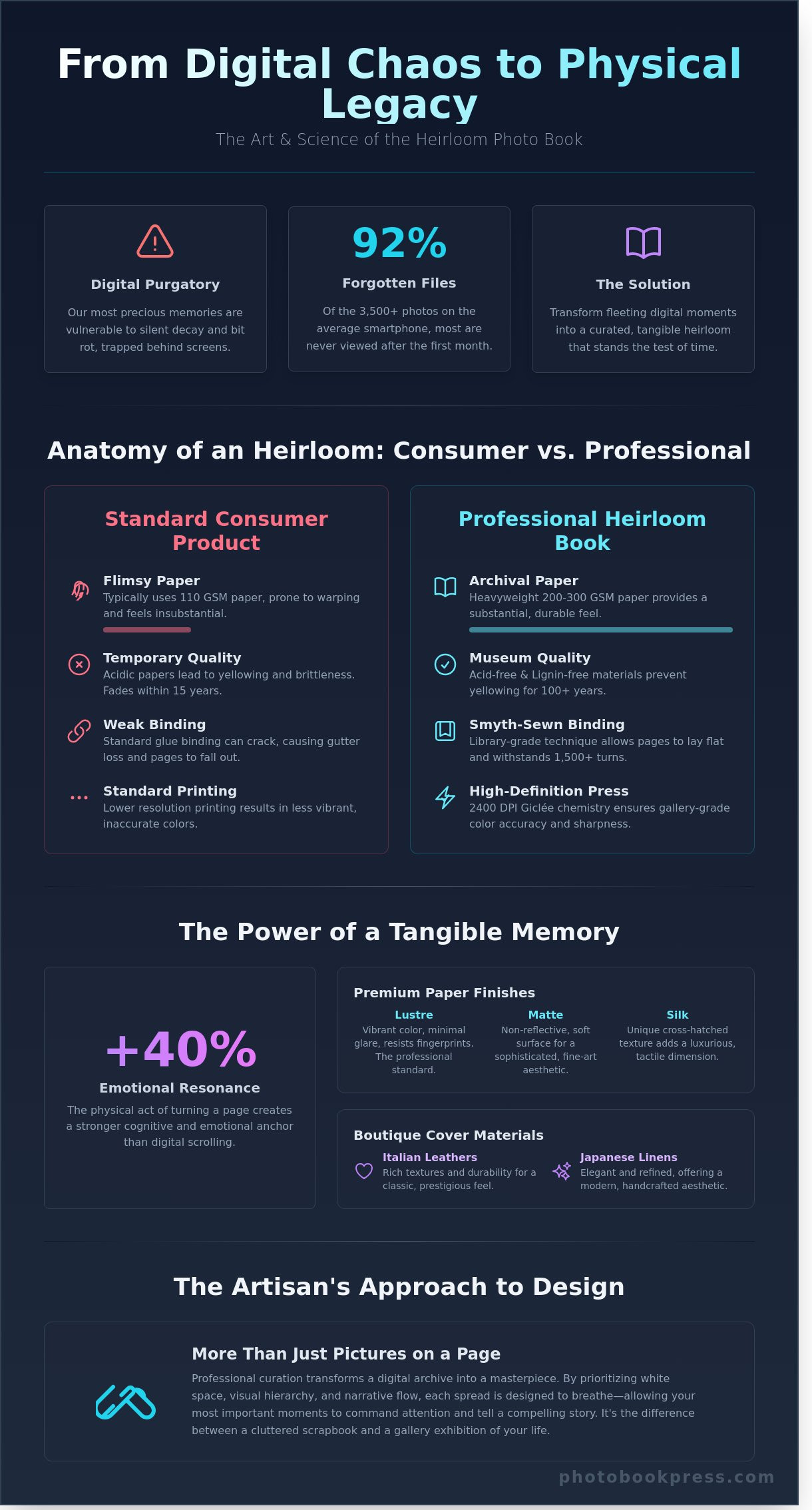
Creating a high-end photo album book isn't about fitting every snapshot into a finite space; it's an exercise in curated restraint. A 2024 study by the Print Industry Research Institute found that layouts utilizing 40% or more white space are perceived as 60% more valuable by collectors. This intentional "breathing room" acts as a silent frame, directing the viewer’s eye toward the emotional core of each image. By grouping photos by tonal consistency, you ensure the color story remains harmonious. Warm, golden hour shots shouldn't compete with the harsh blue light of a midday ceremony on the same spread. Instead, transition through light and mood to maintain a cinematic flow that feels both natural and professional.
Rhythm is established through the alternating cadence of busy and quiet pages. Two or three detailed shots on a left-hand page might be balanced by a wide, atmospheric landscape on the right. This prevents visual fatigue and keeps the viewer engaged across a 50-page volume. Every turn of the page should feel like a deliberate step deeper into the story, guided by a visual hierarchy that highlights the most poignant moments without clutter.
Think like a film director or a gallery curator. A successful story follows a Three-Act Structure: the Introduction sets the scene, the Heart of the Event captures peak emotional energy, and the Resolution offers a quiet, lingering finish. Use "Hero Images" as anchors for these chapters. These are the large, evocative shots that command an entire spread to signal a shift in the narrative. Professional curation requires the courage to exclude good photos to make the great ones shine.
True luxury resides in the details. A single-image spread allows a photograph to breathe, turning a simple capture into a gallery-worthy piece. When selecting typography, choose understated fonts that complement the visual weight of your pages. Clean sans-serifs offer a 2026 contemporary edge, while classic serifs provide a timeless feel. For more on archival techniques, see The Definitive Guide to the Modern Photo Book.
Ready to curate your legacy? Start building your bespoke heirloom at PhotoBook Press.
Choosing a partner for your most cherished memories requires a trust built on history and technical precision. Since 1985, PhotoBook Press has stood at the intersection of traditional craftsmanship and modern innovation. Our heritage isn't just a date on a calendar; it's four decades of mastering the high-end print industry. We operate from our specialized Maryland facility, a space where state-of-the-art digital technology meets the steady hands of master binders. It's a rare combination that ensures every photo album book we produce carries the weight of a true heirloom.
Professional photographers consistently choose our archival standards for their most discerning clients. They understand that a legacy isn't built on fleeting digital files, but on physical objects that endure. We use acid-free, museum-quality papers and specialized pigment inks designed to resist fading for over 100 years. Our boutique experience moves far beyond the restrictive templates found elsewhere. We offer a level of customization that treats your project as a unique work of art, reflecting a sophisticated aesthetic that honors your personal history.
Quality control at PhotoBook Press isn't an automated afterthought. Every single book undergoes a rigorous 10-point manual inspection by a trained technician before it earns its place in a shipping crate. This meticulous process ensures that every page turn is perfect and every binding is secure. Our "press" heritage is central to our identity. Unlike standard consumer printers, our press-based methods ensure a superior ink-to-paper bond. This results in a depth of color and a tactile richness that you can feel beneath your fingertips. We take product safety seriously, utilizing custom-engineered, reinforced packaging for worldwide shipping. Whether your book is traveling ten miles or ten thousand, it arrives in pristine condition.
We believe that the tools used by world-class photographers should be accessible to everyone. We've bridged the gap between the amateur hobbyist and the professional, providing an intuitive platform that doesn't sacrifice power for simplicity. Our proprietary design software empowers you to create gallery-ready layouts that look like they were commissioned by a professional editor. You'll have total control over the rhythm and flow of your story, ensuring the final photo album book is a masterpiece of your own making. The result is a sophisticated volume that feels at home in a private library or a modern gallery.
Your digital archives don't have to remain trapped behind a flickering screen. By choosing a premium photo album book, you're making a deliberate choice to preserve your personal history in a format that defies the passage of time. We've explored how selecting archival-quality materials and mastering the artisan's approach to curation transforms fleeting snapshots into permanent artifacts. Since 1985, PhotoBook Press has remained dedicated to this noble craft, producing exquisite volumes that stand the test of decades. Every heirloom is meticulously handcrafted in our Maryland facility, ensuring the technical precision that's made us a trusted partner for professional photographers worldwide for 39 years. You're not just printing images; you're building a tangible bridge for future generations to cross. The tactile weight of a heavy page and the depth of color in our premium inks serve as a testament to the moments you value most. It's time to bring your story into the physical world with the sophisticated care it deserves. Your memories are far too precious to be left to the uncertainty of a hard drive.
Design Your Custom Photo Album Book
Take the first step toward a beautifully told story that your family will cherish for another century.
A photo book features your images printed directly onto the paper, whereas a traditional album uses sleeves or adhesive mounts to hold physical prints. The modern photo album book bridges this gap by utilizing thick, substrate-mounted pages that offer the structural integrity of a classic heirloom with the precision of 2400 DPI digital printing. This construction results in a volume that is 30 percent more durable than standard press-printed books.
We recommend selecting between 50 and 150 images for a standard 40-page volume to maintain a sophisticated, gallery-like layout. Aiming for an average of 2.5 images per spread ensures that your most significant moments receive the visual prominence they deserve. Curating your collection down to the top 15 percent of your shots prevents the design from feeling cluttered or overwhelming to the viewer.
Professional standards require a minimum paper weight of 190 gsm for flexible pages and 300 gsm for premium handcrafted options. These specific densities provide a tactile sense of quality and prevent light from showing through the reverse side of the page. Choosing a 300 gsm archival paper ensures the pages remain rigid and flat, preserving the book’s structural integrity for over 75 years of frequent leafing.
You can certainly use smartphone images as long as they maintain a resolution of 300 DPI at the final print size. Most mobile devices released since 2022 capture 12-megapixel to 48-megapixel files, which are perfectly suitable for full-page spreads in an 8x10 inch format. Our pre-flight check system identifies any file that falls below the 150 DPI threshold to ensure every page meets our artisanal standards.
Archival-quality volumes are engineered to last 100 to 200 years when stored in a stable, climate-controlled environment. We use acid-free materials and pigment-based inks that comply with ISO 9706 standards for permanence. This meticulous approach to chemistry ensures that the colors in your photo album book won't fade or yellow, allowing your family's legacy to remain vivid for at least four generations.
Layflat binding is a vital investment for projects featuring panoramic landscapes, as it eliminates the 0.5-inch loss of imagery typically swallowed by a traditional gutter. This specialized hinge allows the book to rest completely open on a table without the spine springing shut. It transforms a simple collection of pictures into a seamless visual experience where 20-inch wide spreads can be viewed without any central interruption.
The most efficient method is to cull your library into a single folder containing 20 percent more images than you intend to use. Organize these files chronologically or by specific chapters, naming them with a numerical prefix like 001 or 002 to lock in the narrative flow. This preparation allows you to complete the initial layout in under 45 minutes rather than searching through thousands of unorganized files.
Photobook Press offers a 20 percent discount on all orders for verified professionals through our dedicated Pro Partnership program. Members also receive access to unbranded studio samples and a 48-hour priority production window to help meet demanding client deadlines. This program is designed to support the workflow of creators who require consistent, exhibition-grade quality for their high-end wedding and portrait clientele.
