No Products in the Cart


A photograph shouldn't just sit on a wall; it should breathe with the same vibrancy it possessed the moment the shutter clicked. You've likely felt the frustration of watching a beloved print lose its luster or worried that modern acrylic photo printing might feel too clinical for your personal sanctuary. It's a common concern for those who view their photos as more than just images, but as a legacy that deserves to be preserved with the utmost care.
This guide explores how this medium serves as the structural preservation of light, transforming your most significant moments into museum-quality masterpieces defined by unparalleled depth and archival longevity. You'll discover the technical superiority of this craft, from the clarity of face-mounting to the resilience of UV-resistant inks. We'll walk through the nuances of creating a vibrant focal point that remains as breathtaking decades from now as it is today.
The essence of excellence in print is often found in how light interacts with the image. modern acrylic photo printing is the art of encasing a high-definition photograph within a premium, optical-grade polymer. Unlike traditional framing where a photo sits passively behind a pane of glass, this process involves a sophisticated bond that allows light to travel through the material. This refraction creates a sense of internal illumination. It's as if the image glows from within, capturing the eye with a brilliance that standard prints lack.
This medium offers a borderless, "floating" aesthetic. By eliminating bulky frames, the focus remains entirely on your visual narrative. The hidden hanging systems allow the piece to hover an inch from the wall, casting a soft shadow that adds to the perceived depth. It's a choice that transforms a residential hallway or a professional boardroom into a curated gallery space. To source professional-grade fine art for such a setting, you can learn more about Galerie Prints. Beyond the beauty, the material is inherently resilient. High-grade acrylic is shatter-proof and offers significant scratch resistance, ensuring your investment remains pristine for decades.
To better understand the precision and artistry involved in creating these pieces, watch this demonstration of the assembly process:
Acrylic possesses a unique optical quality that standard glass cannot match. With a light transmission rate of approximately 92%, it allows nearly every photon to reach the image and bounce back to the viewer. This creates a "backlit" effect that enhances saturation and contrast without the need for actual bulbs. The depth is further amplified by the thickness of the sheet itself, typically ranging from 1/8 to 1/4 inch. This physical dimension provides a three-dimensional quality that draws the viewer into the frame. Much of this technical foundation stems from the Diasec process, which pioneered the face-mounting technique to ensure a permanent, bubble-free bond between the print and the acrylic.
In 2026, interior design favors a minimalist approach that prioritizes clean lines and unobstructed views. Traditional matted frames can sometimes feel heavy or dated in a contemporary setting. Choosing modern acrylic photo printing represents a shift toward a more immersive viewing experience. Designers now use these luminous pieces to anchor large rooms, using the vibrant clarity of the medium to balance neutral color palettes. Maintenance is equally effortless. A simple wipe with a microfiber cloth keeps the surface brilliant, making it a practical choice for high-traffic areas. It's a seamless blend of high-tech production and timeless aesthetic appeal.
The transition from a digital file to a physical masterpiece requires more than just high-end machinery; it demands a meticulous understanding of material science. In the world of modern acrylic photo printing, the primary technique utilized is second-surface printing. This involves applying the image to the back of the acrylic sheet rather than the front. By doing so, the image is viewed through the thickness of the polymer. This naturally protects the ink from surface abrasions while creating the signature depth that defines the medium.
A critical component of this process is the white block-out layer. Without it, the translucent nature of the acrylic would allow light to pass through the inks, resulting in a washed-out appearance. By applying a dense, opaque white backing, every hue is forced to reflect back through the acrylic. This makes the colors pop with a vividness that mimics a high-definition screen. To achieve a truly professional finish, the edges of the sheet undergo flame polishing. This step uses a high-temperature torch to melt the saw-cut edges into a crystal-clear, glass-like finish, ensuring the image is visible from every angle without distortion.
While direct printing is efficient for many applications, professional galleries often prefer the face-mounting method. This involves printing the image onto a high-quality, metallic or fine art paper before bonding it to the acrylic using a specialized adhesive. This technique eliminates the risk of "silvering" or bubbling, providing a level of clarity that direct-to-substrate methods can struggle to replicate. If you are looking to elevate your collection, exploring the range of Acrylic Prints available can help you decide which finish best suits your aesthetic goals.
True artistry is measured by its ability to withstand the test of time. In 2026, the standard for archival quality is defined by the synergy between pigment-based inks and UV-resistant polymers. These materials are engineered to maintain environmental stability, even in rooms with significant natural light. Unlike canvas, which can sag, or paper, which can yellow when exposed to humidity, acrylic remains structurally sound. Lightfastness is the measure of how well a print resists fading when exposed to light over several decades. By utilizing inks that are rated for high lightfastness, these prints ensure that your personal history remains as vibrant for the next generation as it was on the day it was created.
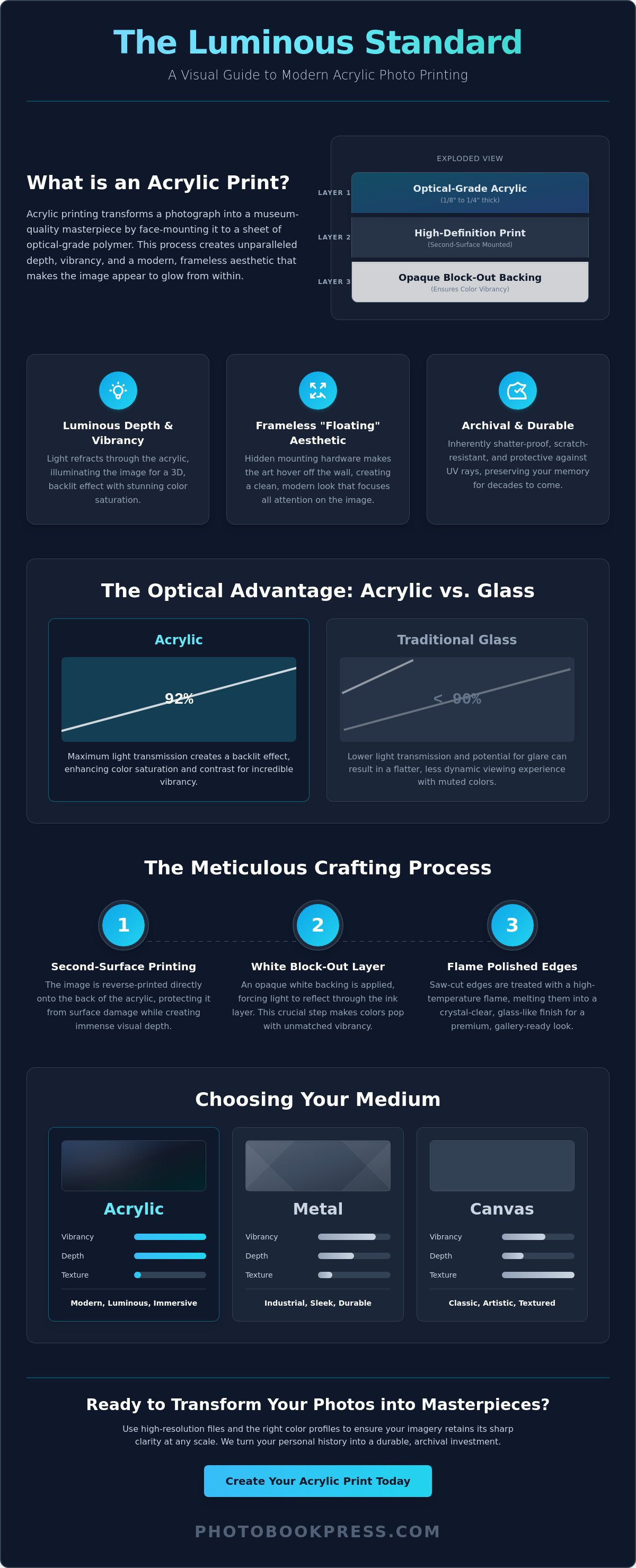
Selecting the right substrate for your imagery is an act of curation that extends beyond simple aesthetics. While modern acrylic photo printing is celebrated for its luminous depth, other mediums like metal and canvas offer distinct emotional and physical qualities. Metal prints provide an industrial, often matte or semi-gloss finish that feels contemporary and rugged. In contrast, canvas offers a tactile, organic texture that softens an image, making it feel more like a traditional painting. The choice depends on how you want the light to behave within your space and the story you wish to tell.
The physical presence of these materials varies significantly. Acrylic is substantial. A standard 1/4-inch sheet has a weight that feels significant in the hands, requiring sturdy mounting hardware to ensure it hangs securely. Metal is remarkably thin and lightweight, making it ideal for minimalist displays or walls with limited load-bearing capacity. Canvas is the lightest of the three, offering a classic wrap that doesn't require a frame to look complete. When deciding, consider the room's atmosphere. A high-gloss acrylic piece rewards a viewer in a controlled lighting environment, while the non-reflective surface of canvas or matte metal is more forgiving in rooms with large, bright windows.
Acrylic is the definitive choice for high-contrast photography where every detail must be preserved. Landscape photographers often favor this medium because it captures the translucent glow of a sunset or the sharp clarity of a mountain range with forensic precision. It's also an excellent choice for luxury environments. Because the material is non-porous and resistant to humidity, it's perfectly suited for high-moisture areas like designer kitchens or primary bathrooms. In these spaces, modern acrylic photo printing provides a sleek, polished look that complements high-end stone finishes and minimalist cabinetry; if you are looking to extend this high-performance quality to your landscaping, you can check out EverTurf Inc for premium synthetic turf solutions.
There's a perceived value in the "heaviness" of a well-crafted acrylic print. When given as a gift, the physical density of the polymer suggests a level of permanence and care that lighter materials might not convey. It serves as a modern heirloom, often used to showcase the pinnacle moments of a wedding or a professional portfolio. For those seeking a softer aesthetic or a more traditional fine-art feel, our Artisan’s Guide to Custom Canvas Prints explores how textured surfaces can add warmth to a personal gallery. Ultimately, acrylic is for the moments that demand to be noticed; it's a bold declaration of quality that turns a simple photograph into a commanding architectural element.
The transformation from a digital memory to a physical masterpiece begins long before the printer starts its work. Preparation is the bridge between a simple file and a legacy piece. modern acrylic photo printing acts as a visual amplifier. Because the polymer is optically clear, it functions like a lens, highlighting every detail of the source image. This means that while it enhances beauty, it also exposes technical flaws. Choosing the right subject matter and file specifications is the first step in the artisan's journey toward a perfect wall display.
Subject matter plays a significant role in how the final piece interacts with its environment. Architectural photography thrives on acrylic; the sharp lines and geometric patterns are emphasized by the material's clean, frameless edges. Similarly, nature shots with high contrast or vibrant color palettes benefit from the internal light refraction we discussed earlier. When selecting your file, pay close attention to the thickness of the acrylic. A 1/4-inch sheet provides a deep, immersive experience that is ideal for large focal points. For smaller, more intimate spaces, a 1/8-inch sheet offers a sleek profile that remains sophisticated without feeling heavy.
Clarity is non-negotiable. For a standard 24x36 inch print, your file should ideally maintain a resolution of 150 to 300 pixels per inch (PPI). If the resolution is too low, the magnifying effect of the acrylic will make pixelation or "noise" visible to the naked eye. We recommend using professional-grade files with embedded color profiles, much like the standards required for professional photo books. This ensures that the transition from the RGB light of your monitor to the physical inks of the print remains faithful to your original vision.
The way you light your art determines its presence in the room. High-gloss acrylic is reflective by nature, so positioning is vital. Avoid hanging your piece directly across from large, uncovered windows to minimize distracting glare. Instead, consider dedicated gallery lighting. A well-placed ceiling spotlight can make the colors "bloom," creating that coveted backlit effect. If your space has uncontrollable light sources, you might opt for a non-glare acrylic finish. This provides a softer, matte appearance that preserves the depth of the image while diffusing harsh reflections.
Once you've selected your most meaningful image and verified its technical quality, you're ready to bring it to life. You can start your custom acrylic print project today to see how your vision translates into a luminous work of art.
Since our founding in 1985, Photobook Press has stood at the intersection of traditional craftsmanship and technical evolution. While the tools of the trade have changed over the decades, our philosophy remains rooted in the belief that a photograph is a precious artifact. Today, we apply this long-standing heritage to modern acrylic photo printing, ensuring that the same level of care once reserved for hand-bound albums is now applied to every luminous wall display we create. We don't view our work as simple manufacturing. Instead, we view it as the stewardship of your personal history.
Every piece that leaves our studio undergoes a rigorous manual inspection that no automated system can replicate. Unlike mass-produced alternatives that treat photography as mere signage, our process is defined by a series of deliberate, human touches. We look for the subtle nuances in color balance and the absolute clarity of the bond before any piece is cleared for delivery. To create a truly cohesive narrative for your home, you might consider pairing your new wall art with a layflat photo book. This allows you to celebrate a single, commanding moment on your wall while preserving the broader story within the pages of an archival volume.
The difference between a standard print and a masterpiece is found in the final stages of production. Our artisans spend significant time on the flame-polishing and mounting phases, ensuring the edges are as clear as the surface itself. This level of precision is why we are a trusted partner for creators through our wholesale portfolio book program. Whether you are a professional photographer or a family historian, our commitment to archival quality remains the same. We use materials designed to protect your imagery from the degradation of time, ensuring that your legacy remains vibrant for the next generation.
Bringing your vision to life shouldn't be a complex chore. Our online design tool offers a sophisticated yet intuitive experience, allowing you to upload your high-resolution files and select the perfect specifications with ease. Once your art is crafted, it's secured in professional-grade packaging designed to withstand the rigors of transit. We ensure that your investment arrives in gallery condition, ready to be installed as the new focal point of your space. Excellence requires patience and attention to detail, and we're honored to help you achieve it. Transform your most cherished image into a modern acrylic masterpiece today.
Your photographs are more than mere digital data; they are the physical anchors of your most cherished stories. Choosing modern acrylic photo printing is an investment in a medium that honors that history. By mastering the interplay of light transmission and the precision of second-surface mounting, you move beyond the limitations of traditional decor. You gain a three-dimensional masterpiece that remains structurally sound and visually vibrant for decades. It's a choice that prioritizes clarity, depth, and the enduring nature of fine art over fleeting trends.
Since 1985, our master printers have hand-finished every piece with a level of care that respects the artisan tradition. We utilize archival-grade pigments and UV-resistant polymers to ensure your work meets the exacting standards of professional gallery exhibitions. This meticulous approach ensures that your memories don't just occupy space; they command it. Elevate Your Memories with Artisan Acrylic Printing and allow your personal history to shine with the brilliance it deserves. Your legacy is ready to be seen in its best light.
Acrylic offers distinct advantages over traditional glass framing in terms of both optical performance and durability. It provides superior light transmission, allowing more of the image's natural color and detail to reach the eye. Because it's shatter-proof and significantly lighter than glass, it's a safer and more versatile choice for large-scale wall art in high-traffic residential or professional environments.
Maintaining the brilliant surface of your print requires a gentle touch and the correct materials. We recommend using a clean, dry microfiber cloth to remove surface dust. For a deeper clean, utilize a mild, non-abrasive, and ammonia-free cleaner specifically formulated for polymers. It's vital to avoid paper towels or coarse sponges, as these can create microscopic scratches that dull the finish over time.
A resolution of 300 DPI at the final print size is the gold standard for achieving gallery-quality results. While a minimum of 150 DPI can produce acceptable results for pieces viewed from a distance, the inherent clarity of modern acrylic photo printing tends to magnify any digital imperfections. High-resolution files ensure that every detail remains sharp and the color transitions stay smooth.
These pieces are engineered for long-term stability using UV-resistant polymers and archival pigment inks. This combination protects the imagery from the fading typically caused by sun exposure, allowing the colors to remain vibrant for decades. While the materials are highly lightfast, we still advise avoiding locations where the art is subjected to constant, harsh sunlight to ensure the maximum lifespan of the piece.
The choice between thicknesses is primarily a decision about visual depth and physical presence. A 1/4 inch sheet provides a more dramatic three-dimensional effect, creating a sense of immersion that pulls the viewer into the photograph. The 1/8 inch option offers a sleeker, more minimalist profile that's lighter and easier to mount in smaller spaces. Both maintain the same exceptional optical clarity.
You can use smartphone photos for smaller prints, but caution is necessary for larger formats. Even with the advanced sensors available today, low-resolution files can exhibit digital noise or pixelation when scaled to wall-art sizes. For modern acrylic photo printing to truly shine, we recommend verifying that your file's pixel dimensions are sufficient for the intended size without relying on artificial upscaling.
Large prints are best secured using specialized hardware like French cleats or stainless steel standoffs. A French cleat system is often preferred for a clean look, as it's hidden behind the print and allows the piece to float level against the wall. Standoffs are a more visible, industrial option that secures the acrylic through pre-drilled holes, ensuring the art remains firmly in place.
Acrylic is highly resistant to moisture and humidity, making it an ideal choice for luxury bathrooms or indoor pool areas. However, these prints aren't intended for permanent outdoor installation where they're exposed to direct rain and extreme temperature shifts. While the polymer is durable, prolonged exposure to the elements can eventually impact the integrity of the bond between the print and the acrylic sheet.
