No Products in the Cart


What if the most vibrant moments of your life were destined to vanish before your grandchildren could ever truly see them? It's a quiet anxiety many families share, watching a cherished portrait slowly succumb to the relentless pull of light and time. You've likely felt a pang of worry when seeing a vintage photo with yellowed edges, wondering if your own investment in archival ink photo printing will truly stand the test of the next century or simply fade into a muted memory.
We believe your history deserves the same meticulous care as a gallery masterpiece. This guide explores the technical artistry and scientific standards that transform a simple image into a permanent historical artifact. You'll gain a deep understanding of the crucial differences between pigment and dye, along with the confidence to choose materials that meet museum-grade ISO requirements. We'll show you how a deliberate focus on craftsmanship ensures your heirlooms remain as vivid as the day they were captured, preserving your family's legacy for over 200 years. By demystifying the jargon, we'll help you ensure that your most precious stories are never lost to the passage of time.
At its heart, archival ink photo printing is a commitment to the future. It represents a departure from the ephemeral nature of standard snapshots, where colors bleed and memories dim within a single generation. By choosing archival materials, you aren't just making a copy of an image; you're creating a permanent artifact. This process relies on The Science of Permanence, utilizing mineral-based pigments that offer unparalleled stability. It's a shift in perspective that treats your personal history with the same reverence a curator shows a museum masterpiece.
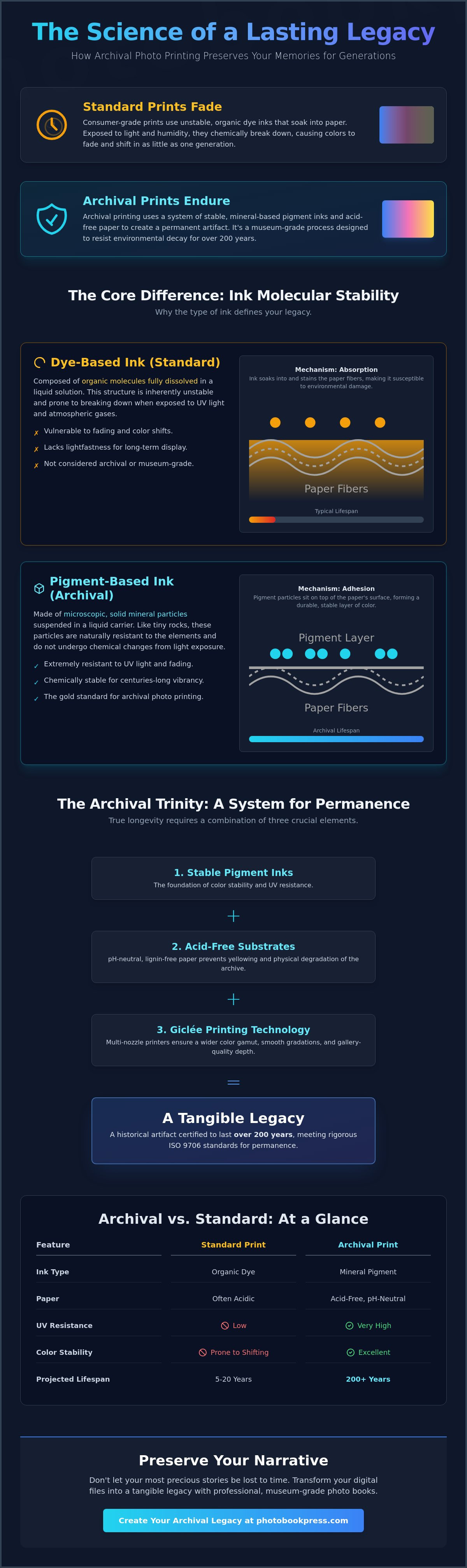
Unlike the organic dyes found in home printers, archival inks are composed of microscopic solid particles. These pigments don't merely soak into the paper fibers where they can be easily broken down by environmental factors. Instead, they rest upon the surface, creating a resilient layer of color that resists the chemical decay typically seen in consumer-grade prints. This fundamental shift in chemistry allows for lightfastness measured in centuries rather than years, ensuring your investment remains vibrant long after standard prints have faded.
To better understand how a photograph transforms from a digital file into a unique piece of art, watch this helpful video:
As of 2026, the industry adheres to rigorous benchmarks like ISO 9706 and the newer ISO 18937-3 to define true longevity. For a print to be considered "archival," it must demonstrate a projected lifespan of at least 100 years under gallery conditions without significant fading or color shifting. A critical component of this durability is pH-neutrality. Acidic environments cause paper to become brittle and yellow over time; therefore, an archival system requires acid-free substrates that protect the integrity of the ink. Archival ink is a suspension of microscopic pigment particles that sit atop the paper fibers rather than soaking in, ensuring the visual precision remains sharp for generations.
The term "Giclée" remains the gold standard for those seeking the highest echelon of archival ink photo printing. Derived from the French word for "to spray," this technique utilizes high-end inkjet printers equipped with multiple precision nozzles. This sophisticated multi-nozzle spray allows for a significantly wider color gamut and smoother gradations than standard digital printing. It’s the difference between a flat reproduction and a print with tactile depth and soul. Photobook Press utilizes this exact Giclée technology for every professional photo book, ensuring that each page reflects the meticulous standards of a gallery exhibition.
The difference between a memory that lasts and one that dissolves into a hazy spectrum of magenta and cyan lies in the molecular foundation of the ink. When you invest in archival ink photo printing, you're making a choice between organic transience and mineral permanence. Dye-based inks are composed of organic molecules dissolved in a liquid carrier. While they offer bright initial colors, their very structure is their undoing. Because they're liquid-based, they permeate the paper fibers, leaving them exposed to every atmospheric change and ray of light that enters a room.
Pigment inks, by contrast, are made of microscopic mineral particles suspended in a carrier fluid. Think of these particles as tiny rocks. They're naturally resistant to the elements in a way that organic dyes simply can't match. To maintain the highest archival standards, curators and artisans prioritize these pigments because they create a mechanical bond with the paper. They sit on the surface, forming a resilient layer that stands up to the passage of time. This physical stability is the cornerstone of any print intended to outlive its creator.
Dye-based prints suffer from what's often called the "sunburn" effect. High-energy UV light strikes the organic bonds of the dye, physically breaking them apart. This chemical degradation doesn't happen uniformly. Often, the yellow and red dyes break down first; this is why older, low-quality photos frequently take on a ghostly blue or magenta cast. Beyond light, dye is also highly susceptible to oxidation from atmospheric pollutants like ozone. Since the ink is soluble, even a small amount of humidity can cause the colors to bleed or shift. It's a temporary medium, perfect for a grocery store flyer but unsuitable for a family heirloom.
The stability of pigment particles ensures that the "D-Max," or the maximum density of black, remains deep and rich for centuries. This high-end contrast is vital for black-and-white photography and high-drama portraits where shadow detail is paramount. Pigment inks are also inherently water-resistant; once the carrier fluid evaporates, the mineral particles remain locked in place. This stability is why the sophisticated printing processes at Photobook Press favor multi-color pigment sets. These systems achieve a superior color gamut and sensory depth that dye simply cannot replicate. It's a technical triumph that allows your most significant life events to be preserved with the visual precision they deserve.
While the molecular stability of pigment is vital, archival ink photo printing is only as enduring as the surface that holds it. Think of it as a masterwork painted on a crumbling wall. The quality of the paint cannot save the image if the foundation fails. True preservation requires a symbiotic triangle where stable ink, purified paper, and a controlled environment work in concert to defy the decades. This ensures your most significant narratives remain untarnished by the passage of time. Excellence requires a solid foundation.
The relationship between ink and substrate is a delicate dance of chemistry and physics. When pigment particles settle onto a high-quality surface, they must remain undisturbed by the chemical composition of the paper itself. If the paper contains acidic elements, those acids will eventually migrate into the ink, causing the very fading and shifting you sought to avoid. To achieve a museum-grade result, every component must be curated with an eye toward absolute stability.
The primary enemy of paper longevity is lignin. This organic polymer, found naturally in wood pulp, is what causes newspapers to turn yellow and brittle within a few short years. In high-end photo printing services, the paper must be lignin-free to prevent this inevitable decay. Professional-grade stocks are often buffered with calcium carbonate to maintain a stable, slightly alkaline pH. This neutralizing agent acts as a shield. It absorbs atmospheric acids that would otherwise trigger oxidation. Without this chemical balance, even the finest pigment eventually suffers as the substrate beneath it degrades.
The tactile quality of a print significantly influences how we perceive the depth of an image. Archival pigments interact differently with various finishes. Your choice should reflect the emotional intent of the work. For example, matte papers are often the preferred choice for fine art. Their smooth, non-reflective surfaces allow the viewer to focus on intricate details without the distraction of glare. Luster provides a traditional photo feel, offering a subtle sheen that enhances color saturation while resisting the oil from fingerprints. Heavier paper weights, typically measured in grams per square meter (gsm), provide a physical presence that suggests durability. A 300 gsm cotton rag paper doesn't just look better; it feels like an investment in history.
Quantifying the lifespan of a memory requires more than just hope; it demands rigorous scientific validation. To ensure that archival ink photo printing truly stands the test of time, professional labs utilize accelerated aging tests. These procedures subject prints to intense light, high temperatures, and varying humidity levels to simulate decades of environmental exposure in a matter of weeks. By measuring the rate of chemical degradation under these extreme conditions, experts can predict how a print will behave in a standard home or gallery setting. It's a meticulous process that transforms the promise of longevity into a measurable reality.
Every print faces four primary enemies: light, heat, humidity, and atmospheric contaminants. Archival ink specifically mitigates these risks through its mineral-based composition. While organic dyes are easily dismantled by UV radiation or oxidized by ozone in the air, pigment particles remain inert. They don't react to the environment in the same volatile way. This chemical stability allows your images to maintain their structural integrity even when exposed to the subtle, daily fluctuations of a living space. It's the difference between a temporary image and a permanent record.
The industry often measures light resistance using the Blue Wool Scale, a standard that ranks how materials respond to prolonged light exposure. Archival pigment inks are engineered to absorb UV radiation without the chemical bonds breaking down, a feat that standard inks cannot achieve. This resistance is why a print's "on-display" lifespan is often rated at 100 years or more. However, when protected from constant light, the results are even more profound. Archival prints kept in a closed photo book can last over 200 years, as the dark storage environment virtually eliminates the primary catalyst for fading.
The vessel that holds your print is just as important as the ink itself. Sealing a portrait behind UV-protective glass or within a high-quality binding creates a micro-environment that shields the paper from dust and pollutants. Layflat books are an ideal archival vessel because they protect pages from both light and physical friction. Their unique construction ensures that the printed surfaces don't rub against one another, preventing the microscopic abrasions that can dull an image over time. You can explore the structural benefits of this format in our guide to The Art of the Layflat Photo Book. To begin preserving your own collection with this level of care, explore our custom options at Photobook Press today.
Excellence in preservation is not merely a matter of selecting the right components; it's an act of deliberate assembly. At Photobook Press, we stand at the intersection of state-of-the-art archival tech and the time-honored traditions of fine bookbinding. Our Maryland facility serves as a sanctuary for your memories, where the science of archival ink photo printing is applied with the steady hand of a master artisan. We don't simply produce books. We construct vessels for personal history that are designed to endure for generations.
The transition from a digital file to a tangible heirloom requires a meticulous eye for detail. While high-resolution screens offer a temporary brilliance, they lack the sensory depth and permanence of a physical object. By choosing a medium that prioritizes longevity, you're ensuring that your narrative remains accessible and vibrant long after digital formats have become obsolete. This is the essence of heirloom quality, a standard where the emotional value of a photograph is matched by the technical superiority of its production.
We utilize the same sophisticated pigment ink technology trusted by world-class galleries and professional photographers to achieve unparalleled color accuracy. Every project undergoes a rigorous manual inspection process. Our specialists examine each page to ensure it meets our exacting standards for archival clarity and tonal depth. This human touch complements our mechanical precision, identifying subtle nuances that automated systems might overlook. To safeguard these pages, we offer a range of durable leather and hardcover bindings. These premium materials provide a physical shield against the elements, reinforcing the stability of the archival ink within.
In an era of fleeting digital interactions, there is profound value in the "archival physical." Moving your images from a cloud server to a curated book transforms them into a permanent record of your life's most significant events. For professional photographers, offering this level of archival ink photo printing to clients is more than a service; it's a way to provide lasting peace of mind. It validates the investment in high-end photography by ensuring the results never fade. Your stories deserve to be told through materials that respect their importance. Create your archival-quality wedding album or photo book today at Photobook Press and begin your journey of preservation.
Choosing to preserve your memories is an act of quiet foresight that honors the depth of your personal journey. True longevity isn't accidental; it's the result of combining molecularly stable pigments with pH-neutral substrates that resist the chemical decay of the decades. By prioritizing the meticulous standards of archival ink photo printing, you ensure your most significant stories remain as vivid and tactile as the moment they were captured. This commitment to craftsmanship transforms your photography from a fleeting digital file into a permanent historical artifact that survives the passage of time.
Since 1985, we've refined this noble craft at our state-of-the-art Maryland production facility, earning the trust of professional photographers who demand museum-grade results for their most discerning clients. We've seen how the right materials can bridge the gap between a simple print and a cherished heirloom. We invite you to begin your legacy project with Photobook Press archival printing today. Your history is a singular work of art, and it deserves to be seen by the generations yet to come.
Yes, in the context of professional photography, archival ink is almost always a pigment-based medium. While some specialized dyes claim archival properties, solid mineral pigments are the industry standard for museum-grade permanence. These microscopic particles provide the molecular stability required to resist UV degradation and oxidation over long periods, ensuring your images remain as sharp as the day they were printed.
Archival prints can last over 200 years when stored in dark conditions like a closed book, while standard dye-based prints often begin to fade or shift color within 15 to 20 years. Under gallery display conditions, archival ink photo printing maintains its vibrancy for 100 years or more. This exceptional longevity is verified through accelerated aging tests that simulate centuries of environmental exposure in a controlled lab setting.
Yes, archival ink must be paired with acid-free and lignin-free paper to achieve its full potential. If the substrate is acidic, it will eventually yellow and degrade the ink from beneath, regardless of the ink's quality. True archival excellence is a complete system where the pigment and the paper work in chemical harmony to prevent the brittleness and discoloration associated with lower-quality materials.
Pigment-based archival inks are highly water-resistant once they have fully dried on a compatible substrate. Unlike dye inks, which are soluble and bleed immediately upon contact with moisture, pigment particles form a mechanical bond with the paper fibers. While you shouldn't submerge your prints, they can typically withstand accidental splashes or high humidity without the colors running, blurring, or losing their original precision.
You can certainly use archival ink for any image you value, though its cost and quality are typically reserved for significant milestones. While standard printing is sufficient for temporary items like office documents, archival ink photo printing is the definitive choice for wedding albums, family portraits, and legacy portfolios. It treats every captured moment as a precious artifact worthy of the highest level of care.
Identifying archival quality in older prints often requires looking for signs of chemical decay or checking the original production records. If a print shows yellowed edges or a ghostly shift toward magenta or blue tones, it likely uses non-archival dyes and acidic paper. Professional prints from a specialized lab will usually be documented as pigment-based or Giclée, indicating they meet the rigorous standards for long-term preservation.
The ideal environment for your archival collection is a cool, dry, and dark location with stable temperatures. Avoid basements or attics where humidity and heat fluctuate, as these conditions can stress the binding and the paper fibers over time. Storing your books flat rather than upright can also prevent the pages from sagging, maintaining the structural integrity and tactile elegance of your heirloom for decades.
The higher cost reflects the premium raw materials and the complex manufacturing process required to create stable mineral pigments. Unlike liquid dyes, these microscopic particles must be precisely ground and suspended in a sophisticated carrier fluid to ensure consistent flow and color accuracy. This investment provides a wider color gamut and a level of durability that standard consumer inks simply don't possess.
