No Products in the Cart


What if the digital archives you’ve carefully curated for over 10 years vanish because of a single hardware failure or a corrupted cloud drive? It’s a sobering thought that leads many to seek the permanence of physical print. You already know that holding a high-quality volume offers a sensory connection that a smartphone screen simply cannot match. However, not every photo book maker is equipped to handle your legacy with the reverence it deserves. Mass-market apps often sacrifice resolution and durability for speed, leaving you with prints that may lose their vibrancy in less than 60 months.
For readers seeking to implement these design standards with efficiency, Pixovo offers a specialized platform that uses advanced automation to help create high-quality hardcover and softcover photobooks.
You deserve a medium that honors your history rather than merely displaying it. This guide will help you distinguish between temporary novelties and professional-grade heirlooms designed to survive for generations. We’ll explore the essential criteria for 2026, from the precision of high-definition ink systems to the structural integrity of genuine lay-flat binding. By the end, you’ll understand how to select a partner who treats your memories as a gallery curator treats a masterpiece. Your story, beautifully told, begins with a commitment to craftsmanship that transcends the ordinary.
In 1984, family memories were often relegated to adhesive-backed "magnetic" albums that eventually yellowed and brittle-aged the very prints they were meant to protect. By 2026, the role of a sophisticated photo book maker has transformed into a vital bridge between the ephemeral nature of digital files and the permanence of a physical legacy. This transition represents a shift from simple, automated printing services to a master press methodology where every volume is treated as a curated artifact. Modern technology now allows for a level of precision that mirrors the standards of gallery-grade monographs.
The journey from 20th-century film to the high-fidelity digital-to-print tech of today highlights a growing desire for tactile substance. To understand how we arrived at this intersection of art and technology, one can explore the history of the photo book, which traces the medium from 19th-century botanical studies to the high-definition presses of the current era. Choosing a creator today isn't just about selecting a software interface; it's about selecting a partner capable of translating digital light into ink and fiber.
To better understand how modern digital platforms have democratized the initial design process, watch this helpful video:
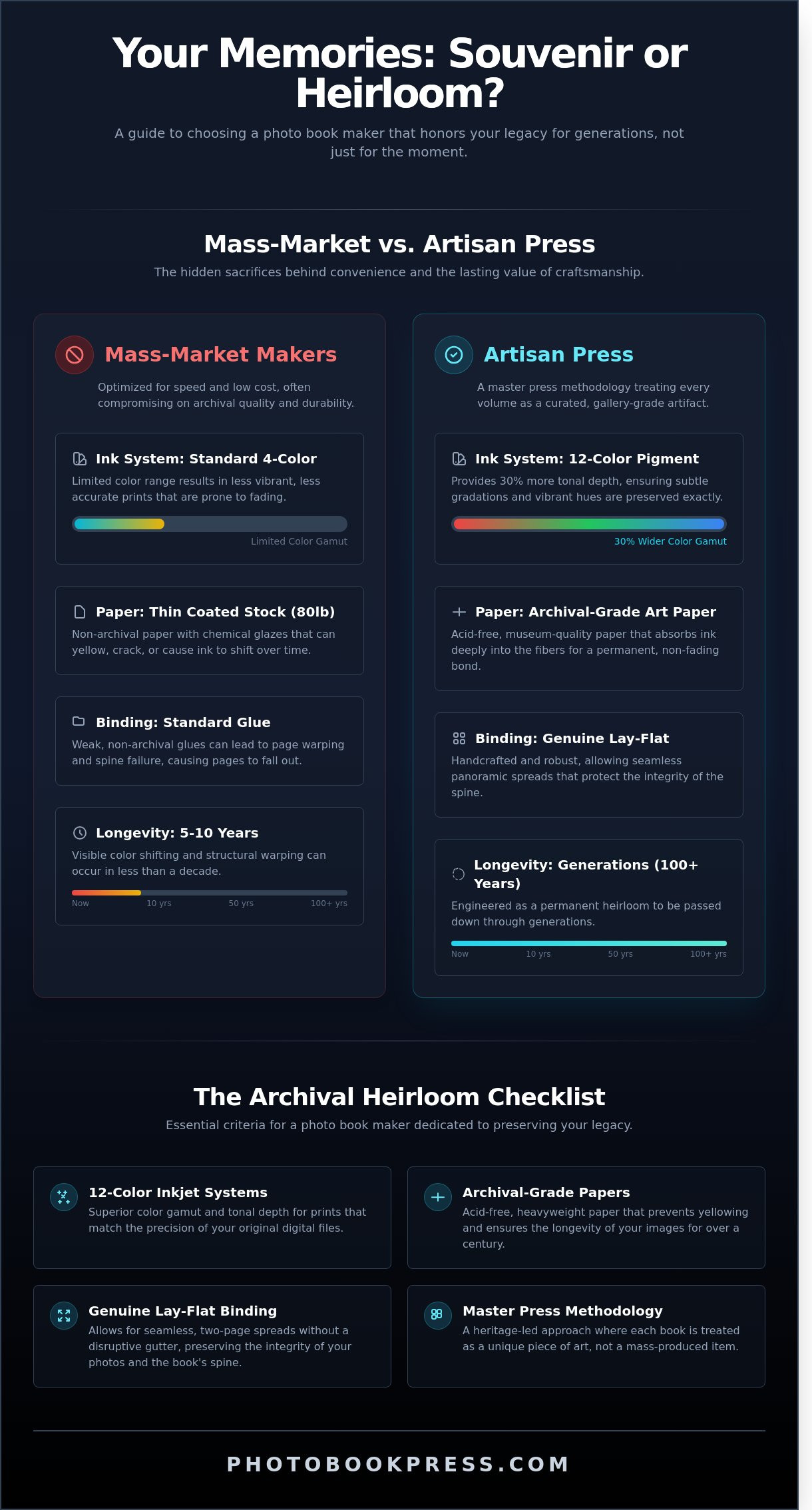
Convenience in the mass-market sector often demands a hidden sacrifice in archival durability. Many budget apps utilize thin 80lb paper stocks and non-archival glues that lack the structural integrity to survive the next 25 years. Data from industry aging tests suggests that low-quality inks can exhibit visible color shifting and page warping in as little as 10 years when exposed to standard household humidity. While "free" or "cheap" introductory offers are enticing, they rarely account for the long-term cost of a deteriorating legacy. A souvenir is temporary, but a true photo book maker builds for the next generation.
A new class of boutique makers has emerged to reclaim the standards of heritage print houses. These artisans prioritize the tactile experience of the photo book by pairing modern inkjet precision with traditional handcrafted binding techniques. This approach ensures that every spine is robust and every page lay-flat. Supporting these specialized houses provides a level of project stability that mass-market algorithms cannot replicate. It’s the difference between a fleeting digital print and a heavy, cloth-bound volume that commands attention on a library shelf. When the craftsmanship is deliberate, the book becomes an investment in personal history.
Discerning creators understand that a professional-grade photo book maker is more than a service; it's a partner in engineering a legacy. The distinction between a standard volume and a gallery-quality artifact lies in the trinity of paper, ink, and binding architecture. While many commercial printers rely on high-speed 4-color digital presses, true artisans utilize 12-color pigment-based inkjet systems. These advanced systems provide a significantly wider color gamut, allowing for 30% more tonal depth than standard CMYK printing. This precision ensures that the subtle gradations of a shadow or the vibrant hues of a landscape are preserved exactly as the photographer intended.
The physics of the page also dictates the longevity of the work. Standard coated papers often rely on chemical glazes that can crack or peel over time. Professional makers prioritize archival-quality art papers, which are designed to absorb ink deeply into the fibers for a permanent bond. This technical nuance is a cornerstone in the evolution of the photobook, where the medium has transitioned from a simple storage solution to a respected art form. Every book should undergo a rigorous hand-inspection phase. A master printer's eye catches the micro-imperfections that automated sensors miss, ensuring that every spread meets a standard of perfection before it leaves the workshop.
Traditional perfect binding often forces the viewer to fight against the spine, losing precious details in the gutter. Professional layflat photo books solve this through a specialized hinge mechanism. This architecture allows pages to rest completely flat, providing a seamless canvas for panoramic imagery. High-end makers also utilize reinforced spines and premium adhesives that remain flexible for decades, preventing the page detachment often seen in budget alternatives.
To be truly archival, a book must be chemically stable. Budget papers frequently contain lignin, an organic polymer that causes paper to yellow and become brittle when exposed to light. A premium photo book maker uses only acid-free and lignin-free stocks. These museum-grade materials ensure that the paper remains pristine for over 100 years. This commitment to chemistry is what transforms a collection of images into a family heirloom that can be passed down through generations.
The result of these meticulous choices is a tactile experience that resonates with quality. If you're ready to see your vision realized through this level of craftsmanship, you can explore our signature collections to begin your project.
Selecting a photo book maker is an act of curation that extends far beyond simple software preferences. It represents a choice between a temporary digital print and a permanent physical legacy. To choose correctly, you must first categorize your project by its intended lifespan. A casual collection of smartphone snapshots might thrive in a standard press-printed book, but a milestone event demands the structural integrity of a gallery-grade volume. High-end makers distinguish themselves through the "Heirloom Test"; if the materials don't feel substantial enough to survive fifty years of handling, they aren't suitable for your most cherished memories.
The distinction between automated machine assembly and manual binding is often the clearest indicator of quality. While mass-market providers rely on automated glues that can become brittle over time, boutique artisans utilize hand-stitched or reinforced layflat techniques. This craftsmanship ensures that the spine remains supple and the pages stay secure through decades of page-turns. When evaluating a photo book maker, consider these essential technical markers:
A wedding album is a foundational family artifact. It requires the highest tier of full-grain leather and true layflat construction to ensure every detail of the ceremony is visible across the gutter. Precision is paramount here; color calibration must be exact to capture the subtle ivory of a gown or the specific warmth of skin tones during golden hour. Professional makers provide the bandwidth for high-resolution file uploads, ensuring that 60-megapixel captures retain their clarity in print. This level of detail transforms a simple book into a tactile masterpiece.
The vastness of a landscape requires a medium that won't clip the vibrancy of a sunset or the deep blues of a coastal horizon. Utilizing custom photo book design tools allows you to optimize layouts for panoramic vistas, spanning two pages without losing the horizon line to the binding. Modern travel narratives often benefit from soft-touch matte finishes, which reduce glare and resist fingerprints during frequent viewing. These volumes aren't just collections of places; they're durable records of personal discovery, built to withstand the curiosity of every guest who picks them up from your coffee table.
The design stage is where digital files transform into a physical legacy. A professional photo book maker shouldn't restrict you with rigid, pre-set templates that stifle your vision. Instead, it should offer a fluid workspace where you control every millimetre of the layout. This creative freedom allows you to prioritize the "white space" that defines high-end editorial design. Minimalist aesthetics aren't about what's missing; they're about what's preserved. By leaving room for the eye to rest, you elevate your photographs from simple snapshots to curated art. This approach ensures that your most significant moments are never crowded by unnecessary clutter.
Curating your selection is equally vital to the final result. Resist the urge to include every frame from a sequence. A single, high-resolution image on a page carries more emotional weight than a cluttered collage of five. Technical precision is non-negotiable here. You must ensure your files meet a minimum of 300 DPI at their final print size to maintain crispness. Professional tools will also help you manage the bleed, usually a 3mm margin, to ensure your images extend perfectly to the edge of the page without unsightly white borders after the final trim. This attention to detail separates a standard product from a true archival piece.
A book is a journey, not a gallery wall. The photobook photo functions as part of a larger whole, requiring a different approach than a standalone print. You want to build a rhythmic flow that guides the reader. Pair a wide-angle landscape with a macro detail shot on the facing page to create visual depth. Use typography sparingly to anchor memories. A single line of elegant sans-serif text can provide context without overwhelming the imagery, ensuring your story is beautifully told through a balanced narrative structure.
The experience of your book begins before the first page is turned. Selecting a cover is a tactile decision that sets the emotional tone of the entire project. Genuine Italian leather offers a timeless, substantial feel, while fine European linen provides a modern, organic texture. You can add a bespoke touch with foil stamping or deep debossing for a personalized finish. These details turn a book into an heirloom. Match your materials to the theme; a vibrant photo-wrap suits a travel journal, while charcoal buckram suggests the gravity of a family history or a professional portfolio.
Since 1985, Photobook Press has remained steadfast in its commitment to the traditional press craft. While the digital age has transformed how we capture images, the physical manifestation of those memories requires a level of precision that only decades of experience can provide. Choosing a premium photo book maker is about more than just selecting a template; it's about partnering with artisans who understand the weight of a legacy. Our Maryland based facility operates with a singular focus, treating every volume as a unique work of art rather than a mass produced commodity.
The Photobook Press difference is rooted in technical superiority and manual oversight. We utilize a 12 color archival printing process, which offers a significantly wider color gamut and smoother gradients than the standard 4 color CMYK processes used by high volume competitors. This ensures that skin tones are lifelike and deep shadows retain their detail. Every book is finished with manual binding techniques, ensuring that the structural integrity of your volume lasts for generations. This meticulous approach serves both the professional photographer requiring gallery quality results and the discerning hobbyist who refuses to compromise on their personal history.
We bridge the gap between digital convenience and artisan quality by focusing on the sensory details that define a luxury object. It is the specific weight of the acid free paper and the distinct, satisfying snap of the binding that sets our work apart. For industry leaders, our portfolio books represent the gold standard in physical presentation, providing a tactile edge in a saturated digital market. We treat every project with the same level of scrutiny, ensuring that your creative vision is translated perfectly from the screen to the page.
Starting your project is a seamless experience through our refined design interface, which offers professional grade tools without unnecessary complexity. As a dedicated photo book maker, we also provide specialized support for high volume creators. Professional photographers can access recurring fulfillment discounts, making it easier to provide clients with heirloom quality products consistently. Your story deserves to be told with grace and preserved with the highest level of care. Visit our design studio today to begin crafting a legacy that will stand the test of time, beautifully told through the art of the press.
Choosing a photo book maker in 2026 requires looking beyond digital convenience to find true artisanal quality. We've explored how the industry has shifted from mass-market disposability toward the enduring standards of a fine art gallery. Selecting a partner who prioritizes technical precision is essential for those who view their memories as precious artifacts. At Photobook Press, we've served as master printers since 1985, ensuring every page meets a standard of excellence that spans generations. Our 12-color archival inkjet technology delivers color accuracy that surpasses traditional 4-color processes; meanwhile, every volume undergoes a rigorous hand-inspected manual binding process to ensure structural integrity.
Your history deserves more than a temporary digital home. It's time to transform your digital captures into a tangible heirloom that feels as significant as the moments it holds. By choosing professional-grade materials and expert craftsmanship, you're not just making a book; you're investing in a legacy. Create your archival legacy with Photobook Press today. We're ready to help you turn your most meaningful chapters into a permanent masterpiece.
A professional press distinguishes itself through the use of heavy-weight, acid-free papers and calibrated ink systems that exceed standard commercial CMYK limits. While mass-market options often prioritize volume with thin 100lb paper, a boutique artisan focuses on 2400 dpi print resolution and hand-inspected binding. These heirloom-quality volumes are designed to resist yellowing for 100 years, whereas standard consumer books may show degradation within 15 years.
Archival-quality paper isn't a universal standard, but it remains a hallmark of a premium photo book maker. True archival stocks are pH-neutral and lignan-free to prevent the chemical breakdown of the fibers over time. We utilize papers that meet the ISO 9706 standard for permanence. This ensures your photographs maintain their clarity and structural integrity for over a century, preserving your story for future generations.
You can certainly use a high-end service to create professional wedding albums that rival traditional studio offerings. Discriminating couples often choose these services for their access to museum-grade materials and custom embossing options. By selecting a 12x12 inch format with reinforced pages, you transform digital captures into a physical legacy. These books offer the durability required to be passed down through the decades as a family treasure.
Layflat binding is the gold standard because it allows images to flow across a two-page spread without any loss of detail in the center gutter. This technique uses a specialized hinge or a continuous sheet of paper that rests perfectly flat at a 180-degree angle. It's essential for panoramic landscapes or group portraits where every millimeter of the frame matters. This architectural precision ensures your narrative remains uninterrupted and visually immersive.
Creating a handcrafted volume typically requires 10 to 14 business days for production before the item is ready for shipment. This duration accounts for the 48-hour curing process needed for adhesives to set and the meticulous hand-stitching of the spine. While automated factories might ship in 48 hours, the artisanal approach ensures each book undergoes a 5-point quality inspection. This deliberate pace guarantees that the final product meets our exacting standards.
Premium makers offer genuine top-grain leather sourced from reputable tanneries as an alternative to synthetic substitutes. These covers provide a tactile richness and a natural scent that develops a unique patina over 20 or 30 years of handling. Unlike bonded leather, which contains only 60 percent leather fibers, genuine leather offers superior flexibility and strength. It serves as a resilient, exquisite shield for your most cherished memories.
You ensure color accuracy by using a monitor calibrated to 100 percent of the sRGB or Adobe RGB color space. Many professional makers provide downloadable ICC profiles that allow you to soft-proof your images within software like Adobe Lightroom or Photoshop. This process accounts for the specific ink and paper combination used during printing. It eliminates the 15 percent shift in saturation that often occurs when moving from screen to physical page.
Most bespoke services allow you to order a single, custom volume with no minimum requirement. This flexibility is ideal for creating one-of-a-kind gifts or personal portfolios. While some commercial printers require 50 or 100 copies to be cost-effective, a boutique photo book maker utilizes digital offset technology to produce individual masterpieces. You receive the same level of artisanal attention whether you order one book or 50 copies for a corporate event.
